
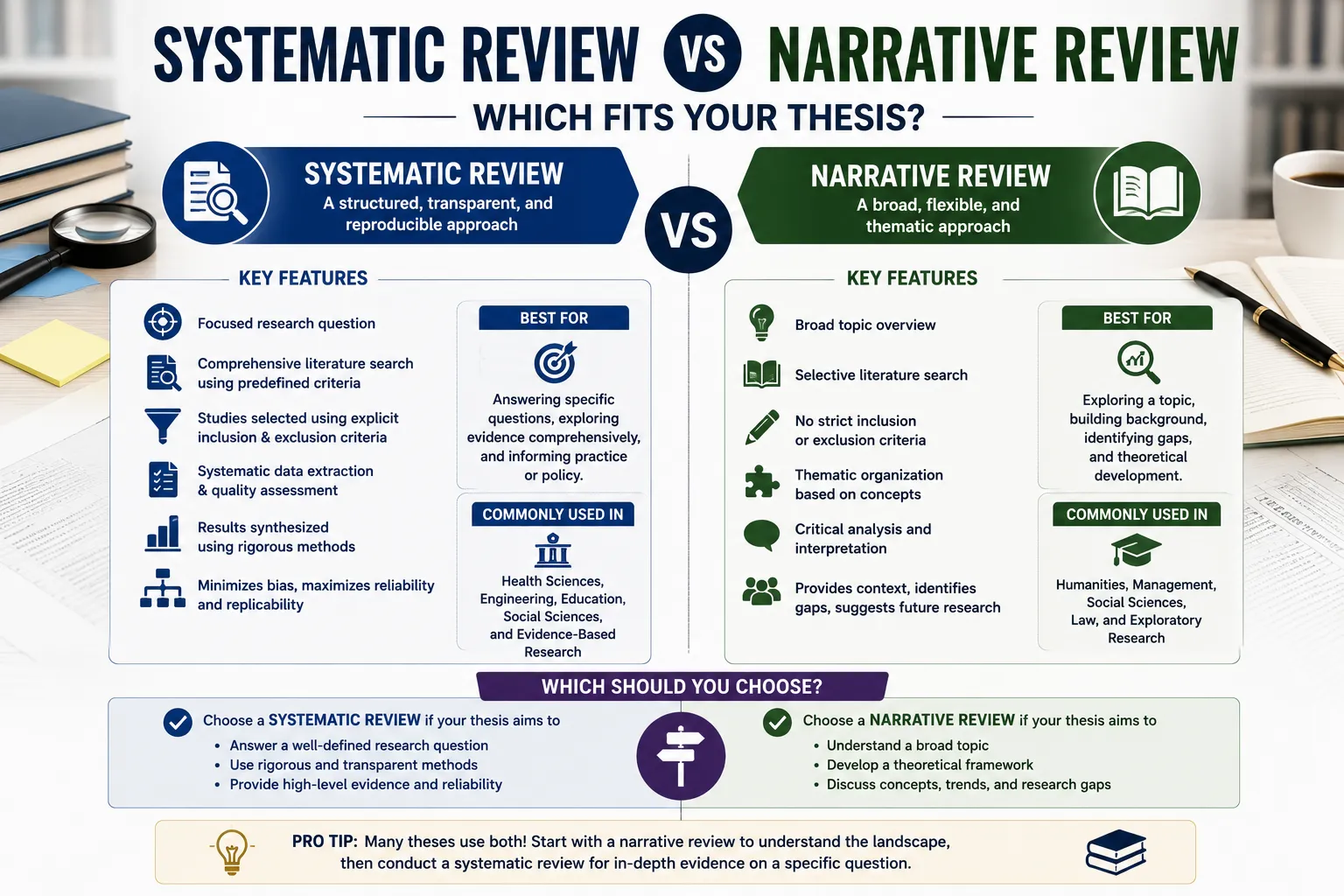
Somewhere in your early thesis planning, you'll likely run into this exact fork in the road: should your literature review follow a formal, protocol-driven systematic process, or a more flexible, narrative approach? Pick the wrong one, and you either burn months building a full systematic review protocol your thesis doesn't actually need, or you write a loosely organized narrative review when your research question genuinely called for the rigor of a systematic search.
This guide compares systematic review vs narrative review approaches directly — what each one actually involves, when each is the right fit, and how to make this call for your own specific thesis. We've written it the way an experienced thesis mentor would talk you through the decision, because that's exactly the kind of guidance ThesisLikho's PhD-qualified team gives to the thousands of scholars we've supported through this exact choice.
The Core Difference: Reproducibility
Nearly every distinction between these two review types traces back to one underlying difference: reproducibility. A narrative review reflects one author's informed, expert reading of a body of literature — studies are selected at the author's discretion, and the synthesis is built around the author's own analytical judgment. A systematic review, by contrast, follows a transparent, pre-registered, reproducible methodology, engineered specifically to minimize bias, such that an independent researcher following your same protocol would arrive at broadly the same set of included studies and the same conclusions.
This single distinction cascades into everything else that follows — the search strategy, the screening process, the level of formal documentation required, the timeline, and ultimately how much evidentiary weight readers and examiners place on your conclusions.
What a Narrative Review Actually Involves
A narrative review is the format most thesis writers are already familiar with, even if they haven't heard the specific term. It synthesizes literature thematically or chronologically, built around the author's own interpretation and critique of the field, without a fixed or standardized structure. Design choices — which sources to prioritize, how to group them, which debates to foreground — are left to the researcher's judgment, guided by the review's purpose rather than a rigid protocol.
This flexibility isn't a weakness — it's precisely what makes narrative reviews well suited to broad, exploratory, or conceptual topics, and to tracking how a field or idea has developed over time, in a way a narrowly-scoped systematic review simply isn't built to do.
What a Systematic Review Actually Involves
A systematic review follows a much stricter process, typically built around PRISMA (Preferred Reporting Items for Systematic Reviews and Meta-Analyses) reporting guidelines. It begins with a precise, narrowly defined research question — often structured using the PICO framework (Population, Intervention, Comparison, Outcome) — followed by a pre-registered protocol specifying exact databases to search, inclusion and exclusion criteria, and a documented, reproducible screening process.
Critically, a systematic review requires that the question has already been studied by multiple prior researchers — if there's no existing body of research on your specific question, there's nothing to systematically review yet, and a systematic review isn't the right tool.
Side-by-Side Comparison: Narrative Review vs. Systematic Review
Choosing between a narrative review and a systematic review depends on the purpose of your research. A narrative review provides a broad, thematic overview of existing literature, allowing the researcher to explore concepts, theories, and trends with flexibility. It is the most common approach used in undergraduate, postgraduate, and PhD thesis literature review chapters because it helps establish the background, identify research gaps, and build the theoretical foundation for a study.
A systematic review, in contrast, is designed to answer a specific and narrowly defined research question using a rigorous, transparent, and reproducible methodology. Unlike a narrative review, it follows a predefined review protocol, conducts comprehensive searches across multiple academic databases, and documents every stage of the study selection process according to recognized reporting standards such as PRISMA 2020. Systematic reviews often use structured research question frameworks, such as PICO or PICOT, and are ideally conducted by two or more reviewers to minimize selection bias and improve reliability.
From a practical perspective, a narrative review can usually be completed within a few weeks and is well suited for most thesis and dissertation projects. A systematic review, however, typically requires several months due to its extensive search strategy, screening process, quality assessment, and detailed reporting requirements. If your goal is to summarize existing knowledge and justify your research direction, a narrative review is generally the appropriate choice. If your thesis itself is intended to make a methodological contribution by systematically evaluating all available evidence on a focused topic, then a systematic review is the more suitable approach.
When a Narrative Review Is the Right Fit
A narrative review is almost always the right choice for a standard thesis literature review chapter — the kind that exists to build context and justify your research gap, rather than serving as your thesis's primary contribution. Signs a narrative review fits your situation:
- Your literature review exists to support and contextualize your primary research (a survey, case study, or experiment), not to be the primary research
- Your topic is broad or conceptual, spanning multiple sub-themes rather than one narrow, previously-tested question
- You're working alone or with limited time, without the resources for a multi-person screening and extraction process
- Your field or department doesn't have an established systematic-review tradition for thesis-level work (common outside health sciences and evidence-based policy research)
Most MBA, management, and general social science theses fall squarely into this category — the literature review chapter builds a case for the research gap, and a narrative structure is both appropriate and expected.
When a Systematic Review Is the Right Fit
A systematic review makes sense when your thesis's core contribution is the review itself — not a supporting chapter, but the primary piece of research you're submitting. This is common in specific situations:
- Your research question asks about the effectiveness of an intervention across multiple existing studies (a classic systematic-review use case, historically rooted in evidence-based medicine but increasingly used in management, education, and policy research too)
- Your department or discipline has an established systematic-review tradition for thesis-level work (common in health sciences, some education research, and evidence-based policy programs)
- You have institutional support for the process — access to multiple databases, ideally a second reviewer for screening, and enough time (typically several months, not weeks) to complete the protocol properly
- Your supervisor or program has explicitly requested a systematic review as your thesis format
If you're unsure whether your specific research question meets the bar for a systematic review, a useful test: has your exact question already been investigated by more than one prior study? If genuinely not, there isn't yet enough existing research to systematically review, and a narrative approach — or a different research design entirely — is the more appropriate fit.
What PRISMA and PICO Actually Mean
If you do move forward with a systematic review, two frameworks will come up constantly:
PRISMA is a reporting standard — a checklist and flow diagram specifying exactly what needs to be documented and disclosed at each stage of your review (how many records were found, how many were screened, how many were excluded and why, and how many were ultimately included). It exists to make your review's process fully auditable by another researcher.
PICO (sometimes extended to PICOT, adding "Type of study design") is a framework for structuring your research question before you begin: Population (who), Intervention (what's being studied or applied), Comparison (compared to what), and Outcome (what's being measured). A well-formed PICO question might look like: "Among Indian SMEs (Population), does digital marketing adoption (Intervention), compared to traditional marketing approaches (Comparison), improve customer acquisition rates (Outcome)?" This structure is precisely what keeps a systematic review narrow and searchable — a vague or overly broad question makes both the search and the eventual synthesis unmanageable.
Time, Team, and Resource Requirements
This is often the deciding factor in practice, even when both approaches seem conceptually plausible for a topic. A narrative review, as part of a broader thesis, is typically completed within 4–8 weeks by a single researcher. A properly conducted systematic review — with a registered protocol, comprehensive multi-database search, dual screening, and PRISMA-compliant reporting — routinely takes several months, and best-practice guidance recommends a team of at least two to three people specifically to reduce bias during screening and study selection.
For a single-author thesis with a standard academic timeline, this resource gap is often the practical deciding factor: a systematic review attempted solo, without adequate time or a second screener, risks compromising the exact rigor that justifies calling it "systematic" in the first place.
Can a Thesis Combine Both?
Yes — and this is more common than students expect. Some theses use a narrative review overall, while borrowing specific systematic-review habits for rigor: documenting search terms used, stating clear inclusion and exclusion criteria, and being transparent about the scope and limitations of the search, even without following a formal, pre-registered protocol. This hybrid approach captures much of the transparency systematic reviews are valued for, without requiring the full multi-person, multi-month process a genuine systematic review demands.
Some published reviews explicitly label themselves this way — describing their approach as a "systematic narrative review" when they use a single documented search workflow without the full dual-screening rigor of a formal systematic review. This is a reasonable middle ground for many thesis-level literature reviews, provided you're transparent about exactly which elements of the systematic process you did and didn't follow.
For guidance on organizing sources and citations regardless of which format you choose, see our companion piece: [Link: How to Organize Sources and Citations for a Literature Review].
Related Terms Worth Knowing: Meta-Analysis and Scoping Reviews
Two adjacent terms often get confused with the systematic-vs-narrative choice, and it's worth being precise about both.
A meta-analysis is not a separate review type — it's a statistical technique sometimes applied within a systematic review, where the quantitative results of multiple included studies are mathematically combined to produce a single, pooled effect estimate. Not every systematic review includes a meta-analysis (this depends on whether the included studies are similar enough in design and reporting to combine numerically), but a meta-analysis, on its own, is not a substitute for the review's underlying systematic search and screening process.
A scoping review sits somewhere between the two main formats covered in this guide — it uses a systematic, documented search process similar to a full systematic review, but with a broader aim: mapping the extent and nature of existing research on a topic, rather than answering one narrow effectiveness question. Scoping reviews are sometimes used as a preliminary step before committing to a full systematic review, or as a standalone thesis format when the goal is to map a still-developing research area rather than draw a definitive conclusion from existing evidence.
If your topic is broad enough that a single PICO-style question feels forced, but you still want more documented rigor than a purely narrative approach, a scoping review is worth discussing with your supervisor as a middle-ground option.
Common Mistakes When Choosing
- Calling a narrative review "systematic" without following PRISMA or a documented protocol — this creates a credibility mismatch between the label and the actual rigor behind it
- Attempting a full systematic review solo, with a single-semester timeline — underestimating the multi-month, often multi-person nature of the process
- Choosing a systematic review for a question that hasn't been previously studied — there's nothing to systematically synthesize yet
- Choosing a narrative review for a narrow effectiveness question where existing literature is extensive enough to support a genuine systematic synthesis, missing an opportunity for a stronger, more defensible contribution
- Not clarifying with your supervisor early which format your specific department or program expects — this is a conversation worth having before you invest weeks in either direction
A Realistic Decision Scenario
Scenario — Aditi, a master's student in public health management
Aditi initially planned a narrative review for her thesis on telemedicine adoption, since that's what she'd seen most classmates use. But her specific research question — comparing patient satisfaction outcomes between telemedicine and in-person consultations across existing published studies — turned out to be a near-perfect fit for a systematic review, given that multiple prior studies had already investigated closely related outcomes. Her supervisor recommended reframing her question using the PICO structure and pursuing a systematic review instead, since her department (health sciences) had both the disciplinary tradition and the timeline flexibility to support it. The lesson here: the right choice isn't about which approach sounds more rigorous in the abstract — it's about which one actually matches your specific question, your field's norms, and your available time and support.
Scenario — Rahul, an MBA student researching consumer behavior
Rahul, midway through his thesis on omnichannel retail strategy, briefly considered switching to a systematic review after reading that it was considered more rigorous. On closer inspection with his supervisor, this would have been the wrong call: his broad, exploratory research question — spanning consumer perception, retail technology adoption, and customer loyalty across multiple sub-themes — was exactly the kind of conceptual, wide-ranging topic a narrative review is built for, not a narrow, previously-tested effectiveness question a systematic review requires. Attempting a full systematic protocol would have meant either artificially narrowing his research question just to fit the format, or spending months on a process his single-semester MBA timeline couldn't support. He stayed with a narrative review, but adopted the transparency habits of a systematic approach — documenting his search terms and inclusion criteria clearly — which strengthened his chapter without requiring the full protocol overhead.
Decision Checklist
- Is your literature review the primary contribution of your thesis, or a supporting chapter for other research? (Primary contribution → lean systematic; supporting chapter → lean narrative)
- Has your specific research question already been investigated by multiple prior studies? (Yes → systematic is possible; no → narrative or a different design)
- Does your department or field have an established systematic-review tradition for thesis work?
- Do you have several months, ideally with a second reviewer, available for the process?
- Can your question be structured narrowly using a PICO-style format, or is it inherently broad and thematic?
- Have you confirmed your supervisor's expectations before committing significant time to either approach?
Getting Expert Support
Choosing between these two approaches is a decision worth getting right early — reversing course after weeks of work in the wrong direction is one of the more avoidable sources of delay in thesis writing.
ThesisLikho's mentoring team — PhD-qualified experts who've guided over 10,000 scholars through this exact decision — offers structured review-format guidance as part of our Thesis Writing Service, helping you confirm which approach genuinely fits your research question before you commit.
Frequently Asked Questions
What is the difference between a systematic review and a narrative review, and which fits your thesis?
A narrative review is a flexible, author-synthesized overview of a topic, while a systematic review follows a rigorous, reproducible protocol (typically PRISMA-based) to answer a specific, previously-studied question — most standard thesis literature review chapters fit the narrative format, while systematic reviews suit theses where the review itself is the core research contribution.
How long does it take to complete a thesis using this approach?
A narrative review typically takes 4–8 weeks as part of a broader thesis timeline, while a properly conducted systematic review often takes several months, given its more extensive search, screening, and documentation requirements.
Is professional help available for choosing between systematic and narrative review formats?
Yes — structured mentoring on evaluating your research question and selecting the right review format is a standard, legitimate form of academic support. ThesisLikho's PhD-qualified mentors offer this kind of guided review for thesis scholars.
Why does choosing between a systematic and narrative review matter?
Choosing the wrong format either wastes months building unnecessary protocol rigor for a broad, exploratory topic, or under-delivers the reproducibility and evidentiary weight a narrow, previously-studied question genuinely calls for.
How does this choice affect a thesis overall?
The right choice shapes your entire timeline, resource needs, and the credibility of your conclusions — a systematic review demands significantly more time and often a second reviewer, while a narrative review offers the flexibility most standard thesis literature reviews actually need.
Talk to a Thesis Expert
If you'd like a mentor to help confirm which review format fits your specific thesis, ThesisLikho's team is ready to help. Talk to a Thesis Expert →