
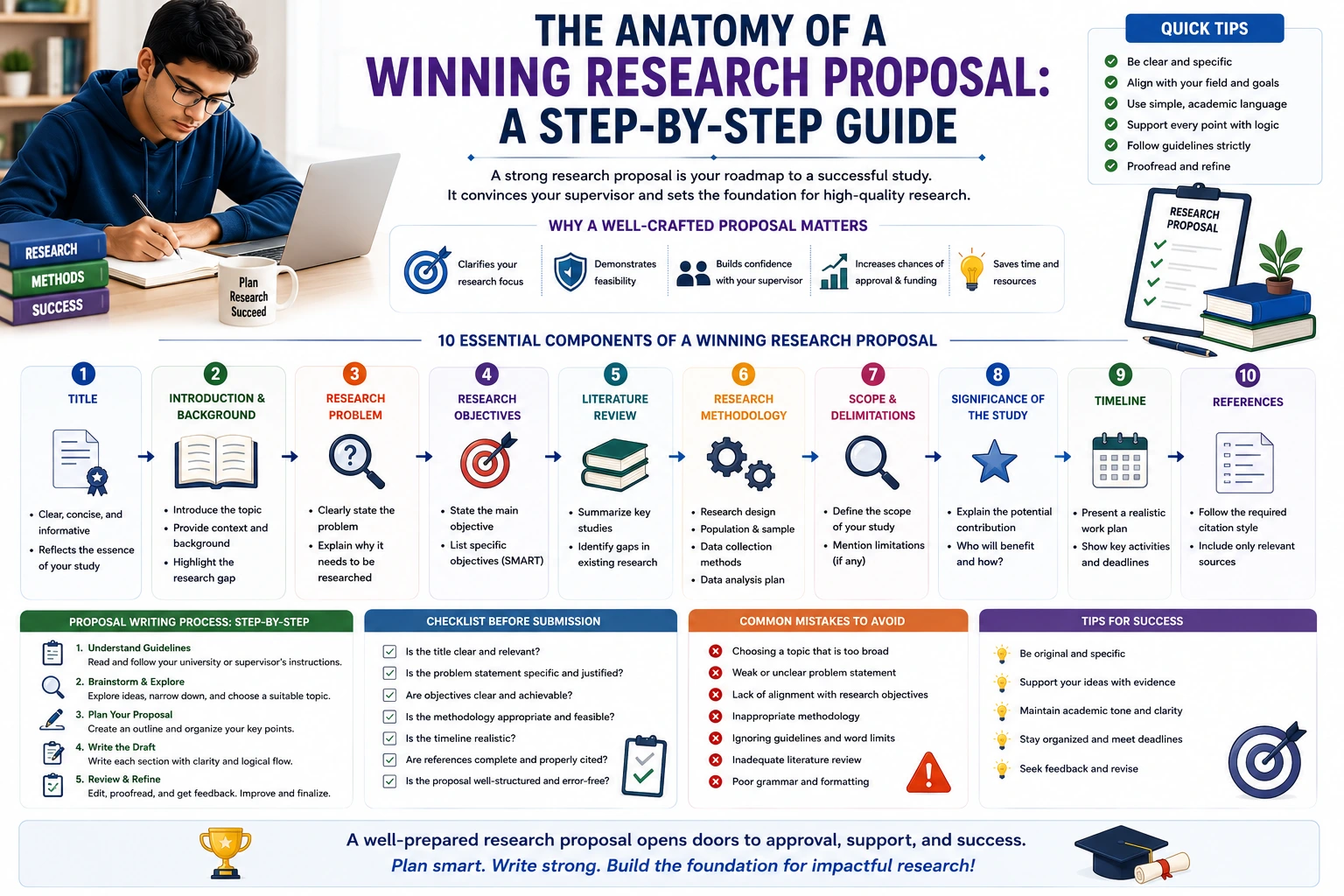
A research proposal is much more than a formality—it is the blueprint of your entire research journey. Whether you are applying for a PhD, submitting a Master's dissertation proposal, seeking research funding, or presenting your study for university approval, a well-written research proposal can determine whether your project gets accepted or rejected.
Many students underestimate the importance of a research proposal. They often focus on choosing a research topic but fail to present a clear plan for investigating it. Universities and supervisors, however, evaluate proposals based on their clarity, originality, feasibility, and academic significance. A strong proposal demonstrates that you understand the problem, have reviewed the existing literature, selected an appropriate methodology, and can complete the research within the available time and resources.
For Indian scholars, where universities follow structured research guidelines under UGC and institutional regulations, preparing a comprehensive proposal is an essential milestone before beginning data collection. An effective proposal not only convinces your supervisor but also serves as a roadmap that guides every chapter of your thesis.
In this detailed guide, you'll learn the anatomy of a winning research proposal, understand the purpose of each section, discover practical writing tips, and avoid common mistakes that often lead to proposal rejection.
What Is a Research Proposal?
A research proposal is a formal academic document that explains what you intend to study, why the study is important, and how you plan to conduct the research. It outlines your research objectives, identifies the research gap, reviews relevant literature, describes your methodology, and presents a realistic timeline for completing the project.
Think of it as a business plan for your research. Just as investors want to know how a business idea will succeed, your supervisor or review committee wants to know whether your research is valuable, feasible, and methodologically sound.
Depending on your university or funding agency, a research proposal may range from 2,000 to 5,000 words, though doctoral proposals can be significantly longer.
Why Is a Strong Research Proposal Important?
A compelling proposal does more than secure approval. It lays the foundation for your entire research project.
A well-prepared proposal helps you:
- Clarify your research problem.
- Define realistic objectives.
- Identify gaps in existing knowledge.
- Select an appropriate research methodology.
- Plan resources, timelines, and data collection.
- Receive constructive feedback before beginning the study.
- Improve the quality and direction of your thesis.
Most importantly, a strong proposal demonstrates your readiness to undertake independent academic research.
The Essential Components of a Winning Research Proposal
Every university may have slightly different formatting requirements, but most successful research proposals include the following sections.
1. Title Page
Your title page creates the first impression. A strong research title should be concise, informative, and clearly indicate the focus of your study.
Characteristics of a Good Research Title
- Specific and focused
- Describes the main variables
- Indicates the target population
- Includes the geographical area if relevant
- Avoids unnecessary jargon
Example
Weak Title
Social Media and Marketing
Improved Title
The Impact of Instagram Influencer Marketing on Purchase Intentions Among Indian Gen Z Consumers
A precise title immediately communicates the scope of the research.
2. Introduction
The introduction provides background information and explains the context of your study.
Your introduction should answer questions such as:
- What is the topic?
- Why is it important?
- What is happening in this research area?
- Why should readers care?
Begin with general information before gradually narrowing your discussion to the specific research problem.
A compelling introduction often includes:
- Industry statistics
- Current trends
- Recent developments
- Existing challenges
- Academic context
By the end of this section, readers should understand why the study deserves attention.
3. Research Problem Statement
The research problem is the heart of your proposal. It identifies the issue your research seeks to address.
A strong problem statement should:
- Clearly define the issue.
- Explain why the problem exists.
- Describe who is affected.
- Highlight the consequences of not solving it.
- Show the gap in existing research.
Example
Many studies have explored digital marketing strategies in developed countries. However, limited research has examined how Instagram influencer marketing affects purchase intentions among consumers in Tier-2 Indian cities. This lack of evidence creates uncertainty for businesses targeting emerging digital markets.
A well-written problem statement convinces reviewers that your research is necessary.
4. Research Objectives
Research objectives describe what your study aims to achieve.
Effective objectives should be:
- Clear
- Specific
- Measurable
- Achievable
- Relevant
- Time-bound where applicable
Example Objectives
- To examine the influence of Instagram influencers on consumer purchase intentions.
- To analyse the relationship between influencer credibility and brand trust.
- To investigate demographic differences in consumer behaviour.
Objectives guide your methodology and analysis.
5. Research Questions
Research questions translate your objectives into specific inquiries.
Examples include:
- How does influencer credibility affect purchase intention?
- Which factors influence trust in social media influencers?
- Does age moderate consumer purchase behaviour?
Each research question should align with one or more objectives.
6. Research Hypotheses (If Applicable)
Quantitative studies often include hypotheses that predict relationships between variables.
Example
H1: Influencer credibility positively affects purchase intention.
H2: Brand trust mediates the relationship between influencer credibility and purchase intention.
Qualitative studies generally use research questions instead of hypotheses.
7. Literature Review
The literature review demonstrates your understanding of previous research and identifies the knowledge gap your study will address.
Rather than summarising articles individually, synthesise the findings by comparing studies, identifying patterns, discussing contradictions, and highlighting areas that require further investigation.
An effective literature review should:
- Discuss recent and relevant studies.
- Organise findings by themes.
- Critically evaluate previous research.
- Identify methodological limitations.
- Explain how your study contributes to the field.
Use recent peer-reviewed journal articles wherever possible, especially those published within the last five to ten years.
8. Research Gap
A proposal becomes compelling when it clearly identifies what existing studies have overlooked.
Research gaps may include:
- Understudied populations.
- Emerging technologies.
- New geographical contexts.
- Contradictory findings.
- Methodological limitations.
- Changes in consumer behaviour or industry practices.
Clearly explain how your study addresses these gaps.
9. Significance of the Study
Explain why your research matters.
Discuss the potential contributions to:
Academic Knowledge
Will your study extend existing theories or fill a research gap?
Industry
Can businesses or organisations use your findings?
Policymakers
Will the research inform public policy or institutional decision-making?
Society
Will your findings benefit communities or improve practices?
Demonstrating significance increases the value of your proposal.
10. Research Methodology
The methodology explains how you will conduct your research.
This section should provide enough detail for another researcher to replicate your study.
Include the following components:
Research Design
Examples include:
- Quantitative
- Qualitative
- Mixed Methods
- Experimental
- Descriptive
- Exploratory
- Case Study
Population
Identify the group you intend to study.
Example:
MBA students enrolled in private universities in Delhi NCR.
Sampling Technique
Examples include:
- Simple Random Sampling
- Stratified Sampling
- Purposive Sampling
- Snowball Sampling
- Convenience Sampling
Explain why the chosen technique is appropriate.
Sample Size
Justify your sample size using recognised methods such as:
- Cochran's Formula
- Krejcie and Morgan Table
- G*Power Analysis
Data Collection Methods
Examples include:
- Surveys
- Interviews
- Focus Groups
- Questionnaires
- Observations
- Secondary Data
Describe how and where data will be collected.
Data Analysis
Explain which software and analytical techniques you will use.
Examples include:
- SPSS
- R
- Python
- AMOS
- SmartPLS
- NVivo
- MAXQDA
Mention relevant statistical tests or qualitative analysis methods, such as regression analysis, thematic analysis, or structural equation modelling.
11. Ethical Considerations
Ethical compliance is a critical component of modern research.
Address issues such as:
- Informed consent.
- Confidentiality.
- Participant anonymity.
- Voluntary participation.
- Secure data storage.
- Ethical approval from institutional review boards where required.
Assure reviewers that your research follows ethical guidelines.
12. Scope and Delimitations
Clearly define the boundaries of your research.
Specify:
- Geographic location.
- Target population.
- Time period.
- Variables studied.
- Industry or sector.
Also explain what your study will not cover and why.
This helps reviewers understand the limits of your research.
13. Expected Outcomes
Describe the anticipated findings or contributions of your study.
For example, you may expect to identify significant factors influencing consumer behaviour, develop a conceptual framework, or provide recommendations for industry practitioners.
While you should not claim results before conducting the research, outlining expected contributions demonstrates the practical value of your work.
14. Research Timeline
A timeline shows that your project is realistic and manageable.
Typical stages include:
Activity Estimated Duration
Topic Selection 2 Weeks
Literature Review 6 Weeks
Proposal Approval 2 Weeks
Data Collection 8 Weeks
Data Analysis 4 Weeks
Thesis Writing 8 Weeks
Revision & Submission 3 Weeks
Presenting a clear timeline reflects good project planning.
15. Budget (If Required)
Funding proposals often require an estimated budget.
Include costs related to:
- Data collection
- Software licences
- Travel
- Printing
- Survey platforms
- Internet access
- Conference presentations
Provide realistic estimates and brief justifications for major expenses.
16. References
Every proposal should conclude with a properly formatted reference list.
Use the citation style specified by your university, such as:
- APA
- MLA
- Harvard
- Chicago
- IEEE
Ensure that all in-text citations appear in the reference list and vice versa. Reference management tools like Zotero, Mendeley, or EndNote can help maintain consistency.
Common Mistakes That Lead to Proposal Rejection
Even promising research ideas can be rejected if the proposal is poorly prepared.
Avoid these common mistakes:
- Choosing a topic that is too broad or vague.
- Failing to identify a clear research gap.
- Writing unclear objectives and research questions.
- Using outdated or irrelevant literature.
- Selecting an inappropriate methodology.
- Ignoring ethical considerations.
- Providing unrealistic timelines or sample sizes.
- Including grammatical errors and formatting inconsistencies.
- Not following university guidelines.
Careful proofreading and supervisor feedback can prevent many of these issues.
Tips for Writing a Winning Research Proposal
To maximise your chances of approval:
- Start with a focused and original research topic.
- Read extensively before writing.
- Support claims with recent scholarly sources.
- Ensure every section flows logically into the next.
- Keep your writing concise and academic.
- Align your objectives, questions, methodology, and analysis.
- Use headings and subheadings for readability.
- Revise multiple times before submission.
- Seek feedback from your supervisor or peers.
- Follow your university's formatting requirements carefully.
Remember, clarity and coherence are just as important as originality.
Frequently Asked Questions (FAQs)
How long should a research proposal be?
The length depends on your university or funding agency. Master's proposals are often between 2,000 and 3,000 words, while PhD proposals may range from 3,000 to 5,000 words or more.
What is the most important section of a research proposal?
The research problem, objectives, literature review, and methodology are considered the core sections. They demonstrate the significance, originality, and feasibility of your study.
Can I change my proposal after approval?
Many universities allow revisions with supervisor approval, especially if new evidence or practical challenges emerge. However, significant changes may require formal approval from the research committee.
Should I include references in the proposal?
Yes. Every factual claim, theoretical concept, or previous study cited in your proposal should be properly referenced using the required citation style.
How can I make my proposal stand out?
Focus on an original research gap, present a clear and logical structure, justify your methodology, use current academic sources, and ensure the proposal is free from language and formatting errors.
Final Thoughts
A winning research proposal is more than a document required for academic approval—it is the foundation upon which your entire research project is built. By clearly defining your research problem, reviewing the existing literature, setting measurable objectives, selecting a robust methodology, and demonstrating the significance of your study, you create a persuasive proposal that inspires confidence in supervisors, review committees, and funding agencies.
Investing time in developing a thoughtful proposal will save countless hours later in your research journey. It provides a clear roadmap, minimises confusion during data collection and analysis, and ensures your thesis remains focused on answering meaningful research questions.
Whether you are preparing for a PhD, Master's dissertation, or research grant application, understanding the anatomy of a winning research proposal will significantly improve your chances of success. Approach the process systematically, seek constructive feedback, and refine your work until every section aligns with your research goals. A well-crafted proposal is the first step toward producing impactful, credible, and publishable research.
Contact ThesisLikho
Call / WhatsApp: +91 96438 02216
Website:www.ThesisLikho.com