
With a population exceeding 1.4 billion people, India’s absence from the elite tiers of global football remains one of the sport's most baffling and enduring paradoxes. Walk down the streets of Kolkata, peer into the neighborhoods of Kerala, or visit the hills of the Northeast, and you will find an ocean of passionate fans. Turn on any television set during a weekend, and millions are glued to the high-octane drama of the English Premier League or the UEFA Champions League.
Yet, when it comes to the national team—the Blue Tigers—the reality is starkly different. Ranked 138th in the official FIFA World Rankings, India remains a spectator on the grandest stages of international football, such as the FIFA World Cup.
How is it possible that a nation of this scale, possessing immense economic growth and a deep cultural affection for sport, fails to produce a competitive global powerhouse? To answer this, we must strip away surface-level assumptions and explore the intricate web of historical golden eras, structural gaps, grassroots neglect, and economic realities holding Indian football back.
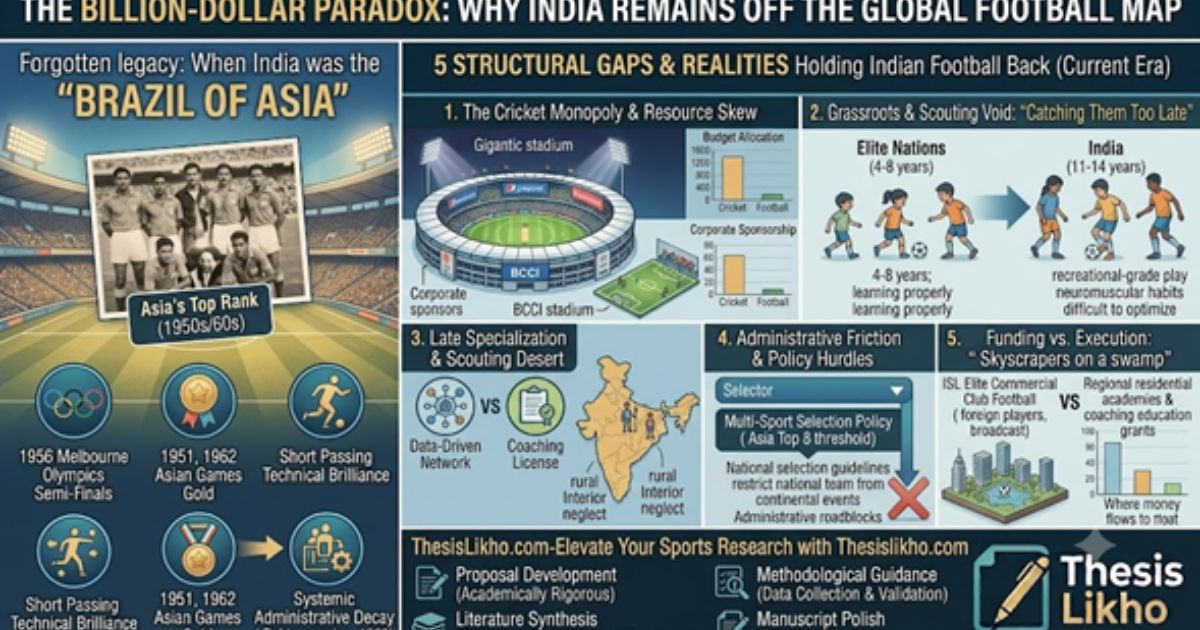
1. A Forgotten Legacy: When India Was the "Brazil of Asia"
To understand the depth of current frustrations, one must first look backward. Contrary to popular belief, India was once an undisputed powerhouse in Asian football.
During the 1950s and 1960s, under the legendary guidance of coach Syed Abdul Rahim, the Indian national team played an innovative brand of short-passing football that earned global acclaim.
- The 1956 Melbourne Olympics: India became the first Asian team to reach the semi-finals of an Olympic football tournament, finishing fourth after a stellar campaign highlighted by Neville D'Souza’s historic hat-trick against Australia.
- Asian Games Glory: India claimed the gold medal at the inaugural 1951 Asian Games in New Delhi and repeated the feat at the 1962 Jakarta Asian Games, triumphing in front of hostile crowds of over 100,000 people.
- The Style: Legends like T.K. Raman, Chuni Goswami, P.K. Banerjee, and Jarnail Singh commanded such technical brilliance that international observers and opponents famously dubbed India the "Brazil of Asia".
However, following Rahim’s untimely passing in 1963, Indian football experienced a slow, systemic administrative decay. Without a forward-thinking institutional framework to modernize coaching and infrastructure, the nation slipped behind East Asian and Middle Eastern competitors who rapidly professionalized their domestic setups.
2. The Cricket Monopoly: Resource Skew and Cultural Oxygen
It is impossible to analyze Indian sports without addressing the colossal shadow cast by cricket.
Cricket is not merely a sport in India; it is an economic and cultural religion. The Board of Control for Cricket in India (BCCI) operates as a financial juggernaut, generating billions of dollars, securing unmatched corporate sponsorships, and providing a clear, lucrative, and secure career pathway for aspiring athletes.
- The Attention Economy: Media houses, brands, and young talents naturally gravitate toward where the spotlight and financial security reside.
- Resource Starvation: Football federations and state bodies operate on heavily constrained budgets by comparison. While grassroots cricket enjoys structured district academies, state-of-the-art practice pitches, and multi-tiered talent pipelines, football infrastructure remains erratic. Outside of a few historic regional pockets, young athletes often have to choose between a secure career path in cricket or navigating an uncertain, underfunded football landscape.
3. The Grassroots and Scouting Void: Catching Them Too Late
In nations that dominate world football—such as Brazil, France, or Spain—elite player development begins at an exceptionally young age. Children are introduced to structured technical training, spatial awareness, and tactical intelligence between the ages of 4 and 8.
In India, the structural pipeline is fundamentally broken:
- Late Specialization: Most children in India play football purely recreationally. They enter organized, professional-grade academies much later in their youth (often between 11 and 14 years old), by which point foundational neuromuscular habits, foot-eye coordination, and tactical IQ are already difficult to optimize.
- The Scouting Desert: India’s massive geographical expanse lacks a comprehensive, data-driven scouting network. While football thrives organically in states like West Bengal, Kerala, and the Northeast, talent identification in rural and semi-urban interiors is almost entirely non-existent. Thousands of naturally gifted kids slip through the cracks simply because there is no scout watching.
- Coaching Quality at the Base: Grassroots physical education teachers and local coaches frequently lack formal tactical licenses or modern developmental curriculums. Children are often herded into chaotic groups chasing a single ball rather than learning proper mechanics, defensive positioning, and passing triangles.
4. Administrative Friction and Policy Hurdles
The governance of Indian football has long been plagued by administrative turbulence, legal disputes, and regulatory misalignments.
A prime example of systemic roadblocks surfaced regarding multi-sport event policies. National selection guidelines implemented by sports authorities often restrict teams from participating in continental events unless they occupy a top-tier regional ranking (such as Asia’s top eight). Consequently, despite qualifying for major events like the Asian Games, national teams have faced sudden administrative withdrawals or eleventh-hour uncertainties due to strict ranking thresholds.
Furthermore, while private corporate investments have poured billions of rupees into domestic franchise leagues like the Indian Super League (ISL) to modernize club broadcasting and infrastructure, a chasm remains between elite commercial club football and the developmental needs of the national team pipeline. The total match volume and high-intensity competitive minutes logged by an average Indian player per year still lag significantly behind peers in Japan, South Korea, or the Middle East.
5. Funding vs. Execution: Where Did the Money Go?
A common misconception is that Indian football suffers strictly from a lack of financial capital. Over the past decade, massive capital has flowed into the ecosystem. Private entities and corporate stakeholders have pumped thousands of crores into launching professional leagues, franchise fees, broadcasting rights, and title sponsorships.
Yet, the capital injection has failed to translate into on-field success because of poor operational execution.
- Money is heavily front-loaded into top-tier league glamour, foreign player salaries, and broadcast production rather than filtering down into regional residential academies, coaching education grants, and district-level scouting networks.
- Without a robust foundation, pouring capital into the apex of the pyramid is like building a skyscraper on a swamp.
The Roadmap Forward: How Can India Rise?
Transforming India into a competitive global football nation requires abandoning quick fixes and committing to a rigorous, 15-to-20-year structural overhaul.
- Decentralized Grassroots Academies: The All India Football Federation (AIFF) and state associations must establish regional, state-funded residential academies modeled after successful European and East Asian systems, ensuring free access for underprivileged talents.
- Standardized Coaching Licences: Massive investment must be directed toward certifying local coaches at the grassroots level, ensuring that children receive elite technical instruction from the age of five.
- Diaspora Integration: Exploring pathways for international players of Indian origin (PIOs) to represent the national team—similar to strategies successfully deployed by Morocco or the Philippines—could inject vital tactical maturity and global experience into the squad.
- Structured League Pyramids: Establishing a seamless, merit-based promotion and relegation system across all tiers of domestic football will drive competitive hunger and match intensity for developing players.
Until these structural roots are nurtured, India will remain a sleeping giant—watching the world's greatest game from the sidelines while waiting for a spark that requires deliberate, systemic engineering to ignite.
Elevate Your Sports Research with Thesislikho.com
Analyzing complex systemic issues like sports administration failures, socio-economic barriers in athletic development, or policy impacts on national representation requires meticulous research rigor. Whether you are drafting a master's thesis on sports economics, compiling a data-driven policy proposal on sports governance, or evaluating the socio-cultural dynamics of fan engagement, Thesislikho.com provides the expert scaffolding you need:
- Proposal Development: We assist you in formulating sharp, academically rigorous research questions that isolate institutional gaps.
- Literature Synthesis: We help you synthesize massive volumes of socio-economic and sports management literature into coherent theoretical frameworks.
- Methodological Guidance: Our experts guide you through qualitative and quantitative methodologies, ensuring robust data collection and statistical validation.
- Manuscript Polish: We provide structural editing to ensure your research meets the exacting publication standards of top-tier academic journals.
Partner with the experts at Thesislikho.com to ensure your academic work achieves professional excellence and scholarly impact.
Why is India not at the Football World Cup?
This video provides an in-end breakdown of the systemic issues, infrastructural challenges, and historical factors keeping the Indian national team away from the FIFA World Cup stage.
website: https://thesislikho.com/