
However, a groundbreaking discovery published in Nature Communications (June 2026) by researchers from King’s College London and the UK Dementia Research Institute has shattered this consensus, introducing the world to karyoptosis a novel, violent form of cell death that is fundamentally different from what we previously understood.
The Anatomy of Cellular Collapse
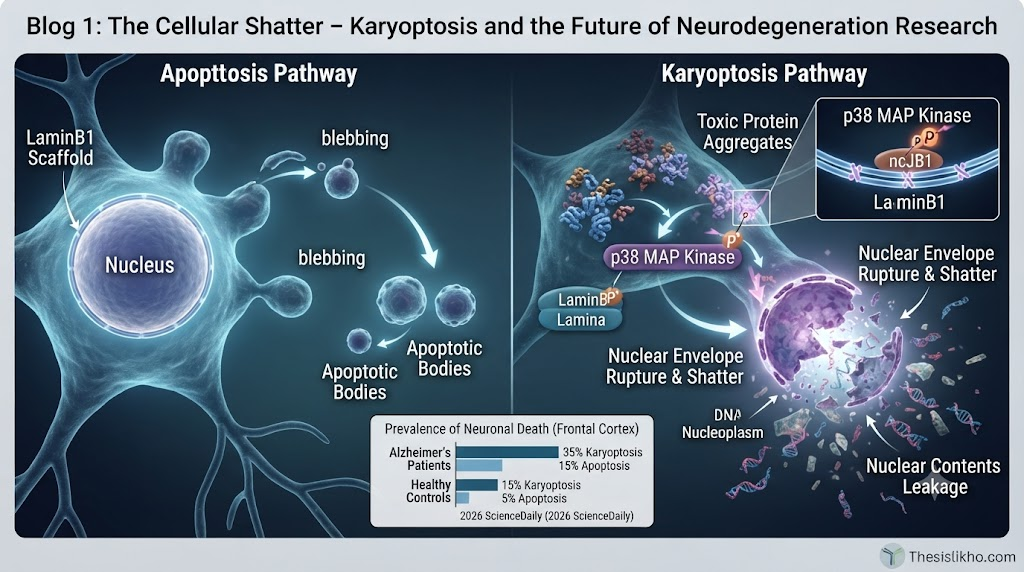
To understand the gravity of this discovery, we must examine the structural difference between "traditional" cell death and the newfound karyoptosis. While apoptosis is often described as a methodical, systematic breakdown of a cell, karyoptosis is structural trauma on a cellular scale.
The research identified that toxic protein accumulation the "proteotoxic stress" inherent in dementia triggers a specific biochemical pathway. The process is governed by the interaction between p38 MAP kinase and a vital structural protein called LaminB1 Casterton et al., 2026. Under healthy conditions, LaminB1 acts as a scaffold, providing the necessary tension to keep the nuclear envelope taut and stable.
In the karyoptotic state, however, proteotoxic stress causes p38 MAP kinase to mark LaminB1 for destruction via direct phosphorylation. As this structural scaffold fails, the nucleus does not simply shrink; it shrivels, distorts, and eventually shatters, ejecting its internal contents into the cytoplasm Nature Communications. This is not a slow, orderly degradation; it is a rapid, terminal collapse of the neuron’s control center.
The clinical significance is staggering. The researchers used computational algorithms to analyze approximately 3,000 cells from the brains of 28 patients. They found that 35% of neurons in the frontal cortex of Alzheimer’s patients exhibited signs of karyoptosis, compared to only 15% in healthy aged controls ScienceDaily. This suggests that karyoptosis is not a rare occurrence but a major driver of the widespread cell loss seen in millions of patients worldwide.
Research Frontiers for Scholars
For doctoral candidates, this discovery opens a massive corridor for research. We are no longer just looking at protein plaque removal (the "clean-up" approach); we are looking at structural preservation of the neuron. This shifts the therapeutic focus toward protecting the nuclear envelope.
Current research potential includes:
- Targeted Inhibitors: Developing small-molecule drugs that selectively block the interaction between p38 MAP kinase and LaminB1 without interfering with other cellular functions.
- Biomarker Development: Tracking the levels of LaminB1 leakage in the cytoplasm as a potential early-stage diagnostic marker for neurodegenerative progression.
- Genetic Susceptibility: Investigating whether specific variants in the LMNB1 gene or the MAPK signaling pathway render certain individuals more susceptible to karyoptotic neuron death.
How Thesislikho.com Empowers Your Research
Navigating a breakthrough of this magnitude requires extreme precision in both methodology and literature review. The rapid pace of publication in 2026 means that your thesis must be anchored in the most current, verified data to be considered "original." Thesislikho.com provides comprehensive assistance to scholars at every stage of this journey:
- Translating Breakthroughs into Research Objectives: If you are struggling to narrow down a thesis topic, our experts help you identify specific gaps in the current literature. We assist you in framing your research whether it is wet-lab, computational, or clinical so it addresses the exact mechanism of karyoptotic cell death.
- Methodological Rigor: Whether your work involves CRISPR screening, immunohistochemistry, or advanced computational modeling, we assist in structuring your methodology to ensure reproducibility and scientific rigor. This is essential for meeting the standards of Q1/SCI-indexed journals.
- Advanced Literature Synthesis: The speed of publication in 2026 is relentless. Thesislikho provides analytical support to synthesize the latest breakthroughs, ensuring your thesis is grounded in the absolute latest scientific discourse.
- Defense & Submission Excellence: From drafting your research proposal to finalizing your thesis for submission, we ensure your arguments are clear, coherent, and formatted to perfection. We provide the editorial polish required for top-tier publication, allowing you to defend your work with confidence before any committee.
If you are currently planning a PhD or research project in neurobiology, the discovery of karyoptosis is arguably the most exciting opportunity in the last decade. Don't face these analytical challenges alone. Connect with the team at Thesislikho.com to transform your research from a collection of raw data into a profound academic contribution that shapes the future of dementia treatment.
As you consider the implications of karyoptosis, do you believe this discovery will shift the focus of Alzheimer’s research from plaque-clearing therapies toward intracellular structural protection?
Website: www.thesislikho.com
Call / WhatsApp: +91 96438 02216