
In 2026, the modern home has evolved into a hyper-connected hub. From educational robotics kits and AI-driven smart baby monitors to interactive storytelling tablets, the "Internet of Toys" (IoToys) has transitioned from a niche luxury to a fundamental staple of childhood development. However, this convenience carries a profound, often overlooked risk: the vulnerability of the child’s digital environment.
As of July 2026, global research and regulatory bodies, including the Coalition for Children's Rights and Protection in the Age of AI, have identified that our current security infrastructure is woefully inadequate to handle the unique threats faced by the next generation. We are essentially living in an era where the pace of hardware innovation has far outstripped our ability to secure it, leaving children’s data and their physical safety at a crossroads.
The Anatomy of Vulnerability: Why Toys Are Not Just Toys
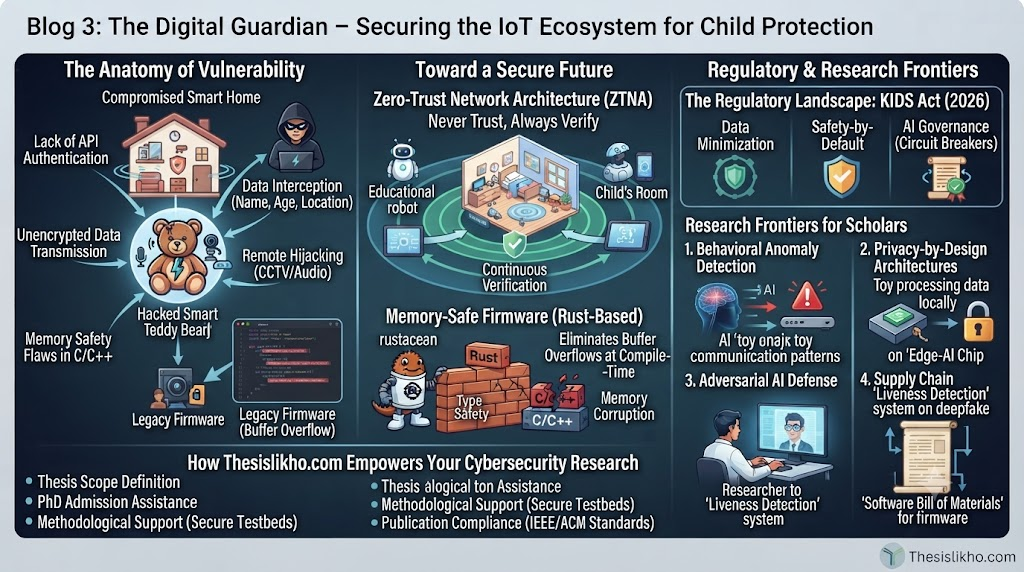
The primary danger today is not merely external hacking; it is the intrinsic lack of memory safety in the firmware of low-cost connected devices. Research published in mid-2026 suggests that a vast majority of smart toys regardless of their premium price tags suffer from critical security flaws, such as the lack of authentication enforcement on APIs.
Yalantis
These vulnerabilities allow cybercriminals to intercept data including a child’s name, age, and location or, more alarmingly, to remotely hijack a device’s microphone and camera. By bypassing parental authorization, attackers can initiate covert communication, effectively turning a child’s favorite toy into a tool for grooming or social engineering. As highlighted by recent industry threat reports, the "brand trust" consumers place in high-end toy manufacturers is often a dangerous fallacy in the 2026 consumer market, as many companies prioritize feature-rich functionality over secure-by-design principles.
Fabrity
The "Memory Safety" Crisis
The technical core of this issue lies in Memory Corruption. Many IoT devices still run on legacy C/C++ firmware that is prone to buffer overflows and "use-after-free" vulnerabilities. In 2026, cybercriminals are using AI-driven automated exploit kits to identify these specific flaws in smart home firmware, enabling them to gain administrative control over devices in milliseconds. This is not just a software bug; it is a systemic failure to protect the smallest, most vulnerable users of our digital ecosystems.
Medium
Toward a Zero-Trust Childhood
The academic response to this crisis is the paradigm shift toward Zero-Trust Network Architecture (ZTNA). In a Zero-Trust model, the mantra is "never trust, always verify." No device whether it is a simple sensor or a high-end educational robot is granted access to the home network by default. Every communication attempt is continuously verified against identity, device health, and environmental context.
IBM+ 2
The Rise of Rust-Based Firmware
One of the most promising research frontiers is the transition to memory-safe programming languages. New frameworks, such as Tosca, are leveraging the Rust programming language to eliminate entire classes of security vulnerabilities at compile-time. Unlike C, which allows for dangerous memory manipulations, Rust enforces strict memory ownership rules, making it nearly impossible for a developer to accidentally introduce a buffer overflow. This transition is becoming the gold standard for manufacturers seeking compliance with the EU Cyber Resilience Act, which mandates rigorous security standards for all products with digital elements.
Medium
The Regulatory Landscape: KIDS Act and Beyond
The legislative environment is also shifting. The KIDS Act (2026) represents a monumental attempt to force accountability upon platforms and manufacturers. It mandates:
- Data Minimization: Companies must delete personal information of minors once it is no longer strictly necessary for the service.
Pillsbury Winthrop Shaw Pittman
- Safety-by-Default: Platforms must default to the most protective privacy settings for users identified as minors.
Crowell & Moring LLP
- AI Governance: Chatbots and interactive AI toys must implement "circuit breakers" for long sessions to prevent compulsive usage and escalation of inappropriate content.
However, critics argue that this creates a paradox: to comply with these laws, platforms often feel pressured to implement intrusive age verification (e.g., facial scanning), which in itself creates a new database of sensitive biometric information essentially creating a new privacy risk to solve an old one.
R Street Institute
Research Frontiers for Scholars
For cybersecurity and computer science researchers, the field is wide open. Current "hot" research topics include:
- Behavioral Anomaly Detection: Developing AI models that recognize when a smart toy’s communication pattern deviates from its typical baseline, signaling a potential hijacking attempt before it occurs.
MDPI
- Privacy-by-Design Architectures: Researching how to implement "local-only" processing for audio and video data in toys, ensuring that sensitive biometric information never leaves the home (Edge-AI).
- Adversarial AI Defense: As criminals use generative AI to create hyper-realistic deepfakes to impersonate parents or friends on smart-home devices, researchers are working on "liveness detection" and "speaker authentication" to confirm the identity of the user.
- Supply Chain Transparency: Mapping the "bill of materials" for IoT firmware to identify insecure third-party libraries that may be hidden in a toy’s operating system.
Relevant Software
How Thesislikho.com Empowers Your Cybersecurity Research
Navigating the intersection of child psychology, cybersecurity law, and embedded systems architecture requires a multidisciplinary expert partner. Thesislikho.com provides the specialized support necessary for your research journey:
- Thesis Scope Definition: We help you refine your research focus whether you are investigating memory-safe firmware or blockchain-based IoT authentication ensuring your thesis is both technically sound and socially significant.
- PhD Admission Assistance: Crafting a research proposal that resonates with top-tier cybersecurity departments requires a deep understanding of current threat models. Our experts assist in drafting proposals that align with modern research needs in child-centric privacy and AI governance.
- Methodological Support: From designing secure IoT testbeds (e.g., utilizing Raspberry Pi or specialized MCU simulators) to validating your cryptographic defenses, our team provides technical consultancy to ensure your findings are reproducible and empirically robust.
- Publication Compliance: We ensure your research complies with strict IEEE/ACM formatting standards and that your work satisfies the regulatory nuances of global cybersecurity legislation, preparing you for publication in high-impact journals like IEEE Internet of Things or Computers & Security.
Conclusion: The Road Ahead
We are currently living through a pivotal moment in the history of the internet. The "Internet of Toys" has the potential to educate, inspire, and entertain, but only if we treat security as a fundamental right of childhood, not a secondary feature. As a researcher, your work in this field is not just about code; it is about building a digital world where children can explore safely.
The challenge is significant, but the tools from Zero-Trust architectures to Rust-based firmware are finally becoming available. The team at Thesislikho.com is dedicated to ensuring your research is as secure and impactful as the digital world you are helping to protect.
As we move toward a future of fully interconnected childhoods, do you believe the primary responsibility for child safety should rest with the hardware manufacturers, or should government regulation enforce a "digital immunization" of IoT devices before they are allowed to enter the home?