
From "Muda" to Digital Waste
For decades, the eight wastes of Lean (Muda) were physical: excess inventory, unnecessary motion, and overproduction. In 2026, researchers and practitioners are identifying a new category: Digital Waste. This includes the automated generation of useless data, redundant system integration, and the "automation of unnecessary activities."
The current consensus in research (as highlighted by Bonfiglioli Consulting and recent ResearchGate studies) is that implementing digital tools without a Lean foundation leads to catastrophic inefficiencies. If a process is fundamentally broken, automating it only serves to scale the waste. Modern Lean leaders are now employing a "Sense → Store → Analyse → Display" operational cycle. By using IoT sensors to create high-fidelity digital twins of production lines, managers can simulate changes in a risk-free digital environment before a single machine is reconfigured. This move from trial-and-error to simulation-based decision-making is the hallmark of the 2026 Lean practitioner.
The Human-Machine Collaboration (Industry 5.0)
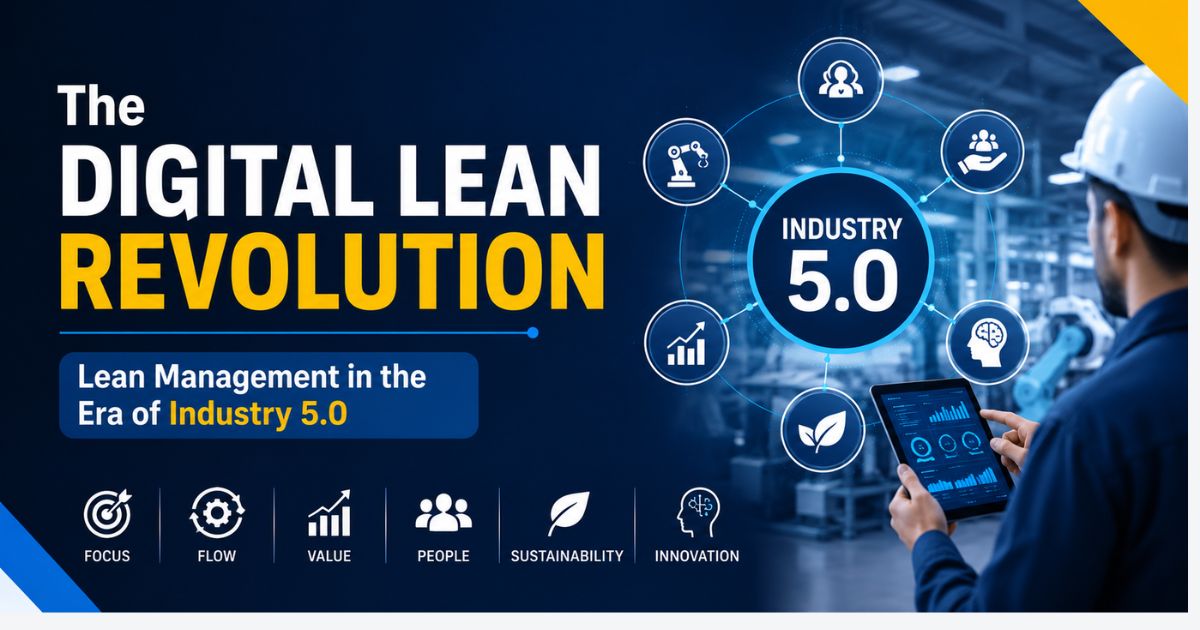
While Industry 4.0 focused heavily on connectivity and the "lights-out" factory, Industry 5.0—the current frontier—is re-centering the human element. The goal is no longer to replace the worker, but to augment their capabilities.
AI-driven systems are now handling the "predictive" workload—forecasting maintenance needs, optimizing load balancing, and sensing supply chain risks months in advance. This allows the human workforce to focus on what humans do best: creative problem-solving, intuitive judgment, and the nuanced continuous improvement that a machine cannot simulate. We are seeing a shift toward "Human-Centric Lean," where augmented reality (AR) work instructions and cobots (collaborative robots) are used to upskill workers in real-time, reducing training time and physical strain while increasing first-pass quality yields.
Metrics for the Modern Age
The traditional KPI of Overall Equipment Effectiveness (OEE) is also evolving. In 2026, it is no longer enough to measure availability, performance, and quality as lagging indicators. Leading organizations are moving toward Predictive OEE. By leveraging AI-driven trend analysis, managers can anticipate a performance dip before it occurs, shifting operations from reactive correction to proactive optimization. This shift is deeply rooted in the "Lean & Digital World Class" model, which prioritizes supply chain visibility over pure cost optimization, ensuring that resilience is baked into the operating model from day one.
How Thesislikho Can Help Your Management Research
Researching the intersection of Lean and digital transformation is a balancing act. It requires a deep understanding of management philosophy, technical operational data, and organizational behavior. Whether you are conducting a thesis on the efficacy of Digital Lean in SMEs or modeling the impact of Industry 5.0 on worker productivity, the academic rigor required is substantial.
Thesislikho.com acts as your academic research partner, providing the specialized support needed to bring complex management theories to life:
- Bridging Theory and Practice: If you are struggling to connect traditional Lean principles (like VSM or Kaizen) with modern digital tools (like AI/IoT), our consultants help you construct a theoretical framework that is both academically sound and grounded in contemporary industrial reality.
- Data Analysis for Operations: Lean research is increasingly quantitative. We assist in structuring your data collection, performing statistical analysis (using SPSS or R), and interpreting operational performance metrics, ensuring your conclusions are backed by solid evidence.
- Literature Synthesis: With the "Digital Lean" field growing rapidly, we help you identify the most relevant, high-impact research gaps, ensuring your thesis contributes original value to the scholarly community.
- Professional Formatting: We ensure your work complies with the stringent formatting standards of top-tier management schools and journals, from citation styles to complex organizational chart presentations.
If you are embarking on a research project that aims to redefine operational excellence in this new digital era, the team at Thesislikho.com has the strategic expertise to guide you through the process, from your initial proposal to the final defense.
As you look at the evolution of Lean, do you believe that AI-driven automation will ultimately strengthen the culture of continuous improvement, or will it create a dangerous dependency that masks deeper process flaws?
Call / WhatsApp: +91 96438 02216
Visit:ThesisLikho.com