
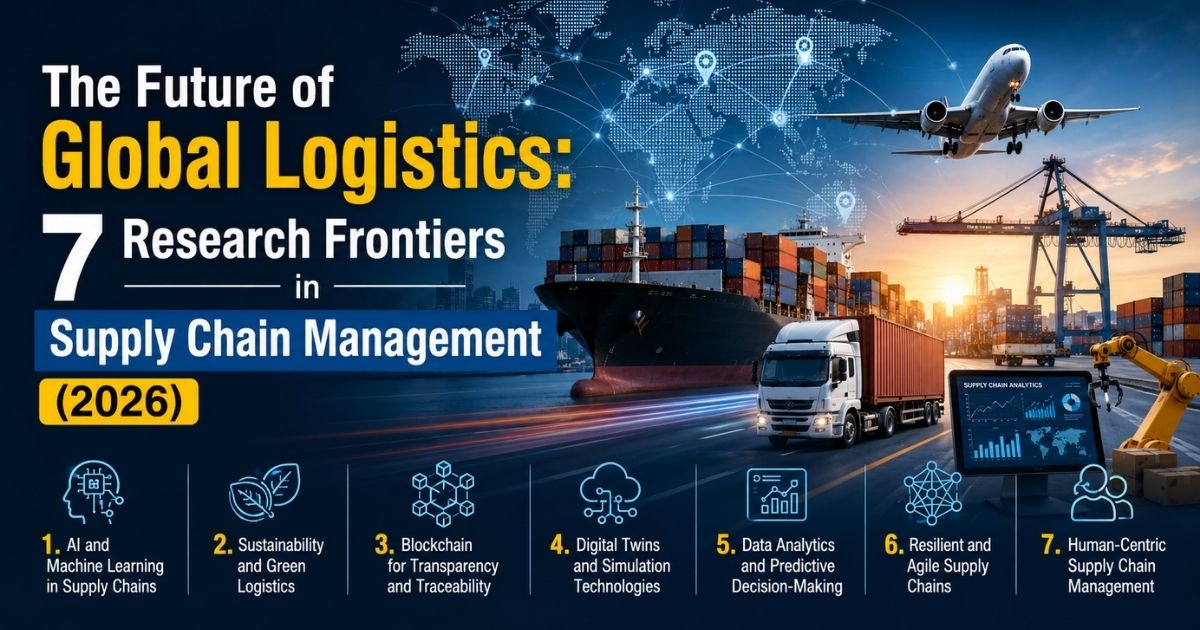
In 2026, the global supply chain has evolved from a back-office logistics function into the central nervous system of the modern economy. The era of permanent crisis mode has transitioned into a new focus on intelligent orchestration, where resilience, sustainability, and automated intelligence are strategic imperatives rather than mere goals.
For doctoral scholars and supply chain professionals, this is a prime era for research. As geopolitical volatility, resource scarcity, and rapid technological integration reshape the field, impactful research is moving beyond cost-cutting to focus on "Total Value" the strategic unification of customer, partner, and digital interactions.
1. 7 Research Frontiers in Supply Chain Management (2026)
1. From Predictive to Agentic AI
In 2026, AI has moved beyond proof-of-concept dashboards to embedded, agentic capabilities. AI agents are now capable of identifying risks, proposing workarounds, and autonomously triggering corrective actions within established guardrails. Research is increasingly focused on "human-plus-machine" workflows, where AI copilots manage repetitive analysis while human experts focus on scenario choice and stakeholder communication.
2. Continuous Planning at the Speed of Business
Traditional monthly or quarterly planning cycles are struggling to keep pace with global volatility. The industry is shifting toward continuous planning, utilizing unified, end-to-end models that support strategic, tactical, and operational decisions on a single harmonized dataset. Scholars are now studying how near-real-time scenario simulations such as testing a port closure or demand spike can allow firms to make probability-guided decisions.
3. AI-Blockchain "Trilemma" Solutions
The integration of AI and Blockchain technology (BCT) is addressing the "Trilemma of Supply Chain Modernization": Speed, Cost, and Trust. While blockchain provides immutable "truth," AI provides the intelligence. Current frontier research explores "Provenanced AI," where predictions can be traced back to verified, tamper-resistant blockchain data, which is critical for ESG reporting and sustainability.
4. Operational Resilience as a Strategic Asset
Resilience is now a measurable competitive advantage. Organizations are building resilience into their network architecture through nearshoring and multi-sourcing strategies. Academic focus is shifting toward developing new metrics that go beyond lead time to include "recovery time after disruptions" and "supplier diversification agility".
5. Circular Logistics and Sustainability
Sustainability has moved from a cost to a core infrastructure. With regulations like the EU Corporate Sustainability Due Diligence Directive, traceability is mandatory. Research into circular supply chains focused on repair, reuse, and recycling shows how these strategies can stabilize input costs and protect firms against resource scarcity.
6. The Skills Gap in Digital Ecosystems
Paradoxically, the barrier to transformation is often the skills gap rather than the lack of technology. Research is currently investigating how organizations can design role-specific capability development programs to ensure that planners and operators can work effectively with AI agents.
7. Agentic AI Collaboration in Workflows
Scholars are studying how different AI agents such as a material planner assistant collaborating with a demand forecast assistant can work together to provide automated, optimized recommendations for complex business outcomes.
Frequently Asked Questions (FAQ)
Q1: What is the most significant shift in Supply Chain Management in 2026?
A: The shift from reactive firefighting to proactive, AI-driven orchestration, where planning and execution are synchronized across the entire business network.
Q2: How does blockchain change supply chain research?
A: Blockchain provides an immutable "truth," solving data quality issues for AI models and enabling verifiable transparency for ESG and sustainability claims.
Q3: What are "Agentic AI" agents in the supply chain?
A: Unlike simple chatbots, agentic AI can identify risks, propose workarounds, and trigger corrective actions such as automatically onboarding a new supplier within predefined guardrails.
Q4: How can researchers contribute to these trends?
A: By focusing on empirical modeling of new digital interventions, designing new resilience metrics, and conducting longitudinal studies on the effectiveness of human-AI collaborative workflows.
Elevate Your Research with Thesislikho.com
The supply chain landscape of 2026 is intellectually vibrant, yet the barriers to entry the pressure for interdisciplinary rigor, the need for data-driven methodology, and the competitive race for publication have never been higher.
Thesislikho.com provides the expert scaffolding you need to turn your intellectual vision into a globally recognized piece of scholarship.
- Proposal Development: We help you define research questions that are both academically sophisticated and timely.
- Methodological Rigor: We assist you in building robust theoretical frameworks and guide you through analytical tools, from simulation modeling to multivariate statistical analysis.
- Manuscript Polish: We provide structural editing to ensure your research communicates its significance powerfully and is perfectly aligned with the standards of top-tier SCI and Scopus-indexed publications.
- AI Policy Guidance: We help you navigate the ethical use of AI, ensuring that your work remains 100% original while using technology to enhance your productivity.
Do not let the hurdles of academic writing slow down your vital contribution. Partner with the experts at Thesislikho.com to ensure your academic journey culminates in research that is recognized, respected, and published at the highest levels.
The Intelligent Frontier: 7 Research Frontiers in Operations Research (2026)
Author: Dr Pankaj Mishra
About: Dr. Pankaj Mishra is an edtech entrepreneur, educator, and visionary leader dedicated to transforming modern education. He is the Founder Director and President of Operations at Stuvalley Technology, a platform focused on making high-quality, future-ready learning accessible to students and researchers worldwide. With a strong background in academic leadership, research development, and technological innovation, Dr. Mishra regularly shares insights on career growth, academic excellence, and the evolution of modern edtech.
Connect with him on LinkedIn.
In 2026, Operations Research (OR) has transcended its traditional role as a tool for static optimization. It has become the "computational engine" driving the modern enterprise, shifting from simple efficiency-seeking to the design of autonomous, resilient, and sustainable systems. As of July 2026, the academic and industrial landscape is dominated by the integration of agentic AI, circular economy modeling, and autonomous orchestration.
For scholars, this is a pivotal time. The following seven frontiers represent the most significant research trajectories currently dominating high-impact journals and industry R&D.
1. Agentic Operations and Autonomous Orchestration
The most profound shift in 2026 is the rise of Agentic Operations. Unlike traditional OR models that provided recommendations for humans to execute, agentic AI can reason, plan, and autonomously execute multi-step workflows across digital environments.
- The Research Gap: How do we design "governed orchestration"? Scholars are exploring how to pair the creative reasoning of AI agents with deterministic automation control planes that enforce safety, auditability, and policy compliance.
2. Resilience Metrics for Fragmented Global Networks
Resilience is no longer an abstract goal; it is a measurable strategic asset. 2026 research is focused on developing standardized metrics that quantify recovery time and network agility.
- The Frontier: Moving beyond standard lead-time analysis to model "disruption propagation" in complex supply networks, considering the heterogeneity of individual enterprises.
3. Circularity as an Industrial Strategy
Circularity is no longer framed as cost avoidance but as a core driver of competitiveness, resource security, and growth. Research is shifting toward optimizing reverse logistics networks and secondary market models that extend product lifecycles.
- The Challenge: Modeling the trade-offs between material efficiency, cost, and environmental impact in a net-zero framework.
4. AI-Native Optimization in R&D
Operations Research is moving "upstream." Industry leaders now deploy AI-native or agentic platforms directly in R&D, using OR techniques to accelerate the design of new products, materials, and operational models before they ever reach the manufacturing floor.
- Key Focus: Using OR to optimize the scalability of these AI-driven R&D initiatives.
5. Multi-State Flow Network Reliability
As supply chains face increasing uncertainty from geopolitical and climate-related disruptions, OR scholars are advancing multi-state flow network reliability estimation.
- The Frontier: Applying Monte Carlo-based algorithms to estimate reliability in networks with variable supply capacities and stringent regulatory constraints, such as transportation emission caps.
6. Human-AI Collaborative Decision-Making
Research is increasingly investigating the organizational design of teams where humans provide strategic intent and policy guardrails, while AI agents manage high-frequency operational execution.
- The Research Gap: Understanding how to design AI agent "personalities" that complement human colleagues to optimize performance, productivity, and team outcomes.
7. Digital Twins and Simulation-Based Optimization
The use of Digital Twins high-fidelity virtual replicas of physical systems is now standard in OR.
- The Frontier: Integrating real-time IoT data into these twins to enable dynamic optimization, allowing systems to self-correct in response to changing environmental conditions or resource availability.
Frequently Asked Questions (FAQ)
Q1: What is the most significant shift in Operations Research in 2026?
A: The transition from static, human-led optimization to Agentic Operations, where AI agents autonomously plan and execute complex, multi-step workflows while remaining under governed, deterministic orchestration.
Q2: How is sustainability impacting OR research?
A: Sustainability is now an industrial strategy for resilience and growth. OR research is focused on modeling circular economies, optimizing reverse logistics, and incorporating environmental regulations as core constraints in network design.
Q3: What are "Agentic Operations" for infrastructure?
A: It is an operating model where AI agents reason over operational context to propose actions, while the execution is performed through a control plane that enforces approvals, auditability, and safety policy.
Q4: How can scholars contribute to these research frontiers?
A: By developing new optimization methodologies that can handle uncertainty, integrating real-time data into simulation models, and designing architectures for human-AI collaborative workflows.
Elevate Your Research with Thesislikho.com
The field of Operations Research in 2026 is intellectually vibrant, yet the barriers to entry the pressure for interdisciplinary rigor, the need for data-driven methodology, and the competitive race for publication have never been higher.
Thesislikho.com provides the expert scaffolding you need to turn your intellectual vision into a globally recognized piece of scholarship.
- Proposal Development: We help you define research questions that are both academically sophisticated and timely. Whether you are exploring agentic AI architectures or sustainable supply chain networks, we help you frame a compelling proposal.
- Methodological Rigor: OR research today requires structure. We assist you in building robust theoretical frameworks and guide you through the analytical tools needed to validate your claims, from simulation modeling to multivariate statistical analysis.
- Manuscript Polish: The difference between rejection and acceptance in high-impact journals is often the narrative flow and the precision of your critical argument. Our experts provide comprehensive structural editing to ensure your voice is powerful, clear, and perfectly aligned with the standards of top-tier publications.
- AI Policy Guidance: We help you navigate the ethical use of AI, ensuring that your work remains 100% original while using technology to enhance your productivity.
Do not let the hurdles of academic writing slow down your vital contribution. Partner with the experts at Thesislikho.com to ensure your academic journey culminates in research that is recognized, respected, and published at the highest levels.
Call / WhatsApp: +91 96438 02216
Website:www.ThesisLikho.com