
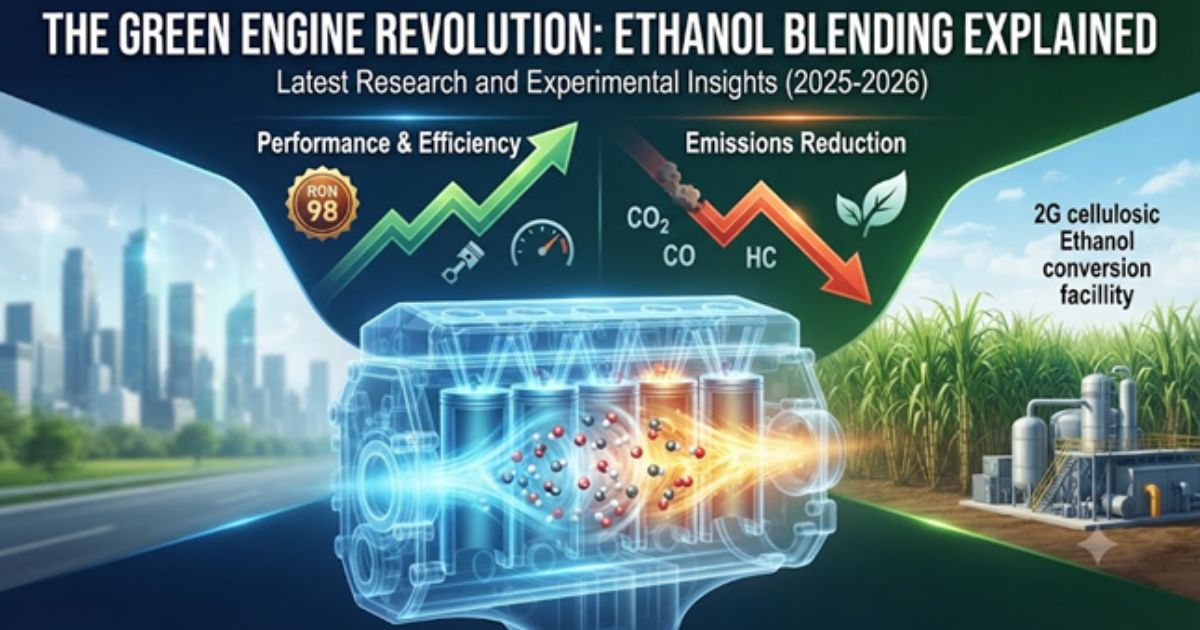
As the global community confronts the twin crises of accelerating climate change and geopolitical energy vulnerability, the transportation sector remains under intense scrutiny. Accounting for a massive share of global petroleum consumption and urban air pollution, internal combustion engine (ICE) transport is undergoing a forced, yet innovative, evolution. Among the various alternative energy strategies, ethanol fuel blending—mixing anhydrous bioethanol with conventional petroleum gasoline—has emerged as one of the most economically viable, scalable, and rapidly deployed transition mechanisms worldwide.
From Brazil’s pioneering decades-long multi-blend infrastructure to India’s aggressive nationwide acceleration to E20 (20% ethanol, 80% petrol) and regulatory frameworks for E30, bio-ethanol is reshaping the chemical and mechanical properties of vehicular fuel. However, this transition is not without controversy. Public debates surrounding fuel economy drops, engine longevity, and food-versus-fuel resource competition have triggered a surge in rigorous scientific inquiry.
This comprehensive, evidence-based exploration examines the physicochemical mechanics of ethanol blending, dissects the latest experimental research published in top-tier journals, evaluates real-world engine performance and emission metrics, and outlines the future of high-blend biofuels.
1. The Physicochemical Mechanics of Ethanol Blending
To understand how ethanol affects a spark-ignition (SI) engine, one must first look at its chemical structure compared to traditional fossil gasoline.
Ethanol ($\text{C}_2\text{H}_5\text{OH}$) is an oxygenated hydrocarbon containing approximately 34.7% oxygen by weight. This inherent oxygen content fundamentally alters combustion chemistry. When blended into petroleum, even in modest quantities (such as 10% or 20%), it introduces distinct thermodynamic properties:
- High Octane Number: Pure ethanol possesses a Research Octane Number (RON) of approximately 108.5, significantly higher than standard commercial unleaded petrol (which typically ranges from 88 to 91 RON). Blending ethanol into petrol raises the overall octane rating of the fuel pool (e.g., pushing standard Indian petrol to around 95 RON), providing exceptional anti-knock characteristics. This allows modern engines to operate at higher compression ratios without destructive engine knocking.
- Latent Heat of Vaporization: Ethanol has a latent heat of vaporization (approx. $900 \, \text{kJ/kg}$) nearly three times higher than that of conventional gasoline ($350 \, \text{kJ/kg}$). As ethanol evaporates inside the intake manifold, it draws a massive amount of thermal energy from the incoming air charge, cooling it down. This cooling effect increases air-charge density and volumetric efficiency, partially compensating for energy density losses.
- Flame Speed and Combustion Velocity: Ethanol exhibits a faster laminar flame speed than standard gasoline. This accelerates the combustion process, resulting in a more uniform, complete pressure wave inside the cylinder and lower cycle-to-cycle variations at part-load conditions.
- Lower Energy Density (Calorific Value): The stoichiometric air-fuel ratio for ethanol is lower (~9:1) compared to gasoline (~14.7:1), and its lower heating value (LHV) is roughly 33% less than pure petroleum. This means more volumetric fuel must be injected to release the exact same amount of thermal energy, forming the root cause of real-world volumetric fuel economy variations.
2. Global Policy Landscape and the Push Toward High Blends
The deployment of ethanol blending programs is anchored by national mandates designed to insulate economies from crude oil price shocks and fulfill Paris Agreement carbon reduction targets.
- Brazil: The undisputed global pioneer, Brazil mandates an E27 blend for standard gasoline vehicles alongside a massive fleet of dedicated flexible-fuel vehicles (FFVs) running on hydrous ethanol (E100).
- The United States: Driven by the Renewable Fuel Standard (RFS), the U.S. relies predominantly on the nationwide baseline of E10, with seasonal and regional expansions into E15.
- India: India’s Ethanol Blended Petrol (EBP) Programme stands as one of the fastest energy transitions in the developing world. Having achieved its 10% target (E10) ahead of schedule in 2022, India crossed the 20% milestone (E20), rolling out E20 nationwide. Furthermore, the Bureau of Indian Standards has notified specifications for advanced E22 to E30 blends under IS 19850:2026, signaling the next phase of the biofuel roadmap. According to government figures, the EBP programme has saved over ₹1.65 lakh crore in foreign exchange since 2014 and cumulatively reduced $\text{CO}_2$ emissions by over 830 lakh metric tonnes.
3. Latest Research Findings: Experimental and Numerical Insights (2025–2026)
Recent studies published in leading energy, thermal engineering, and mechanical journals provide granular insights into how high-percentage ethanol blends impact engine performance, combustion stability, and tailpipe emissions.
A. Combustion Efficiency and Power Output Dynamics
A comprehensive experimental and numerical study published in PubMed Central investigating drop-in ethanol-gasoline blends in single-cylinder spark-ignition engines revealed critical operational thresholds:
- Moderate Blends (E10 to E30): Blending ethanol up to 30% by volume consistently enhances combustion quality. In-cylinder peak pressures and Indicated Mean Effective Pressure (IMEP) show noticeable improvements due to faster flame propagation and higher octane ratings.
- The High-Blend Wall (Beyond E40): The study highlighted that pushing ethanol concentrations past E40 without modifying engine timing or compression ratios leads to combustion instability, misfires, and efficiency losses. Because of ethanol's lower heating value, excessive high-blend ratios require advanced electronic control unit (ECU) re-mapping and optimized spark timing to prevent power drops.
- Engine Engine-Type Comparison: Parallel studies comparing 2-stroke and 4-stroke engines using bio-ethanol blends demonstrated that 4-stroke architectures extract significantly higher brake thermal efficiency (up to a 29% to 50% improvement at full load compared to baseline fuel) because they handle higher compression ratios without knock. Conversely, 2-stroke engines struggle with scavenging losses and incomplete combustion at higher blend ratios.
B. The Mitigation of Exhaust Emissions
The most undisputed advantage of ethanol blending lies in its environmental profile. Because the fuel molecule carries its own oxygen atom, it promotes cleaner, more complete oxidation of carbon molecules during the power stroke.
Recent findings from controlled dynamometer testing of bioethanol-petrol blends (such as E15, E20, and higher experimental fractions like E40–E60) document profound emission reductions:
- Carbon Monoxide (CO): Drops consistently by 27% to 53% due to oxygen enrichment forcing complete combustion of carbon into $\text{CO}_2$ rather than toxic CO.
- Unburned Hydrocarbons (HC): Reductions ranging from 47% to 57% have been recorded, driven by the elimination of fuel-rich pockets near cold cylinder walls.
- Carbon Dioxide ($\text{CO}_2$): While tailpipe fossil $\text{CO}_2$ emissions scale with carbon content, the lifecycle carbon footprint is reduced by roughly 40% to 50% because the carbon emitted was originally sequestered from the atmosphere by the biomass feedstocks during growth.
- Nitrogen Oxides ($\text{NO}_x$): Results vary by load and engine tuning. While lower combustion temperatures induced by ethanol’s high latent heat can reduce $\text{NO}_x$ by up to 38% under specific operating conditions, advanced combustion phasing can sometimes cause localized temperature spikes, creating marginal $\text{NO}_x$ increases unless handled by Exhaust Gas Recirculation (EGR) systems.
4. Addressing Real-World Concerns: Mileage, Engine Wear, and Compatibility
Despite robust laboratory validation from regulatory bodies like the Automotive Research Association of India (ARAI), the Indian Institute of Petroleum (IIP), and the Society of Indian Automobile Manufacturers (SIAM), the commercial rollout of E20 has sparked public debate among motorists.
Concern 1: The "Mileage Drop" Myth vs. Reality
- The Consumer Claim: Many drivers report a sudden, severe drop in fuel economy (up to 20–30%) after switching to E20.
- The Scientific Fact: Because ethanol contains roughly 33% less energy per litre than pure petrol, thermodynamic theory dictates a volumetric penalty. However, controlled fleet evaluations and manufacturer data (such as extensive service records from Maruti Suzuki covering millions of vehicles) indicate that the real-world fuel economy reduction for E20-compatible vehicles is marginal—typically between 1% to 3%. Larger perceived drops in daily driving are overwhelmingly driven by external variables, including aggressive urban traffic congestion, tire pressure, auxiliary air-conditioning loads, and driving habits.
Concern 2: Corrosion and Legacy Engine Damage
- The Consumer Claim: Ethanol destroys rubber gaskets, corrodes fuel tanks, and damages older engines not originally built for high blends.
- The Scientific Fact: Pure ethanol is hygroscopic (it absorbs ambient moisture from the air) and can act as a mild solvent over extended periods, which historically caused degradation in older elastomeric hoses, brass fittings, and fiberglass tanks used prior to the mid-2010s. However, automotive manufacturers began phasing in ethanol-resistant materials (such as fluorocarbon elastomers, stainless steel fuel lines, and anodized components) as early as 2020–2023. Extensive real-world servicing data on millions of older, non-E20-certified vehicles running on blended fuel for years has shown no widespread or catastrophic engine failure patterns directly attributable to routine E20 use, provided basic maintenance is observed.
5. Frequently Asked Questions (FAQ) on Nanomaterials & Fluid Mechanics in Advanced Fuels
Q1: How do nanofluids intersect with ethanol-blended petrol research?
A: While ethanol alters the chemical and thermodynamic profile of fuel, modern thermal engineering research frequently combines alternative fuels with nanofluids (base coolants doped with metal oxide nanoparticles like $Al_2O_3$ or carbon nanotubes) in engine cooling systems. Because ethanol combustion generates localized thermal variations, advanced nanofluid coolants are utilized in next-gen radiators to enhance heat dissipation and maintain optimal engine operating temperatures.
Q2: Does ethanol blending affect engine oil degradation?
A: Studies indicate that higher alcohol content can occasionally lead to marginal blow-by of unburnt ethanol past piston rings into the crankcase during cold starts, slightly accelerating engine oil dilution over long oil-change intervals. However, modern synthetic oils formulated with advanced detergent packages effectively neutralize this risk.
Q3: Can unmodified older cars run on E20 fuel safely?
A: Vehicles manufactured prior to the widespread material-compliance era can run on E20 without immediate breakdown, but long-term use may accelerate the drying and cracking of legacy rubber fuel lines and seals. Routine inspection and replacement of older fuel filters and hoses mitigate these risks entirely.
Q4: What are the primary feedstocks for sustainable bio-ethanol production?
A: While first-generation ethanol relies on sugar cane and starch crops (corn, wheat), research and industrial investments have shifted heavily toward second-generation (2G) cellulosic ethanol, which utilizes agricultural waste, rice straw, bagasse, and municipal solid waste, completely bypassing the food-versus-fuel debate.
6. Career Pathways: Becoming an Expert in Alternative Fuels and Fluid Dynamics
The rapid global pivot toward sustainable energy and biofuels has triggered a massive corporate and academic demand for specialists in fluid mechanics, alternative combustion chemistry, and automotive tribology.
Core Skill Sets for Future Experts
- Computational Fluid Dynamics (CFD): Mastering software suites like ANSYS Fluent or OpenFOAM to model in-cylinder spray patterns, fuel vaporization rates, and flame propagation dynamics for multi-blend biofuels.
- Tribology and Material Compatibility: Understanding how oxygenated fuels interact with metallic and polymeric engine components under extreme thermal and mechanical stress.
- Life Cycle Assessment (LCA): Proficiency in evaluating the true "well-to-wheel" carbon intensity of alternative fuels, from feedstock harvesting to tailpipe emission.
High-Growth Sectors
- Automotive Powertrain R&D: Major manufacturers are aggressively hiring combustion engineers to calibrate ECUs for multi-fuel flexibility (E20 to E85).
- Energy Policy and Regulatory Bodies: Governments and international think tanks require specialized technical consultants to draft safety standards, environmental compliance frameworks, and biofuel infrastructure roadmaps.
7. Elevate Your Research with Thesislikho.com
Conducting experimental or numerical research on complex thermodynamic systems—such as modeling ethanol combustion kinetics, evaluating nanofluid cooling loops, or performing engine dynamometer emissions testing—requires absolute precision. Navigating the stringent review processes of high-impact Q1 and Q2 SCI-indexed journals can be a daunting hurdle for early-career scholars and doctoral candidates.
Thesislikho.com is your ultimate academic partner, offering comprehensive, expert-led support across every phase of your research journey:
- Advanced Methodological & CFD Support: Whether you are struggling to configure multiphase droplet evaporation models in ANSYS or debugging chemical reaction mechanisms for multi-blend fuels, our team of technical experts and data scientists provides hands-on consultancy.
- Proposal and Synopsis Development: We help you craft compelling, original research proposals that address genuine, cutting-edge gaps in the current 2026 energy literature, ensuring high acceptance rates for doctoral admissions and grant applications.
- Data Analysis & Statistical Rigor: We assist in processing complex experimental data arrays, performing uncertainty analyses, and generating publication-ready graphs and regression models.
- Q1/SCI Manuscript Polish and Editing: We provide comprehensive structural editing, ensuring your scientific arguments are articulated with the precise, formal academic English demanded by top-tier publishers like Elsevier, Springer Nature, and Taylor & Francis.
Do not let the complexities of academic writing and advanced modeling slow down your contribution to sustainable science. Partner with the experts at Thesislikho.com to ensure your research achieves global recognition, respect, and publication success.
website: https://thesislikho.com/