The Rise of Digital Lean and Resilience
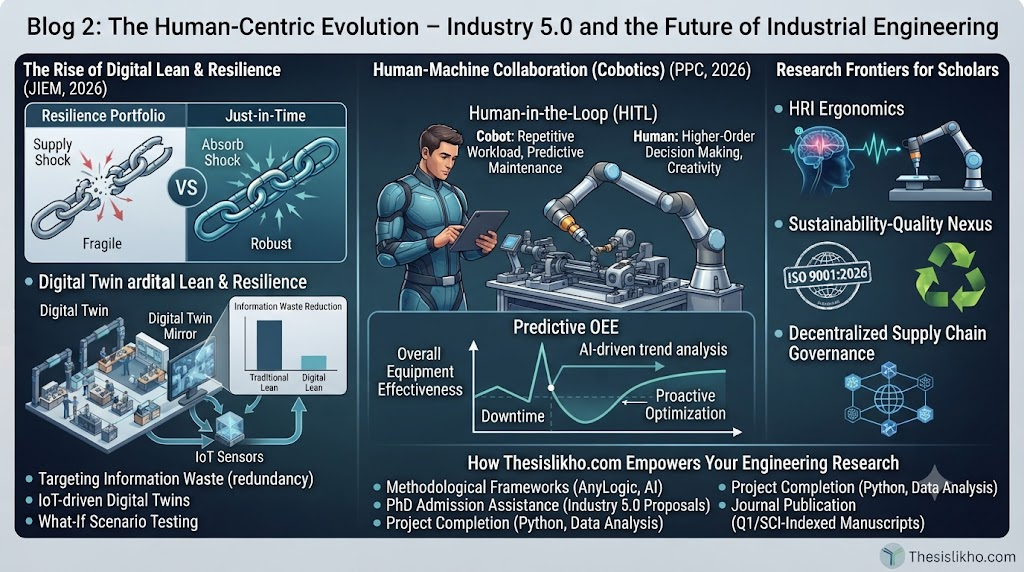
For researchers in Industrial Engineering, the primary challenge of 2026 is no longer just "efficiency" it is structural resilience. The fragility of global supply chains, highlighted by the geopolitical and climate-related disruptions of the past three years, has necessitated a move away from lean manufacturing’s traditional emphasis on "just-in-time" (JIT) production. As noted in the Journal of Industrial Engineering and Management JIEM, 2026, the modern goal is the "Resilience Portfolio," where manufacturing systems are built to absorb shocks while maintaining high output quality.
The core of this evolution is Digital Lean. While classic Lean management aimed to eliminate the "eight wastes" (Muda), Digital Lean targets "Information Waste" the accumulation of redundant data and the disconnection between ERP systems and shop-floor reality. By implementing IoT-driven Digital Twins, engineers can now create high-fidelity simulations of production lines IEEE Transactions on Industrial Informatics. These digital replicas allow teams to test "what-if" scenarios such as a sudden raw material shortage or a component failure without jeopardizing physical assets.
Human-Machine Collaboration (Cobotics)
The defining feature of Industry 5.0 research is the "Human-in-the-Loop" (HITL) architecture. Current studies, such as those featured in Production Planning & Control PPC, 2026, indicate that collaborative robots (cobots) are most effective when they handle the predictive and repetitive workload, freeing human workers to focus on higher-order decision-making.
This human-centric model is being backed by Predictive OEE (Overall Equipment Effectiveness). By leveraging AI-driven trend analysis, managers can anticipate performance dips before they happen, shifting operations from reactive correction to proactive optimization. This shift is not merely technological; it is a fundamental redesign of industrial culture, where the worker is viewed as an essential intelligence node rather than a replaceable component.
Research Frontiers for Scholars
For doctoral candidates and engineering researchers, this transition presents a wealth of potential thesis topics. Current "hot" research areas include:
- Human-Robot Interaction (HRI) Ergonomics: Measuring the long-term cognitive and physical impact of cobot collaboration on shop-floor personnel.
- Sustainability-Quality Nexus: Modeling how energy-efficient manufacturing processes impact the quality-standard benchmarks of the ISO 9001:2026 revisions.
- Decentralized Supply Chain Governance: Using blockchain-enabled frameworks to ensure transparency and trust in distributed manufacturing networks.
How Thesislikho.com Empowers Your Engineering Research
The integration of complex management theory, high-tech simulation, and human factors research requires expert academic oversight. Thesislikho.com serves as the primary bridge between your raw industrial data and a high-impact, submission-ready thesis:
- Methodological Frameworks: We assist in structuring your research using advanced simulation models (e.g., AnyLogic, Arena, or custom AI-based frameworks), ensuring your results are rigorous, reproducible, and robust enough for a doctoral defense.
- PhD Admission Assistance: Crafting a research proposal for Industrial Engineering requires a deep understanding of the 2026 global trends. Our consultants help you draft proposals that highlight your expertise in Industry 5.0 and sustainable resilience, maximizing your chances at top-tier universities.
- Project Completion: From troubleshooting Python scripts for data analysis to refining organizational chart presentations in your thesis, our technical team provides the consultancy needed to hit your project deadlines.
- Journal Publication: Our editors are deeply familiar with the standards of Q1/SCI-indexed engineering publications. We assist in translating your findings into persuasive, technically precise manuscripts that withstand the scrutiny of reviewers in journals like Nature Manufacturing or IJPE.
If you are currently researching the intersection of AI, Lean management, and human-centric systems, do not navigate these technical complexities alone. The team at Thesislikho.com is dedicated to helping you turn your most ambitious industrial engineering ideas into an impactful, finished piece of scholarly work that stands as a benchmark in the industry.
As you look toward the future of industrial quality, do you think the push for real-time, automated compliance will lead to a more resilient manufacturing sector, or will it create an over-reliance on digital systems that leaves companies vulnerable to systemic technical failure?
Website: www.thesislikho.com
Call / WhatsApp: +91 96438 02216