
The Paradigm Shift: Why 2026 is the Year of Truth for AI
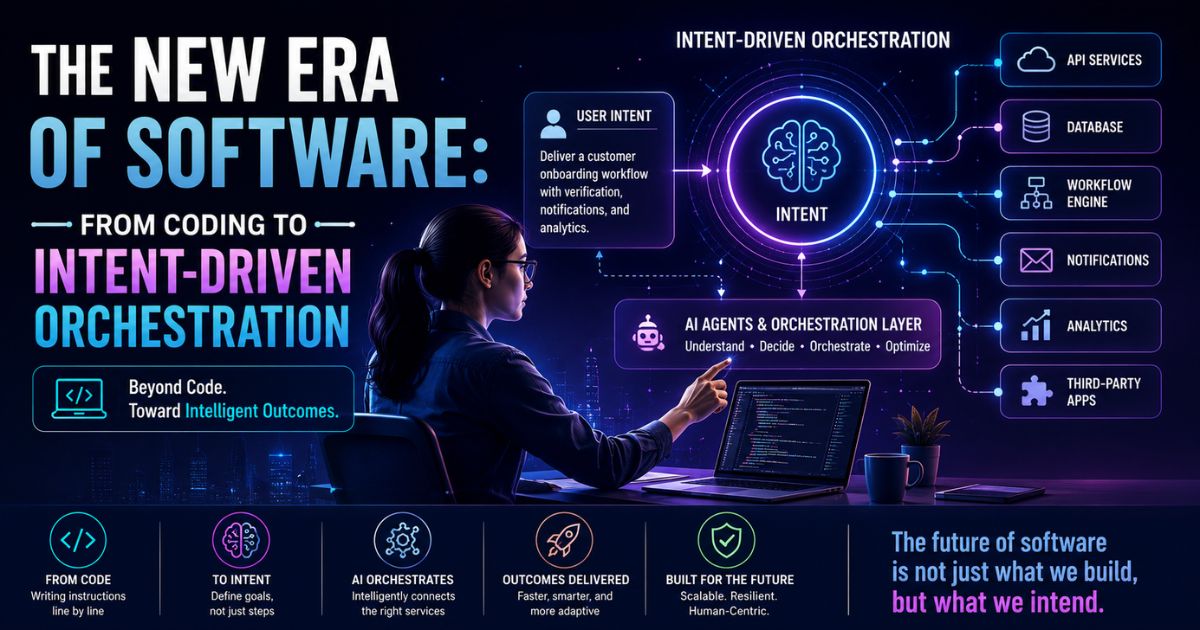
After years of experimental pilots, 2026 has been dubbed the "Year of Truth for AI." In the enterprise, this has manifested as a move from isolated, "black-box" generative models to coherent, adaptive, and trusted value systems. Software is no longer just a collection of static scripts; it is becoming a "living ecosystem."
The shift from "writing code" to "expressing intent" is not merely semantic—it is functional. Modern development environments now allow engineers to articulate high-level outcomes, such as "build a secure, scalable authentication module that integrates with our existing database," and the AI autonomously delivers, integrates, and maintains that system. As software becomes increasingly self-assembling and self-healing, the competitive advantage for developers has pivoted entirely. It is no longer about who can write the most efficient loop or debug the fastest; it is about who can master AI orchestration and governance.
The Rise of Agentic AI
The most significant trend shaping this transformation is the emergence of Agentic AI. Unlike the generative AI of 2024 or 2025, which were primarily focused on content creation, current agents function as autonomous operators. These systems can coordinate with one another, handle complex workflows with minimal human oversight, and exhibit a level of goal-oriented reasoning that was previously the domain of human project managers.
In a modern production pipeline, these agents are now responsible for:
- Autonomous Debugging: Identifying vulnerabilities and performance bottlenecks before they hit production, often self-correcting the code in real-time.
- System Integration: Automatically managing the complex web of APIs and dependencies that define modern microservices architectures.
- Context-Aware Maintenance: Continuously monitoring codebases to ensure that legacy components remain compatible with new updates, reducing the "technical debt" that has long plagued engineering teams.
Governance as the New Competitive Moat
With this increase in autonomy comes an unprecedented risk of error. A single agentic error can be amplified across a system within seconds, which is why governance and reliability have become the most valuable skills in the industry. As organizations move toward production-scale AI, the focus has shifted toward building "durable foundations."
This means that "Good Policy" is now as important as "Good Code." Researchers are currently prioritizing the development of AI evaluation frameworks, robust testing methodologies, and transparent AI usage disclosures. The most successful engineering teams of 2026 are those that treat AI governance not as a bureaucratic burden, but as a "competitive moat"—a way to ensure their systems are more trustworthy, resilient, and secure than those of their competitors.
The Changing Role of the Human Engineer
If AI is handling the "execution," what is left for the human developer? The answer lies in the transition from tactical implementation to strategic architecture. The modern engineer is now a "System Architect." They spend their time defining the constraints within which the AI agents operate, auditing the system for bias, and ensuring the architecture remains aligned with long-term business objectives.
This evolution is fundamentally reducing the "cognitive load" on developers. Instead of burning out on repetitive syntax and boilerplate generation, engineers are liberated to focus on higher-order problem-solving and innovative design. The best developers in 2026 are those who act as "human-in-the-loop" decision-makers, managing the balance between the efficiency of automation and the nuance of human judgment.
Partnering with Thesislikho.com: Your Research Foundation
As computer science research moves toward these complex, system-level integrations, the process of writing an academic thesis or research paper has become equally sophisticated. The team at Thesislikho.com is specifically designed to support researchers navigating this interdisciplinary frontier.
When your research involves cutting-edge topics like agentic orchestration, AI governance, or system-level reliability, Thesislikho provides the technical and editorial support you need to ensure your work meets the highest academic standards:
- Defining Research Scope: They help you narrow down massive fields like "AI Governance" into specific, researchable hypotheses that contribute original value to the academic community.
- Methodological Rigor: They provide guidance on the experimental validation of AI systems, helping you document your findings with the transparency and reproducibility required for top-tier journal submissions.
- Technical Synthesis: Writing about the intersection of human intent and machine execution requires clarity. Their team helps you craft a narrative that resonates with both technical and non-technical stakeholders.
- Structural Excellence: Whether you are following IEEE, ACM, or other rigorous engineering formatting standards, Thesislikho ensures your bibliography, code appendices, and logic flows are presented with professional, error-free precision.
If you are currently working on a thesis that sits at the intersection of AI, software architecture, and the future of technology, don't navigate these complex waters alone. The expertise at Thesislikho.com is built to help you turn your most ambitious ideas into finished, impactful research.
As you look toward your next project, are you planning to focus your research on the architectural design of AI agents, or are you more interested in the governance frameworks required to keep those agents reliable?
Call / WhatsApp: +91 96438 02216
Visit:ThesisLikho.com