
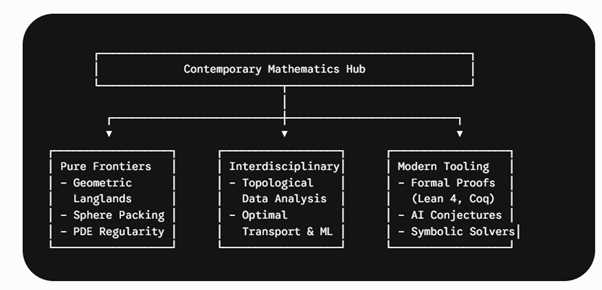
Introduction: The Shifting Frontier of Mathematical Inquiry
Mathematical research has long been characterized by its timelessness. Unlike experimental sciences, where empirical data can render a decade-old laboratory technique obsolete, a proved mathematical theorem remains true indefinitely. Yet, the ways mathematicians formulate questions, discover patterns, and verify proofs are undergoing a radical evolution.
Historically, pure mathematics—encompassing fields like number theory, abstract algebra, and algebraic topology—was pursued largely for its intrinsic intellectual beauty. Applied mathematics—such as numerical analysis, partial differential equations (PDEs), and mathematical physics—was treated as a distinct, pragmatic endeavor. Today, this dichotomy is vanishing. Modern fields like topological data analysis (TDA), quantum information theory, and deep learning geometry rely directly on deep, abstract machinery from category theory, differential geometry, and algebraic geometry.
Concurrently, the global scientific community evaluates mathematical contributions through peer-reviewed literature categorized into quartile rankings:
- Q1 Journals (Top 25%): Venues such as Annals of Mathematics, Journal of the American Mathematical Society (JAMS), Inventiones Mathematicae, Acta Mathematica, and Communications on Pure and Applied Mathematics (CPAM) set the world standard for conceptual originality and rigor.
- Q2 Journals (Top 25–50%): Outlets like Journal of Algebra, Bernoulli, Journal of Noncommutative Geometry, and Discrete Mathematics publish critical foundational advancements, specialized domain solutions, and vital incremental progress.
Understanding these publishing landscapes is essential for any researcher seeking to contribute meaningfully to the discipline.
Section 1: Decoding the Q1 and Q2 Publishing Ecosystem in Mathematics
To understand where to read and publish, one must first grasp how journal quartiles are determined and why mathematics differs from other STEM disciplines in its publishing dynamics.
How Journal Quartiles Work (Scopus & JCR)
Journal rankings are updated annually based on citation metrics compiled by Web of Science (Journal Citation Reports - JCR) and Elsevier (Scopus/SCImago). The quartile is calculated by ranking journals within a specific subject category (e.g., Mathematics, Applied, Mathematics, Pure, or Mathematical Physics) by their Impact Factor (JCR) or SCImago Journal Rank (SJR):
Where $N$ is the total number of journals in the category and $R$ is the journal's rank position.
- Q1 (75th – 100th Percentile): The top 25% of journals in a subfield. These represent seminal, highly cited works that shape the direction of whole research fields.
- Q2 (50th – 75th Percentile): The second tier (top 25–50%). High-quality, rigorous peer-reviewed journals with solid reputation and consistent scholarly influence.
- Q3 (25th – 50th Percentile) & Q4 (0 – 25th Percentile): Niche, regional, or emerging journals.
The Uniqueness of Mathematical Publishing Culture
Unlike biology or computer science—where rapid preprints, conference proceedings (e.g., NeurIPS, ICML), or quick monthly journal turnarounds dominate—mathematics operates under a distinct publishing culture:
- The Preponderance of the arXiv: Almost all major mathematical breakthroughs are posted as open-access preprints on arXiv.org (primarily under math.NT, math.AG, math.AP, math.DG) long before formal publication.
- Extended Peer Review Cycles: Due to the absolute necessity of verifying step-by-step logical correctness, peer review in Q1/Q2 math journals frequently takes between 6 to 24 months. Referees must meticulously read dozens or hundreds of pages of rigorous proofs.
- Citation Longevity vs. Citation Volume: Math papers generally accrue citations slowly over decades rather than spiking immediately. Consequently, Impact Factors for top pure math journals (often between 2.0 and 8.0) appear lower than top medical journals (e.g., NEJM or Lancet), yet their lasting scientific footprint is immense.
Section 2: Deep Dive into Breakthroughs in Pure Mathematics
Recent publications across Q1 and Q2 pure mathematics journals showcase extraordinary leaps in resolving long-standing open problems. Let us examine key domains where transformative work is occurring.
1. Number Theory & Arithmetic Geometry: The Geometric Langlands Resolution
The Langlands Program, often described as the "Grand Unified Theory of Mathematics," seeks to build vast bridges connecting number theory (galois representations, prime distribution) with harmonic analysis and representation theory (automorphic forms).
A landmark milestone was achieved with the public release and submission of the comprehensive, multi-part, 800-page proof of the Unramified Geometric Langlands Conjecture (championed by Dennis Gaitsgory, Sam Raskin, Nick Rozenblyum, and collaborators). Published across elite venues and detailed monographs, this work translates arithmetic questions into the language of algebraic geometry using derived categories of $D$-modules and perverse sheaves on stacks of $G$-bundles.
Key Conceptual Formula: The Spectral-Automorphic Duality
The Geometric Langlands Correspondence posits an equivalence of derived categories:
Where:
is the moduli stack of flat G-connections on a smooth algebraic curve X.
This monumental result in Q1 algebraic geometry literature provides unprecedented tools to study quantum field theory, dualities in mathematical physics, and non-abelian class field theory.
2. Discrete Geometry & Sphere Packing in High Dimensions
How tightly can identical $n$-dimensional spheres be packed into Euclidean space $\mathbb{R}^n$? While everyday intuition solves this in 3D (the face-centered cubic lattice, proved formally by Thomas Hales in the Kepler Conjecture), high-dimensional sphere packing remains notoriously elusive.
Following Maryna Viazovska’s Fields Medal-winning work proving that the $E_8$ lattice and the Leech lattice ($\mathbb{R}^{24}$) provide the densest packings in dimensions 8 and 24 respectively using modular forms, recent Q1 publications (e.g., in Annals of Mathematics and JAMS) have tackled general lower bounds in arbitrary dimension $n$.
Mathematicians (such as Marcelo Campos, Matthew Jenssen, Marcus Michelen, and Julian Sahasrabudhe) shattered a 75-year-old bound established by Claude Shannon and Rogers. By introducing radical graph-theoretic methods, semi-random packing algorithms, and statistical mechanics into pure geometry, they proved that the maximum packing density $\Delta(n)$ satisfies:
This marked the first exponential improvement in sphere packing efficiency since 1947, with direct applications to information theory, error-correcting codes, and signal transmission.
3. Partial Differential Equations: Regularity & Fluid Mechanics
In fluid dynamics, the 3D Navier-Stokes Equations and Euler Equations dictate the motion of viscous and incompressible fluids. The Millennium Prize Problem asks whether smooth solutions always exist for all time, or whether finite-time singularities ("blow-ups") can form from smooth initial conditions.
Recent Q1 publications in journals like Communications on Pure and Applied Mathematics and Acta Mathematica have made profound strides:
- Euler Singularity Formation: Researchers (including Thomas Hou and collaborators) established computer-assisted rigorous proofs showing that smooth initial data for 3D incompressible Euler equations can develop finite-time blow-ups at boundary interfaces.
- Convex Integration Techniques: Inspired by Nash’s embedding theorems, the adaptation of convex integration by Camillo De Lellis and László Székelyhidi Jr. has yielded breakthrough results on wild, non-unique solutions to the Navier-Stokes equations in energy spaces, fundamentally altering our understanding of turbulence.
Section 3: Horizons in Applied, Computational, and Interdisciplinary Mathematics
Applied mathematics is no longer merely the implementation of known pure formulas; it is a fertile ground where high-level abstract structures yield practical computational tools.
1. Topological Data Analysis (TDA) and Persistent Homology
Modern datasets often exist as high-dimensional point clouds in $\mathbb{R}^D$. Traditional linear techniques like Principal Component Analysis (PCA) fail to capture non-linear topological features like loops, voids, and higher-dimensional cavities.
Persistent Homology, a cornerstone of contemporary applied topology published heavily in Q1/Q2 journals like SIAM Journal on Applied Algebra and Geometry (SIAGA) and Journal of Applied and Computational Topology, tracks topological features across multiple spatial scales:
- Given a point cloud $X \subset \mathbb{R}^D$, build a parameter-dependent family of simplicial complexes (e.g., the Vietoris-Rips complex $VR(X, \epsilon)$) by connecting points within distance $\epsilon$.
- Compute the $k$-th homology group $H_k(VR(X, \epsilon))$ for increasing values of $\epsilon$.
- Track the "birth" ($\epsilon_b$) and "death" ($\epsilon_d$) of topological holes.
- Plot these intervals on a Persistence Diagram or encode them as Persistence Landscapes suitable for machine learning classifiers.
Point Cloud ---> Vietoris-Rips Complex VR(ε) ---> Homology Groups H_k ---> Persistence Diagram
(Data) (Filtration) (Birth/Death) (ML Input)
This theoretical framework is now actively deployed in drug discovery, analyzing structural genomics, and detecting anomalies in power distribution grids.
2. Optimal Transport, Wasserstein Metrics, and Deep Learning
The mathematical theory of Optimal Transport (OT)—originally formulated by Gaspard Monge in 1781 and formalized by Leonid Kantorovich—has emerged as a foundational driver of modern machine learning theory.
Given two probability measures on a metric space M, the p-Wasserstein distance is defined as:
Where denotes the set of all joint distributions (transports) with marginals $\mu$ and $\nu$.
Published extensively in Q1 journals like SIAM Journal on Mathematical Analysis (SIMA) and Journal of Machine Learning Research (JMLR), OT provides:
- Generative Adversarial Networks (WGANs): Replacing Kullback-Leibler divergence with Wasserstein distance eliminates vanishing gradients during neural network training.
- Gradient Flows in Wasserstein Space: Formulating neural network optimization as partial differential equations governing density distributions over parameter space, offering theoretical convergence guarantees for deep learning models.
Section 4: The Paradigm Shift: Formal Proofs, Lean 4, and AI in Mathematics
Perhaps the most radical disruption occurring in mathematical research today is the rapid adoption of Interactive Theorem Provers (ITPs) and Artificial Intelligence.
1. Formal Proof Verification and the Lean 4 Ecosystem
Historically, verifying a 100-page pure math manuscript relied entirely on human peer reviewers—a process prone to subtle oversight. The emergence of the Lean 4 proof assistant (developed at Microsoft Research and nurtured by a vibrant global academic community) is changing this paradigm.
In Lean, mathematical statements are written in dependently typed logic, and the computer verifies that every single step follows rigorously from basic axioms (Zermelo-Fraenkel set theory with Choice).
Case Study: The Liquid Tensor Experiment
When Fields Medalist Peter Scholze and Dustin Clausen developed the theory of Condensed Mathematics, Scholze requested the community to formally verify a crucial, highly intricate foundational lemma regarding condensed abelian groups.
A team led by Johan Commelin successfully formalized the proof in Lean within six months. Scholze remarked:
"I think this experiment showed that computer proof assistants are now capable of handling state-of-the-art research mathematics, verifying complex arguments that stretch human capacity to check."
Today, major Q1 and Q2 publications are increasingly accompanied by GitHub repositories containing complete Lean 4 formalizations, establishing a new gold standard for absolute mathematical accuracy.
2. AI as a Co-Pilot for Mathematical Discovery
Artificial intelligence has evolved beyond simple symbolic calculation. Frontier neural architectures are actively generating novel mathematical conjectures and discovering proofs:
- AlphaGeometry & AlphaProof: DeepMind's systems achieved Gold Medal-level performance on International Mathematical Olympiad (IMO) problems by combining neural language models with formal symbolic deduction search engines.
- FunSearch: Utilizing Large Language Models paired with automated code evaluators, researchers discovered new construction algorithms for the Cap Set Problem in extremal combinatorics, improving upon existing bounds published in mathematical literature.
Rather than replacing mathematicians, AI serves as an interactive co-pilot—speeding up pattern exploration across millions of examples while leaving the ultimate synthesis and conceptual conceptualization to human researchers.
Section 5: Masterclass: How to Structure and Publish a Q1/Q2 Math Paper
Publishing in top-tier mathematical journals requires more than just a correct theorem; it demands clear exposition, deep context, and strategic venue selection. Below is a structured blueprint for taking a manuscript from initial draft to final acceptance.
1. Structuring the Manuscript for Maximum Impact
A well-crafted math paper should follow a logical narrative structure that guides the reader—and the referee—through the technical complexity.
Section-by-Section Blueprint
2. Writing Clear Mathematical Proofs
To minimize referee friction, adhere to these golden rules of mathematical writing:
- Separate Strategy from Mechanics: Before diving into five pages of dense algebraic manipulation, provide an intuitive paragraph explaining what the calculation achieves.
- State Scope Explicitly: Ensure every theorem explicitly lists its hypotheses (e.g., "Let $M$ be a compact, connected Riemannian manifold with non-negative Ricci curvature...").
- Avoid Notation Pollution: Reuse standard notation whenever possible (e.g.,
3. Navigating the Peer Review Process
When your manuscript undergoes peer review at a Q1/Q2 journal, you will receive a detailed Referee Report. Handling this report professionally is critical:
Rule of Thumb for Revisions: Treat the referee as an intelligent reader who became confused. If a referee misunderstands a step, do not merely reply "The referee missed line 14." Instead, rewrite the passage in the manuscript to make the step unambiguous.
Constructing a Response Matrix
Provide a point-by-point response document alongside your revised manuscript:
Section 6: Comparative Directory of Leading Q1 and Q2 Math Journals
Selecting the appropriate publication venue is pivotal for career progression, grant funding, and research dissemination. The table below compares leading Q1 and Q2 journals across various subdisciplines of mathematics.
Journal Name
Publisher
Quartile
Primary Scope
Average Review Time
Key Selection Criteria
Annals of Mathematics
Princeton Univ / IAS
Q1
Pure Math (All areas)
12–18 Months
Monumental breakthroughs resolving major open problems.
Journal of the AMS (JAMS)
Amer. Math. Soc.
Q1
Pure & Applied Math
8–14 Months
Field-defining results with extraordinary technical depth.
Inventiones Mathematicae
Springer
Q1
Pure Mathematics
6–12 Months
High-impact conceptual advancements in geometry, algebra, analysis.
Acta Mathematica
Institut Mittag-Leffler
Q1
Pure Mathematics
10–16 Months
Comprehensive, definitive research monographs of top caliber.
Comm. Pure & Applied Math (CPAM)
Wiley / Courant
Q1
PDEs, Analysis, Applied
6–10 Months
World-class developments in analysis, fluid dynamics, and PDEs.
SIAM Review (SIREV)
SIAM
Q1
Applied & Computational
4–8 Months
Masterful survey articles and high-level applied innovations.
Journal of Algebra
Elsevier
Q2
Algebra, Representation Theory
4–8 Months
Deep, rigorous contributions to group theory, ring theory, modules.
Bernoulli
Bernoulli Society
Q2
Probability & Statistics
6–10 Months
High-quality theoretical probability and mathematical statistics.
Journal of Noncommutative Geometry
EMS Publishing
Q2
Geometry, Operator Algebras
5–9 Months
Specialized research in operator algebras and NC geometry.
Discrete Mathematics
Elsevier
Q2
Combinatorics, Graph Theory
3–6 Months
Solid, elegant results in graph theory and discrete optimization.
Contemporary Mathematics
Universal Wiser
Q1/Q2
Multidisciplinary Math
3–6 Months
Accessible, emerging theoretical and applied math research.
Conclusion: The Horizon of Mathematical Research
As mathematics advances deeper into the 21st century, the field is undergoing a profound transformation. The classical boundaries separating number theory, geometry, partial differential equations, and computer science have dissolved into a unified, interconnected Web of mathematical thought.
Furthermore, the integration of interactive proof assistants like Lean 4 and AI-driven conjecture generators is democratizing discovery and elevating standards of logical precision.
Whether you are proving abstract theorems in algebraic geometry or developing optimal transport algorithms for artificial intelligence, aim for clarity, a rigorous foundation, and deep conceptual engagement. By aligning your work with the standards of top-quartile (Q1/Q2) peer-reviewed literature, you contribute directly to the enduring, ever-expanding edifice of human mathematical knowledge.
Further Exploration & Media
To see a visual breakdown of recent major mathematical breakthroughs—including high-dimensional sphere packing, patterns in prime sets, and the geometric Langlands proof—watch this detailed video summary:
Biggest Breakthroughs in Math: 2024
This video provides an excellent visual overview of several landmark mathematical proofs discussed throughout this article, illustrating how abstract theories translate into historical breakthroughs.
ThesisLikho supports researchers through key stages of the academic process:
- Topic Selection & Proposal Guidance: Helps scholars identify relevant research gaps and frame well-defined research proposals or synopses.
- Literature Review & Theoretical Frameworks: Assists in sourcing, synthesizing, and organizing recent scholarly literature across major citation databases.
- Data Analysis & Technical Computation: Provides statistical support using specialized software tools such as SPSS, MATLAB, Python, R, and AMOS.
- Drafting & Chapter Structuring: Helps organize and draft individual chapters (Introduction, Methodology, Results, and Discussion) according to university guidelines.
- Plagiarism & Integrity Checks: Uses specialized detection tools like Turnitin to review text for originality and ensure compliance with academic guidelines.
- Proofreading & Formatting: Ensures accurate style formatting (e.g., APA, MLA, IEEE, Chicago) along with grammar refinement and structural editing.
- Journal Publication Support: Assists in refining manuscripts into journal-ready papers targeted for Scopus, SCI, or UGC-listed publications.