
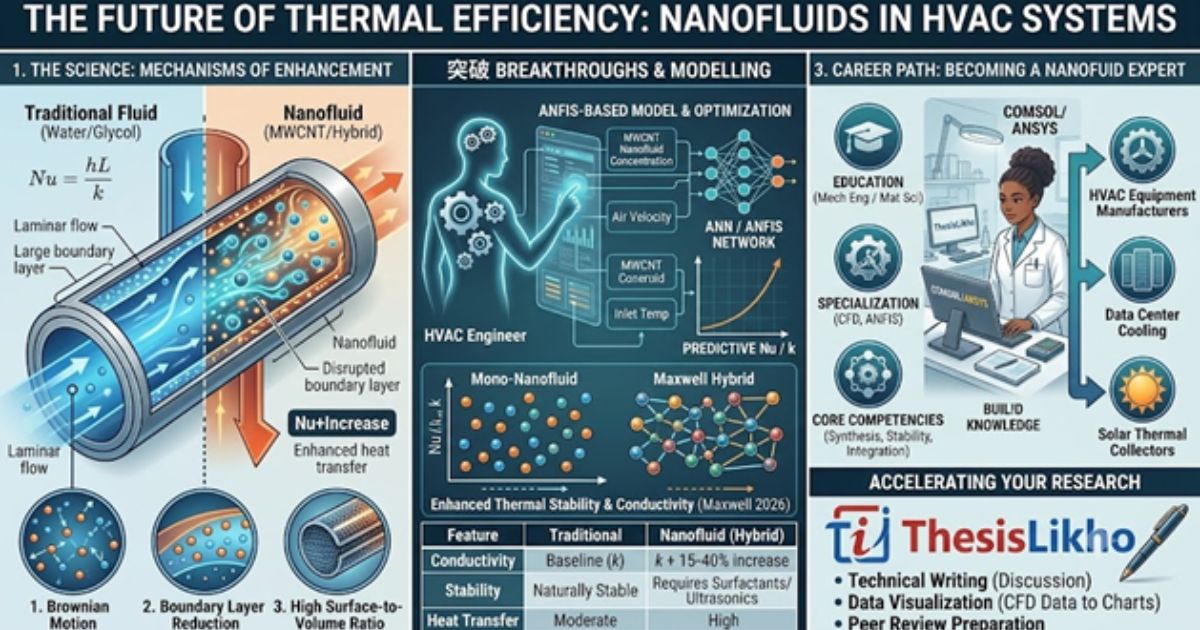
Introduction: Why the HVAC Industry Is Turning to Nanofluids
Heating, ventilation, air conditioning, and refrigeration (HVAC&R) systems are among the largest consumers of energy in modern buildings, industrial plants, and data centers. As global energy demand climbs and net-zero targets tighten, engineers and researchers are racing to find ways to squeeze more performance out of existing thermal systems without a complete hardware overhaul. One of the most promising avenues to emerge from thermal engineering research over the past decade is the use of nanofluids — engineered heat transfer fluids that carry a suspension of nanometre-scale particles.
According to a comprehensive 2025 systematic review that screened over 900 papers down to 200 peer-reviewed studies, nanofluids have demonstrated up to a 45% improvement in heat transfer coefficients and up to a 51% increase in the coefficient of performance (COP) in HVAC&R systems (Nanofluid-Enhanced HVAC&R Systems, Sustainability, 2025). These are not marginal gains — in an industry where a 2–3% efficiency improvement is often considered a meaningful upgrade, double-digit performance jumps represent a genuine shift in what's achievable.
This blog post takes a deep, evidence-based look at the latest Q1 and Q2 journal publications on nanofluid applications in HVAC, explains the underlying science in plain language, reviews real experimental results, and closes with practical guidance for students and professionals who want to build a career in this fast-growing niche of thermal and mechanical engineering.
What makes this moment particularly interesting for engineers and researchers is the convergence of three separate trends: decades of accumulated nanofluid characterisation data, growing pressure on facility managers to cut cooling-related electricity bills, and the arrival of machine learning tools that can predict nanofluid behaviour without expensive trial-and-error prototyping. Together, these trends are pushing nanofluid-HVAC research out of purely academic journals and into pilot deployments in real buildings, data centers, and industrial plants.
A Brief History: From Laboratory Curiosity to HVAC Retrofit Technology
The term 'nanofluid' was coined in the mid-1990s to describe suspensions of nanometre-scale particles in conventional heat transfer fluids, and for roughly the first fifteen years, most research stayed confined to fundamental thermophysical characterisation — measuring how much a given nanoparticle concentration raised viscosity, density, and thermal conductivity under laboratory conditions. It was only in the 2010s that researchers began systematically testing nanofluids inside functioning mechanical systems: automotive radiators, solar collectors, and eventually HVAC condensers and chillers.
The 2015–2025 decade covered by the major systematic review referenced throughout this article represents the field's maturation phase, where the emphasis shifted from 'does this work in a beaker' to 'does this work in a real air handling unit, chiller plant, or data center.' That shift in emphasis is precisely why full-system, real-building validation studies — still relatively rare — are considered the most valuable and citable contributions a new researcher can make today.
What Exactly Is a Nanofluid?
A nanofluid is a heat transfer fluid created by dispersing solid nanoparticles — typically metals, metal oxides, carbon-based nanostructures, or composite hybrid materials — into a conventional base fluid such as water, ethylene glycol, mineral oil, or refrigerant. Common nanoparticles used in HVAC-related research include aluminium oxide (Al2O3), copper oxide (CuO), titanium dioxide (TiO2), silicon carbide (SiC), multi-walled carbon nanotubes (MWCNT), and silver oxide (Ag2O).
Because these particles are typically between 1 and 100 nanometres in size, they dramatically increase the surface-area-to-volume ratio of the suspension. This boosts the fluid's effective thermal conductivity far beyond what the base fluid can achieve alone, which in turn improves convective heat transfer inside pipes, coils, and heat exchangers — the very components that make up an HVAC system (PatSnap Nanofluid Technology Landscape, 2026).
Latest Q1/Q2 Journal Publications on Nanofluid HVAC Applications
1. Systematic Review: Nanofluid-Enhanced HVAC&R Systems (2015–2025)
Published in Sustainability (MDPI, Q1/Q2 journal, Impact Factor tier), this 2025 review is arguably the most complete synthesis of nanofluid-HVAC research to date. Read the full paper here. The authors thematically categorised the literature into experimental, numerical, hybrid, and AI/ML-based studies. A key finding is that most current research remains siloed at the component level — testing a single coil or condenser — with limited full-system validation and minimal use of artificial intelligence for holistic optimisation, pointing to a clear direction for future research.
2. Solar-Assisted Absorption Chiller with Nanofluids for Central Air Conditioning
Published in the International Journal of Ambient Energy (Taylor & Francis, accepted January 2026, published online February 2026), this study modelled a solar-heated absorption chiller for central air conditioning in Cairo, Egypt using TRNSYS simulation software. View the study. Four nanoparticle types were tested — magnesium oxide (MgO), silicon carbide (SiC), aluminium oxide (Al2O3), and multi-walled carbon nanotubes (MWCNT). At a 6% MWCNT concentration, the system achieved its highest COP of 1.11 with a solar fraction of 0.978, meaning nearly all the cooling energy was supplied by solar heat rather than grid electricity.
3. Nanofluid-Based Data Center HVAC Efficiency & CO2 Reduction
Published in Applied Thermal Engineering (Elsevier/ScienceDirect, 2025), this case study instrumented a real, operating data center HVAC system with a commercial Al2O3/water nanofluid. Read the case study. Prior comparative work referenced in the same study found COP increases of up to 22.1% using Al2O3 nanofluid and 29.4% using CuO nanofluid in air/water conditioning units, translating directly into lower greenhouse gas emissions for energy-hungry data center cooling infrastructure.
4. Vapor Compression Refrigeration with Ag2O–R134a Nanofluid Refrigerant
Published in the Journal of Polymer & Composites (2026), this energetic and exergetic investigation examined silver oxide nanoparticles suspended directly in R134a refrigerant. View the article. Nano-refrigerants like this one target the refrigeration side of HVAC&R rather than the water/glycol loop, opening a second major pathway for nanofluid integration — directly inside the vapor compression cycle itself.
5. Hybrid Nanofluids: Advancements, Synthesis and HVAC Applications
Published in Discover Applied Sciences (Springer Nature, 2025), this review focuses specifically on hybrid nanofluids — combinations of two or more nanoparticle types — which the authors show can overcome the stability and scalability limitations of single-particle nanofluids. Read the review The paper discusses applications across automotive systems, HVAC, and renewable energy technologies, while flagging economic feasibility and performance variability as ongoing challenges.
6. Full-Scale Experimental Evaluation of a Nanofluid HVAC System
Published in Energies (MDPI, Q2 journal), researchers at the University of Salento ran a year-long field trial comparing two identical HVAC systems in an educational building — one using nanofluid, one without. Read the full-scale study. Under real operating conditions, the nanofluid-equipped system showed an average COP increase of 9.8% in winter and 8.9% in summer, with daily peaks around 15% — one of the few studies validating nanofluid performance outside a controlled lab environment.
How Nanofluids Are Prepared and Characterised
Before a nanofluid ever reaches a chiller loop or condenser test rig, it has to be prepared and validated in the lab. Two broad synthesis routes dominate the literature: the two-step method, where nanoparticles are manufactured separately (often purchased as a dry powder) and then dispersed into the base fluid using ultrasonication or high-shear mixing; and the one-step method, where nanoparticles are synthesised directly inside the base fluid, reducing agglomeration but generally being harder to scale to industrial volumes.
Once prepared, a nanofluid sample typically undergoes several rounds of characterisation before it is considered ready for system-level testing:
● Thermal conductivity measurement — usually via the transient hot-wire method, to quantify the actual conductivity gain over the base fluid.
● Viscosity and rheology testing — since added nanoparticles increase pumping power requirements, and this trade-off has to be weighed against heat transfer gains.
● Zeta potential and stability testing — to predict how well the particles will stay suspended over weeks or months of operation, which is the single biggest barrier to commercial deployment identified across the literature.
● TEM/SEM imaging — transmission and scanning electron microscopy to confirm particle size, shape, and dispersion quality.
● pH and surfactant optimisation — many formulations require a surfactant (such as sodium dodecylbenzene sulfonate or gum arabic) or pH adjustment to prevent particles clumping together over time.
Only after a formulation clears these benchmarks does it typically progress to component-level testing (a single coil, condenser, or heat exchanger) and, less commonly, to full-system field trials of the kind conducted at the University of Salento.
How Nanofluids Improve HVAC Performance: The Engineering Behind the Numbers
Enhanced Thermal Conductivity
The addition of high-conductivity nanoparticles raises the overall thermal conductivity of the base fluid. Even small volume fractions — often between 0.1% and 6% — can produce disproportionately large gains in heat transfer coefficient because nanoparticles disrupt the thermal boundary layer that normally insulates flowing fluid from a heat exchanger wall.
Improved Convective Heat Transfer in Coils and Condensers
In experimental work on air-conditioner condensers, researchers found that using nanofluid as an external cooling jacket significantly improved COP, with heat transfer coefficient enhancements as high as 163.2% at a 0.4% volume fraction (Faizan & Khan, Energy Reports, 2021). This kind of gain at the condenser stage directly reduces compressor workload and electricity consumption.
Nano-Lubricants and Nano-Refrigerants
Beyond the water/glycol loop, nanoparticles are also blended into compressor lubricants and refrigerants themselves. SiO2-enhanced polyalkylene glycol (PAG) nano-oil has shown COP enhancements averaging 10.5%, with peaks of 24%, while also improving flash point, fire point, and viscosity index — extending compressor life (Parametric investigation, Scientific Reports, 2021). Nano-refrigerants such as CuO/R134a and Al2O3/R134a have independently produced COP improvements of 12.2% and 3.42% respectively.
System-Level Energy and Carbon Savings
Because HVAC accounts for such a large share of building and data center energy consumption, even single-digit COP improvements scale into meaningful reductions in operating costs and carbon emissions when applied across an entire facility's cooling infrastructure over its operating lifetime.
Cost and Economic Considerations for Facility Managers
For anyone evaluating a nanofluid retrofit — whether for a commercial chiller plant or a data center cooling loop — the business case ultimately comes down to comparing the upfront cost of nanoparticle synthesis, dispersal, and any pump/seal compatibility upgrades against the value of the resulting energy savings over the system's operating life.
The data center case study noted above included a dedicated economic analysis alongside its performance results, reflecting a broader shift in the literature toward publishing payback-period and lifecycle-cost figures rather than performance numbers alone (Reducing CO2 emissions through nanofluids, Applied Thermal Engineering, 2025). This is an encouraging sign for commercial adoption: as more studies report cost-per-kWh-saved alongside COP gains, facility managers and building owners will have the concrete figures they need to justify a retrofit to finance and sustainability teams.
Broadly, nanofluid retrofits tend to be most economically attractive in high-utilisation, high-cooling-load environments — such as data centers and central plant chillers running near-continuously — where even a modest percentage COP improvement compounds into substantial annual electricity savings. Seasonal or intermittent-use residential systems typically see a longer payback period, which is why most of the strongest full-system field results to date come from continuously operating commercial and institutional buildings.
Where the Research Gaps Still Are
Despite these promising numbers, the 2025 systematic review is candid about the field's limitations. Most published research remains at the component or lab-bench scale rather than validating performance across a complete, real-world HVAC system. There is also minimal use of artificial intelligence and machine learning for holistic, system-wide optimisation — a gap the review's authors propose as a strategic roadmap for future work.
● Long-term colloidal stability of nanoparticles remains the primary unresolved barrier to commercial adoption, since particles can agglomerate and settle out of suspension over months of continuous operation.
● Full-system, real-building validation studies (like the Salento University trial) are still rare compared to lab-scale component testing.
● Economic feasibility — the cost of nanoparticle synthesis and functionalisation versus the energy savings achieved — needs clearer quantification for facility managers to justify retrofits.
● Standardised testing protocols across studies would make it easier to compare COP and heat transfer results between different nanoparticle types and concentrations.
Practical Applications Across the HVAC&R Value Chain
Central Air Conditioning and Chillers
Solar-assisted absorption chillers, central plant chillers, and district cooling systems are increasingly being modelled and retrofitted with nanofluid loops to raise COP without adding mechanical capacity.
Data Centers
With cooling representing a huge fraction of data center operating expenditure, nanofluid-enhanced HVAC has emerged as a direct lever for both cost reduction and corporate sustainability targets, as demonstrated by real-world case studies showing double-digit COP gains.
Residential and Commercial Air Conditioners
Nanofluid cooling jackets around condensers, and nano-lubricants inside compressors, offer retrofit-style upgrades that don't require replacing the entire unit — an attractive proposition for existing building stock.
Refrigeration Cycles
Nano-refrigerants integrate nanoparticles directly into the working refrigerant (e.g., R134a), improving both energetic and exergetic performance of vapor compression refrigeration systems used in HVAC&R and cold-chain logistics.
The Road Ahead: AI, Hybrid Nanofluids, and Smart HVAC
The next wave of research is converging around two themes: hybrid/ternary nanofluids that combine two or three nanoparticle types to balance stability against performance, and AI-driven modelling — particularly Artificial Neural Networks (ANN) and CFD-ANN hybrid methods — used to predict nanofluid thermal performance without the cost of building physical prototypes for every formulation. As these tools mature, expect nanofluid selection itself to become a data-driven, optimisation-based engineering decision rather than largely empirical trial and error.
Careers in Nanofluid & HVAC Thermal Engineering
As nanofluid technology moves from lab bench to commercial deployment, a genuine career track is opening up at the intersection of nanotechnology, mechanical engineering, and building energy systems. This is a field where academic research and industry application are unusually well connected — meaning a strong postgraduate research background can translate directly into industry consulting, R&D, or product development roles.
Roles You Can Pursue
● Thermal/HVAC Research Engineer — designing and testing nanofluid formulations for heat exchangers, chillers, and cooling towers in R&D labs or university research centers.
● Nanomaterials Scientist — synthesising and functionalising nanoparticles (Al2O3, CuO, TiO2, MWCNT, hybrid combinations) to improve colloidal stability and thermal performance.
● Energy Efficiency Consultant — advising data centers, hospitals, and commercial building owners on nanofluid retrofits to cut cooling energy costs and emissions.
● CFD & AI Simulation Specialist — using ANN and CFD-ANN hybrid modelling to predict nanofluid performance in HVAC systems before physical prototyping.
● Product Development Engineer (Nano-lubricants/Nano-refrigerants) — working with manufacturers on compressor oils and refrigerants enhanced with nanoparticles.
● Academic Researcher / PhD Track — publishing in Q1/Q2 journals such as Sustainability, Applied Thermal Engineering, Energies, and the International Journal of Ambient Energy, building toward a faculty or senior research position.
Skills That Set You Apart
● Strong grounding in heat transfer, fluid mechanics, and thermodynamics.
● Hands-on experimental skills: nanofluid preparation, characterisation (TEM/SEM, viscosity, thermal conductivity measurement), and stability testing.
● Simulation tools: ANSYS Fluent, TRNSYS, MATLAB/Simulink, and increasingly Python-based ANN/machine learning frameworks.
● Ability to design and run full-system, real-world validation studies — not just component-level testing — since this is exactly where the current literature identifies the biggest gap.
● Scientific writing and publication skills, since this field rewards researchers who can get findings into indexed Q1/Q2 journals.
For students choosing a thesis or dissertation topic, nanofluid-HVAC integration is an especially fertile area right now precisely because the major review papers openly state that full-system validation and AI-based optimisation are underexplored — meaning a well-designed study in either direction has a real chance of making a genuine, citable contribution to the field rather than incrementally repeating prior lab-scale work.
How Thesislikho Supports Researchers in This Field
Producing a rigorous, publishable piece of research on a technical topic like nanofluid HVAC applications requires far more than enthusiasm for the subject — it demands structured literature review, correct methodology design, statistical and simulation rigor, and disciplined academic writing. This is exactly where Thesislikho's support mechanism is built to help.
● Literature Review & Gap Analysis — helping students identify a genuine, defensible research gap (such as full-system validation or AI-integrated nanofluid modelling) rather than a saturated sub-topic.
● Methodology Design — guidance on experimental setup, simulation tool selection (CFD, TRNSYS, ANN), and appropriate nanoparticle/base-fluid combinations for the chosen HVAC application.
● Data Analysis Support — assistance interpreting thermal conductivity, COP, and exergetic efficiency results, and presenting them with statistically sound, publication-ready figures and tables.
● Academic Writing & Structuring — turning raw findings into a coherent thesis, dissertation, or journal manuscript that follows the conventions expected by Q1/Q2 engineering and energy journals.
● Citation & Referencing Accuracy — ensuring every claim is properly sourced and formatted, which is critical for passing plagiarism checks and journal peer review.
● Plagiarism-Free Assurance & Revision Cycles — structured review rounds so the final submission is original, well-argued, and ready for supervisor or journal review.
● One-on-One Mentorship — pairing students with subject-matter guidance so technical concepts like nanofluid rheology or hybrid nanoparticle synthesis are explained clearly, not just written about.
Whether you are working on an undergraduate capstone project, a master's thesis, or a PhD dissertation chapter on nanofluid-enhanced HVAC systems, Thesislikho's support mechanism is designed to walk with you from topic selection through to a defensible, well-cited final document — reducing the friction between having a good research idea and producing a document that meets academic and journal standards.
Frequently Asked Questions (FAQ): Nanomaterials & Nanofluids
Q1. What is a nanomaterial?
A nanomaterial is any material with at least one dimension between roughly 1 and 100 nanometres. At this scale, materials often display different physical, chemical, thermal, and optical properties compared to their bulk form — for example, dramatically higher surface area and enhanced thermal conductivity, both of which are exploited in nanofluid applications.
Q2. What is a nanofluid, and how is it different from a regular fluid?
A nanofluid is a base fluid (such as water, ethylene glycol, oil, or refrigerant) with nanoparticles suspended in it. Unlike ordinary fluids, nanofluids exhibit enhanced thermal conductivity and heat transfer performance because the suspended nanoparticles disrupt the thermal boundary layer and increase the effective surface area for heat exchange.
Q3. Which nanoparticles are most commonly used in HVAC nanofluids?
The most widely studied nanoparticles in HVAC and refrigeration research include aluminium oxide (Al2O3), copper oxide (CuO), titanium dioxide (TiO2), silicon carbide (SiC), silver oxide (Ag2O), and multi-walled carbon nanotubes (MWCNT). Hybrid nanofluids combine two or more of these to balance performance against stability.
Q4. Are nanofluids safe to use in HVAC systems?
Research indicates nanofluids can be compatible with existing HVAC hardware at low volume concentrations (typically 0.1%–6%), though long-term studies on material compatibility, nanoparticle toxicity in accidental exposure scenarios, and safe disposal are still an active area of investigation. Facility-level deployment should follow manufacturer and safety data sheet guidance for the specific nanoparticle-base fluid combination used.
Q5. What is the biggest challenge preventing widespread commercial adoption of nanofluids?
According to current technology landscape analysis, colloidal stability over operational lifetimes — meaning preventing nanoparticles from clumping together and settling out of suspension — is cited as the primary unresolved challenge across virtually all research in this area (PatSnap, 2026).
Q6. How much can nanofluids actually improve HVAC energy efficiency?
Reported improvements vary by system type and nanoparticle concentration, but published studies show heat transfer coefficient gains of up to 45%, COP improvements of up to 51% in review-level synthesis, and real full-scale field trials showing 8.9%–9.8% average COP gains with peaks near 15%.
Q7. What is a hybrid nanofluid?
A hybrid (or ternary) nanofluid combines two or more different types of nanoparticles in a single base fluid. This approach is used to offset the individual weaknesses of single-particle nanofluids — for example, pairing a highly conductive particle with a more chemically stable one — improving overall stability, scalability, and thermal performance.
Q8. Can nanofluids be added to existing HVAC systems, or do they require new hardware?
Many studies focus specifically on retrofit-style applications — such as nanofluid cooling jackets around existing condensers, or nano-lubricants added to existing compressor oil — precisely because they don't require replacing core HVAC hardware. However, full nanofluid loop retrofits may need pump and seal compatibility checks depending on the base fluid and particle type used.
Q9. What is a nano-refrigerant?
A nano-refrigerant is a refrigerant (such as R134a) with nanoparticles suspended directly in it, rather than in the separate water/glycol loop. This targets the vapor compression cycle itself and has shown measurable COP improvements in several experimental refrigeration studies.
Q10. Where can I find peer-reviewed research on nanofluids for my thesis or dissertation?
Reputable Q1/Q2 journals publishing in this space include Sustainability, Applied Thermal Engineering, Energies, the International Journal of Ambient Energy, Scientific Reports, and Discover Applied Sciences, among others. All sources referenced in this article are linked above for direct access to the original studies.
Website: www.thesislikho.com