
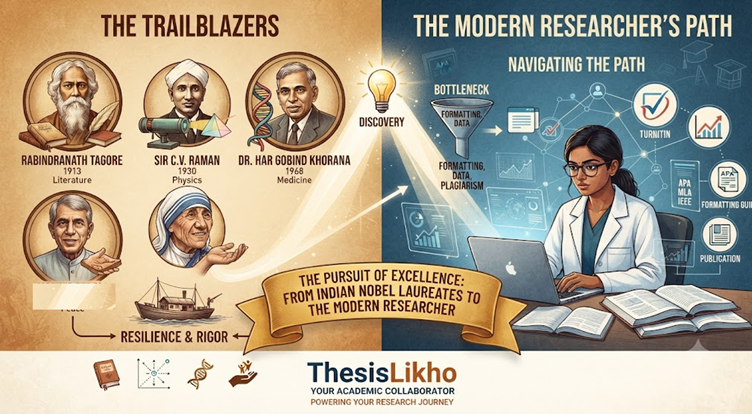
Introduction: The Anatomy of Genius and Resilience
The Nobel Prize represents the pinnacle of human intellectual achievement. Across literature, physics, chemistry, medicine, economics, and peace, this global accolade honors those who fundamentally alter humanity’s understanding of existence. For India, a nation with a rich civilization history marked by colonial subjugation, economic struggles, and geopolitical shifts, the journey to the Nobel podium has been nothing short of extraordinary.
Indian Nobel laureates—whether citizens by birth, residency, or diaspora—did not merely win medals; they shattered glass ceilings, overcame systemic and infrastructural constraints, and challenged Eurocentric paradigms of knowledge. Their journeys offer a masterclass in perseverance, curiosity, and scientific or literary rigor.
1. The Trailblazers: How India Claimed Its First Global Accolades
Rabindranath Tagore (Literature, 1913)
- The Breakthrough: Rabindranath Tagore became the first non-European and the first Asian to win a Nobel Prize. Awarded for his collection Gitanjali (Song Offerings), Tagore’s win introduced the ethereal, deeply spiritual, and lyrical dimensions of Bengali philosophy to the West.
- The Journey: Tagore's path was rooted in an intense quest for cultural synthesis. Translating his own poems into English, he bridged an immense cultural gap. His journey teaches researchers the power of cross-disciplinary and cross-cultural communication—the ability to make localized, profound wisdom universally understood.
Sir C.V. Raman (Physics, 1930)
- The Breakthrough: Raman won the Nobel Prize in Physics for his pioneering work on the scattering of light and the discovery of the phenomenon known as the Raman Effect.
- The Journey: Working with rudimentary equipment at the Indian Association for the Cultivation of Science (IACS) in Kolkata, Raman observed the change in wavelength of light when deflected by molecules. His journey exemplifies resourcefulness. With limited funding and modest laboratory conditions, Raman proved that world-class scientific breakthroughs depend less on extravagant budgets and more on sharp observation, relentless questioning, and absolute dedication.
2. Pushing Boundaries: The Mid-Century Giants
Dr. Har Gobind Khorana (Physiology or Medicine, 1968)
- The Breakthrough: Khorana shared the Nobel Prize for his interpretation of the genetic code and its function in protein synthesis.
- The Journey: Born in a small village in Punjab under British rule, Khorana's path took him through Lahore, Liverpool, Zurich, and eventually North America. His journey highlights the challenges of brain drain and the necessity of global mobility. Khorana's meticulous synthesis of nucleic acids laid the foundation for modern biotechnology and genetic engineering.
Mother Teresa (Peace, 1979)
- The Breakthrough: Awarded the Nobel Peace Prize for her humanitarian work through the Missionaries of Charity in the slums of Kolkata.
- The Journey: Mother Teresa’s journey was defined by radical empathy and grassroots action. While not a traditional academic researcher, her methodology—direct observation of systemic suffering, deep immersion in the field, and unrelenting execution of care—mirrors the core qualitative research framework: proximity to the subject and unyielding commitment to truth.
3. The Diaspora and Modern Masters: Expanding Horizons
Subrahmanyan Chandrasekhar (Physics, 1983)
- The Breakthrough: Awarded for his theoretical studies of the physical processes crucial to the structure and evolution of stars, famously establishing Chandrasekhar’s Limit (the maximum mass of a stable white dwarf star).
- The Journey: As a young man on a boat voyage from India to England, Chandrasekhar calculated the fate of dying stars. Yet, when he presented his findings to the British establishment (most notably Sir Arthur Eddington), he was publicly ridiculed and dismissed. Instead of giving up, Chandrasekhar persevered across decades, relocating to the University of Chicago. His journey is a testament to academic resilience—dealing with peer review rejection, institutional bias, and the loneliness of being ahead of one's time.
Amartya Sen (Economic Sciences, 1998)
- The Breakthrough: Honored for his foundational contributions to welfare economics, including theories on famine, poverty, and human development indices.
- The Journey: Growing up during the Bengal famine of 1943 deeply shaped Sen's academic trajectory. He transformed personal observation into rigorous mathematical and philosophical inquiry, proving that famines are often caused by institutional failure and distribution issues rather than absolute food scarcity. Sen’s work demonstrates how empirical data can be married to deep ethical considerations.
Venkatraman Ramakrishnan (Chemistry, 2009)
- The Breakthrough: Awarded for atomic-level studies of the structure and function of the ribosome.
- The Journey: Beginning his education in India with a degree in physics, Ramakrishnan transitioned into biology, navigating multiple continents and complex technological barriers. His breakthrough relied on advanced X-ray crystallography, a grueling trial-and-error process that took years of computational and physical modeling.
Kailash Satyarthi (Peace, 2014)
- The Breakthrough: Awarded for his struggle against the suppression of children and young people and for the right of all children to education.
- The Journey: Satyarthi gave up a career as an electrical engineer to liberate children from forced labor. His journey emphasizes action research—using data collection, rescue operations, and global advocacy to systematically dismantle illegal supply chains.
Abhijit Banerjee (Economic Sciences, 2019)
- The Breakthrough: Shared the prize for an experimental approach to alleviating global poverty.
- The Journey: Banerjee, alongside Esther Duflo and Michael Kremer, revolutionized development economics by introducing Randomized Controlled Trials (RCTs). Their journey highlights the shift from macro-speculation to micro-level, evidence-based experimentation—testing interventions on the ground to see what truly works.
4. Common Threads in the Journey of Indian Laureates
Analyzing these exceptional pathways reveals recurring themes that define groundbreaking research:
- Overcoming Resource Constraints: From C.V. Raman’s makeshift optics lab to S. Chandrasekhar’s mathematical isolation, Indian pioneers have consistently turned limitations into catalysts for ingenuity.
- Interdisciplinary Thinking: Raman was a physicist interested in acoustics and light; Tagore bridged literature, painting, and philosophy; Banerjee merged economics with behavioral psychology and field experimentation.
- Resilience Against Skepticism: Chandrasekhar faced outright dismissal from scientific giants; Khorana and Ramakrishnan navigated complex global academic transitions. Breakthroughs rarely happen in comfort zones.
5. The Modern Academic Reality: Why Today’s Researchers Struggle
While historical figures like Raman and Tagore achieved greatness through decades of isolated grit, the modern research landscape is vastly different. Today's master's and PhD scholars in India and across the globe face an entirely new set of systemic hurdles:
- Information Overload and Formatting Nightmares: Navigating thousands of research papers, managing literature reviews, and adhering strictly to university-specific formatting guidelines (APA, MLA, IEEE, Chicago) consumes hundreds of hours that should be spent on critical thinking.
- The Data Analysis Dilemma: Translating raw data into meaningful statistical insights—whether using SPSS, R, Python, or qualitative coding—often becomes a bottleneck for scholars lacking deep technical backgrounds.
- The Scourge of Plagiarism and Editorial Rejections: With stringent Turnitin checks and hyper-critical peer reviewers, drafting a 100% original, publication-ready thesis or journal article is a high-stakes stress test.
- Time Constraints: Many researchers juggle teaching responsibilities, lab work, funding applications, and financial pressures, leaving them stretched thin.
6. How ThesisLikho Empowers New Researchers in Their Journey
Greatness is rarely achieved entirely alone. Just as historical institutions and mentors guided scientific pioneers, modern researchers need reliable digital infrastructure and expert scaffolding to turn their raw ideas into polished, impactful contributions. This is where ThesisLikho steps in as an essential collaborator for academic scholars.
Comprehensive End-to-End Support
ThesisLikho is designed to bridge the gap between a researcher's raw findings and a successfully defended, publication-grade thesis. Operating with a deep understanding of academic rigor across diverse fields—from Computer Science and Biotechnology to Economics and Literature—ThesisLikho offers targeted assistance:
- 100% Plagiarism-Free Thesis & Dissertation Writing: Ensuring that research is articulated with absolute originality, supported by certified Turnitin reports.
- Advanced Data Analysis Services: Helping scholars make sense of complex quantitative and qualitative datasets, ensuring statistical validity and robust interpretation.
- Research Proposal & Synopsis Development: Structuring the foundational phase of a PhD journey so scholars start on solid footing with clear hypotheses and methodologies.
- Editing, Proofreading, and Formatting: Perfecting manuscripts to meet exact institutional guidelines, eliminating structural flaws, grammatical errors, and citation inconsistencies.
- Journal Publication Support: Assisting researchers in targeting high-impact factor journals (Scopus, SCI, ABDC) to ensure their findings reach a global audience.
Why ThesisLikho Matters for the Next Generation
Every Nobel laureate started as a nervous, overwhelmed student wrestling with a complex problem. The difference between a stalled project and a world-class thesis often lies in having access to the right guidance, clear structure, and technical support.
By removing the administrative friction, formatting anxiety, and analytical bottlenecks of academic writing, ThesisLikho allows modern researchers to focus on what truly matters: discovery, innovation, and critical inquiry.
Conclusion: Your Journey Awaits
The legacy of India's Nobel laureates proves that transformative ideas can emerge from anywhere. They faced the blank page, the difficult experiment, and the grueling review process with unyielding courage.
Your research journey—whether you are working on a master’s dissertation or a multi-year doctoral thesis—is your unique chapter in this ongoing narrative of human progress. Equip yourself with resilience, seek out the right tools and expert mentorship when the path gets steep, and remember that every great breakthrough begins with a single, well-documented step.
📞 WhatsApp: +91 96438 02216
🌐 Website: https://thesislikho.com