
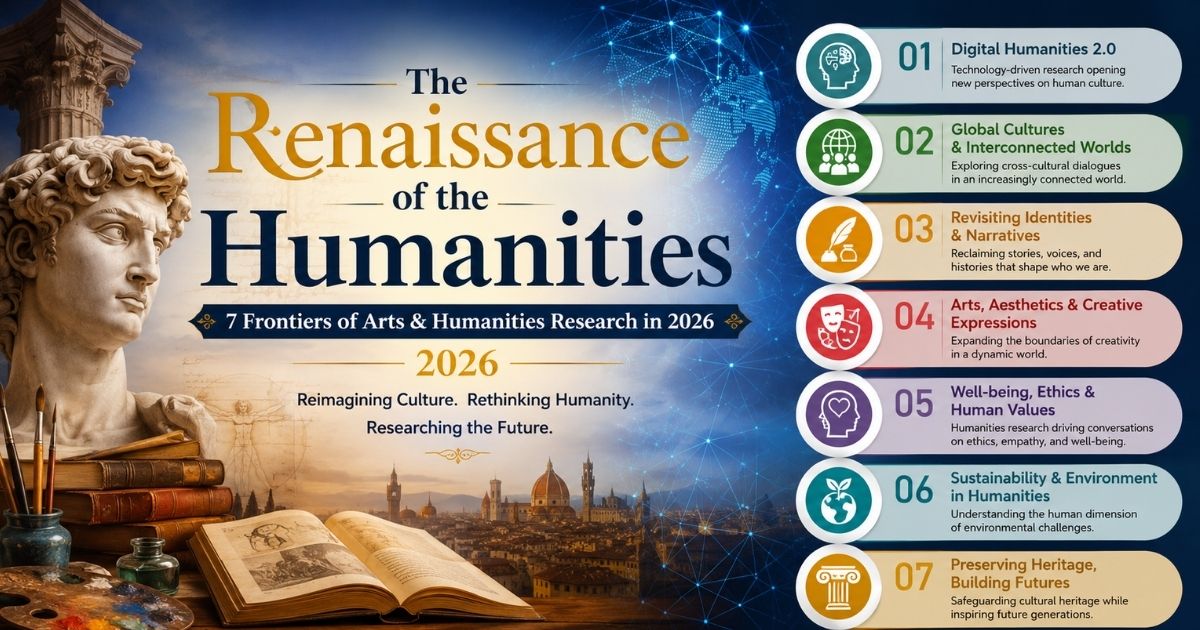
In the popular imagination, the Arts and Humanities are often viewed as static disciplines a pursuit of dusty archives and age-old philosophical questions. However, as of July 2026, this perception has been decisively dismantled. The modern Humanities researcher is no longer just a passive observer of culture; they are an active, data-informed, and technologically adept architect of social meaning.
The 2026 academic landscape is defined by a bold synthesis: the integration of computational rigor with deep hermeneutic inquiry. We are living in an era where Digital Humanities (DH) researchers are using AI to reconstruct lost languages, sociologists are mapping the ethics of algorithmic governance, and cultural historians are using spatial modeling to visualize the migration of ideas across centuries.
This blog explores the seven most critical research frontiers currently redefining the Arts and Humanities, offering evidence-based insights into where the field is headed and how scholars can carve out highly impactful doctoral and research careers.
1. Algorithmic Humanities and the Ethics of AI Governance
Perhaps the most pressing frontier in 2026 is the study of Artificial Intelligence not as a tool, but as a cultural agent.
The Research Context
Scholars are moving beyond simple "AI and Art" debates to engage in Critical AI Studies. Researchers are actively analyzing how Generative AI models encode, reinforce, or dismantle human biases. A seminal paper published in Digital Scholarship in the Humanities (June 2026) demonstrated how LLMs reflect the linguistic "digital aphasia" of dominant cultures, effectively flattening the nuance of marginalized dialects.
Research Significance
This research is essential for establishing "Ethical AI Governance." As nations roll out AI policies, Humanities scholars are providing the critical vocabulary and ethical frameworks needed to prevent AI from becoming a tool of cultural homogenization.
2. Digital Humanities (DH) and Data Sovereignty
Digital Humanities has transcended the basic digitization of texts. In 2026, the focus is on Data and Software Sovereignty.
The Research Context
Researchers are now concerned with who owns the digital history of humanity. The "Common Ground" movement in DH emphasizes that archiving is an act of power. Current projects are focused on creating decentralized, community-owned digital archives that protect the intellectual property of indigenous and marginalized communities against the encroachment of massive tech corporations.
Research Significance
For a PhD scholar, this offers a fertile ground for "Data Activism." Mapping how digital archival practices influence historical memory is a burgeoning field, with high-impact journals like Journal of Cultural Heritage actively seeking manuscripts on these themes.
3. Affective Neuroscience and Literary Studies
How does a novel make you feel? Cognitive Literary Studies is merging with affective neuroscience to map the biological reality of narrative engagement.
The Research Context
Researchers are utilizing eye-tracking, galvanic skin response, and fNIRS (functional near-infrared spectroscopy) to observe how the human brain processes metaphor, irony, and trauma in literature. We are moving toward a biological explanation of empathy and catharsis.
Research Significance
This provides an empirical basis for literary theory. A thesis that bridges the gap between the "feel" of a narrative and the neural patterns it triggers is a cutting-edge contribution to both psychology and literature, opening doors to high-impact journals like Literature and Medicine.
4. Post-Humanism and Environmental Humanities
In the wake of the climate crisis, "Humanities" is being redefined to include the non-human.
The Research Context
The field of Environmental Humanities is investigating the "more-than-human" world. Researchers are analyzing how literature, film, and visual arts depict the Anthropocene not as a backdrop, but as a participant. Scholars are exploring "Ecological Grief" and the storytelling of the climate-displaced.
Research Significance
This is the most "urgent" research in the Humanities today. By providing the cultural narrative for ecological survival, Humanities scholars are influencing environmental policy and building public empathy, creating a direct bridge to climate advocacy.
5. Global South Perspective and Decolonial Historiography
The "decolonial turn" in 2026 is not just a theoretical framework; it is an active reconstruction of history.
The Research Context
Scholars are engaged in "archival silences" recovering the lost narratives of the Global South. Researchers are using computational tools to bridge archival gaps, linking fragmented colonial records with oral histories to provide a more truthful, polyphonic account of history.
Research Significance
This research is dismantling the Eurocentric dominance of the Humanities. Doctoral candidates who contribute to this recovery of marginalized narratives are at the forefront of the most significant intellectual shift of the decade.
6. The "Artistic Research" Paradigm (Common Ground Model)
We are moving away from the idea that art is a "subject" of research, toward the idea that art is the research.
The Research Context
The "Artistic Research" model defines the creative process itself as a valid, rigorous academic methodology. Scholars in visual arts, theatre, and music are documenting their creative practice as a way of producing new knowledge, embracing the "messiness" of innovation rather than trying to sanitize it into a traditional research paper format.
Research Significance
This model allows for high-level transdisciplinary work. If you are a practitioner-researcher, this field recognizes your craft as an intellectual contribution equal to a standard scholarly treatise.
7. Memory Studies and the Digital Archive
How do we remember in an age of ephemeral digital content?
The Research Context
Memory Studies is investigating the "digital afterlife." How do social media archives, virtual memorials, and digital obituaries change our relationship with the deceased? Researchers are applying sociological models to virtual spaces, questioning the permanence of digital memory.
Research Significance
This is a critical area for Sociology and Cultural Studies. Understanding the politics of digital forgetting is vital for preserving the identity of future generations.
Frequently Asked Questions (FAQ)
Q1: Is a Humanities degree relevant in the age of AI? A: Absolutely. While AI can process data, it lacks the critical ethics, historical context, and human-centric nuance that Humanities research provides. Humanities scholars are the ones critiquing AI, not being replaced by it.
Q2: What is "Digital Humanities"? A: It is the intersection of traditional Humanities methods with digital tools like using data visualization to map literary trends or machine learning to transcribe ancient, faded manuscripts.
Q3: Can art practice be considered academic research? A: Yes. The "Artistic Research" paradigm views the creative process as a rigorous method for producing new knowledge, now widely accepted in premier PhD programs globally.
Q4: How do I choose a research topic in this field? A: Focus on "urgent gaps." Look for areas where technology (like AI) or crises (like climate change) are colliding with traditional cultural narratives.
Q5: How do I ensure my research is published in top journals? A: Aim for a mix of rigorous theory and empirical methodology. Use data-driven approaches where possible, and ensure your work speaks to broader global themes, not just localized contexts.
Your Partner in Scholarly Excellence: Thesislikho.com
The Arts & Humanities have never been more intellectually vibrant, yet the barriers to entry the pressure for interdisciplinary rigor, the need for data-driven methodology, and the competitive race for publication have never been higher.
Thesislikho.com provides the expert scaffolding you need to turn your intellectual vision into a globally recognized piece of scholarship.
How We Empower You:
- Proposal Development: We help you define research questions that are both academically sophisticated and timely. Whether you are exploring the ethics of AI or decolonial historiography, we help you frame a compelling proposal.
- Methodological Rigor: Humanities research today requires structure. We assist you in building robust theoretical frameworks and, if your research is digital or empirical, we guide you through the analytical tools needed to validate your claims.
- Manuscript Polish for SSCI/Scopus Journals: The difference between rejection and acceptance in high-impact journals is often the narrative flow and the precision of your critical argument. Our experts provide comprehensive structural editing to ensure your voice is powerful, clear, and perfectly aligned with the standards of top-tier publications.
- AI Policy Guidance: We help you navigate the ethical use of AI, ensuring that your work remains 100% original while using technology to enhance your productivity.
The Humanities are the bedrock of human understanding. Do not let the hurdles of academic writing slow down your vital contribution.
Partner with the experts at Thesislikho.com to ensure your academic journey culminates in research that is recognized, respected, and published at the highest levels.
As AI continues to learn from and emulate human creativity, do you believe that in 2030, a scholarly paper written by an AI will be considered as intellectually valid as one written by a human, provided the insights are novel?
Call / WhatsApp: +91 96438 02216
Website:www.ThesisLikho.com