
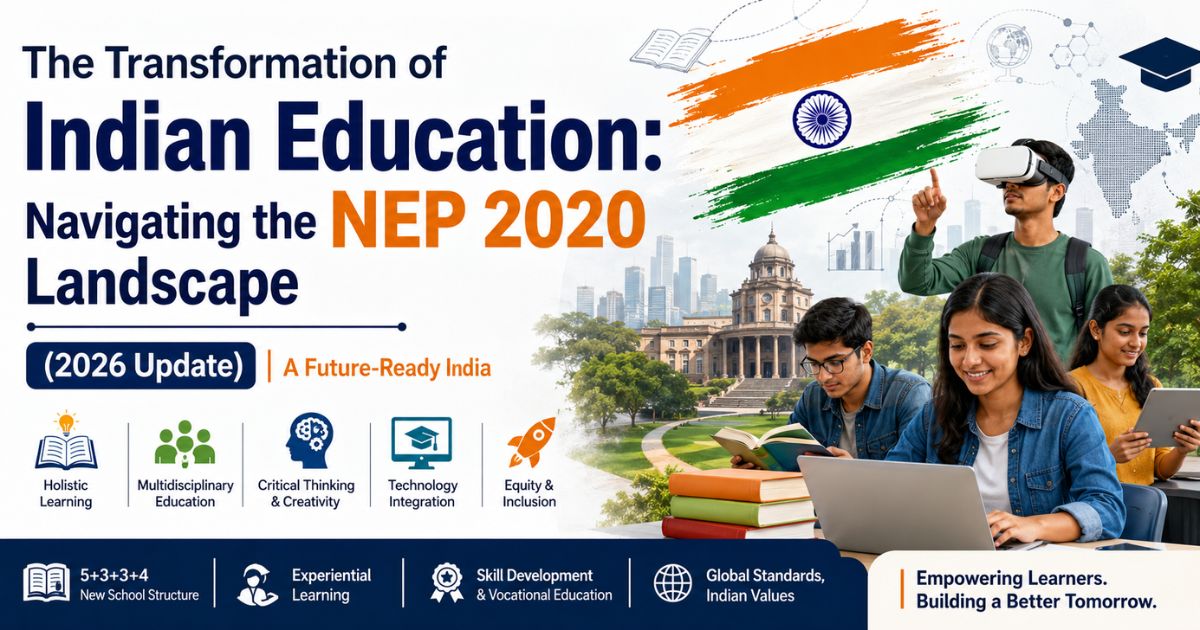
The Core Pillars: A 2026 Progress Report
The NEP 2020 is anchored in five foundational pillars: Access, Equity, Quality, Affordability, and Accountability. By 2026, we see tangible evidence of these pillars being operationalized.
1. Holistic and Multidisciplinary Learning
The traditional 10+2 system is being rapidly phased out in favor of the 5+3+3+4 structure, which prioritizes foundational literacy and numeracy (FLN) from ages 3 to 8. Research shows that early adoption of these methods has boosted foundational learning rates, particularly in rural districts where pre-schooling is finally being formalized as part of the mainstream system.
2. Technology-Enabled Transformation
Perhaps the most visible impact has been the digitalization of the classroom. Programs like DIKSHA and SWAYAM have reached over 4 crore students. In states like Gujarat, the Vidya Samiksha Kendra now monitors 1.15 crore students and 54,000 schools, providing a data-driven layer to governance that was previously non-existent.
3. Vocational and Skill-Based Integration
A major mandate of NEP 2020 is to enroll 50% of students in vocational training by 2025. While national integration is ongoing, the expansion of the National Apprenticeship Training Scheme (NATS) to include AI and healthcare training indicates a shift in focus toward "future-ready" skills.
Persistent Hurdles: Why Implementation is Uneven
Despite the successes, the implementation of NEP 2020 is a story of "mixed outcomes." The challenges are systemic, structural, and cultural.
1. The Federal Coordination Gap
India’s federal structure means that education is a concurrent subject. While the Centre provides the vision, the States execute it. This has created a fragmented environment. Some states (e.g., Karnataka, Maharashtra) have surged ahead with structural reforms like the Academic Bank of Credits, while others are mired in debates over the three-language policy or budgetary limitations.
2. The Financial Sustainability Crisis
NEP 2020 reiterates the long-standing goal of spending 6% of GDP on education. In 2026, public spending remains closer to 3.5%–4%. Without a legally binding financial framework, the "infrastructure deficit" lack of classrooms, libraries, and high-speed internet in tribal and rural belts remains a stubborn barrier.
3. Teacher Preparedness and "Mindset Resistance"
The most sophisticated curriculum is only as good as the teacher delivering it. The shift from rote memorization to "experiential learning" requires a massive cultural shift among faculty. Many educators, accustomed to decades of traditional methods, are facing "change fatigue." Furthermore, there is a persistent shortage of qualified faculty in rural areas, leading to significant gaps in delivering the high-quality, multidisciplinary instruction promised by the policy.
4. The Digital Divide
While urban India has embraced EdTech, nearly 43% of schools still lack functional computers or reliable internet access. Relying on digital learning as a cornerstone of the NEP risks widening the "learning divide" between students who have access to high-end AI labs and those who lack basic electricity.
Research-Based Solutions: Moving Forward
Research from journals and policy reviews in 2026 suggests that the path to success requires a shift from top-down mandates to decentralized support models.
- Public-Private Partnerships (PPPs): States with limited budgets can leverage NGOs and corporate CSR initiatives to fill infrastructure gaps, particularly in digital literacy and robotics labs.
- Decentralized Decision-Making: Instead of a "one-size-fits-all" national rollout, states should be encouraged to pilot reforms tailored to their linguistic and socio-economic demographics.
- Continuous Professional Development (CPD): Training for teachers must move from theoretical workshops to hands-on, peer-mentoring networks where successful NEP-aligned schools mentor those struggling with implementation.
Frequently Asked Questions (FAQ)
Q1: What is the most significant change under NEP 2020?
A: The structural shift from 10+2 to 5+3+3+4, which emphasizes foundational learning, holistic development, and the removal of rigid silos between academic and vocational streams.
Q2: Is the NEP 2020 mandatory for all states?
A: Education is a concurrent subject. While the NEP 2020 provides a national framework, state governments retain the flexibility to adapt these reforms to their specific linguistic and cultural contexts.
Q3: How does the NEP address the "digital divide"?
A: The policy advocates for a hybrid approach integrating technology through platforms like DIKSHA while emphasizing the need for universal physical infrastructure (labs, internet, smart classrooms) to ensure no student is left behind.
Q4: Why is the transition to mother tongue-based instruction difficult?
A: While pedagogically sound, the primary hurdle is the lack of bilingual textbooks, shortage of teachers trained to teach in local dialects, and the parents' preference for English as a medium for job market competitiveness.
Q5: How can researchers contribute to the NEP’s success?
A: Researchers can focus on "Implementation Science" studying specific districts or states to document what actually works, identifying success stories, and providing evidence-based feedback to policymakers to refine the strategy.
Your Research Partner: Thesislikho.com
Implementing the vision of NEP 2020 requires rigorous research and data-driven policy analysis. Whether you are a scholar researching the socio-economic impacts of vocational training, or a PhD candidate analyzing the digital divide in rural education, the complexity of these topics requires a specialized academic partner.
Thesislikho.com provides the technical and editorial scaffolding you need:
- Proposal Development: We help you frame research questions that are both academically significant and policy-relevant.
- Statistical Analysis: Our team helps you analyze large educational datasets, ensuring your findings on policy impact are robust and publishable in top-tier journals.
- Literature Synthesis: We assist you in mapping the rapidly evolving NEP literature, ensuring your research is anchored in the most current 2026 developments.
- Journal Publication: From structural editing to formatting for SSCI and Scopus-indexed journals, we ensure your insights into India’s educational transformation reach the global academic community.
The future of Indian education is being written today. Ensure your research is part of the narrative.
Call / WhatsApp: +91 96438 02216
Website:www.ThesisLikho.com