
Institutions such as the Indian Council of Social Science Research (ICSSR) and the Institute for Social and Economic Change (ISEC) are currently championing research that addresses India’s unique position: a megadiverse, rapidly digitizing society grappling with deep-rooted historical complexities and immediate climate vulnerabilities. The push for international collaboration—highlighted by recent dialogues at the AASSREC Biennial Conference—emphasizes that Indian social science is not just observing local phenomena; it is generating theoretical models applicable to the entire Global South.
For master's and doctoral scholars, the demand for rigorous, mixed-methods research has never been higher. Getting published in top-tier SSCI (Social Sciences Citation Index) and Scopus-indexed journals now requires scholars to blend deep ethnographic insight with robust quantitative or computational analysis.
Below is an expansive, evidence-based deep dive into the seven most critical areas of Social Science research currently defining the academic landscape in India.
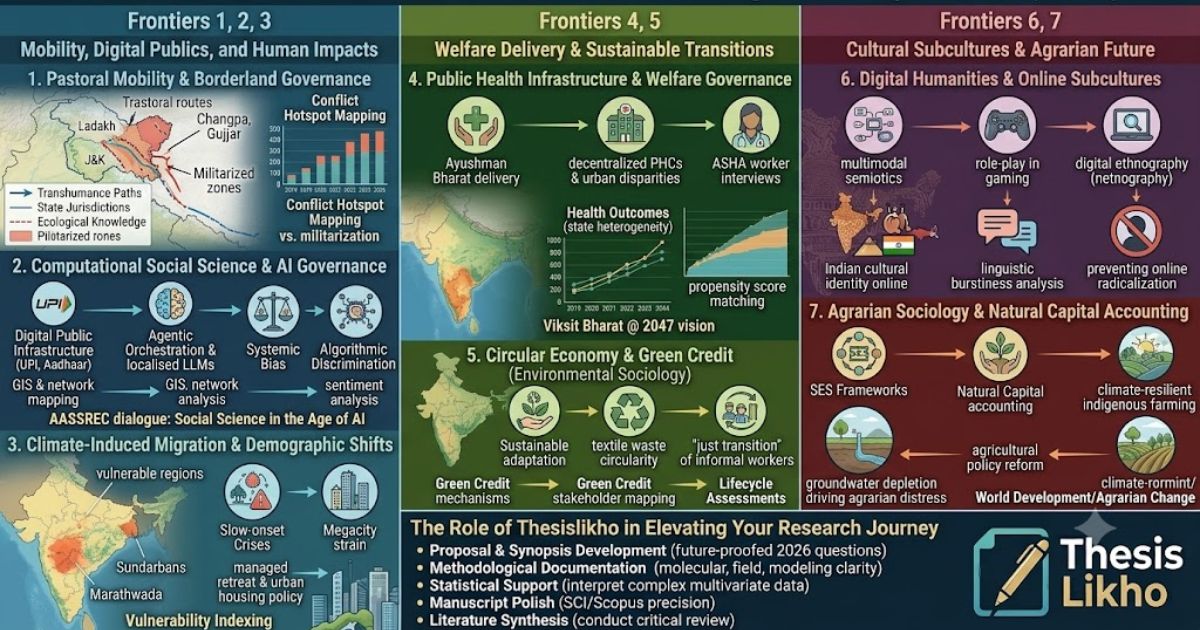
1. Pastoral Mobility and Borderland Governance
One of the most fascinating and complex research frontiers in modern political geography and sociology is the study of how state boundaries interact with traditional, nomadic ways of life. For centuries, pastoralist communities have relied on transhumance—the seasonal migration of livestock to access transient resources. However, modern geopolitical realities are increasingly restricting these ancient pathways.
The Research Context
In the Indian context, borderland governance is often viewed purely through a military or strategic lens. Yet, current sociological research is shifting the focus toward the human and ecological dimensions of these spaces. Communities such as the Changpa of the trans-Himalayan Ladakh region, or the Gujjars and Bakarwals of Jammu and Kashmir, inhabit highly contested borderlands. Their mobility is routinely disrupted by shifting militarized zones, geopolitical standoffs, and the imposition of rigid bureaucratic jurisdictions over fluid ecological landscapes.
Recent international frameworks, such as the XCEPT Research on Borderland Governance, highlight that borderlands are not "ungoverned spaces." Rather, they are governed by complex, localized cross-border agreements negotiated by the communities themselves.
Methodological Approach and Significance
Research in this domain frequently employs a combination of spatial mapping (GIS), historical archival analysis, and extended ethnographic fieldwork. Scholars are investigating how pastoral communities negotiate access to grazing lands under the shadow of the state, and how climate-induced degradation of high-altitude pastures exacerbates these tensions.
- Significance: This research is crucial for redefining national security and environmental policies. By demonstrating how traditional ecological knowledge and mobility are vital for the survival of both the communities and the fragile highland ecosystems, researchers can advocate for border policies that accommodate pastoral transhumance rather than criminalizing or suffocating it. Publications in journals like Political Geography or The Journal of Peasant Studies focusing on this dynamic are currently achieving high impact factors.
2. Computational Social Science and AI Governance
The integration of advanced technology into daily life has necessitated a massive pivot in how sociologists and political scientists study human behavior. We are firmly in the "Age of AI," and the impact of predictive algorithms on social mobility, systemic bias, and labor dynamics is a paramount concern.
The Research Context
The recent AASSREC Conference prominently featured the theme "Social Sciences in the Age of AI: Ethics, Inclusion, and Transformation." In India, the rapid rollout of Digital Public Infrastructure (DPI)—such as the UPI payment network and the Aadhaar biometric system—has created unparalleled datasets regarding human behavior. However, it has also introduced new vulnerabilities regarding data privacy, algorithmic discrimination, and the digital divide.
Furthermore, scholars are beginning to use the very tools they study. The use of agentic orchestration frameworks (like web-automation tools combined with localized Large Language Models) allows researchers to scrape, parse, and analyze massive amounts of qualitative data—from analyzing the linguistic burstiness of political speeches to identifying prompt injection vulnerabilities that could manipulate public discourse on social media.
Methodological Approach and Significance
This field requires a hybrid skill set: the critical theory of a sociologist combined with the technical acumen of a data scientist. Researchers are utilizing sentiment analysis, network mapping, and algorithmic auditing to uncover how digital platforms reinforce or dismantle traditional caste, class, and gender hierarchies, particularly within the burgeoning "gig economy."
- Significance: Research in this area directly informs the drafting of national data protection laws and AI regulatory frameworks. Understanding how digital architectures impact societal trust and democratic engagement is essential. High-impact journals like New Media & Society and Big Data & Society are actively seeking manuscripts that empirically evaluate the social realities of AI implementation in India.
3. Climate-Induced Migration and Demographic Shifts
While climate change is a physical reality, its most profound impacts are social. India is ranked among the countries most vulnerable to climate change, and this environmental stress is acting as a massive "threat multiplier" for internal migration and demographic upheaval.
The Research Context
The 6th Annual International Migration Conference 2026, held in India, centers entirely on "Climate-Induced Migration: Global Challenges, Transnational Dynamics, and Policy Responses." We are witnessing large-scale displacement not just from sudden disasters like cyclones in the Bay of Bengal, but from slow-onset crises like sea-level rise in the Sundarbans and chronic, multi-year droughts in regions like Marathwada and Bundelkhand.
Methodological Approach and Significance
Social scientists are moving beyond simple "push-pull" migration models. Current research utilizes longitudinal household surveys, vulnerability indexing, and climate modeling to understand the exact tipping points that force a family to abandon agrarian life for urban informal labor.
- Significance: The influx of climate refugees into tier-1 and tier-2 megacities is placing unprecedented strain on urban local bodies. Sociological research in this field is vital for developing frameworks for "managed retreat" and designing equitable urban housing and welfare policies for undocumented internal migrants. This area of study is highly relevant for journals such as Population and Environment and Global Environmental Change.
4. Public Health Infrastructure and Welfare Governance
The trauma of the early 2020s fundamentally reshaped the priorities of health economists and medical sociologists in India. The current research mandate, closely aligned with the government’s vision for "Viksit Bharat @ 2047" (Developed India by 2047), is the critical evaluation of decentralized public health infrastructure.
The Research Context
As evidenced by the series of 2026 ICSSR-CAG Colloquiums focusing on the "State of Finances and Public Health Infrastructure" across various Indian states, there is a massive push to understand the efficiency of welfare delivery. India's health architecture is highly heterogeneous, with massive disparities in quality between rural Primary Health Centres (PHCs) and urban tertiary hospitals.
Methodological Approach and Significance
Researchers in this domain are investigating health-seeking behaviors, the socio-economic determinants of maternal and infant mortality, and the effectiveness of flagship insurance schemes like Ayushman Bharat. Methodologies often involve massive randomized control trials (RCTs), propensity score matching, and deep-dive qualitative interviews with frontline ASHA (Accredited Social Health Activist) workers.
- Significance: By evaluating how state-level financial allocations translate into actual health outcomes on the ground, social scientists provide the necessary auditing that policymakers need to correct systemic failures. Papers that successfully link health financing to localized sociological outcomes are highly prized in journals like Social Science & Medicine and Health Policy and Planning.
5. The Circular Economy, Green Credit, and Environmental Sociology
Sustainable development has moved from a buzzword to a regulatory requirement. Environmental sociology in India is currently focusing on how communities, corporations, and governments are adapting to the principles of the Circular Economy and the newly introduced "Green Credit" mechanisms.
The Research Context
Institutions like ISEC have organized major national seminars in 2025/2026 focusing on "Green Credit for Climate Resilient and Sustainable India" and "Rethinking Circularity in Textile Waste Management." The core sociological question is how these macroeconomic and environmental policies affect livelihoods at the micro-level. For instance, when a city formalizes its waste management system to meet circularity goals, what happens to the informal network of waste pickers and recyclers who have historically managed this sector?
Methodological Approach and Significance
Scholars utilize political ecology frameworks, lifecycle assessments, and stakeholder mapping. They investigate the "just transition"—ensuring that the shift toward a green economy does not disproportionately disenfranchise marginalized communities whose livelihoods depend on informal, carbon-intensive, or unregulated sectors.
- Significance: This research ensures that environmental policies are socially sustainable. Studies analyzing the socio-economic impacts of carbon offsetting and green credits provide essential feedback for the Ministry of Environment, Forest and Climate Change. Journals such as Ecological Economics and Environmental Sociology are the prime targets for this impactful research.
6. Digital Humanities and the Sociology of Online Subcultures
As internet penetration reaches the deepest parts of rural India, the ways in which culture is produced, consumed, and archived have fundamentally changed. The intersection of cultural studies, sociology, and digital media has birthed the rapidly expanding field of Digital Humanities.
The Research Context
Evidenced by upcoming 2026 conferences on Digital Humanities and Computational Linguistics, researchers are exploring how digital spaces facilitate the survival of indigenous languages and marginalized narratives. Conversely, there is intense sociological interest in how digital subcultures operate. For example, researchers are analyzing how complex narrative construction, role-play mechanics, and behavioral deception in multiplayer gaming environments serve as microcosms for broader societal trust and interaction dynamics.
Methodological Approach and Significance
This field heavily utilizes digital ethnography (netnography), discourse analysis, and multimodal semiotics. Researchers spend extensive time in virtual environments, analyzing forums, social media burstiness, and digital archives to understand the socialization of the "digital native" generation.
- Significance: Understanding digital socialization is critical for addressing issues of online radicalization, digital literacy, and the preservation of intangible cultural heritage. Publications in Information, Communication & Society and Digital Scholarship in the Humanities help define how we understand the modern Indian cultural identity in a globalized digital space.
7. Agrarian Sociology and Natural Capital Accounting
Despite rapid urbanization, India remains fundamentally an agrarian society. However, the nature of Indian agriculture is experiencing intense distress due to land fragmentation, changing climate patterns, and market volatility.
The Research Context
Modern agrarian sociology has moved beyond the traditional study of rural caste dynamics to incorporate ecological economics. Highlighted by ISEC’s 2025 Regional Training Programme on "Natural Capital Accounting", the current trend involves quantifying the economic value of natural resources (like groundwater and soil fertility) that rural communities depend upon.
Methodological Approach and Significance
Researchers are investigating how the depletion of "natural capital" drives agrarian distress and farmer suicides. Methodologies involve socio-ecological systems (SES) frameworks, econometric modeling of crop yields versus water table depths, and qualitative studies on the adoption of climate-resilient indigenous farming practices.
- Significance: This research is the backbone of agricultural policy reform. By proving that sustainable agriculture (like millet farming or zero-budget natural farming) is not only ecologically necessary but economically superior in the long run, social scientists provide the data required to shift massive government subsidies away from resource-intensive crops. This research is vital for journals like World Development and The Journal of Agrarian Change.
Elevating Your Social Science Research with Thesislikho.com
The scope of Social Science research in India is vast, intellectually demanding, and holds the power to shape national policy. Whether you are conducting a literature survey for an M-Tech thesis on the intricacies of borderland governance, or structuring a PhD on the sociological impacts of AI and digital automation, the journey from raw data to a published, high-impact manuscript is fraught with methodological and administrative hurdles.
Social Science research uniquely requires scholars to balance theoretical depth with empirical rigor. This is where many brilliant ideas falter—not due to a lack of insight, but due to challenges in structuring arguments, executing complex data analysis, or navigating the stringent formatting requirements of international peer review.
Thesislikho.com serves as your premier academic partner, providing the scaffolding necessary to elevate your research:
- Synopsis and Proposal Mastery: Securing admission into premier institutes (like JNU, TISS, or IIT HSS departments) requires a proposal that is both novel and meticulously structured. Our consultants help you define clear research questions, ensuring your proposal highlights critical gaps in the current 2026 literature.
- Literature Synthesis & Theoretical Frameworks: Whether you are navigating the complex theories of pastoral mobility or the ethics of computational social science, we assist in synthesizing massive volumes of literature into a coherent, defensible theoretical framework.
- Advanced Methodological Support: Social sciences today demand methodological rigor. If your research involves complex mixed-methods—such as combining qualitative field interviews with automated quantitative data scraping or econometric modeling—our technical team provides the analytical support required to ensure your findings are robust and valid.
- Manuscript Polish for SSCI/Scopus Journals: The difference between rejection and acceptance in top-tier journals often comes down to narrative clarity and strict adherence to formatting guidelines (APA, Chicago, etc.). We provide comprehensive structural editing to ensure your research communicates its significance powerfully to a global academic audience.
Your research has the potential to influence policy, protect vulnerable communities, and redefine how we understand modern Indian society. Do not let the complexities of academic writing hinder your contribution. Partner with the experts at Thesislikho.com to ensure your academic journey culminates in research that is recognized, respected, and published at the highest levels.
Website: www.thesislikho.com
Call / WhatsApp: +91 96438 02216