
Your thesis might run to hundreds of pages, but for many readers — supervisors deciding whether to dig deeper, examiners forming their first impression, future researchers scanning a database — the abstract is the only part they'll actually read closely. Getting 200 or 300 words to carry that much weight is a genuinely different writing challenge than anything else in your thesis. This guide walks through thesis abstract writing with a clear structure and worked examples, so those few hundred words do justice to everything behind them.
What an Abstract Actually Is
An abstract is a short, self-contained summary of a longer work. It concisely reports the aims, methods, results, and conclusions of your research, so readers know exactly what your thesis is about without needing to read further. This self-contained quality matters more than it might seem: your abstract must be fully understandable on its own, not an excerpt pulled from elsewhere in your paper. A reader who has never seen your thesis should be able to read your abstract and understand your entire study — problem, approach, findings, and significance — in isolation.
The IMRaD Structure
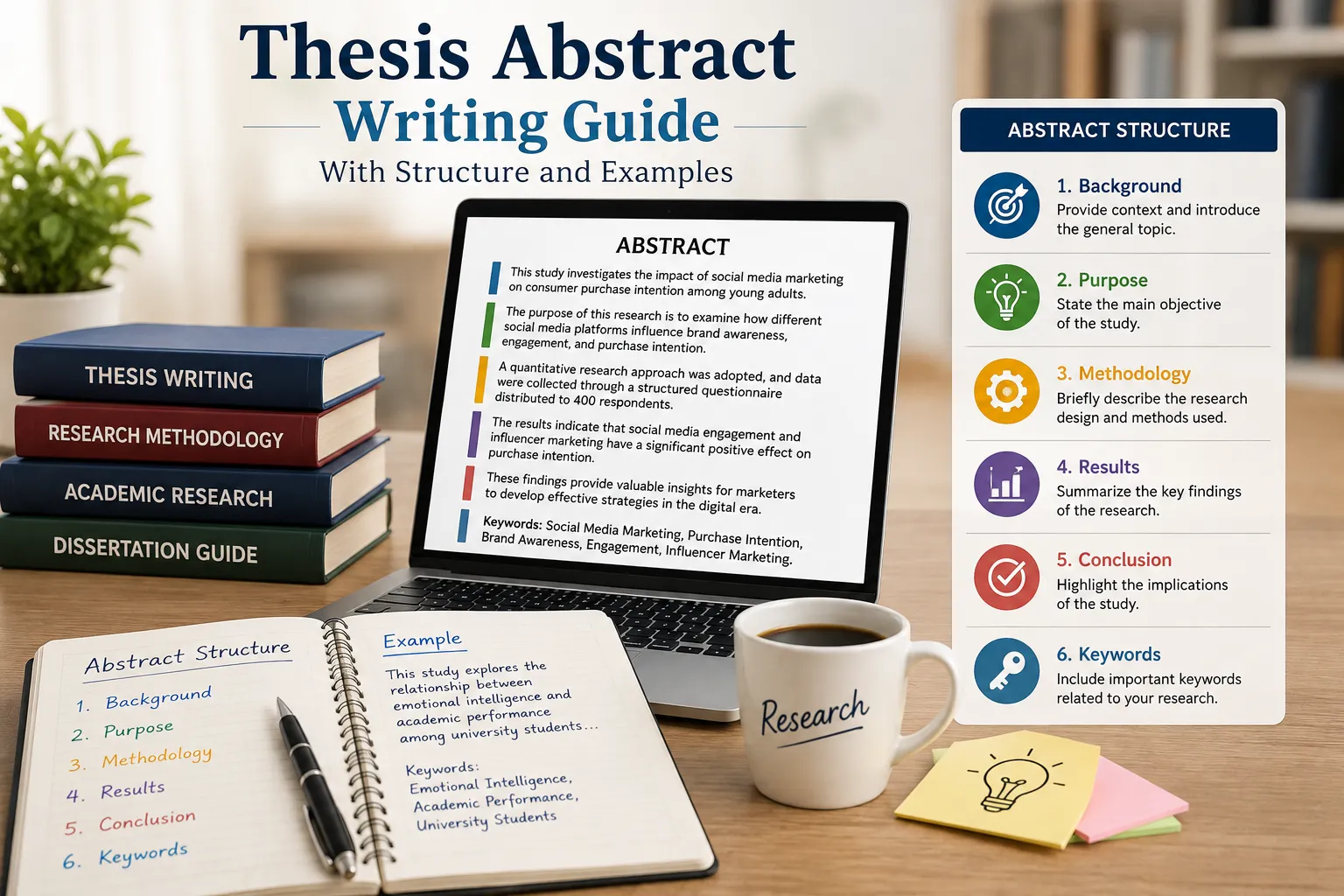
Most abstracts follow the IMRaD pattern: Introduction (or background), Methods, Results, and Discussion (or conclusion). Every abstract, whether explicitly labeled with these subheadings or written as flowing prose, covers the same four core parts — the only real variable is how much space each part gets:
- Background/problem (1–2 sentences) — why this matters and what gap your study fills
- Methods/approach (1–2 sentences) — how you conducted your research
- Key results (2–3 sentences) — what you found, with specific numbers or findings where possible
- Conclusion/implication (1–2 sentences) — what your findings mean
Structured vs. Unstructured Abstracts
A structured abstract uses explicit subheadings — Background, Methods, Results, Conclusions — which is standard in biomedical journals because it makes content scannable. An unstructured abstract is flowing prose containing the same elements, just implicit rather than explicitly labeled, and is more common in physical sciences, humanities, computer science, and most non-medical fields. Word limits are typically slightly higher for structured abstracts (250–300 words) than unstructured ones (150–200 words), since the headings themselves consume word budget that would otherwise go toward content.
Check your specific department's convention before drafting — some disciplines and universities expect structured abstracts with explicit labels, while others expect a single flowing paragraph.
How Long Should Your Abstract Be?
A dissertation or thesis abstract is usually 200–300 words, often capped at one page, though the exact limit depends on your university's specific formatting requirements. Some universities set different limits by degree level — for example, a master's thesis abstract capped at 150 words, with a PhD abstract allowed up to 350. Always confirm your specific institution's exact figure rather than assuming a general range applies to you.
Worked Example: A Structured Abstract
Here's how the IMRaD structure might look applied to a hypothetical management thesis:
"Employee turnover in India's IT sector remains persistently high despite widespread adoption of retention programs, with limited research examining how managerial communication style specifically influences retention intent among early-career employees. [Background] This study surveyed 240 employees across three IT firms in Bengaluru using a validated communication style scale and a standardized turnover intention measure, analyzing the relationship through multiple regression. [Methods] Results showed that transformational communication style was significantly associated with lower turnover intention (β = -.34, p < .001), explaining 22% of the variance beyond salary and tenure. [Results] These findings suggest that manager communication training may offer a cost-effective retention lever for early-career employees, complementing existing compensation-focused retention strategies."
Notice how each sentence does specific work — no sentence is filler, and a reader with no other context could understand the entire study from this paragraph alone.
Why the Abstract Should Always Be Written Last
Write your abstract last, after your full thesis is finished, so that every claim in it matches your final results. Writing it early risks including claims or framing that no longer match what your finished thesis actually delivers — a methodology that shifted slightly, a finding that turned out different from your hypothesis, or a framing that evolved as your argument developed. Treat your abstract as one of the very final things you write, not an early planning document.
A Practical Technique for Drafting
A genuinely useful drafting technique: for each chapter or section of your thesis, list keywords and draft one to two sentences summarizing its central point or argument. This builds a natural framework for your abstract's eventual structure, section by section — by the time you've done this for your introduction, methodology, results, and discussion chapters, you effectively have a rough abstract draft ready to refine and compress.
Style Rules That Matter
Use the active voice, and past or present simple tense consistently throughout. Use plain language, and avoid jargon, citations, and undefined abbreviations entirely — your abstract needs to be understandable to a reader outside your immediate subfield, including examiners from adjacent disciplines and database users searching broadly. Citations in particular don't belong in an abstract; if a specific prior study is central enough to mention, describe its contribution in your own words rather than citing it directly.
Why the Abstract Carries More Weight Than Its Length Suggests
Dissertation and thesis abstracts serve a genuine dual purpose: they summarise your research for supervisors and examiners, and because dissertations often span hundreds of pages, your abstract specifically needs to distil your central argument and findings into a form a reader can absorb quickly. Supervisors and examiners often read only the abstract before deciding whether — and how closely — to review the full document. This makes accuracy and completeness genuinely consequential; an abstract that oversells, undersells, or misrepresents your findings shapes how the rest of your thesis gets read before your reader even reaches Chapter 1.
Matching Emphasis to Your Discipline
Disciplinary emphasis differs meaningfully. Humanities abstracts may emphasise arguments and theoretical contributions more heavily, while STEM abstracts often stress methods and results. Matching this emphasis to your specific discipline's convention strengthens your abstract's fit with what your particular readers expect to see foregrounded.
Where the Abstract Belongs in Your Thesis
The abstract is placed on its own page in your thesis, after the title page and acknowledgements but before the table of contents. This is a standard placement convention across most universities, though you should always check your specific institution's formatting requirements to confirm.
Step-by-Step: Drafting Your Thesis Abstract
- Complete your full thesis first — never draft your final abstract before your thesis is substantially finished
- For each chapter, list keywords and draft one to two sentences summarizing its central point
- Assemble these into a rough draft following the IMRaD structure: background, methods, results, conclusion
- Check whether your department expects a structured (explicit subheadings) or unstructured (flowing prose) format
- Cut jargon, citations, and undefined abbreviations
- Convert passive constructions to active voice, and confirm consistent tense throughout
- Check your word count against your specific institution's limit, trimming filler phrases rather than cutting results or conclusions
- Read the abstract aloud, in isolation, and confirm it makes complete sense without any context from the rest of the thesis
- Confirm every claim in the abstract accurately matches your final results — not an earlier hypothesis or draft finding
Practical Checklist: Is Your Thesis Abstract Ready?
- Written last, after the full thesis is substantially complete
- Covers all four IMRaD elements: background, methods, results, conclusion
- Format (structured with subheadings, or unstructured prose) matches your department's convention
- Falls within your specific institution's word limit
- Fully understandable on its own, without needing the rest of the thesis for context
- Uses active voice and consistent tense throughout
- Contains no jargon, citations, or undefined abbreviations
- Includes specific numbers or findings in the results portion, not vague generalities
- Every claim accurately matches the final thesis, not an earlier draft or hypothesis
- Placed correctly — after title page and acknowledgements, before the table of contents
Two Practical Scenarios
Scenario 1 — Catching an Outdated Claim
A scholar drafted their abstract early in the writing process, stating their study "confirmed a significant positive relationship" between two variables. By the time their full analysis was complete, the relationship turned out to be significant but negative in direction. Because the scholar had planned to revisit the abstract only after the thesis was finished, this discrepancy was caught and corrected before submission — illustrating exactly why abstracts should always be finalized last.
Scenario 2 — Trimming an Overlong Draft
A scholar's first abstract draft ran to 480 words against a 300-word institutional limit. Rather than cutting results or conclusions to make space, the scholar trimmed filler phrases throughout — replacing "in order to investigate" with "to investigate," and "it is important to note that the findings suggest" with simply "findings suggest" — bringing the abstract down to 310 words while preserving every substantive claim, then making one final targeted cut to a background sentence that repeated information already implied elsewhere.
Common Mistakes Thesis Writers Make With Abstracts
- Writing the abstract early, before the thesis is finished, risking claims that no longer match the final results.
- Including citations, jargon, or undefined abbreviations, making the abstract harder to understand for readers outside the immediate subfield.
- Writing vague results ("the study found significant differences") instead of specific findings with numbers where possible.
- Exceeding the institutional word limit and cutting substantive content instead of trimming filler phrases first.
- Treating the abstract as an excerpt copied from the introduction or conclusion, rather than a genuinely self-contained summary.
Frequently Asked Questions
How do you write a thesis abstract with proper structure?
Follow the IMRaD pattern — background, methods, results, conclusion — writing it only after your full thesis is complete, using plain language, active voice, and specific findings, and checking your department's convention for structured versus unstructured format.
Why does thesis abstract structure and quality matter?
Supervisors and examiners often read only the abstract before deciding how closely to review the full thesis, making it disproportionately consequential relative to its short length — an inaccurate or unclear abstract can shape how the rest of the document gets read.
How does the abstract affect a thesis's overall impression?
A well-structured, accurate abstract signals clarity and rigor from the very first page, while a vague or outdated one can create doubt before a reader even reaches your introduction.
How long does it take to complete a thesis using this approach?
Drafting the abstract last, using the chapter-by-chapter keyword technique, typically takes less time than attempting to write it from scratch, since much of the raw material is already distilled from your finished chapters.
Is professional help available for thesis abstract writing guide with structure and examples?
Yes. ThesisLikho's PhD-qualified mentors have guided 10,000+ scholars through abstract writing, structure planning, and complete thesis writing assistance tailored to individual disciplines and degree levels.
Get Expert Guidance on Your Thesis Abstract
Writing an abstract that's accurate, complete, and genuinely self-contained within a tight word limit takes careful, deliberate compression. If you'd like expert input on structuring your abstract or fitting it within your institution's word limit, ThesisLikho's PhD-qualified team offers abstract writing support, structure guidance, and complete thesis writing assistance. If you need expert guidance with your abstract, chapter structure, or overall thesis writing, you can explore our Thesis Writing Assistance service.
[Link: How to Structure the Discussion Chapter of a Thesis] [Link: How Long Should Each Thesis Chapter Be]
Talk to a Thesis Expert → https://thesislikho.com/writing-services/thesis-writing