
You've picked a topic you're genuinely excited about. You've read around it, maybe even started sketching a rough outline. Then it goes in front of your departmental committee — and comes back with questions you weren't prepared for, or worse, a request to rework it entirely.
This happens more often than students expect, mostly because the thesis topic approval process is judged against a fairly consistent set of criteria that rarely gets spelled out clearly in advance. This guide walks through exactly what university committees look for when they evaluate a proposed topic, why proposals get sent back, and how to frame your topic so it holds up under scrutiny the first time around.
We've written this the way an experienced thesis mentor would talk you through your own committee meeting — because that's genuinely the kind of guidance ThesisLikho's PhD-qualified mentors provide to the thousands of scholars we've supported through exactly this stage.
What the Topic Approval Process Actually Involves
Most universities require a proposed thesis topic to pass through some form of formal review before full research begins — this might be a departmental committee, a supervisor's sign-off followed by a committee ratification, or (at the doctoral level) a Doctoral Research Committee. Regardless of the exact name or structure, the underlying purpose is the same: someone with subject-matter expertise needs to confirm that your topic is worth pursuing, realistically achievable, and clearly enough defined to guide the rest of your research.
For most students, this is the first time their independent research judgment is formally evaluated — which is exactly why it can feel more nerve-wracking than it needs to be. Understanding what committees are actually checking for takes a lot of the guesswork out of it.
Why This Stage Matters More Than Students Expect
A rejected or revised topic early on is inconvenient but cheap to fix. A topic that sails through approval only because no one scrutinized it closely enough, and later turns out to be too broad or under-supported by data, is far more expensive — sometimes costing months of work that has to be reframed mid-thesis.
This is really why the thesis topic approval process matters so much: it's designed to catch exactly the kinds of problems that are easy to overlook when you're the one excited about the idea, but obvious to a committee with more distance from it. Getting genuinely useful scrutiny at this early stage, even when it means going back to revise, tends to save far more time later than it costs now.
The Five Things Every Committee Evaluates
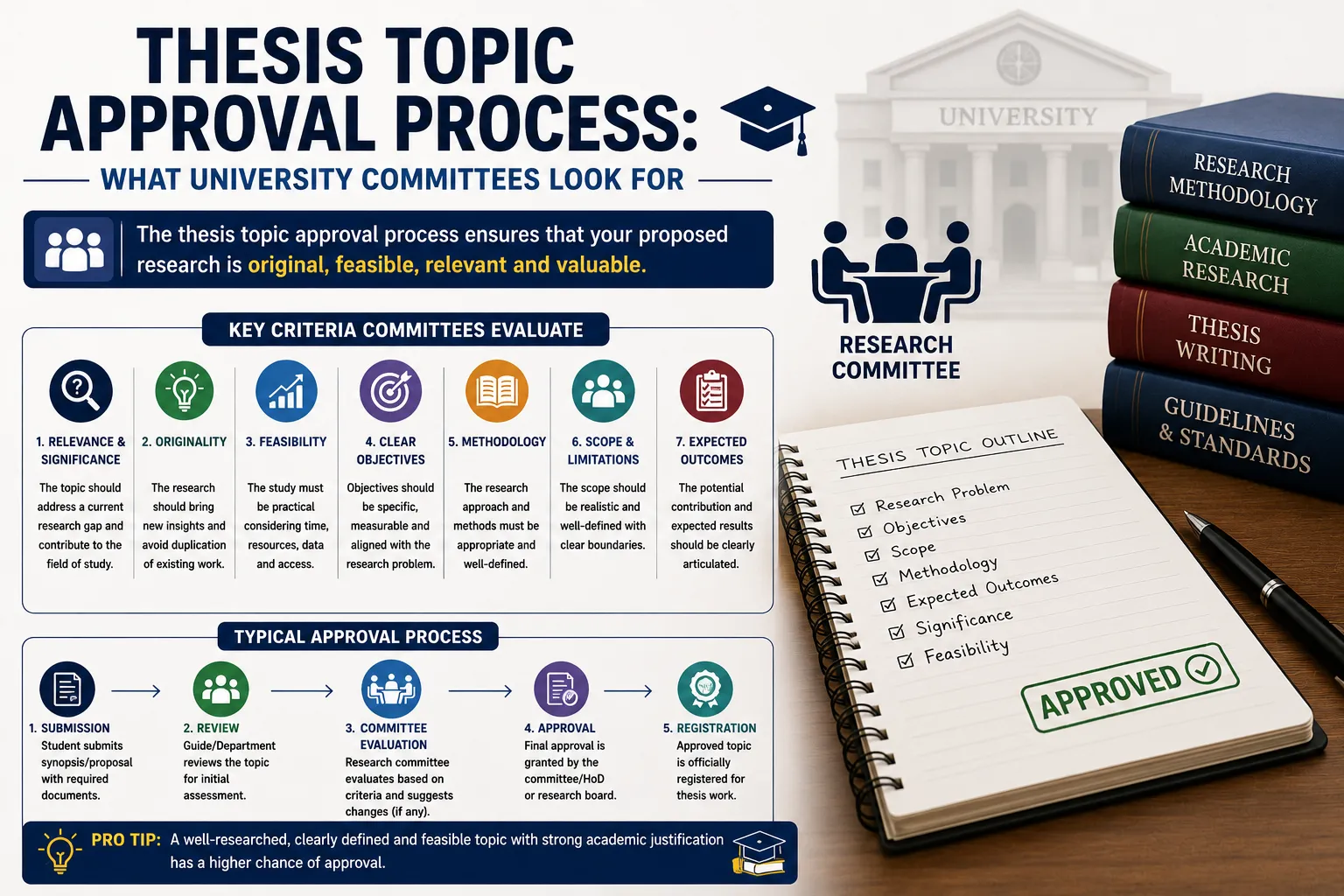
Most research committees assess a proposal or synopsis using five key criteria.
Originality
Shows whether the research offers a new idea, perspective, or contribution to existing knowledge.
Feasibility
Evaluates whether the study can realistically be completed with the available time, resources, and data.
Clarity
Checks if the research problem, objectives, and questions are clear and well-defined.
Methodological Fit
Ensures the proposed research methods are appropriate for answering the research questions.
Relevance
Assesses whether the topic is important to the field and aligns with the department's research focus.
Note: Even a strong research idea may be rejected if it falls short in any one of these areas.
Originality: What "New Enough" Really Means
Originality doesn't mean inventing something no one has ever studied — very few thesis topics genuinely do that. According to Scribbr's guidance on the research process, a strong research problem typically emerges from identifying problems, questions, debates, contradictions, or gaps within an existing body of literature, rather than starting from a completely blank slate.
In practice, originality at the thesis level usually looks like one of these:
- A new context — applying an established framework to a population, region, or industry it hasn't been tested on
- A new angle — examining a well-studied relationship through a different lens (efficiency instead of accuracy, for example, or a mediating variable no one has tested)
- A methodological contribution — using a different or improved method to re-examine an existing question
- An updated timeframe — revisiting a topic that was last studied before a major shift (a new technology, policy, or market condition) that changes the picture
If your topic doesn't fit at least one of these patterns, a committee will likely ask you to clarify exactly what your research adds that existing studies haven't already covered.
For a deeper walkthrough on this specific step, see our companion guide: How to Narrow Down a Broad Research Idea Into a Thesis-Ready Topic.
Feasibility: Can You Actually Finish This?
Feasibility is where genuinely good ideas most often stumble — not because the idea is flawed, but because it assumes access to data, time, or resources the student doesn't actually have. Scribbr's guidance on choosing a topic is direct about this: alongside intellectual interest, students need to weigh their program's specific requirements, the time available to complete the research, and how difficult it will realistically be to access sources and data on the topic.
Committees will typically probe questions like: Is your target population actually reachable within your timeline? Is the dataset you're assuming exists actually publicly available, or does it require permissions you haven't secured? Does your proposed methodology require tools, software, or statistical expertise you'd need to learn from scratch?
A topic that sounds impressive in a one-line pitch but falls apart under these questions is a common reason for a "revise and resubmit" outcome rather than outright rejection — committees generally want to see the underlying interest preserved, just scoped to something achievable.
Clarity of the Problem Statement
A problem statement is where many strong topics get lost in vague language. According to Scribbr's guidance, an effective problem statement describes who the problem affects, why the research is needed, and how the proposed research will contribute to addressing it — a compact structure that, when missing any one element, tends to leave committees unsure of the topic's real purpose.
Compare a weak version — "There is a lack of research on social media marketing in India" — against a stronger one: "Despite the rapid growth of Instagram-based influencer marketing among Indian D2C brands, there is limited empirical research on how influencer credibility specifically affects purchase intention among Gen Z consumers, leaving marketers without clear guidance on which credibility signals actually drive conversion." The second version names who's affected, why it matters now, and what specific gap the research addresses — exactly what a committee is trying to locate in your proposal.
Alignment Between Topic, Objectives, and Methodology
Even a well-defined problem statement can fail approval if the proposed method doesn't actually match the question being asked. A common misalignment: proposing a purely quantitative survey to answer a question that's fundamentally about lived experience or perception — a mismatch that usually calls for a qualitative or mixed-methods approach instead.
Committees are specifically checking whether your objectives map logically to your intended method. If your objective is to "understand how managers perceive a phenomenon," a large-scale Likert-scale survey won't get you there as effectively as semi-structured interviews would — and a committee will usually flag this disconnect directly rather than let it pass.
Relevance to Your Field and Department
Relevance operates on two levels. First, does the topic matter to your broader field — is it addressing something practitioners, policymakers, or other researchers would actually care about? Second, does it fit within your specific department's scope and your supervisor's area of expertise? A brilliant topic that sits entirely outside your department's specialization can still face pushback, not because the idea lacks merit, but because the committee needs confidence that appropriate expertise exists to guide and evaluate your work.
A Note on Plagiarism Checks and Committee Review
Topic approval and formal plagiarism/similarity checks are two different stages, and it's worth not conflating them. Similarity checks (via tools like Turnitin) typically apply to your actual written thesis or dissertation at a later submission stage — not to a topic proposal, which is usually just a page or two of original writing evaluated on its ideas, not run through a formal similarity report.
That said, it's worth understanding this correctly now, since misunderstanding it can create unnecessary anxiety later. Turnitin's own guidance is explicit that a similarity percentage is not, by itself, a verdict on plagiarism — it measures textual overlap with other sources, and properly cited quotations, references, and common academic phrases can meaningfully inflate a score without indicating any actual misconduct. Manual review of exactly what's been flagged matters far more than the raw percentage alone. Keeping this distinction in mind early — that similarity scores require contextual interpretation rather than a fixed pass/fail cutoff — will serve you well once you reach the thesis-writing and submission stages later on.
Who Actually Sits on the Committee
Understanding who's in the room changes how you prepare. Most thesis or dissertation committees include your primary supervisor, one or two additional faculty members from your department (sometimes including a subject-matter specialist chosen specifically because your topic falls in their area), and at the PhD level, often an external member not affiliated with your immediate research group. Some departments also include a coordinator whose role is less about evaluating the research itself and more about confirming procedural compliance — word count, formatting, and whether the required sections are present.
This composition matters because different committee members tend to probe different criteria. Your supervisor, already familiar with your thinking, often focuses on feasibility and whether the scope matches your actual working relationship and timeline. A subject specialist is more likely to challenge originality — pointing out existing work you may not have found yet. An external or more general committee member often asks the broadest "so what" questions, since they don't share your department's built-in assumptions about why the topic matters.
How Approval Expectations Shift Across Degree Levels
Research expectations become more rigorous as you progress to higher academic levels.
Undergraduate
The focus is on a clear and manageable project. Applying existing methods to a new topic is usually acceptable.
Master's / MBA
Students are expected to identify a meaningful research gap and demonstrate that the study is feasible within the available time.
PhD
The emphasis is on making an original contribution to knowledge. Committees closely evaluate the research gap, methodology, feasibility, and data availability before granting approval.
Note: PhD synopsis evaluations are typically more formal and are reviewed by a Doctoral Research Committee (DRC) or Research Advisory Committee (RAC) rather than only a supervisor.
Common Reasons Topics Get Sent Back
- Too broad to investigate meaningfully within the available word count and timeline
- No clear gap identified — the proposal reads as a restatement of settled knowledge rather than pointing toward something unresolved
- Data or access assumptions that aren't realistic — assuming access to a dataset, population, or organization without having actually secured it
- Mismatch between research question and proposed method
- Overlap with existing, already-registered research in the same department without acknowledging it
- Vague problem statement that doesn't specify who's affected or why the research matters now
Two Realistic Scenarios
Scenario 1 — Meera, a first-time master's thesis writer Meera proposed studying "consumer behaviour in online shopping" — a topic so broad her committee couldn't tell what specific question she intended to answer. After a follow-up meeting, she narrowed it to "The effect of return-policy transparency on purchase confidence among first-time online apparel shoppers in Tier-2 Indian cities." The revision wasn't a smaller idea — it kept her original interest in online consumer behaviour but gave the committee something specific enough to actually evaluate for originality and feasibility.
Scenario 2 — Vikram, a PhD candidate proposing an ambitious multi-country study Vikram's original topic proposed comparing consumer trust in digital payments across five countries — intellectually interesting, but his committee raised feasibility concerns given his available time and lack of established contacts in most of those markets. Rather than rejecting the topic outright, they asked him to narrow the comparison to two countries where he already had access to research partners. The core research question stayed intact; only the scope became realistic. This is a pattern we see constantly in mentoring work: committees are rarely trying to kill an idea — they're trying to make sure it's completable by the specific student in front of them.
Questions Committees Commonly Ask — and How to Answer Them
Beyond the general criteria, it helps to rehearse specific questions you're likely to face, since a well-prepared, direct answer often does more to build committee confidence than the underlying idea itself.
"What's already been published on this, and what does your research add?" Have two or three specific existing studies ready to reference, and be precise about the gap — not "not much research exists," but "existing studies have examined X in context A; my research examines the same relationship in context B, where it hasn't been tested."
"How will you actually get your data?" Vague answers ("I'll survey students") invite follow-up scrutiny. A stronger answer names the specific population, an estimated sample size, how you'll reach them, and what you'll do if response rates are lower than expected.
"Why does this matter beyond your own interest in the topic?" This is the "so what" question in disguise. Answer with a concrete audience — practitioners, policymakers, or a specific industry — who would find your findings useful, rather than a purely academic justification.
"What will you do if your initial hypothesis isn't supported?" Committees ask this to check you understand that research doesn't always confirm what you expect. A confident answer acknowledges that a null or unexpected result is still a valid, reportable outcome, not a failed thesis.
Rehearsing answers to these four questions specifically, before your meeting, resolves a large share of the friction students otherwise encounter during committee review.
How to Prepare for Your Committee Meeting
- Anticipate the five criteria covered above, and have a one-line answer ready for each — originality, feasibility, clarity, methodological fit, and relevance.
- Bring evidence of feasibility, not just assertions — if your method depends on a dataset or population, show you've already checked it's accessible.
- Practice explaining your problem statement in under 30 seconds. If you can't do this clearly, your committee likely won't be able to follow it either.
- Prepare for the "so what" question. Committees frequently ask why the research matters beyond academic interest — have a specific, non-generic answer ready.
- Get informal feedback from your supervisor before the formal meeting. Most supervisors would rather flag a scope issue in a private conversation than in front of the full committee.
Before finalizing your topic for committee review, it's worth running it through a structured self-check — our companion guide, How to Validate a Thesis Topic Before You Start Writing, walks through exactly this kind of pre-submission validation process.
Tips for First-Time Thesis Writers in India
Indian university committees often add a few practical considerations beyond the core five criteria: whether your topic requires ethics clearance (particularly for topics involving human subjects, health data, or vulnerable populations), whether it fits within your department's approved broad research areas, and whether your proposed timeline realistically aligns with your program's academic calendar, including semester breaks and internship periods that can affect data collection windows.
First-time scholars often underestimate how much a well-prepared, specific pitch changes the tone of a committee meeting. Coming in with a vague, broad idea invites open-ended questioning; coming in with a narrowly scoped, clearly justified topic tends to shift the conversation toward refinement rather than fundamental rework.
If You Disagree With the Committee's Feedback
Occasionally, a committee's requested revision doesn't sit right — perhaps you believe your feasibility concerns are overstated, or that a suggested narrowing loses something important about your original question. It's reasonable to push back, but the way you do it matters.
Rather than arguing the point directly in the meeting, ask for the specific reasoning behind the concern, then follow up in writing with a brief, evidence-based counterpoint — for instance, showing that you've already secured access to the data a committee member assumed was unavailable. Committees generally respond well to a scholar who engages with feedback thoughtfully rather than either capitulating immediately or resisting without addressing the underlying concern. If a genuine disagreement persists after this exchange, most departments have an informal escalation path through your supervisor or department head, though this is rarely necessary if the initial pushback is handled constructively.
Pre-Approval Checklist
- Your topic identifies a specific gap, contradiction, or under-explored angle — not just a general area of interest
- You've confirmed access to the data, population, or sources your research depends on
- Your problem statement names who's affected, why it matters, and what your research contributes
- Your proposed methodology genuinely matches your research question
- Your topic fits within your department's scope and available supervisory expertise
- Your timeline realistically accounts for your program's academic calendar
- You've had an informal review from your supervisor before the formal committee meeting
Getting Expert Support
Even strong researchers benefit from a second, experienced read before a topic goes in front of committee — a vague problem statement or an unrealistic feasibility assumption is far easier to fix on paper than after a rejected pitch delays your registration timeline.
ThesisLikho's mentoring team — PhD-qualified experts who've guided over 10,000 scholars through this exact stage — offers structured topic review as part of our Thesis Writing Service, helping you sharpen your problem statement and check feasibility before you walk into your committee meeting. If you're specifically working on an MBA thesis, our subject-specific guides — Top MBA Thesis Topics in Marketing for 2026 and Link: Top MBA Thesis Topics in Finance for 2026 — are worth reviewing alongside this one.
Frequently Asked Questions
What is the thesis topic approval process and what do university committees look for?
It's the formal review stage where a departmental committee or supervisor evaluates whether a proposed thesis topic is original, feasible, clearly defined, methodologically sound, and relevant to the field — before full-scale research is permitted to begin.
How long does it take to complete a thesis using this approach?
Topic approval itself typically takes a few weeks to a couple of months depending on committee scheduling and revision rounds, while the full thesis afterward generally takes anywhere from several months to over a year, depending on your degree level and research design.
Is professional help available for the thesis topic approval process?
Yes — structured mentoring on problem-statement framing, feasibility checking, and anticipating committee questions is a standard, legitimate form of academic support. ThesisLikho's PhD-qualified mentors offer this kind of guided review for thesis scholars.
Why does the thesis topic approval process matter?
It catches scope, data-access, and methodology problems early — before months of research get built on an assumption that turns out to be unrealistic, which is far more costly to fix later than at the proposal stage.
How does the topic approval process affect a thesis overall?
A topic that clears approval cleanly, with a specific problem statement and a realistic, well-matched methodology, sets up every later stage — literature review, data collection, and defense — to run far more smoothly than one that was only loosely scrutinized at the outset.
Talk to a Thesis Expert
If you'd like a mentor to review your topic and problem statement before your committee meeting, ThesisLikho's team is ready to help.