
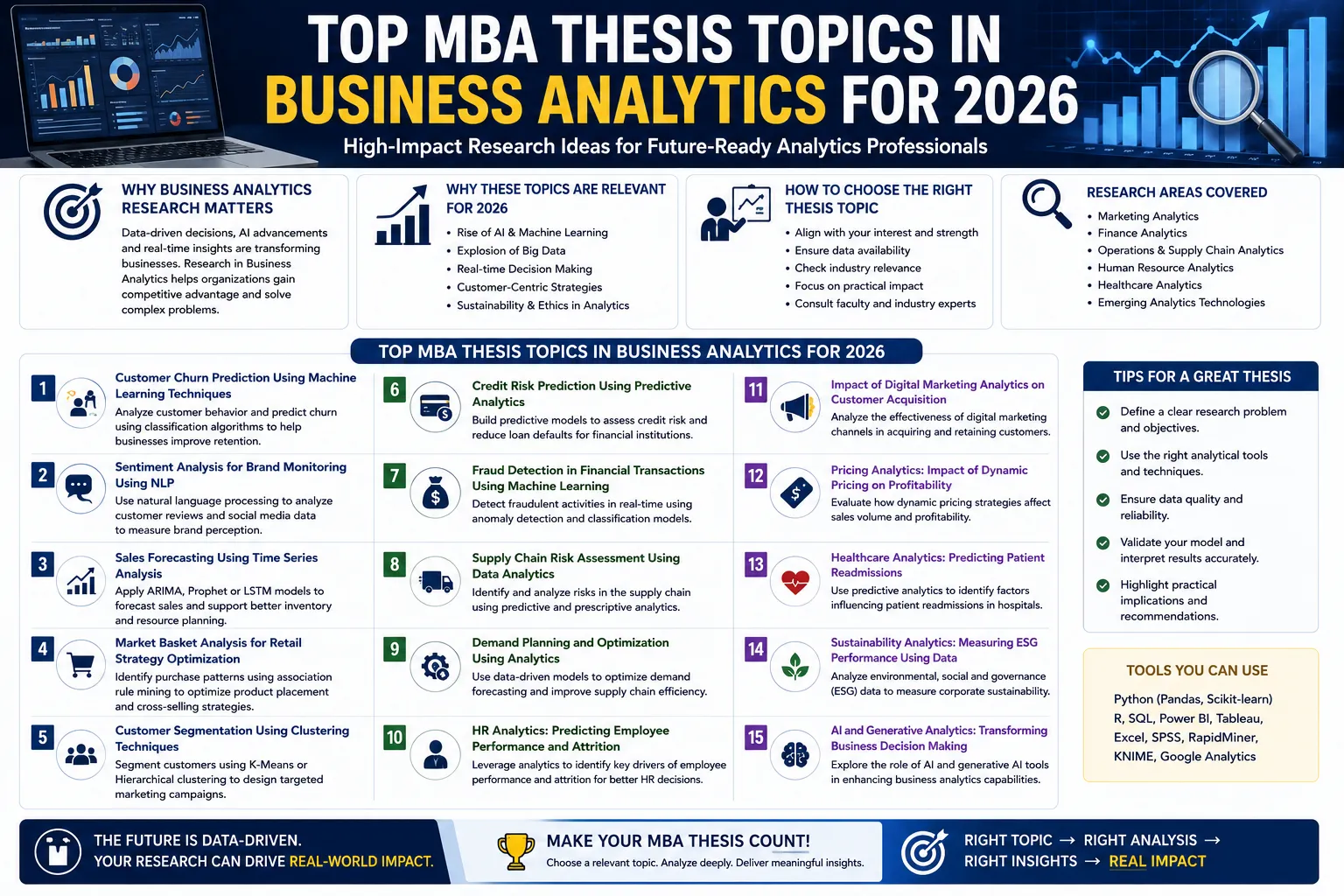
Business analytics as a thesis area is unusually broad — it sits at the intersection of statistics, computer science, and business strategy, which means "business analytics" itself isn't a topic, it's an entire discipline. Picking a genuinely researchable MBA thesis topic means anchoring your interest to a specific analytical category, a specific technique, and a specific business problem. This guide walks through trending, research-ready MBA business analytics thesis topics for 2026, along with how to narrow a broad theme into something your supervisor will actually approve.
The Three Foundational Categories to Anchor Your Topic In
Business analytics thesis topics span three foundational categories, and knowing which one your interest sits in is the first step toward a defensible thesis:
- Descriptive analytics — summarizing historical patterns in business data to understand what has already happened
- Predictive analytics — using historical data and statistical or machine learning models to forecast future outcomes
- Prescriptive analytics — going a step further, recommending optimal decisions based on data-driven models, not just predicting outcomes
Most strong MBA thesis topics live primarily within one of these categories, even when they draw on the others for context. Trying to cover all three comprehensively in a single MBA-level thesis is one of the fastest ways to end up with a topic too broad to complete well.
Why This Is a Genuinely Active Moment for the Field
Generative AI is described as the most disruptive force currently reshaping business research and analytics. Large language models now automate research tasks that previously required hours of manual analysis — synthesizing market reports, generating executive summaries, and identifying thematic patterns across unstructured data. This shift is creating genuinely new research questions that didn't exist even a couple of years ago, particularly around how these tools are being adopted, trusted, and governed within organizations.
One specific, striking statistic worth knowing: data preparation traditionally consumes 60–80% of analytics project time, and generative AI is now automating schema matching, data cleaning, and quality validation — tasks that previously required deep technical expertise. This shift itself is a legitimate, current thesis direction, not just background context.
Trending MBA Thesis Areas in Business Analytics for 2026
1. Predictive Analytics in Financial Forecasting
Comparative studies of predictive analytics techniques applied to financial forecasting remain a strong, well-established thesis direction, appealing to committees because the methodology (regression, time-series models, machine learning comparisons) is well-documented and the business relevance is immediately clear.
Narrowed thesis example: "A Comparative Analysis of ARIMA and Random Forest Models for Quarterly Revenue Forecasting in Mid-Sized Indian Manufacturing Firms"
2. Customer Segmentation Using Big Data Analytics
Using big data analytics for customer segmentation, particularly in retail, remains a strong direction, especially when combined with a clear business outcome like personalized marketing effectiveness.
Narrowed thesis example: "Clustering-Based Customer Segmentation for Personalized Promotional Targeting in an E-Commerce Retail Dataset"
3. Machine Learning for Credit Risk Evaluation
Machine learning techniques for banking credit risk evaluation continue to be an active, practically relevant research area, particularly given ongoing scrutiny of algorithmic decision-making in lending.
Narrowed thesis example: "Comparative Evaluation of Logistic Regression and Gradient Boosting Models for Predicting Loan Default Risk in Retail Banking"
4. Predictive Maintenance in Manufacturing
Predictive maintenance — using historical equipment data to predict failures before they occur — is a well-established, thesis-ready direction combining business analytics with operations management, appealing particularly to students with a manufacturing or operations background.
Narrowed thesis example: "A Predictive Maintenance Model for Reducing Unplanned Downtime in Industrial Machinery Using Sensor Data and Random Forest Classification"
5. Text Analytics and Sentiment Analysis on Customer Reviews
Text analytics and natural language processing represent an accessible, in-demand direction — applying computational linguistics and machine learning to extract insights from unstructured text data like customer reviews and social media. This covers sentiment analysis, topic modeling, text classification, and information extraction, and is genuinely feasible for MBA-level work given the wide availability of open-source NLP tools and public review datasets.
Narrowed thesis example: "Sentiment Analysis of Online Customer Reviews to Identify Key Drivers of Dissatisfaction in the Indian Food Delivery Sector"
6. Customer Churn Prediction
Predicting customer churn in subscription-based businesses is a specifically cited, well-scoped 2026 thesis direction, combining predictive modeling with a clearly measurable, business-relevant outcome.
Narrowed thesis example: "A Machine Learning Approach to Predicting Customer Churn in Subscription-Based OTT Platforms Using Behavioral Usage Data"
7. Generative AI Applications in Business Forecasting
Generative AI applications in business forecasting and strategic planning is highlighted as an emerging 2026 theme, reflecting the field's most current developments — a strong choice for students wanting a genuinely current, forward-looking topic, though one that requires careful scoping given how new and fast-moving this specific area is.
Narrowed thesis example: "Evaluating the Accuracy of Generative AI-Assisted Demand Forecasting Compared to Traditional Time-Series Models in Retail Inventory Planning"
8. Algorithmic Bias and Fairness in AI-Driven Business Decisions
A specifically flagged high-value research gap: AI-driven hiring and decision-making tools are now widely adopted across companies, but relatively few studies have examined their fairness or bias. This represents a genuine, underexplored opportunity, particularly appealing for students interested in the ethical dimension of business analytics rather than purely technical performance metrics.
Narrowed thesis example: "Detecting Gender Bias in AI-Driven Resume Screening Tools: An Empirical Analysis of Model Outputs Across Demographic Groups"
9. ESG Analytics and Sustainability Reporting
ESG analytics and data-driven sustainability reporting frameworks are an active, current direction reflecting growing corporate and regulatory attention to sustainability metrics — a strong choice for students interested in combining analytics with strategy or corporate governance themes.
Narrowed thesis example: "A Data-Driven Framework for Assessing the Accuracy of Self-Reported ESG Scores Against Verified Emissions Data in the Indian Manufacturing Sector"
10. Real-Time Analytics in Omnichannel Retail
Real-time analytics in omnichannel retail environments is another current, well-cited direction, reflecting how retail businesses increasingly need to synthesize data across online and offline channels simultaneously.
Narrowed thesis example: "The Impact of Real-Time Inventory Visibility on Omnichannel Fulfillment Efficiency in Indian Fashion Retail"
Feasibility vs. Novelty: Weighing Your Options
Predictive analytics topics using established techniques — financial forecasting, customer segmentation, credit risk modeling, predictive maintenance — tend to be highly feasible for MBA timelines, since well-documented datasets and established methodologies are widely available, and the required tools (Python, SQL, Power BI, Tableau) are accessible without specialized infrastructure. Generative AI applications and algorithmic bias/fairness topics tend to offer higher novelty, since these are still actively evolving research areas with fewer saturated sub-niches, but may require more careful scoping given how quickly the underlying technology and literature are moving.
Practical Technical Toolkit to Consider
Practical business analytics work in 2026 commonly uses Python (particularly the Pandas library for data manipulation), SQL for data querying, and visualization tools like Power BI or Tableau for presenting findings. For machine learning-based topics, explainability techniques such as SHAP (Shapley Additive exPlanations) are increasingly expected for interpreting model outputs — particularly relevant if your topic involves any kind of "black box" predictive model, since committees increasingly want to see not just that a model predicts well, but why it makes the predictions it does.
Step-by-Step: How to Narrow a Trending Theme Into a Defensible Thesis Topic
- Choose an analytics category — descriptive, predictive, or prescriptive — that matches your genuine interest and skill set
- Pick a specific technique within that category, not the category as a whole
- Name the specific dataset or data source you'll use (public dataset, company data, scraped reviews)
- Define a measurable outcome — accuracy, churn rate reduction, forecast error, bias metric
- State the specific business or industry context — retail, banking, manufacturing, healthcare
- Check feasibility against your available tools and data access
- Verify the specific narrow niche isn't already comprehensively covered by very recent (2025–2026) publications
- Confirm the required interpretability tools (e.g., SHAP) are within your technical comfort zone if using complex machine learning models
Practical Checklist: Is Your Business Analytics Thesis Topic Ready?
- Topic is anchored in one analytics category (descriptive, predictive, or prescriptive), not spread across all three
- Specific technique or model type is named, not just a general concept
- Data source is identified and genuinely accessible
- A measurable outcome or performance metric is defined
- Industry or business context is stated explicitly
- Required technical tools (Python, SQL, visualization software) match your actual skill level
- Supervisor's expertise aligns with the chosen technique and domain
- Recent literature (2025–2026) has been checked to confirm the specific niche isn't already saturated
Two Practical Scenarios
Scenario 1 — Narrowing an Overly Broad AI Topic A student initially proposed "The Impact of AI on Business Decision-Making" — far too broad to defend as a single MBA thesis. After applying the narrowing framework, the topic became "Evaluating the Accuracy of Generative AI-Assisted Demand Forecasting Compared to Traditional Time-Series Models in Retail Inventory Planning," specifying the exact technique comparison, the business context, and a measurable outcome (forecast accuracy) — resulting in a clear, feasible methodology the supervisor approved without revision requests.
Scenario 2 — Choosing Based on Data Access A student interested in both credit risk modeling and algorithmic bias detection evaluated their actual data access: no realistic path to obtaining real banking credit data, but strong access to a public resume-screening dataset with demographic labels through an academic data repository. Recognizing this constraint, the student chose the algorithmic bias direction, which matched available data, over the credit risk direction, which would have required data access the student couldn't realistically secure within the thesis timeline.
Common Mistakes MBA Students Make When Choosing a Business Analytics Topic
- Proposing "business analytics" or "AI in business" as a topic itself, without narrowing to a specific category, technique, and context.
- Choosing a technique without checking data availability first, resulting in a well-designed methodology with no accessible dataset to execute it.
- Ignoring model interpretability expectations, especially for complex machine learning topics where committees increasingly expect explainability discussion.
- Not checking recent literature, resulting in a topic already comprehensively covered in 2025–2026 publications.
- Underestimating the learning curve for specific tools (Python, SHAP, specific ML libraries) before committing to a heavily technical topic.
Frequently Asked Questions
What are the top MBA thesis topics in business analytics for 2026?
Leading areas include predictive analytics in financial forecasting, customer segmentation using big data, machine learning for credit risk evaluation, predictive maintenance in manufacturing, text analytics and sentiment analysis, customer churn prediction, generative AI applications in forecasting, algorithmic bias and fairness in AI-driven decisions, ESG analytics, and real-time analytics in omnichannel retail.
Why does topic selection matter for an MBA thesis in business analytics?
Business analytics spans a genuinely vast, technically diverse field, and a topic that isn't narrowed to a specific analytics category, technique, and business context is difficult to complete within a standard MBA timeline, regardless of how current or interesting the general area is.
How does trending research area selection affect a thesis's outcomes?
Aligning with an active 2026 research direction — generative AI, algorithmic fairness, real-time analytics — increases both relevance and publication potential, but only if the specific niche within that direction is narrowed enough to remain original and technically feasible.
How long does it take to complete an MBA thesis using this approach?
Topics using established techniques and accessible public datasets generally proceed faster than topics requiring proprietary company data or cutting-edge generative AI tools with less established methodological literature to draw on.
Is professional help available for MBA thesis topics in business analytics?
Yes. ThesisLikho's PhD-qualified experts have guided 10,000+ scholars through topic selection, research methodology, and complete MBA thesis writing assistance tailored to business analytics and other specializations.
Get Expert Guidance on Your MBA Business Analytics Thesis Topic
Narrowing business analytics' vast technical landscape into a feasible, defensible thesis topic takes careful attention to available data, technical tools, and current literature gaps. If you'd like expert input on refining your business analytics thesis topic or planning your research approach, ThesisLikho's PhD-qualified team offers topic selection support, research methodology guidance, and complete MBA thesis writing assistance. If you need expert guidance with your thesis topic, research design, or overall project structure, you can explore our MBA Thesis Assistance service.
Get Free MBA Thesis Consultation → https://thesislikho.com/writing-services/thesis-assistance-mba