
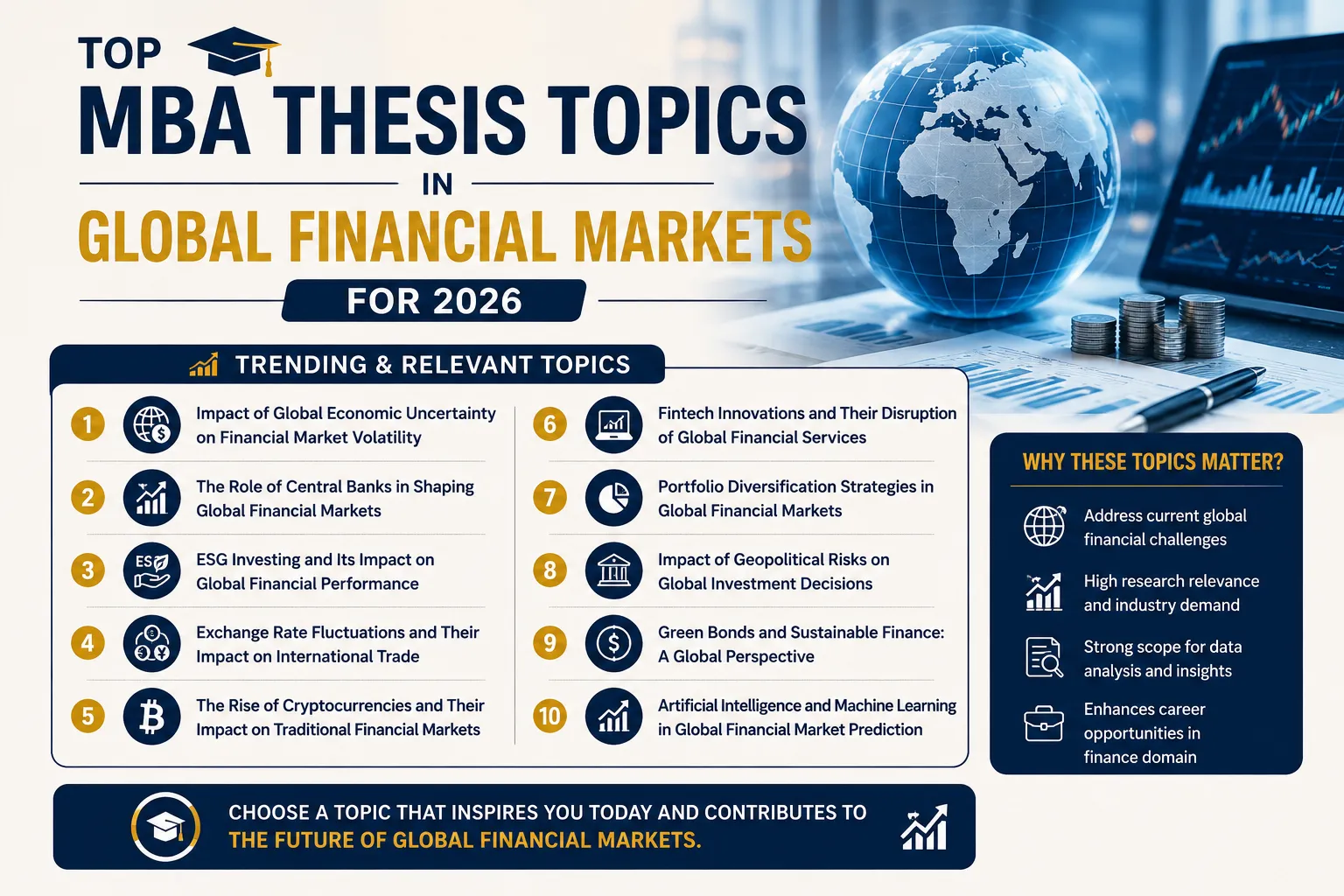
Global financial markets research offers some of the most currently relevant, headline-adjacent topics available to an MBA scholar right now — currency volatility, central bank digital currencies, ESG investing, algorithmic trading. The challenge is exactly the same as with any broad field: "global financial markets" isn't a thesis topic, it's an entire subject area. This guide walks through trending, genuinely research-ready MBA thesis topics in global financial markets for 2026, along with how to narrow a broad theme into something your supervisor will actually approve.
The Core Categories Shaping This Field
International and global financial markets research for 2026 spans several core categories: exchange rate volatility and currency risk, capital flow and financial stability in emerging markets, cross-border capital market integration, spillover effects of major economy monetary policy on global markets, and the effectiveness of capital controls in preventing financial crises. Most strong MBA thesis topics sit clearly within one of these categories, narrowed further to a specific mechanism, market, or comparison.
Trending MBA Thesis Areas in Global Financial Markets for 2026
1. Exchange Rate Volatility and Trade Impact
Exchange rate volatility's impact on international trade remains a strong, well-established direction — a representative, well-scoped approach frames this as a case study of a specific industry, giving the research both theoretical grounding and practical specificity.
Narrowed thesis example: "The Impact of INR-USD Exchange Rate Volatility on Export Competitiveness in the Indian Textile Industry"
2. Cryptocurrency Regulation and Institutional Investor Confidence
Cryptocurrency regulation and its effect on institutional investor confidence is a strong, currently trending direction, reflecting the maturing regulatory landscape around digital assets across major markets.
Narrowed thesis example: "The Relationship Between Cryptocurrency Regulatory Clarity and Institutional Investment Flows: A Comparative Study of India and Singapore"
3. Central Bank Digital Currencies (CBDCs)
Central Bank Digital Currency research specifically framed around India's RBI Digital Rupee is flagged as a currently trending direction, reflecting genuine regional relevance and a still-developing area with real room for original contribution.
Narrowed thesis example: "Consumer Awareness and Adoption Intent Toward the RBI Digital Rupee Among Urban Indian Banking Customers"
4. ESG Investing Returns vs. Traditional Portfolio Performance
ESG investing remains one of the most consistently cited trending areas across virtually every current finance research source, and comparing ESG-focused versus traditional portfolio performance offers a genuinely tractable, quantitative MBA-level research design.
Narrowed thesis example: "A Comparative Analysis of Risk-Adjusted Returns Between ESG-Focused and Traditional Mutual Funds in the Indian Equity Market"
5. ESG Score Accuracy
A more critical, currently relevant angle within the ESG space: ESG score accuracy — specifically, whether ESG scores actually reflect company behavior — represents a genuine research gap given growing scrutiny of ESG rating methodologies.
Narrowed thesis example: "Do ESG Ratings Reflect Actual Corporate Sustainability Performance? A Study of Discrepancies Among Major Indian Listed Companies"
6. Green Bonds Market Development
Green bonds and green finance market development is a specifically flagged, growing sub-area within sustainable finance, relevant for scholars interested in the intersection of climate policy and international capital markets.
Narrowed thesis example: "Determinants of Green Bond Pricing Premiums in Emerging Market Debt Issuances: Evidence from India"
7. Behavioral Biases in International Investment Decision-Making
Behavioral finance topics exploring cognitive biases in cross-border investment decision-making remain a well-established, currently active direction — examining how psychological factors, not purely rational calculation, shape international investment behavior.
Narrowed thesis example: "Home Bias and Overconfidence Among Indian Retail Investors in International Equity Investing"
8. AI and Machine Learning in Algorithmic Trading
AI and machine learning applications in algorithmic trading are specifically flagged among the most trending finance research directions for 2026, reflecting continued expansion of AI into global markets analysis.
Narrowed thesis example: "Comparative Performance of Machine Learning-Based vs. Traditional Technical Trading Strategies in Indian Equity Index Futures"
9. Systemic Risk and Financial Stability in Emerging Markets
Capital flow volatility and financial stability in emerging markets specifically remains a strong, currently relevant direction, particularly given ongoing global monetary policy shifts and their spillover effects on emerging economies.
Narrowed thesis example: "The Effect of US Federal Reserve Interest Rate Decisions on Foreign Portfolio Investment Flows into Indian Equity Markets"
10. Sharia-Compliant and Faith-Based Finance
Sharia-compliant and faith-based finance is a specifically growing academic interest area within global financial markets research, examining risk diversification and portfolio construction within Islamic finance frameworks.
Narrowed thesis example: "A Comparative Risk-Return Analysis of Shariah-Compliant vs. Conventional Equity Indices in the Indian Market"
11. Capital Controls and Financial Crisis Prevention
The effectiveness of capital controls in managing financial crises remains a strong, well-cited direction — a representative approach frames this as a comparative study across different countries, giving the research both theoretical grounding and comparative rigor.
Narrowed thesis example: "A Comparative Analysis of Capital Control Effectiveness During Currency Crises: India and Two Comparable Emerging Economies"
12. Monetary Policy Spillover Effects
Spillover effects of major economy monetary policy — particularly US Federal Reserve decisions — on global financial markets is a strong, currently active direction, connecting macroeconomic policy analysis with cross-border market behavior.
Narrowed thesis example: "Asymmetric Spillover Effects of US Monetary Policy Announcements on Emerging Market Currency Volatility"
Practical Feasibility Considerations
Global financial markets research typically relies on secondary market data rather than primary surveys, which changes your feasibility considerations compared to consumer-behavior-focused MBA research:
- Do you have access to the specific financial databases your topic requires (Bloomberg, CMIE Prowess, RBI databases, exchange-specific historical data)?
- Is your chosen comparison (across countries, across fund types, across time periods) genuinely data-available for the full period you intend to study?
- If your topic involves emerging technology (CBDCs, algorithmic trading), is there enough existing data or literature to support rigorous analysis, given how recent some of these developments are?
Step-by-Step: How to Narrow a Trending Theme Into a Defensible Thesis Topic
- Choose a specific market mechanism or instrument from the list above that genuinely interests you
- Name the specific market or comparison — Indian equities, INR-USD exchange rate, a specific pair of countries
- Define a measurable outcome — returns, volatility, adoption rate, pricing premium
- Identify your specific data source — a named database, exchange, or regulatory dataset
- Check data availability across your intended time period before finalizing the topic
- Verify the specific narrow niche isn't already comprehensively covered by very recent (2025–2026) publications
- Consider a comparative design (across countries, fund types, or time periods) to strengthen the analytical rigor of your topic
Practical Checklist: Is Your Global Financial Markets Thesis Topic Ready?
- Topic is narrowed to a specific mechanism, instrument, or market comparison, not the broad field
- Specific market, country, or comparison group is named explicitly
- A measurable outcome or relationship is defined
- Required financial database or data source is identified and genuinely accessible
- Data availability confirmed across the full intended study period
- Recent literature (2025–2026) has been checked to confirm the specific niche isn't already saturated
- Topic connects to a genuine, current market development (CBDCs, ESG scrutiny, AI trading)
Two Practical Scenarios
Scenario 1 — Narrowing an Overly Broad ESG Topic
A student initially proposed "ESG Investing and Financial Performance" — far too broad to defend as a single MBA thesis. After applying the narrowing framework, the topic became "A Comparative Analysis of Risk-Adjusted Returns Between ESG-Focused and Traditional Mutual Funds in the Indian Equity Market," specifying the exact comparison, the specific market, and a measurable outcome — resulting in a clear, data-driven design the supervisor approved.
Scenario 2 — Checking Data Availability Before Committing
A student interested in both CBDC adoption and algorithmic trading evaluated data availability: limited historical data available for the RBI Digital Rupee given its relatively recent rollout, but strong, extensive historical data access for Indian equity index futures through their university's Bloomberg terminal subscription. Recognizing this constraint, the student chose the algorithmic trading direction, which had genuinely sufficient historical data to support rigorous backtesting, over the CBDC direction, which would have required primary survey data collection instead of the secondary market data analysis originally planned.
Common Mistakes MBA Students Make Choosing Global Financial Markets Topics
- Proposing "global financial markets" or "ESG investing" as a topic itself, without narrowing to a specific mechanism, market, and comparison.
- Choosing a topic requiring database access the student doesn't actually have, without confirming availability before committing.
- Selecting an emerging-technology topic (CBDCs, novel fintech) without checking whether sufficient historical data yet exists to support rigorous analysis.
- Ignoring comparative design opportunities, missing a chance to strengthen analytical rigor through cross-country or cross-instrument comparison.
- Not checking recent literature, resulting in a topic already comprehensively covered in 2025–2026 publications, particularly common for heavily-researched areas like ESG investing.
Frequently Asked Questions
What are the top MBA thesis topics in global financial markets for 2026?
Leading areas include exchange rate volatility and trade impact, cryptocurrency regulation and institutional confidence, Central Bank Digital Currencies, ESG investing performance and rating accuracy, green bonds, behavioral biases in international investing, AI-based algorithmic trading, emerging market systemic risk, Sharia-compliant finance, capital controls, and monetary policy spillover effects.
Why does topic selection matter for an MBA thesis in global financial markets?
This field spans macroeconomic, regulatory, and instrument-specific dimensions that are each genuinely broad on their own, and a topic that isn't narrowed to a specific market, mechanism, and measurable outcome is difficult to research rigorously within a standard MBA timeline.
How does trending research area selection affect a thesis's outcomes?
Aligning with an active 2026 direction — CBDCs, ESG scrutiny, AI trading — increases relevance and potential impact, but only if the specific niche is narrowed enough to remain original and matched to genuinely available data.
How long does it take to complete an MBA thesis using this approach?
Topics relying on well-established, freely or institutionally accessible financial databases generally proceed faster than topics on very recent developments (like CBDCs) where historical data may still be limited, so factor data maturity into your topic choice early.
Is professional help available for MBA thesis topics in global financial markets?
Yes. ThesisLikho's PhD-qualified experts have guided 10,000+ scholars through topic selection, research methodology, and complete MBA thesis writing assistance tailored to global financial markets and other specializations.
Get Expert Guidance on Your MBA Global Financial Markets Thesis Topic
Narrowing global financial markets' broad, fast-moving landscape into a feasible, data-backed thesis topic takes careful attention to database access, data maturity, and current literature gaps. If you'd like expert input on refining your thesis topic or planning your research approach, ThesisLikho's PhD-qualified team offers topic selection support, research methodology guidance, and complete MBA thesis writing assistance. If you need expert guidance with your thesis topic, research design, or overall project structure, you can explore our MBA Thesis Assistance service.
Get Free MBA Thesis Consultation → https://thesislikho.com/writing-services/thesis-assistance-mba
Email: support@thesislikho.com
Mobile No.: +91-9289068414 , +91-9643802216