
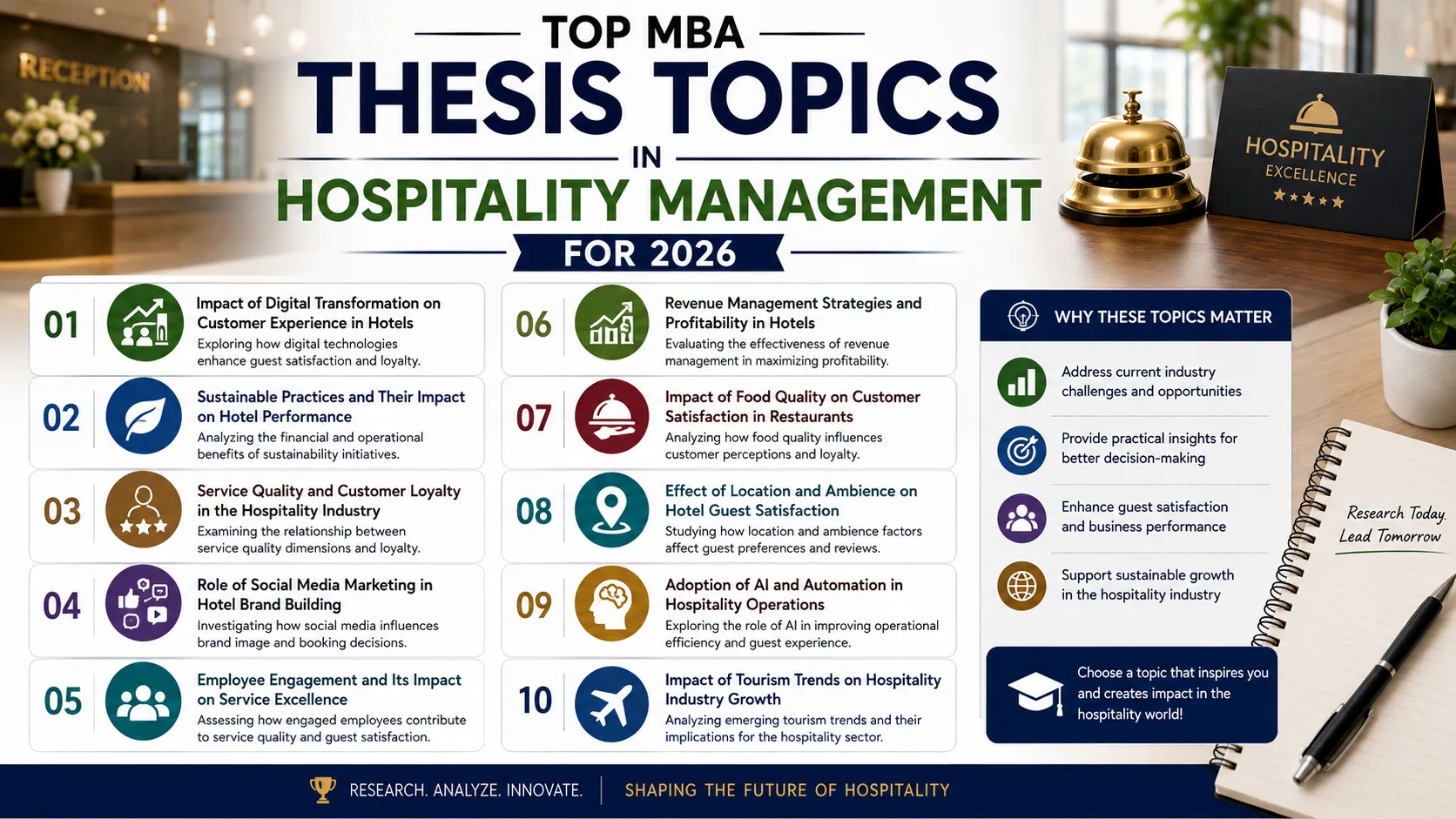
Hospitality management is in the middle of a genuinely unusual moment — AI has moved from pilot projects into daily operational reality at major hotel brands, sustainability has shifted from a marketing line into a measurable cost-saving operational practice, and India's own hospitality sector is expanding into tertiary cities and new experience categories faster than it has in years. Top MBA thesis topics in hospitality management for 2026 sit right in the middle of these live shifts — real properties making real decisions about technology adoption, guest experience design, and market expansion, all generating exactly the kind of applied, data-accessible questions an MBA dissertation is built to investigate.
This guide walks through what's actually shaping hospitality research this year, more than 100 categorized thesis topics across every major sub-area, and the guidance you need to narrow a broad interest into a topic you can realistically complete within an MBA timeline. We've grounded this in current 2026 hospitality industry and Indian tourism policy developments and the patterns we see across MBA scholars ThesisLikho supports through topic selection.
Why Hospitality Is an Especially Active Research Area Right Now
Hospitality management has moved from a largely operational, service-delivery-focused discipline into a genuinely technology- and data-driven one, and 2026 is a particularly active year for that shift. AI-driven revenue management, guest personalization, and operational forecasting are now standard practice at major hotel brands rather than experimental pilots, while sustainability has become a measurable driver of both cost savings and guest expectations rather than a voluntary commitment. At the same time, India's hospitality sector is expanding into new geographies, new guest segments, and new experience categories at a pace that creates genuinely fresh, under-researched territory.
This creates unusually rich ground for MBA research: properties, brands, and platforms are actively making adoption, expansion, and positioning decisions right now, and a well-scoped thesis can meaningfully investigate how those decisions are actually playing out. The challenge, as always, is scoping a topic narrowly enough — by property type, region, technology, or guest segment — that it remains current and genuinely achievable within an MBA timeline.
Latest Hospitality Management Trends Shaping 2026 Research
AI as operational infrastructure, not experimentation. Major hotel brands now use AI for guest-facing concierge services, predictive personalization, dynamic pricing, staffing forecasts, and maintenance scheduling as standard operating practice rather than pilot projects. This shift creates a specific research opportunity: adoption is now widespread enough among large brands that meaningful comparative and effectiveness research is possible, while adoption among independent and mid-market properties remains considerably less studied.
Intelligent Guest Profiles and unified data architecture. Hotels are increasingly consolidating guest data across property management systems and point-of-sale platforms into unified guest identity profiles, enabling more relevant personalization and upsell recommendations — a genuinely current shift in how hospitality technology infrastructure is being redesigned, with adoption maturity varying considerably across property types and brand tiers.
Sustainability as an operational and financial driver. Energy management systems, waste tracking, and water-efficiency programs are increasingly adopted specifically because they lower operating costs and strengthen asset value, not primarily for marketing purposes — a shift that creates research opportunities around measurable ROI from sustainability investment, not just guest perception of sustainability claims.
Workforce transition and skill requirements. Leadership roles increasingly require digital fluency and the ability to manage hybrid human-AI operations, alongside continuing structural challenges around staff turnover and shortages — creating research opportunities at the intersection of technology adoption and human resource strategy.
Personalization and experience-driven demand. Guests increasingly seek unique, experience-driven stays rather than standardized offerings, and hotels are responding with wellness-focused, MICE-driven (meetings, incentives, conferences, exhibitions), and experiential positioning strategies.
Real-time, AI-driven revenue management. Automated pricing systems that adjust rates instantly based on booking patterns, local events, and competitor pricing are increasingly standard even among independent and boutique properties, extending revenue management sophistication well beyond what was previously accessible only to large chains.
India-Specific Developments Worth Building a Thesis Around
India's hospitality sector offers an unusually strong current policy and market backdrop for MBA research. The Union Budget 2026–27 positions tourism explicitly as a high-impact growth sector, with new initiatives spanning Buddhist circuit expansion in the North-East, eco-trail development across biodiversity zones, heritage site revitalization, and dedicated medical tourism hub development — each representing a genuinely current, government-backed growth area with limited existing academic research. The Swadesh Darshan 2.0 scheme has sanctioned 53 projects worth approximately $265 million as of 2026, focused specifically on experience-driven and sustainable tourism development, offering concrete, traceable government investment to ground a thesis around.
India's hospitality sector has been described by industry analysts as entering a "golden cycle" in 2026, supported by sustained growth in average room rates and strong investment returns — alongside a clear structural shift toward regional and tertiary market expansion, with more than half of all new hotel signings in recent years occurring outside major metros, and national occupancy reaching notable highs driven by domestic travel. This regional expansion, alongside a growing preference for asset-light models (management contracts and franchising over direct ownership), wellness tourism, and MICE-driven destinations, creates rich, under-studied research territory specifically because these shifts are recent enough that academic literature hasn't fully caught up with current industry practice.
100+ Categorized MBA Thesis Topics in Hospitality Management
Use these as starting points that still need narrowing to a specific property type, region, brand tier, or guest segment before becoming a defensible thesis question.
AI and Technology Adoption Topics
- AI-driven revenue management adoption among independent Indian hotels
- Guest perception of AI-powered concierge services in Indian luxury hotels
- Intelligent Guest Profile adoption barriers among mid-scale hotel chains
- AI-based predictive maintenance impact on operational cost reduction
- Chatbot adoption effectiveness in guest query resolution
- AI-driven staffing forecast accuracy in seasonal hospitality demand
- Voice search optimization strategies for hotel discoverability
- Employee trust and adoption of AI-assisted scheduling systems
Revenue Management and Pricing Topics
- Real-time dynamic pricing adoption among boutique Indian properties
- Total Revenue Per Available Room (TRevPAR) optimization strategies
- Channel-specific pricing strategy effectiveness across OTA platforms
- Revenue management maturity comparison across hotel tiers
- Demand forecasting accuracy: AI-driven versus traditional methods
- Ancillary revenue optimization through context-aware upsell systems
- Pricing strategy adaptation during regional tourism demand surges
- Competitor-based pricing intelligence adoption among independent hotels
Sustainability and ESG Topics
- Energy management system ROI in mid-sized Indian hotel properties
- Guest willingness to pay for sustainability-certified accommodations
- Water-efficiency program adoption and operational cost impact
- Greenwashing perception risk in hospitality sustainability marketing
- Waste tracking system implementation challenges in hotel operations
- Sustainable sourcing practices in hotel food and beverage operations
- Carbon footprint disclosure practices among Indian hospitality brands
- Regenerative tourism project impact on local community outcomes
Guest Experience and Personalization Topics
- Personalization technology's effect on guest loyalty in Indian hotel chains
- Wellness tourism demand drivers among urban Indian travelers
- Experience-driven travel preferences among Gen Z Indian tourists
- Guest data privacy concerns and personalization technology trust
- Unified guest profile systems and cross-property personalization consistency
- Bleisure (business plus leisure) travel demand patterns post-pandemic
- Immersive technology adoption in luxury hotel guest experience design
- Guest feedback loop effectiveness in service recovery outcomes
Hotel Operations and Management Topics
- Asset-light expansion model effectiveness for regional Indian hotel brands
- Management contract versus franchise model outcomes in tertiary markets
- Operational efficiency gains from unified hotel management systems
- Housekeeping workforce productivity under AI-assisted scheduling
- Front office technology adoption impact on check-in guest satisfaction
- Multi-property operational standardization challenges in regional expansion
- Hotel maintenance cost reduction through predictive analytics adoption
- Cross-departmental data integration challenges in mid-market hotels
Market Expansion and Regional Growth Topics
- Tertiary city hotel expansion strategy effectiveness for branded chains
- Regional connectivity improvement impact on hospitality demand in Tier-2 cities
- Heritage site revitalization impact on regional tourism hospitality demand
- Medical tourism hub development and hospitality sector readiness
- Buddhist circuit tourism infrastructure impact on regional hotel investment
- Eco-trail tourism development and hospitality demand in biodiversity zones
- Franchise expansion strategy for regional Indian hotel brands
- Domestic tourism demand drivers in India's post-pandemic travel recovery
Workforce and Human Resource Topics
- Digital fluency skill gap among hospitality management professionals
- Employee turnover reduction strategies in Indian hotel operations
- Hybrid human-AI operations management leadership readiness
- Workforce upskilling program effectiveness for AI-integrated hotel roles
- Staff retention strategies in tertiary market hotel expansion
- Gig economy staffing models in seasonal hospitality demand management
- Employee wellbeing initiatives and service quality outcomes
- Cross-cultural training effectiveness for international guest service teams
MICE and Event Tourism Topics
- MICE (meetings, incentives, conferences, exhibitions) demand growth in regional India
- Convention center hospitality partnership models in emerging destinations
- Corporate event hosting decision factors for Indian business travelers
- Hybrid event format adoption impact on hospitality revenue streams
- Destination positioning strategy for MICE-focused tourism growth
- Incentive travel program design for corporate client retention
Digital Marketing and Distribution Topics
- OTA (online travel agency) dependency and direct booking strategy effectiveness
- Social media influencer marketing ROI for boutique hotel brands
- Large language model optimization strategy for hotel discoverability
- Review platform reputation management practices among independent hotels
- AI-powered travel discovery adoption impact on booking conversion
- Direct booking incentive program effectiveness against OTA commission costs
- Content strategy effectiveness for regional destination marketing
Financial and Investment Topics
- Hotel investment return patterns during India's hospitality "golden cycle"
- Private equity investment trends in regional Indian hotel development
- Asset-light versus asset-heavy expansion financial performance comparison
- Government land monetization impact on hospitality infrastructure investment
- Hotel REIT performance analysis in the Indian hospitality market
- Occupancy rate and average room rate correlation across property tiers
- Capital deployment strategy analysis for hospitality portfolio expansion
Food and Beverage Management Topics
- Organized dining expansion impact on hotel food and beverage revenue
- Farm-to-table sourcing adoption in premium Indian hotel restaurants
- Food waste reduction technology adoption in hotel kitchen operations
- Quick-service restaurant partnership models within hotel properties
- Regional cuisine positioning strategy for destination hotel branding
- Beverage program innovation and guest experience differentiation
Crisis Management and Resilience Topics
- Hotel demand recovery strategies following geopolitical disruption
- Seasonal demand volatility management in regional tourism destinations
- Crisis communication practices during hospitality reputational events
- Business continuity planning maturity among independent hotel operators
- Weather-related disruption preparedness in destination tourism properties
Technology Infrastructure Topics
- Property management system integration challenges in multi-brand portfolios
- Data governance practices in unified guest identity platform adoption
- Cybersecurity risk management in digitally integrated hotel operations
- Cloud-based hotel management platform adoption barriers among independents
- IoT sensor adoption for energy management in Indian hotel properties
- Mobile check-in technology adoption impact on staffing and satisfaction
Luxury and Premium Segment Topics
- Ultra-luxury hotel brand expansion strategy in emerging Indian markets
- Premium guest loyalty program design in the competitive luxury segment
- International luxury brand entry strategy into regional Indian markets
- Wellness retreat positioning strategy for high-net-worth Indian travelers
- Experiential luxury demand drivers among affluent domestic travelers
Comparative and Benchmarking Topics
- Service quality benchmarking across Indian hotel tiers
- Technology adoption maturity comparison: metro versus tertiary market hotels
- Guest satisfaction benchmarking across asset-light and directly-owned properties
- Sustainability practice adoption comparison across international and domestic hotel brands
Emerging and Interdisciplinary Topic Areas
Several of the strongest 2026 topics sit at the intersection of hospitality and other disciplines rather than inside a single traditional silo. Hospitality plus AI ethics examines guest data privacy and consent questions raised by increasingly sophisticated personalization technology. Hospitality plus sustainability finance examines how measurable ROI from sustainability investment is reshaping capital allocation decisions in hotel development. Hospitality plus regional economic development examines how government-backed tourism infrastructure investment is translating into measurable local hospitality sector outcomes. Hospitality plus organizational behavior examines how hybrid human-AI operations are reshaping leadership and workforce management practices specifically within service-intensive environments.
Interdisciplinary topics tend to require slightly more careful methodological scoping, since they draw on two distinct bodies of literature — but they also tend to align well with what's genuinely novel in the field right now, since these intersections remain relatively under-studied compared to single-discipline hospitality questions.
Choosing a Topic You Can Actually Complete
The most important filter for any topic on this list is feasibility within a typical MBA timeline of three to six months. A topic that sounds compelling but depends on data you can't realistically access — internal AI system performance data from a major hotel chain with no existing relationship to you, for instance — will create problems regardless of how current or interesting the subject is.
A useful test: can you name, specifically, where your data will come from — a property or brand you have genuine access to, a government or industry database, a defined set of guests or properties you can survey — before finalizing your topic? If the answer is vague, narrow the topic further until it isn't. For guidance on this narrowing process more broadly, see our related guide, how to choose a strong thesis topic your supervisor will approve.
Data Access: What's Realistic for an MBA Timeline
Hospitality topics vary considerably in how easy they are to research within an MBA-scale study. Topics involving cutting-edge AI or technology adoption often require genuine access to a property or brand already implementing the specific technology, since detailed operational data on these practices remains limited in public sources — securing this access early, ideally before finalizing the topic, is essential. Topics grounded in broader industry or government data (tourism policy impact, regional expansion patterns, occupancy and investment trends) can often draw substantially on published industry reports, government tourism ministry data, and existing market research already available, making them more feasible for scholars without a direct property relationship already secured.
A single-property or single-brand case study remains one of the most practical and defensible designs for an MBA-scale hospitality thesis, since it doesn't require the broader access a multi-property comparative study would demand. It's also worth distinguishing between topics genuinely needing primary guest or staff data — such as guest perception of a specific personalization technology — and topics that can be substantially answered through secondary industry and government data, such as regional hotel investment trends following a specific policy initiative.
Real MBA Thesis Topic Refinement Example
An MBA student initially proposed a thesis on "AI in the hospitality industry" — far too broad to defend, since it implicitly covers every AI application across every hospitality function. After discussing feasibility with her supervisor, she narrowed the topic to: "Guest perception and trust in AI-powered concierge services: a case study of three mid-scale hotel properties in Bengaluru." This version had a specific technology (AI concierge services, not AI broadly), a specific outcome (guest perception and trust), a specific and accessible property tier and region (mid-scale hotels in a single city, where she had existing industry contacts), and a feasible multi-property survey and interview-based methodology. The narrowed version was both more defensible to her committee and considerably more achievable within her remaining thesis timeline than the original broad framing.
Common Mistakes When Choosing a Hospitality Topic
- Choosing a topic scoped at the entire industry or national level when a specific property type, region, or guest segment would be both more defensible and more achievable.
- Building a topic entirely around a cutting-edge technology without confirming genuine property or brand access, since detailed operational data on emerging practices like AI-driven revenue management remains limited publicly.
- Ignoring data access feasibility until after the topic is finalized, rather than checking concretely where the data will come from first.
- Choosing an oversaturated topic — general "sustainability in hospitality" or "AI in hotels" studies are currently popular, meaning differentiation through a specific mechanism, property tier, or region matters more than usual.
- Underestimating how quickly a "current" industry trend can shift, since technology adoption practices and terminology in areas like AI-driven personalization are still evolving rapidly.
- Overlooking accessible government and industry data sources in favor of assuming primary property-level data collection is the only viable option.
- Choosing a multi-region or multi-brand comparative design without realistically accounting for the added time and access complexity compared to a single-property or single-region study.
Topic Selection Checklist
Before finalizing your hospitality management thesis topic, confirm:
- Your topic is narrowed to a specific property type, region, or guest segment, not an industry-wide generalization
- You've identified concretely where your data will come from, whether property access, government tourism data, or industry reports
- The topic connects to a genuinely current hospitality development, with enough grounding to remain relevant through your completion timeline
- Your chosen topic and available access are realistic for your specific MBA timeline
- You've checked existing literature to confirm your specific angle isn't already extensively covered
- Your supervisor has reviewed and approved the narrowed, feasible version of your topic
For guidance on identifying what makes your narrowed topic a genuine contribution rather than a restatement of existing work, see our related guide, [what is a research gap and how to identify one for your thesis].
How Long Does It Take to Complete an MBA Thesis Using This Approach?
Most MBA hospitality management dissertations take three to six months from finalized topic to submission, within an overall MBA program timeline of one to two years. Topics grounded in accessible government or industry data tend to move faster through the research phase than topics requiring extensive primary access to a property piloting cutting-edge technology, which is worth factoring into your topic choice from the start.
Is Professional Help Available for Top MBA Thesis Topics in Hospitality Management for 2026?
Yes — many MBA students work with academic mentors or research consultancies to narrow a broad hospitality interest into a feasible, well-scoped topic, identify realistic data sources, and align their topic with genuinely current industry and policy developments. ThesisLikho's research experts have supported MBA scholars across hospitality management and related specializations, helping ensure every topic is both academically substantive and realistically achievable within an MBA timeline — all while keeping the underlying research and analysis entirely your own. Explore ThesisLikho's MBA thesis assistance services for one-on-one guidance.
FAQs
What is top MBA thesis topics in hospitality management for 2026?
These are current, well-scoped research areas for MBA hospitality management dissertations, shaped by 2026 developments including AI's mainstreaming across hotel operations, sustainability becoming an operational cost driver, and India's regional hospitality expansion under Union Budget 2026-27 initiatives and the Swadesh Darshan 2.0 scheme — narrowed to specific property types, regions, or guest segments feasible within an MBA timeline.
How long does it take to complete an MBA thesis using this approach?
Most MBA hospitality management dissertations take three to six months from finalized topic to submission, with topics grounded in accessible government or industry data typically moving faster than those requiring extensive access to a property piloting emerging technology.
Is professional help available for top MBA thesis topics in hospitality management for 2026?
Yes. Research consultancies and academic mentors, including ThesisLikho's experts, help MBA students narrow broad interests into feasible, current, well-supported hospitality topics while preserving full research originality.
Why does top MBA thesis topics in hospitality management for 2026 matter?
Because hospitality management is unusually dynamic right now — AI adoption, sustainability-driven cost strategy, and regional market expansion are actively reshaping how properties and brands operate, creating genuine, timely research opportunities that a well-scoped topic can meaningfully contribute to.
How does top MBA thesis topics in hospitality management for 2026 affect an MBA thesis?
Your topic choice determines what data you can realistically access, how defensible your research question is to a committee, and whether your findings remain relevant given how quickly hospitality technology and market conditions can shift — a well-chosen, appropriately narrowed topic makes every later stage of the thesis considerably more manageable.
Ready to turn a broad hospitality interest into a defensible thesis topic?
Get Free MBA Thesis Consultation → https://thesislikho.com/writing-services/thesis-assistance-mba