
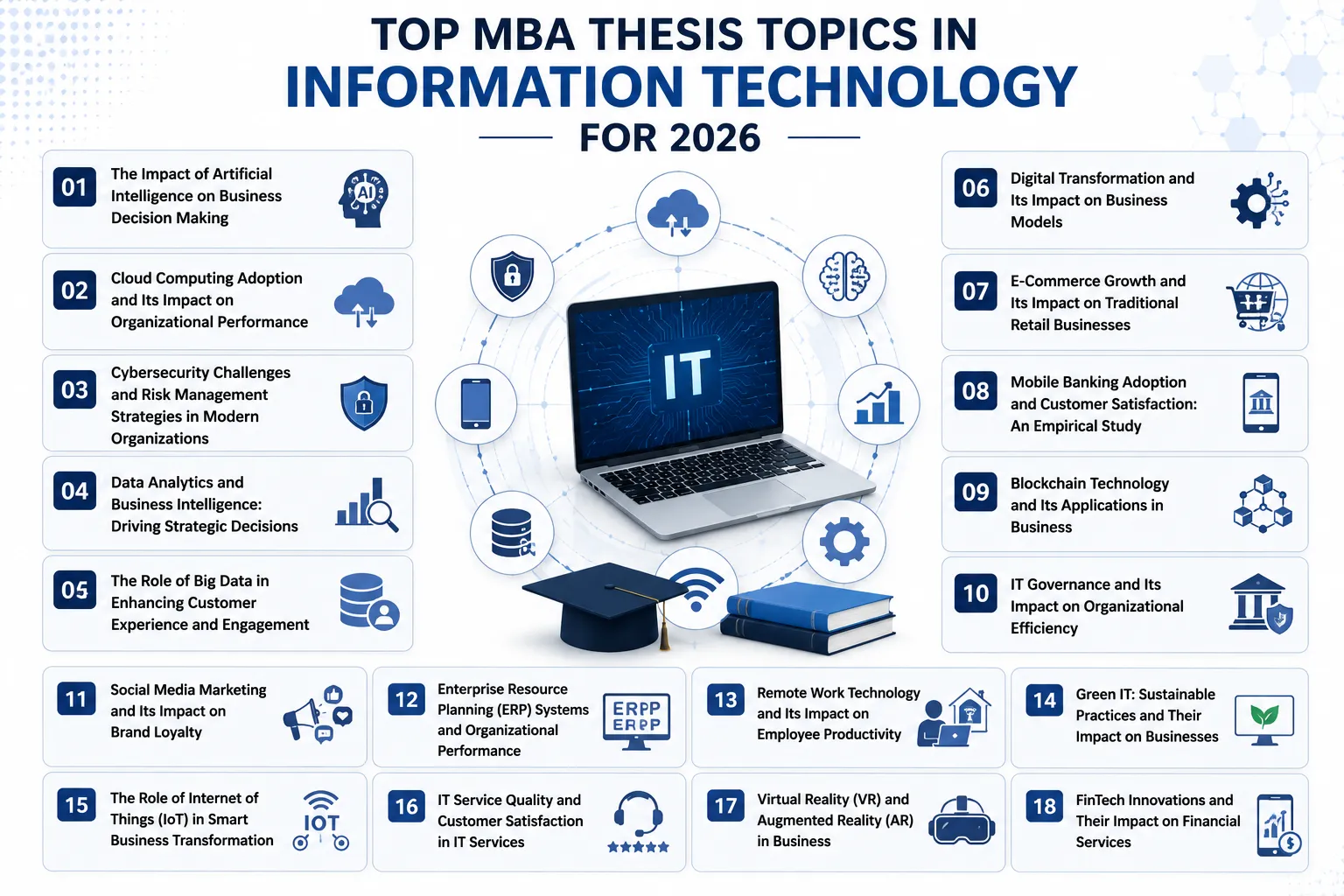
If you're an MBA scholar staring at your fourth-semester dissertation requirement and typing "top MBA thesis topics in information technology for 2026" into Google at midnight, you're in familiar company. Information Technology is one of the busiest MBA specializations to write in — everyone wants "AI" or "digital transformation" in the title, and that's exactly why so many proposals get sent back for being too broad, too vague, or too disconnected from real organizational data.
This guide is built the way an experienced management research supervisor would walk you through it — not a recycled list of buzzwords, but a working framework: what to research, how to narrow a broad IT theme into something defensible, which methodology fits which topic, and where the analysis usually falls apart.
At ThesisLikho, our PhD-qualified mentors have guided more than 10,000 scholars through dissertation topic selection, proposal structuring, and viva preparation across MBA, PhD, and other research programmes. What follows draws on that mentoring experience, checked against current academic guidance on MBA dissertation structure in India and 2025–2026 developments in IT governance, AI adoption, and digital transformation research.
1. Why IT Thesis Topics Are Harder to Choose Than They Look
Information Technology sits at an odd intersection in an MBA programme: it's technical enough that a poorly scoped topic can turn into a computer science project instead of a management dissertation, and it's fast-moving enough that "current" research can feel outdated within a year. A dissertation on "blockchain in business" written with 2021-era framing, for instance, reads very differently in 2026, when the practical conversation has moved to AI governance, agentic automation, and IT-business alignment.
This is why top mba thesis topics in information technology for 2026 for MBA thesis work is really about picking a defensible, organization-relevant angle rather than the most exciting technology name. A good IT dissertation topic combines a real business problem, a management-relevant research question (not a purely technical one), and data you can actually access within your programme's tight timeline — typically one semester of fieldwork inside a four-to-six semester MBA.
2. Where MBA Dissertations in IT Actually Fit Within the Business Research Landscape
Before choosing a topic, it helps to understand what an MBA IT dissertation is — and isn't. Most Indian B-schools, operating under AICTE's technical education framework for management programmes, require a fourth-semester dissertation or project report supervised by a faculty guide, typically structured around six chapters: introduction and objectives, literature review, research methodology, data presentation and analysis, interpretation, and conclusions. Guidelines commonly recommend the dissertation be organization-specific rather than a broad macro-level study — a preference worth keeping in mind as you scope your IT topic.
This is a meaningfully different research design than a PhD thesis: an MBA dissertation in IT is expected to demonstrate applied managerial insight — how a technology, governance framework, or digital initiative affects business outcomes — rather than original technical contribution to computer science or information systems theory. Keep this framing in mind throughout: every topic below is written as a management research question, not an engineering one.
Citation discipline still matters. Most Indian MBA programmes expect APA-style or a university-prescribed referencing format, with a properly organized, alphabetized reference list and consistent in-text citations — a reference manager like Mendeley (offered free by Elsevier) is widely used by MBA and PhD scholars to keep large literature reviews consistent across drafts.
3. Top MBA Thesis Topics in Information Technology for 2026
Treat the list below as starting directions, not final titles — narrow each to a specific organization, sector, or variable before taking it to your guide.
A. Digital Transformation & IT Strategy
- Impact of digital transformation initiatives on organizational agility in mid-sized Indian manufacturing firms
- Role of top management support in digital transformation success
- Legacy system modernization strategies and their effect on operational efficiency
- Digital transformation maturity models: a comparative sector analysis
- IT-business strategic alignment and its effect on firm performance
- Digital business model innovation in traditional retail organizations
- Change management strategies during enterprise digital transformation
- The role of organizational culture in digital transformation adoption
- Digital transformation in SMEs: barriers and enablers in the Indian context
- Post-pandemic acceleration of digital transformation: a sector comparison
- Measuring ROI of digital transformation investments
- Digital transformation and employee digital skill readiness
B. Artificial Intelligence & Business Decision-Making
- Impact of AI-driven decision support systems on managerial decision quality
- Employee perception and trust in AI-assisted decision-making
- AI adoption in HR recruitment: bias, fairness, and organizational outcomes
- Generative AI adoption in marketing content strategy: a case study approach
- AI-driven customer service transformation and customer satisfaction outcomes
- Impact of agentic AI systems on middle management roles
- AI adoption readiness assessment framework for Indian SMEs
- Ethical considerations in AI-based performance evaluation systems
- AI-powered demand forecasting and its impact on inventory management
- Organizational readiness for AI-native operations: a maturity assessment
- Impact of AI chatbots on customer relationship management outcomes
- AI adoption barriers among traditional Indian family-owned businesses
C. Cybersecurity Management & IT Risk
- Impact of cybersecurity governance frameworks on organizational risk posture
- Employee cybersecurity awareness and its effect on data breach incidents
- Cybersecurity investment decision-making in mid-sized enterprises
- Impact of remote/hybrid work models on organizational cybersecurity risk
- Board-level cybersecurity oversight and its effect on incident response readiness
- Comparative analysis of cybersecurity frameworks (NIST vs. ISO 27001) adoption in Indian firms
- Cyber-risk insurance adoption trends among Indian enterprises
- Impact of data breach incidents on brand trust and customer retention
- Third-party vendor cybersecurity risk management practices
- Cybersecurity culture and its influence on employee compliance behavior
D. IT Governance & Enterprise Architecture
- Impact of COBIT-based IT governance frameworks on IT-business alignment
- IT governance maturity and its relationship with organizational performance
- Enterprise architecture adoption and its effect on IT project success rates
- Role of IT steering committees in strategic technology decision-making
- IT governance challenges in merger and acquisition integration
- Impact of IT governance frameworks on regulatory compliance outcomes
- Decentralized vs. centralized IT governance models: a comparative study
- IT portfolio management practices and project prioritization effectiveness
- Governance challenges in multi-cloud enterprise environments
- IT governance and its role in managing shadow IT risk
E. Cloud Computing & IT Infrastructure Strategy
- Cloud migration strategy and its impact on operational cost efficiency
- Multi-cloud adoption strategies among Indian enterprises
- Cloud-native application development and time-to-market advantages
- Impact of cloud computing adoption on business continuity planning
- Vendor lock-in risk management in enterprise cloud strategy
- Cloud computing adoption barriers among traditional Indian SMEs
- Hybrid cloud infrastructure decisions and total cost of ownership analysis
- Cloud security governance practices in regulated industries (BFSI, healthcare)
- Impact of cloud-based ERP adoption on business process standardization
- Edge computing adoption in manufacturing: an operational efficiency study
F. Data Analytics & Business Intelligence
- Impact of business intelligence adoption on strategic decision-making speed
- Data-driven culture development and its effect on organizational performance
- Predictive analytics adoption in customer churn management
- Big data analytics capability and competitive advantage in retail
- Data governance frameworks and their impact on data quality outcomes
- Business analytics maturity models: a sector comparison
- Impact of self-service BI tools on managerial decision autonomy
- Data literacy programmes and their effect on analytics adoption
- Workforce analytics adoption and its impact on HR decision-making
- Customer data platform adoption and personalization outcomes
G. E-Commerce, Digital Marketing & IT-Enabled Business Models
- Impact of omnichannel IT integration on customer experience outcomes
- D2C business model scalability through IT infrastructure investment
- Digital payment adoption and consumer trust in Tier-2/Tier-3 Indian cities
- Impact of personalization algorithms on e-commerce conversion rates
- Social commerce adoption and its effect on SME revenue growth
- IT-enabled supply chain visibility and customer satisfaction
- Impact of mobile-first strategy on digital customer acquisition
- Subscription-based business model sustainability through IT platforms
- Marketplace platform governance and seller trust dynamics
- Digital customer journey mapping and conversion optimization
H. Enterprise Systems (ERP/CRM) Implementation
- Critical success factors in ERP implementation among mid-sized Indian firms
- Change management strategies during ERP rollout
- Post-implementation ERP evaluation: user satisfaction and business value
- CRM system adoption and its effect on sales team performance
- Integration challenges between legacy ERP and modern digital platforms
- Impact of ERP customization versus standardization on implementation success
- User resistance factors during enterprise system implementation
- Cloud ERP versus on-premise ERP: a total-value comparison
- CRM data quality management and its impact on customer retention
I. IT Project Management & Agile Transformation
- Impact of Agile methodology adoption on IT project success rates
- Hybrid Agile-Waterfall project management practices in enterprise IT
- IT project failure factors: a root-cause analysis across sectors
- Impact of Scrum adoption on cross-functional team collaboration
- IT vendor management practices and project delivery outcomes
- Risk management practices in large-scale IT implementation projects
- Impact of remote/distributed teams on Agile project delivery
- IT project governance and stakeholder communication effectiveness
- DevOps adoption and its impact on software delivery speed
J. Fintech, Blockchain & Emerging Technology Adoption
- Fintech adoption and its impact on traditional banking service models
- Blockchain adoption in supply chain transparency: a feasibility study
- Consumer trust in digital lending platforms
- Impact of open banking APIs on financial services innovation
- Blockchain-based smart contracts in vendor management: an adoption study
- Regulatory technology (RegTech) adoption in Indian financial institutions
- Digital wallet adoption patterns among urban and semi-urban consumers
- Impact of embedded finance on traditional retail business models
- Blockchain adoption barriers among Indian logistics companies
K. Sustainability & IT Governance Convergence
- Green IT adoption and its impact on organizational sustainability metrics
- IT's role in enabling ESG reporting and data transparency
- Sustainable data center practices and cost-efficiency outcomes
4. Latest Information Technology Research Trends Shaping 2026
A few cross-cutting shifts are worth understanding before committing to a domain:
- AI-native operations are becoming a board-level conversation. Industry analysis suggests that by 2026, a substantial share of routine activity in certain business functions — such as customer service — is expected to run through AI-first workflows, with human involvement reserved for exceptions and relationship-sensitive cases (Source: IMD Global Center for Digital and AI Transformation). For a dissertation, this shift makes "AI adoption impact on X business function" topics timely, provided you can access organizational data on actual adoption outcomes rather than intentions alone.
- Digital transformation research is increasingly bibliometric and cross-sector, with recent systematic reviews tracking a sharp rise in digital transformation and information systems publications, alongside a stronger connection between digital transformation and sustainability goals (Source: Journal of Information Systems and Informatics).
- IT governance frameworks like COBIT remain the reference model for aligning IT with enterprise strategy, and 2026 discourse increasingly folds AI governance and cybersecurity alignment directly into IT governance frameworks rather than treating them as separate concerns (Source: ISACA).
- General MBA/business dissertation trends for 2026 point toward AI-driven decision-making, ESG and sustainability strategy, hybrid/remote work models, and digital-business-model topics as the dominant themes across MBA cohorts — IT-specific dissertations that connect to one of these broader business themes tend to be easier to position for supervisor approval and eventual publication.
5. A Topic Selection Framework You Can Actually Use
Use this four-step filter rather than picking a topic on instinct or trend-chasing alone:
Step 1 — Interest-to-Access Match. List two or three IT themes you're genuinely curious about, then check which ones you can realistically access organizational data for — through an internship, a family business, a placement company, or a willing HR/IT contact. Access, not ambition, decides your first cut.
Step 2 — Gap Verification. Search recent literature (Google Scholar, Scopus, EBSCO) for the last 3–5 years in your shortlisted area. If the topic is saturated with near-identical Indian-context studies, narrow further by sector, company size, or specific technology.
Step 3 — Scope Reality Check. Confirm your dissertation timeline (commonly one semester of fieldwork within a fourth-semester MBA project) can accommodate your intended data collection method — a large-scale multi-organization survey is rarely feasible in that window; a single-organization case study usually is.
Step 4 — Managerial Relevance Check. Ask: "What decision would a manager make differently because of this research?" If you can't answer that in one sentence, the topic still needs narrowing.
6. How to Identify a Genuine Research Gap in IT Management
A research gap in MBA IT dissertations is not simply "nobody has studied this exact company" — that's true of almost every organization and doesn't by itself make the study valuable. A genuine, defensible gap usually satisfies three conditions:
- It's flagged in existing literature — a "limitations" or "future research" section noting an unexplored moderating variable, an unstudied sector, or conflicting findings.
- It has clear managerial relevance — a finding that would change how a manager allocates budget, structures a team, or evaluates a vendor.
- It's answerable with a method and dataset available to you within your programme's timeline.
A practical technique: pull 12–15 recent papers in your shortlisted IT theme, note their stated limitations in a spreadsheet, and look for the two or three that recur. That recurring limitation is usually your strongest, most defensible gap — and a much safer starting point than an "AI is transforming everything" framing. For a deeper walkthrough, see What Is a Research Gap and How to Identify One for Your Thesis.
7. Topic Feasibility Checklist
Before presenting any topic to your dissertation guide, verify each of these:
☐ Organization/data access confirmed for the fieldwork window
☐ Survey or interview sample size realistic for your timeline
☐ Topic framed as a managerial question, not a purely technical one
☐ At least 10–15 recent, relevant literature sources identified
☐ Research methodology matched to available data type
☐ Guide has relevant expertise or interest in the chosen IT domain
☐ Topic narrow enough to state in one sentence with clear variables
☐ Reference management system (e.g., Mendeley) set up before literature review begins
8. Choosing the Right Research Methodology for IT Dissertations
- Digital transformation / IT strategy — Case study analysis with semi-structured leadership interviews. Single-organization case studies are usually most feasible within a semester.
- AI in decision-making — Survey-based quantitative study using employee perception scales. Validated survey instruments from prior literature save development time.
- Cybersecurity management — Mixed methods combining policy/document analysis with an employee survey. Access-sensitive; anonymize data collection carefully.
- IT governance — Framework-based content analysis paired with expert interviews. A good option for scholars without heavy quantitative data access.
- Cloud computing / infrastructure — Comparative case study with cost-benefit/TCO analysis. Requires access to internal cost data, so confirm early.
- Data analytics / BI — Quantitative survey with regression/correlation analysis. Requires a reasonably large sample for statistical validity.
- ERP/CRM implementation — Case study with pre/post implementation comparison. Strong option when you have access to a company mid-implementation.
- Agile/IT project management — Mixed methods combining project data analysis with team interviews. Works well with placement-company access.
- Fintech/blockchain adoption — Survey-based consumer adoption study using established models like TAM or UTAUT, which simplify design.
9. Supervisor Approval Tips
- Bring two to three narrowed options, not a broad theme — arriving with "I want to study AI" invites rejection; arriving with a scoped question invites feedback.
- Show data access is already lined up. Guides approve topics faster when fieldwork feasibility is demonstrated, not assumed.
- Use an established theoretical model where possible (TAM, UTAUT, COBIT, Resource-Based View) — it signals academic grounding and speeds up the literature review chapter.
- Prepare a one-page concept note: background, gap, research question(s), objectives, methodology, and timeline — before your guide meeting, not during it.
- Anticipate the "so what" question. Be ready to explain the managerial implication of your likely findings, even hypothetically.
10. Common Mistakes First-Time MBA Thesis Writers Make
- Choosing a topic that's really a technology tutorial ("What is blockchain?") rather than a management research question ("How does blockchain adoption affect vendor trust in logistics firms?").
- Underestimating how hard organizational data access actually is — always confirm access before finalizing scope, not after.
- Copying trend lists verbatim without adapting them to an accessible organization, sector, or dataset.
- Skipping the theoretical framework — a dissertation without an established model (TAM, UTAUT, RBV, COBIT) often struggles to justify its analysis structure.
- Neglecting citation consistency early, leading to a scramble to fix formatting in the final week.
- Treating the literature review as a summary rather than a synthesis — reviewers want to see gaps and contradictions surfaced, not just summarized abstracts.
- Ignoring the "why 2026" justification — a strong IT dissertation explains why the question matters now, not just that the technology exists.
11. Publication and Presentation Opportunities
While most MBA dissertations aren't required to publish, a strong IT-focused dissertation can often be adapted into a conference paper or case-study submission for management research conferences, or a shorter article for institutional research journals — useful for scholars considering an MDP, further research, or an academic career path. Structuring your data analysis chapter with clear, publishable tables and a defensible methodology from the outset makes this conversion far easier later.
12. Two Realistic Case Studies
Case Study 1 — From "AI in Business" to a Defensible Dissertation An MBA scholar at a Tier-1 Indian B-school began with the idea "AI in business decision-making" — a topic so broad that the guide sent it back at the first review. After a structured gap-verification exercise, the scholar narrowed the scope to the impact of AI-driven customer service chatbots on customer satisfaction in mid-sized Indian e-commerce firms, using access gained through a summer internship at a retail-tech company. The narrowed scope — one technology, one function, one accessible sector — is what got the topic approved on the second submission.
Case Study 2 — Building a Dissertation Around Existing Organizational Access A first-time MBA thesis writer without a strong research background had placement access to a mid-sized IT services firm undergoing ERP migration. Rather than chasing a trend topic, the scholar designed a pre/post-implementation case study on critical success factors in ERP adoption and their effect on cross-departmental data consistency, using internal implementation logs and structured employee interviews. Because the access was already secured, the dissertation avoided the most common failure point — data collection delays — and was completed within the standard timeline.
If your topic idea resembles either of these scenarios, our MBA Thesis Assistance service can help you pressure-test scope, build the concept note, and prepare your fourth-semester proposal defense.
FAQs
What is "top MBA thesis topics in information technology for 2026"?
It refers to identifying current, feasible, and management-relevant dissertation topics within IT-focused MBA research for the 2026 academic cycle — spanning digital transformation, AI adoption, cybersecurity management, IT governance, cloud strategy, and related domains.
Why does top MBA thesis topics in information technology for 2026 matter?
Because topic selection determines whether you can realistically access the data you need, whether your guide approves the proposal quickly, and how defensible your analysis will be at final evaluation — problems here are far harder to fix mid-dissertation than before you start.
How does this approach affect an MBA thesis in practice?
Scholars who apply a structured feasibility and gap-verification process before finalizing a topic typically experience fewer guide rejections, smoother data collection, and a clearer path to a well-defended final report.
How long does it take to complete an MBA thesis using this approach?
Most Indian MBA dissertations are completed within a single semester (commonly the fourth), following a synopsis submission, guide approval, fieldwork, and final report structure. A well-scoped topic, verified early, meaningfully reduces the time lost to proposal revisions.
Is professional help available for top MBA thesis topics in information technology for 2026?
Yes — mentorship support covering topic selection, proposal structuring, research methodology design, and data analysis is available through services such as MBA Thesis Assistance.
What are some examples of strong MBA IT thesis topics for 2026?
Examples include the impact of AI-driven decision support on managerial decision quality, IT governance maturity and its relationship with project success rates, ERP implementation critical success factors, and cybersecurity governance's effect on organizational risk posture — provided each is scoped to a specific organization, sector, or accessible dataset.
Ready to move from a list of ideas to an approved, defensible dissertation proposal? Get Free MBA Thesis Consultation with ThesisLikho's PhD-qualified mentors.