
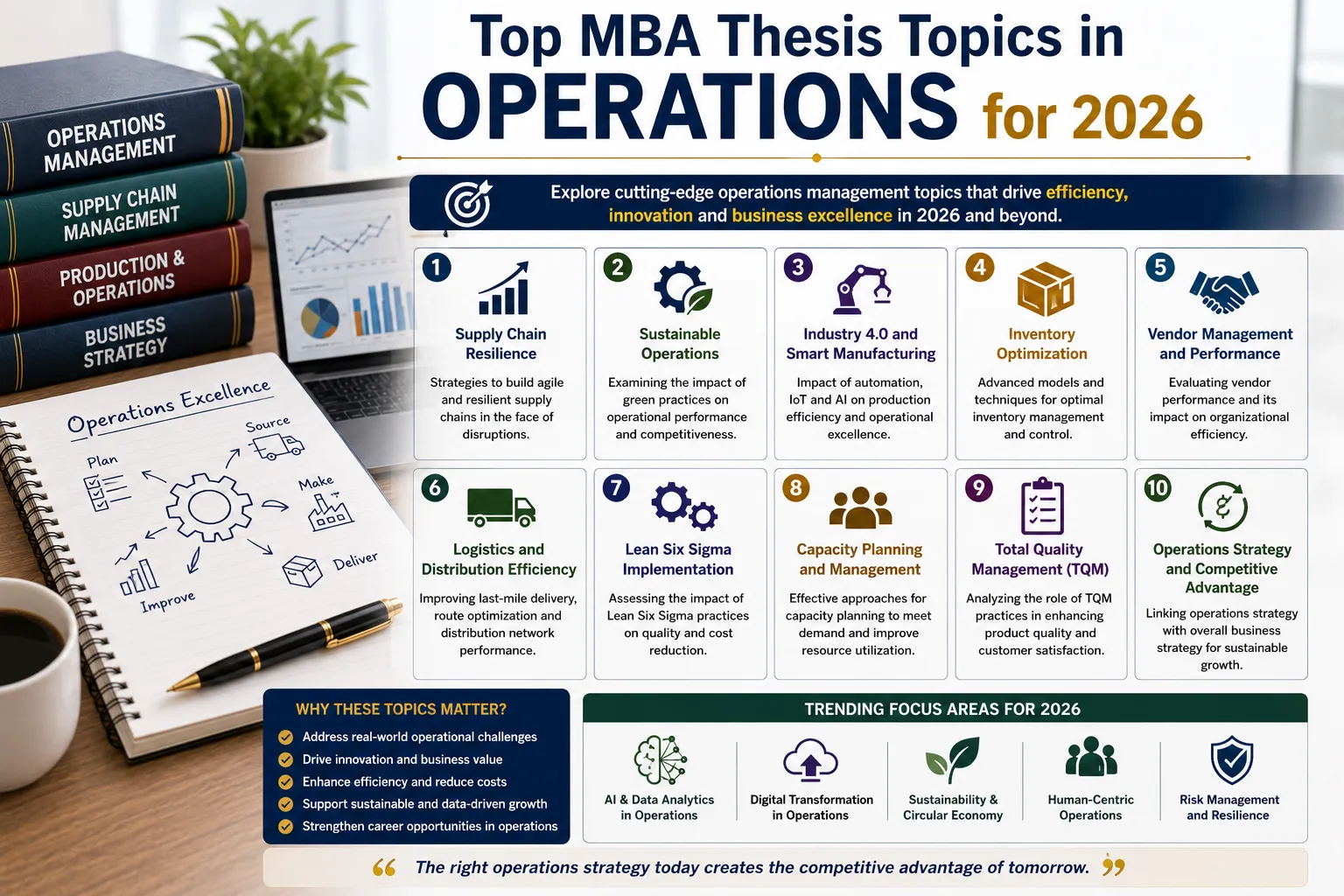
Staring at a blank document with "MBA Thesis" typed at the top and nothing else? You're not alone — choosing among the top MBA thesis topics in operations for 2026 is often the hardest part of the entire process, not because good topics don't exist, but because operations management is broad enough that almost anything sounds researchable until you actually try to scope it.
This guide gives you a curated set of current, genuinely researchable operations topics — organized by cluster so you can find the area that matches your interests and data access — along with practical guidance on how to narrow a broad topic into something specific enough to defend, and how to keep it original enough to pass institutional plagiarism and originality checks without a struggle later.
What Makes an Operations Topic Strong for 2026
Before the list itself, it's worth understanding what separates a strong operations topic from a weak one this year, because the criteria have shifted slightly from a few years ago.
Supply chain management research in 2026 is dominated by four forces: resilience and risk (post-disruption thinking hasn't gone away), decarbonisation and sustainability, AI-driven digitalisation, and a structural shift away from concentrated, single-region sourcing toward more distributed supply networks. The strongest theses this year avoid generic "impact of X on Y" framing and instead test a specific intervention against a measurable outcome — cost, lead-time, emissions, or service reliability — rather than making a broad, unfalsifiable claim about "the impact of AI on operations" in general.
Keep three filters in mind as you browse the list below:
- Specificity: Can you narrow this to one industry, one region, or one intervention rather than "operations" broadly?
- Data access: Is there a realistic path to primary data (surveys, interviews, case access) or credible secondary data (industry reports, government trade data, company disclosures)?
- Currency: Has this exact angle already been thoroughly covered, or is there a genuine, current gap your specific framing addresses?
One more filter worth adding, specific to operations research: measurability. Operations management is unusually well-suited to quantifiable outcomes — cost, cycle time, defect rate, forecast accuracy, emissions, stockout frequency — compared to some other business specializations where outcomes are harder to pin down numerically. A strong operations topic almost always names, even roughly, what it will actually measure. If you can't yet name the outcome variable your research would track, the topic likely needs another round of narrowing before it's ready to propose.
Cluster 1: Supply Chain Resilience and Risk
Supply chain fragility remains one of the richest research areas in operations, and it's far from exhausted — the specific angle matters more than the general theme.
- Supply chain diversification strategies and disruption recovery time — comparing firms that diversified suppliers geographically against those that didn't, using recovery speed after a disruption event as the outcome measure.
- Nearshoring and reshoring decisions in Indian manufacturing — examining why specific manufacturing sectors are relocating production closer to end markets, and what operational trade-offs (cost vs. reliability) drive that decision.
- Supplier risk assessment frameworks in SME supply chains — most existing frameworks are built for large enterprises; a thesis testing feasibility for resource-constrained SMEs fills a genuine population gap.
- The role of digital visibility platforms in supply chain risk mitigation — studying whether real-time tracking and visibility tools measurably reduce disruption impact, not just whether firms have adopted them.
- Geopolitical risk and procurement strategy shifts in a specific industry (pharmaceuticals, electronics, or textiles are well-documented starting points with accessible trade data).
- Single-sourcing versus multi-sourcing trade-offs post-disruption — a comparative case study design works well here, especially with two firms in the same sector that took different approaches.
Cluster 2: Sustainability and Green Operations
Sustainability in operations has moved from a compliance topic to a genuine performance question — which makes it a strong thesis area if you frame it around measurable outcomes rather than intentions.
- Green supply chain management practices and firm performance — a well-established but still active research line, especially when narrowed to a specific sector or region rather than studied broadly.
- Circular economy interventions in manufacturing operations — studying a specific circular intervention (material reuse, remanufacturing, closed-loop packaging) against measurable carbon, water, or waste outcomes, rather than "circular economy" as a broad concept.
- Sustainable procurement practices and supplier selection criteria — how ESG (environmental, social, governance) criteria are actually weighted in supplier scorecards, and whether that weighting changes purchasing outcomes.
- Life cycle assessment as a decision-making tool in product design — a strong methodological fit for scholars with an engineering or manufacturing background.
- Energy efficiency initiatives in manufacturing operations and their cost-benefit outcomes — particularly relevant for India-based manufacturing given current energy cost pressures.
- Corporate sustainability reporting and its relationship to actual operational change — a useful angle for scholars interested in the gap between what companies report and what they operationally implement.
Cluster 3: AI, Automation, and Digital Transformation in Operations
AI-driven business operations remain among the most in-demand research areas in 2026 across specializations — but this is also the most crowded cluster, so specificity matters more here than anywhere else on this list.
- AI-driven demand forecasting accuracy compared to traditional statistical methods — a comparative methodology (forecast accuracy metrics like MAPE) works well and produces clear, defensible quantitative results.
- Barriers to AI adoption in operations among Indian small and medium manufacturers — the population gap here (SMEs specifically, rather than large enterprises) is well-documented as underexplored.
- Robotic process automation in warehouse and fulfillment operations — efficiency and error-rate outcomes make for a measurable, defensible thesis design.
- Predictive maintenance using IoT sensor data in manufacturing operations — technically demanding but rich if you have access to a manufacturing partner or existing dataset.
- Digital twin technology adoption in production planning — still emerging enough in Indian industry to represent a genuine knowledge gap, though data access can be a constraint worth checking early.
- Employee readiness and change management during operations digitalisation — a useful angle for scholars who want to blend operations with an HR or organizational-behavior lens.
Cluster 4: Lean, Six Sigma, and Process Excellence
Lean and Six Sigma remain an active, well-established research cluster — not as headline-grabbing as AI or sustainability, but often easier to design as a feasible, well-scoped MBA thesis because the methodology is mature and widely documented.
- Lean implementation barriers in Indian manufacturing SMEs — a strong feasibility fit, since SME access is often more realistic than large-enterprise access for a student researcher.
- Six Sigma's impact on defect reduction in a specific manufacturing process — process-specific framing (one production line, one defect category) keeps this manageable within a thesis timeline.
- Just-in-time production trade-offs in a post-disruption environment — examining whether firms are quietly moving away from pure JIT toward buffer-stock models, and what that shift costs operationally.
- Kaizen and continuous improvement culture adoption across departments — a strong fit for mixed-methods designs combining process metrics with employee survey data.
- Process mapping and waste identification in service operations (rather than manufacturing) — a less crowded angle, since most lean research still skews toward factory settings.
- Total Quality Management practices and customer satisfaction outcomes in a specific service or manufacturing sector.
Cluster 5: Inventory, Demand Planning, and Forecasting
Inventory and demand planning offer some of the cleanest quantitative thesis designs in operations, since the outcome variables (stockout rates, holding costs, forecast accuracy) are usually already tracked by the organizations you'd study.
- Inventory optimization models in e-commerce fulfillment — a timely angle given the continued growth of Indian e-commerce logistics.
- Demand forecasting accuracy in seasonal retail categories — comparing forecasting methods against actual sales data provides clean, quantifiable results.
- Safety stock policy and service-level trade-offs in FMCG distribution — well-suited to a case study or simulation-based methodology.
- Vendor-managed inventory adoption and its effect on stockout frequency — a good fit for scholars with retail or FMCG industry access.
- The impact of demand volatility on inventory carrying costs post-disruption — building on the broader resilience theme but with a specific inventory-economics angle.
Cluster 6: Logistics, Distribution, and Last-Mile Operations
Logistics research benefits from unusually good public data availability — freight, trade, and e-commerce delivery statistics are more accessible than in most other operations sub-areas, which makes feasibility easier to establish early.
- Last-mile delivery efficiency in tier-2 and tier-3 Indian cities — a strong population gap, since most existing last-mile research concentrates on metro markets.
- E-logistics adoption and its effect on delivery reliability in FMCG distribution.
- Cross-docking implementation and its impact on distribution center throughput.
- Third-party logistics (3PL) partnership models and service quality outcomes — well-suited to a comparative case study of firms using different 3PL structures.
- Reverse logistics and returns management in e-commerce operations — an increasingly relevant, still underexplored angle as online returns volumes grow.
- Route optimization technology adoption among regional logistics providers — technically approachable with either simulation or case-study methodology.
Across all six clusters, notice a pattern: the topics that read as most researchable are the ones already narrowed to a specific population (SMEs, tier-2 cities, a named sector) or a specific intervention (one technology, one practice, one policy change) rather than a broad theme. That narrowing isn't incidental — it's the actual work of topic selection, and it's worth doing deliberately rather than hoping a broad theme will sharpen itself once you start writing.
Matching Your Topic to a Feasible Methodology
Every cluster above tends to pair naturally with certain research methods, and choosing a topic without considering this pairing is one of the most common reasons MBA operations theses stall midway through data collection.
Survey-based quantitative designs work best for topics involving adoption, perception, or barriers — Cluster 3 (AI and digital transformation) and Cluster 4 (lean and process excellence) topics often fit this model well, since you're typically measuring employee or manager perceptions, readiness, or self-reported practices across a sample of firms or respondents. These designs pair naturally with the statistical techniques covered in most MBA research methods courses — reliability testing, correlation, regression — and generally offer the most predictable timeline, since you're not dependent on a single organization's willingness to share proprietary data.
Case study designs suit topics where depth matters more than breadth — Cluster 1 (supply chain resilience) and Cluster 6 (logistics and 3PL partnerships) topics often work best here, especially when comparing two or three organizations that took different strategic approaches to the same operational challenge. Case studies require securing genuine access (interviews, internal documents, or at minimum detailed secondary reporting) before you commit, which makes early feasibility-checking especially important for this methodology.
Secondary data analysis is often the most realistic option for scholars without direct industry access — Cluster 5 (inventory and demand planning) and parts of Cluster 2 (sustainability reporting) lend themselves well to this approach, since government trade databases, published sustainability reports, and industry association data are frequently public and don't require negotiating access with a specific firm.
Simulation-based methodologies — using tools that model supply chain or inventory scenarios — suit quantitatively inclined scholars tackling Cluster 1 or Cluster 5 topics where real operational data isn't accessible but a well-parameterized model can still produce defensible, examinable findings.
Before finalizing any topic from the list above, it's worth sketching which of these four methodology types actually fits your access and skill set — a brilliant topic paired with an inaccessible methodology is, in practice, not a feasible topic at all.
How to Narrow Any Topic on This List Into a Defensible Thesis
None of the topics above are ready to submit as-is — they're starting points, not finished research questions. Turning any of them into a defensible thesis takes three deliberate steps:
1. Narrow the scope explicitly. Take "Green supply chain management practices and firm performance" and narrow it to one industry (say, Indian textile manufacturing), one time window, and one or two specific practices (supplier environmental audits and packaging reduction) rather than "green practices" broadly. The narrower version is both more feasible and more defensible in committee review.
2. Confirm data access before you commit. A topic that depends on internal company data you don't have a realistic path to obtain isn't a feasible thesis, however compelling the question. Check whether your intended methodology — survey, interview, case study, or secondary data analysis — has a genuinely accessible data source before finalizing your topic.
3. State the gap explicitly. For any topic on this list, you should be able to write one or two sentences explaining what existing research hasn't covered and why your specific framing fills that space — whether that's an underexplored population (SMEs instead of large firms), a specific industry context (Indian tier-2 cities instead of global metros), or a specific intervention (one lean tool instead of "lean" broadly).
For a deeper walkthrough of this narrowing process, see our related guide, [How to Choose a Strong Thesis Topic Your Supervisor Will Approve]. And if you're still unclear on what actually counts as a genuine research gap versus a broad topic area, [What Is a Research Gap and How to Identify One for Your Thesis] breaks that distinction down in detail.
Keeping Your Topic Original: What Committees and Turnitin Actually Check
Choosing a specific, well-scoped topic doesn't just make your thesis stronger academically — it also protects you at the originality-checking stage. A topic that's been extensively covered in near-identical form invites heavy paraphrasing from existing sources during your literature review, which is exactly the kind of pattern plagiarism-detection tools are built to catch.
Most universities prefer a Turnitin similarity score below 10%, although exact policies vary by institution, and Turnitin's AI-writing detection features are increasingly run alongside the standard similarity check — meaning heavily templated or generic topic framing can create problems on two fronts, not just one. Scribbr, which offers a Turnitin-powered pre-submission check available to individual students rather than only through institutional access, is a practical way to self-check both plagiarism and formatting before your official submission, particularly useful if your university doesn't provide unlimited pre-checks.
The practical takeaway: picking a genuinely narrow, current angle — rather than a broad, well-worn topic — doesn't just make your research more interesting. It naturally reduces the temptation to lean too heavily on existing literature during your writing, because there's simply less directly-overlapping material to paraphrase from in the first place.
This matters even more in the AI era. Because AI-writing detection is now frequently run alongside standard similarity checking, a thesis chapter built by lightly rewording a handful of well-known sources on an over-covered topic can trigger flags on both fronts at once — not because the writing itself was AI-generated, but because heavily templated framing around a common topic tends to produce prose that pattern-matches to what detection tools are trained to catch. A specific, well-scoped topic with a genuine data component naturally produces more original analysis and discussion, simply because there's less existing material saying the exact same thing in the exact same way.
Two Real Scenarios: A Topic Too Broad, and One Narrowed Correctly
Scenario 1 — The topic that stalled at proposal stage. An MBA scholar proposed "The Impact of AI on Operations Management" as a thesis topic. It was current, relevant, and impossible to research properly within a thesis timeline — the scope spanned dozens of industries, technologies, and use cases, with no clear population, intervention, or measurable outcome defined. The proposal committee sent it back twice, each time asking the scholar to narrow further, costing nearly six weeks before the topic was approved.
Scenario 2 — The topic that moved through approval quickly. A different scholar started from the same general interest but narrowed immediately: "Barriers to AI-driven demand forecasting adoption among Indian textile SMEs." The population (Indian textile SMEs), the intervention (AI-driven demand forecasting specifically, not AI broadly), and the outcome (adoption barriers, measurable through a structured survey) were all explicit from the first draft. The committee approved the topic in its first review, with only minor adjustments to the sample size and survey instrument.
The underlying interest — AI in operations — was identical in both cases. The difference was scope, defined before the proposal was written rather than negotiated afterward through revision cycles. It's also worth noting what the second scholar gained beyond speed: because the topic was narrow from the outset, the literature review naturally centered on a small, genuinely relevant set of sources rather than a sprawling AI-in-business literature that would have been impossible to synthesize coherently within a thesis-length chapter.
How Long Does Topic Selection Typically Take?
Most MBA scholars spend two to four weeks moving from a broad area of interest to a fully scoped, committee-ready topic — reading recent literature in the cluster that interests them, checking data feasibility, and narrowing the framing until it passes the specificity test above. Topics that skip this narrowing step tend to resurface as delays later, either at proposal approval or, worse, midway through data collection when feasibility problems that should have been caught earlier finally surface.
If you'd like guidance narrowing any of the topics above into a proposal-ready thesis question, or checking data feasibility before you commit, you can check out our MBA Thesis Assistance Service — our PhD-qualified mentors work with MBA scholars specifically at this topic-selection and validation stage, across operations and every other specialization.
Once your operations topic is scoped, our guide on [How to Analyze Data for an MBA Human Resources Thesis] walks through the broader data-analysis process that applies across most quantitative MBA research designs, whether HR or operations-focused.
FAQs
What are the top MBA thesis topics in operations for 2026?
The strongest current areas are supply chain resilience and risk, sustainability and green operations, AI and digital transformation, lean and Six Sigma process excellence, inventory and demand planning, and logistics and last-mile distribution — with the best individual topics narrowed to a specific industry, intervention, and measurable outcome rather than framed broadly.
Why does choosing the right operations topic matter for a 2026 thesis?
Because operations management is broad enough that a poorly scoped topic can sound researchable while actually being unmanageable within a thesis timeline — and a topic that's already extensively covered invites both weaker committee approval and higher plagiarism-check risk during the literature review stage.
How does topic choice affect an MBA thesis overall?
A well-scoped, genuinely current topic tends to move through proposal approval faster, gives you clearer data-access planning, and produces a literature review with an actual gap to fill — while a broad or overused topic typically results in revision cycles at the proposal stage or feasibility problems discovered mid-research.
How long does it take to complete an MBA thesis using this approach?
Topic selection and narrowing typically takes two to four weeks. Choosing a well-scoped topic from the start doesn't lengthen your overall thesis timeline — it shortens it, by avoiding the proposal revisions and feasibility surprises that come from an overly broad starting point.
Is professional help available for choosing MBA thesis topics in operations?
Yes. Academic mentoring services can help you narrow a broad area of interest into a specific, feasible, defensible topic, and check data access before you commit — supporting your topic selection process rather than choosing or writing the thesis for you.
The right operations thesis topic for 2026 isn't necessarily the most fashionable one — it's the one you can scope specifically, research with data you can actually access, and defend as a genuine contribution to a still-open question. If you'd like help narrowing any of the topics above into a proposal-ready thesis question, our team at ThesisLikho — PhD-qualified mentors who've guided thousands of MBA scholars through this exact stage — is here to help. Get Free MBA Thesis Consultation.