
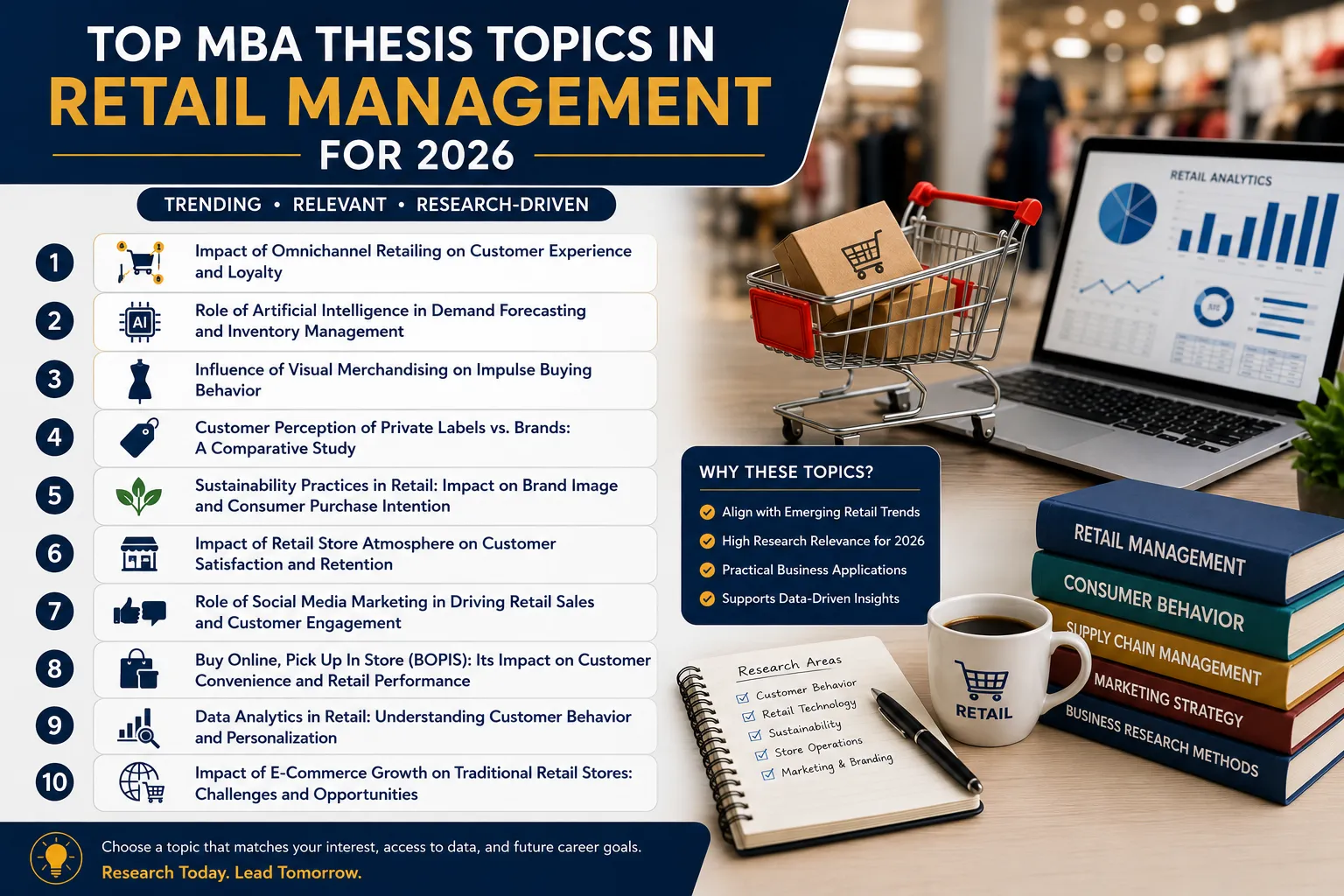
Retail management is one of the most dynamic MBA thesis areas right now — new technology, shifting consumer expectations, and structural changes like quick commerce are reshaping the industry faster than the academic literature can keep up. That's good news for thesis writers: there's genuine room for original contribution. But "retail management" itself is far too broad to be a thesis topic. This guide walks through trending, genuinely research-ready MBA thesis topics in retail management for 2026, along with how to narrow a broad theme into something your supervisor will actually approve.
The Forces Reshaping Retail Right Now
Retail in 2026 is being driven by AI, personalization, and seamless omnichannel experiences, with trends like social commerce, AR/VR, and automation transforming how customers shop. Consumer expectations increasingly center on three specific demands: personalization, convenience, and values alignment. If you're choosing a thesis direction now, situating your topic within one of these forces gives your research genuine currency.
Trending MBA Thesis Areas in Retail Management for 2026
1. Omnichannel Retail Strategy and Consumer Purchase Behavior
The impact of omnichannel retailing on consumer purchasing behaviour remains one of the most consistently researched retail management topics, and for good reason — it's a genuine, ongoing operational challenge for retailers navigating physical, online, and hybrid channels simultaneously.
Narrowed thesis example: "The Impact of Omnichannel Retail Integration on Repeat Purchase Behavior Among Urban Indian Grocery Shoppers"
2. AI-Driven Personalization and Customer Engagement
The effect of e-commerce personalization on customer engagement is a strong, current direction, particularly relevant given rising consumer expectations that AI-personalized experiences feel meaningful rather than intrusive — research suggests satisfaction increases substantially when this balance is achieved well.
Narrowed thesis example: "Consumer Perceptions of AI-Driven Personalization in Fashion E-Commerce: A Study of the Relevance-Intrusiveness Trade-Off"
3. Quick Commerce Delivery and Consumer Behavior
Quick commerce — the faster version of e-commerce where products are delivered within 10–15 minutes via mobile app — is a specifically flagged, rapidly growing area for shopping and consumer behaviour research, with particular relevance to the Indian market given the sector's rapid domestic growth.
Narrowed thesis example: "Factors Influencing Consumer Adoption of Quick Commerce Platforms Among Urban Millennials in Indian Metro Cities"
4. Click-and-Collect Services and Operational Efficiency
Analysis of click-and-collect services on retail operational efficiency is a strong direction combining consumer-facing convenience with operational, supply-chain-adjacent research — appealing to students interested in the operational rather than purely marketing side of retail.
Narrowed thesis example: "The Impact of Click-and-Collect Service Adoption on Inventory Turnover and Operational Efficiency in Mid-Sized Indian Retail Chains"
5. AR/VR in the In-Store Shopping Experience
The role of augmented reality and virtual reality in enhancing the in-store shopping experience is an actively researched direction, with real-world consumer familiarity already established through applications like AR-enabled try-on features in eyewear and cosmetics.
Narrowed thesis example: "Consumer Attitudes Toward AR-Enabled Try-On Features in Online Eyewear Retail: A Survey-Based Study"
6. Technology Acceptance Model Applied to Retail Technology Adoption
Investigating the role of the Technology Acceptance Model (TAM) in understanding consumers' adoption of emerging technologies in retail is a well-established, theoretically grounded direction, giving your thesis a strong existing framework to build from rather than starting entirely from scratch.
Narrowed thesis example: "Applying the Technology Acceptance Model to Understand Consumer Adoption of AI Chatbots in Online Retail Customer Service"
7. Sustainability Practices in Retail Supply Chains
Strategies for integrating sustainable practices in retail supply chains is a strong, currently relevant direction, reflecting growing consumer and regulatory attention to sustainability throughout the retail value chain, not just at the point of sale.
Narrowed thesis example: "Barriers to Sustainable Supply Chain Adoption Among Mid-Sized Fashion Retailers in India"
8. Green Marketing and Consumer Purchasing Decisions
The impact of green marketing on consumer purchasing decisions remains a well-established, quantitatively tractable direction, particularly relevant given increasing sustainability-driven purchase behavior among younger urban consumers specifically.
Narrowed thesis example: "The Influence of Eco-Friendly Packaging Claims on Purchase Intent Among Urban Indian Gen Z Consumers"
9. Digital Payment Methods and Consumer Trust
The influence of digital payment methods on consumer trust is a currently relevant direction, particularly given the continued expansion of UPI and other digital payment infrastructure across Indian retail specifically.
Narrowed thesis example: "The Relationship Between Digital Payment Method Familiarity and Consumer Trust in Online Retail Transactions Among First-Time E-Commerce Users"
10. Loyalty Program Effectiveness
The effectiveness of loyalty programs in retaining customers remains a strong, well-established retail marketing direction, particularly relevant as retailers increasingly compete on retention rather than acquisition alone.
Narrowed thesis example: "Comparing Points-Based and Tiered Loyalty Program Structures on Customer Retention in Indian Organized Retail"
11. Pricing Strategy: Online vs. Brick-and-Mortar
A comparative analysis of the pricing strategies employed by online retailers and traditional brick-and-mortar retailers, and their impact on consumer purchasing behaviour, offers a strong, genuinely comparative research design well-suited to MBA-level analysis.
Narrowed thesis example: "A Comparative Analysis of Dynamic Online Pricing vs. Fixed In-Store Pricing on Consumer Price Perception in the Indian Electronics Retail Sector"
12. Subscription-Based Retail Models
Assessing the impact of subscription-based retail models is a growing, currently relevant direction, reflecting the expansion of subscription commerce beyond its original media and software origins into physical product categories.
Narrowed thesis example: "Customer Retention Drivers in Subscription-Based Beauty and Personal Care Retail: An Indian Market Analysis"
Practical Feasibility Considerations
Since much retail management research relies on primary survey data, keep these questions in mind before finalizing your topic:
- Can you realistically access your target respondent population (a specific consumer segment, or a specific retailer's customer base) within your thesis timeline?
- Does your chosen retail sector or platform have enough existing academic literature to position a genuine research gap against?
- If your topic involves a specific technology (AR, AI chatbots, quick commerce apps), do enough consumers in your target population have real, existing familiarity with it to generate meaningful survey responses?
Step-by-Step: How to Narrow a Trending Theme Into a Defensible Thesis Topic
- Choose a specific retail trend from the list above that genuinely interests you
- Name the specific retail sector or product category — fashion, grocery, electronics, beauty
- Define your specific consumer population — urban millennials, first-time e-commerce users, Gen Z
- State a measurable outcome or relationship — purchase intent, retention, trust, adoption
- Check respondent access feasibility — can you realistically survey or interview this population?
- Verify the specific narrow niche isn't already comprehensively covered by very recent (2025–2026) publications
- Consider anchoring your topic in an existing theoretical framework (like TAM) if it strengthens your design
Practical Checklist: Is Your Retail Management Thesis Topic Ready?
- Topic is narrowed to a specific retail trend, not the broad field
- Retail sector or product category is named explicitly
- Target consumer population is specified and realistically accessible
- A measurable outcome or relationship is defined
- Recent literature (2025–2026) has been checked to confirm the specific niche isn't already saturated
- If technology-focused, target population has adequate real-world familiarity with the technology
- Topic connects to a genuine, current industry force (personalization, quick commerce, sustainability)
Two Practical Scenarios
Scenario 1 — Narrowing an Overly Broad Omnichannel Topic
A student initially proposed "Omnichannel Retail Strategy" — far too broad to defend as a single MBA thesis. After applying the narrowing framework, the topic became "The Impact of Omnichannel Retail Integration on Repeat Purchase Behavior Among Urban Indian Grocery Shoppers," specifying the exact retail sector, the consumer population, and a measurable outcome — resulting in a clear, feasible survey design the supervisor approved.
Scenario 2 — Choosing Based on Respondent Access
A student interested in both AR/VR in-store retail and quick commerce evaluated their actual respondent access: limited ability to survey in-store AR users given limited local retail AR adoption, but strong personal network access to frequent quick commerce app users across several Indian cities. Recognizing this constraint, the student chose the quick commerce direction, which matched realistic respondent access, over the AR/VR direction, which would have required a harder-to-reach, less common consumer segment.
Common Mistakes MBA Students Make Choosing Retail Management Topics
- Proposing "retail management" or "omnichannel retail" as a topic itself, without narrowing to a specific trend, sector, and population.
- Choosing a technology-focused topic without checking real-world consumer familiarity, risking survey responses based on unfamiliarity rather than genuine attitudes.
- Ignoring respondent access feasibility, proposing a population that's difficult to realistically reach within the thesis timeline.
- Not checking recent literature, resulting in a topic already comprehensively covered in 2025–2026 publications, particularly common for heavily-researched areas like omnichannel retail.
- Overlapping too closely with marketing-specific topics without a clear retail management framing — keep the operational, retail-specific angle distinct from a purely marketing-communications angle.
Frequently Asked Questions
What are the top MBA thesis topics in retail management for 2026?
Leading areas include omnichannel retail strategy, AI-driven personalization, quick commerce adoption, click-and-collect operational efficiency, AR/VR in-store experiences, Technology Acceptance Model applications, sustainable supply chains, green marketing, digital payment trust, loyalty program effectiveness, online-vs-offline pricing strategy, and subscription-based retail models.
Why does topic selection matter for an MBA thesis in retail management?
Retail management spans a genuinely broad range of operational, technological, and consumer-behavior dimensions, and a topic that isn't narrowed to a specific trend, sector, and population is difficult to research meaningfully within a standard MBA timeline.
How does trending research area selection affect a thesis's outcomes?
Aligning with an active 2026 direction — quick commerce, AI personalization, sustainability — increases relevance and potential impact, but only if the specific niche within that direction is narrowed enough to remain original and matched to realistic respondent access.
How long does it take to complete an MBA thesis using this approach?
Topics relying on easily accessible consumer populations (general e-commerce users, familiar retail technologies) generally proceed faster than topics requiring access to a narrower or harder-to-reach consumer segment, so factor access into your topic choice early.
Is professional help available for MBA thesis topics in retail management?
Yes. ThesisLikho's PhD-qualified experts have guided 10,000+ scholars through topic selection, research methodology, and complete MBA thesis writing assistance tailored to retail management and other specializations.
Get Expert Guidance on Your MBA Retail Management Thesis Topic
Narrowing retail management's fast-moving landscape into a feasible, defensible thesis topic takes careful attention to respondent access, current literature gaps, and genuine consumer familiarity with any technology involved. If you'd like expert input on refining your retail management thesis topic or planning your research approach, ThesisLikho's PhD-qualified team offers topic selection support, research methodology guidance, and complete MBA thesis writing assistance. If you need expert guidance with your thesis topic, research design, or overall project structure, you can explore our MBA Thesis Assistance service.
Get Free MBA Thesis Consultation → https://thesislikho.com/writing-services/thesis-assistance-mba