
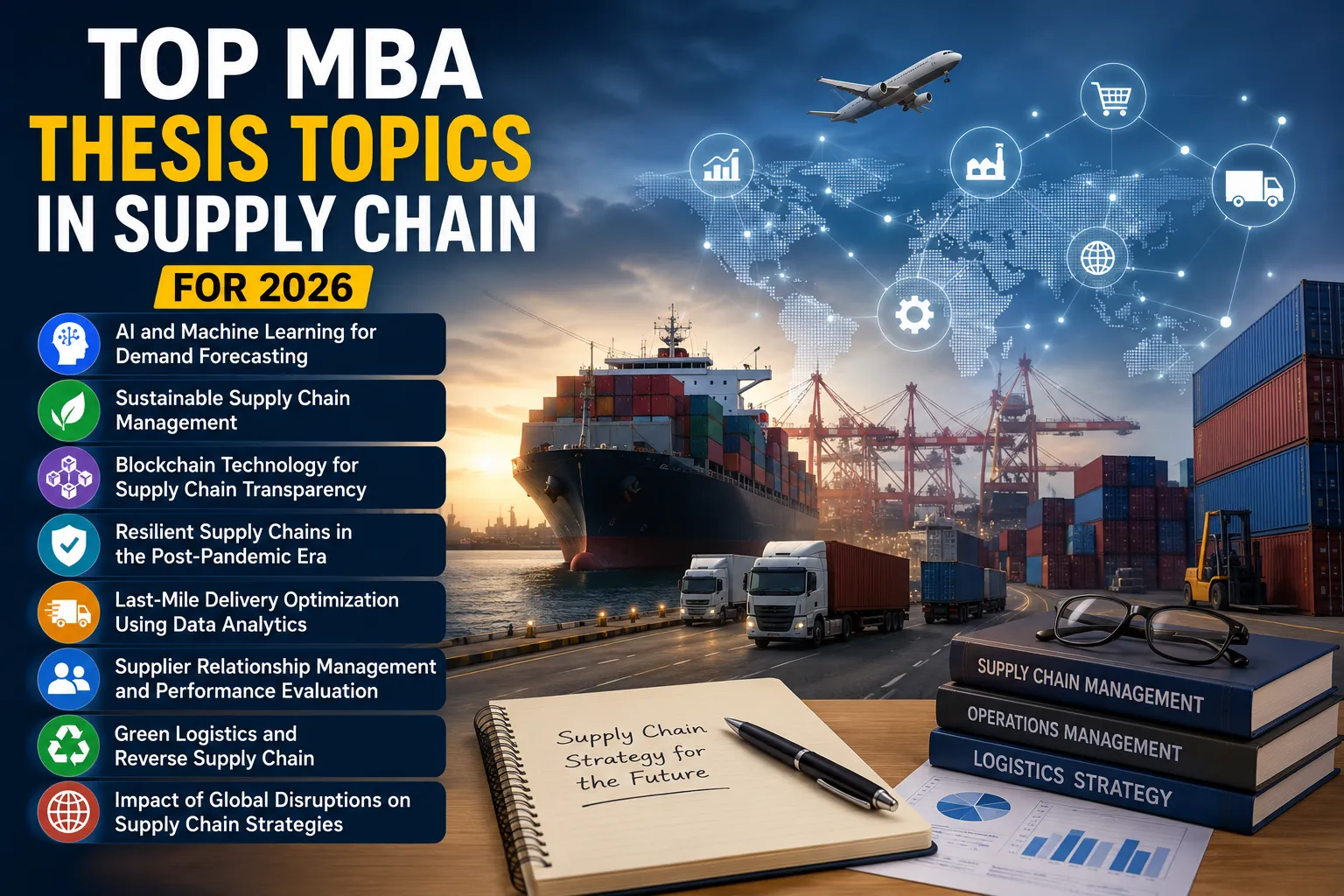
Choosing an MBA thesis topic in international business right now means choosing a moment when the field itself is unusually alive — tariff volatility, new free trade agreements, supply chain reconfiguration, and carbon border rules are reshaping how companies actually operate across borders, and each of these shifts is generating exactly the kind of applied, researchable questions an MBA dissertation is built for. Top MBA thesis topics in international business for 2026 aren't abstract theory exercises; they're grounded in decisions real companies are making right now about where to source, how to price, which markets to enter, and how to manage risk in a genuinely unstable trade environment.
This guide walks through the trends actually shaping international business research this year, more than 100 categorized thesis topics across every major sub-area, and the guidance you need to narrow a broad interest into a topic you can actually complete within an MBA timeline. We've grounded this in current 2026 trade and geopolitical developments and the patterns we see across MBA scholars ThesisLikho supports through topic selection.
Why International Business Topic Selection Matters Right Now
International business as a field moves with real-world events in a way few other MBA specializations do — a new tariff announcement, a concluded trade agreement, or a shift in a major economy's industrial policy can make a topic newly relevant or newly outdated within months. This makes 2026 a genuinely interesting year to write an international business thesis, since the volume of live, unresolved questions in the field is higher than usual — but it also means topic selection needs to be done with an eye toward what data and access will realistically be available by the time you're ready to collect it, not just what feels topical today.
A well-chosen topic in this environment does two things at once: it connects to a genuinely current business problem companies are actively grappling with, and it's scoped narrowly enough — by sector, region, or specific mechanism — that you can complete meaningful, defensible research within an MBA timeline rather than attempting to explain the entire global trade landscape in one dissertation.
Latest International Business Trends Shaping 2026 Research
Tariff volatility and trade policy uncertainty is the dominant theme in international business right now — trade professionals increasingly cite tariff unpredictability as the most disruptive regulatory factor they face, a sharp rise from just a few years ago, and this volatility is reshaping sourcing, pricing, and market entry decisions across nearly every sector.
Supply chain reconfiguration continues as firms shift away from purely cost-driven offshoring toward risk-aware strategies: supplier diversification, near-shoring, friend-shoring toward politically aligned trade partners, and vertical integration to secure critical inputs. This restructuring is creating new trade hubs and altering established supply routes, particularly benefiting emerging manufacturing destinations.
Carbon and sustainability-linked trade compliance is becoming a genuine operational constraint rather than a voluntary commitment — the EU's Carbon Border Adjustment Mechanism takes effect in 2026, requiring companies to account for embedded carbon emissions in certain imported goods, adding a new layer of compliance complexity to cross-border trade in affected sectors.
Geopolitical risk management as a formal business function is expanding, with companies increasingly investing in dedicated geopolitical intelligence capabilities, scenario planning for trade disruption, and formal risk frameworks rather than treating geopolitical shifts as background noise.
Digital trade and cross-border e-commerce continue expanding rapidly, alongside growing regulatory attention to digital trade rules, data localization requirements, and cross-border payment infrastructure — an area where research is still catching up to practice.
Free trade agreement proliferation is reshaping regional trade patterns, with several major agreements concluding or taking effect in the current period, creating fresh, under-studied research opportunities around how newly opened market access actually gets used by firms on the ground.
India-Specific Developments Worth Building a Thesis Around
For Indian MBA scholars specifically, several recent developments offer genuinely current, well-grounded thesis territory. The India-EU Free Trade Agreement, concluded in early 2026, opens improved market access in sectors including automotive, industrial machinery, and premium consumer goods, while also creating new joint venture opportunities in clean energy and semiconductors — a rich area for research on how Indian firms in these sectors are positioning themselves to capture this new access. Alongside this, the India-UK FTA and India-EFTA TEPA have also recently been concluded, each creating distinct, under-researched market entry and export strategy questions.
India's expanded Production-Linked Incentive (PLI) scheme has shifted its design philosophy — moving from rewarding raw production volume toward incentivizing export-linked outcomes, deeper localization, and higher technology content, with renewed sector focus on electronics, pharmaceuticals, renewable energy components, and advanced manufacturing. This shift creates a genuinely current research opportunity: how are firms in PLI-eligible sectors actually adapting their strategies to these newly outcome-based incentives, and what early evidence exists of the scheme achieving its export-competitiveness goals?
These are live policy developments with real companies already responding to them — exactly the kind of grounded, currently unfolding research context that gives an MBA thesis both relevance and a genuine, defensible research gap.
100+ Categorized MBA Thesis Topics in International Business
Use these as starting points that still need narrowing to a specific sector, region, company type, or time frame before becoming a defensible thesis question.
Trade Policy and Tariff Impact Topics
- Tariff volatility's effect on Indian manufacturing export pricing strategy
- Small business adaptation strategies to sudden trade policy shifts
- Trade compliance cost burden on Indian MSME exporters
- Sector-specific tariff impact analysis: electronics versus textiles
- Political risk insurance adoption among export-oriented Indian firms
- Trade policy uncertainty and foreign direct investment decision delay
- Retaliatory tariff impact on bilateral trade relationships
- Customs compliance technology adoption among Indian exporters
Free Trade Agreement Topics
- India-EU FTA impact on automotive component export competitiveness
- Indian pharmaceutical sector readiness for India-EU FTA market access
- SME awareness and utilization of newly concluded free trade agreements
- India-UK FTA effect on services sector market entry strategy
- Comparative analysis of FTA utilization rates across Indian export sectors
- Rules of origin compliance challenges under new FTAs
- FTA-driven joint venture formation in clean energy and semiconductors
- Barriers to SME utilization of preferential tariff access under FTAs
Supply Chain Reconfiguration Topics
- Near-shoring decision factors among Indian manufacturing firms
- Supplier diversification strategies post-geopolitical disruption
- Friend-shoring's effect on emerging market manufacturing hubs
- Vertical integration strategies for securing critical raw material access
- Supply chain resilience metrics for cross-border manufacturing
- India's positioning as an alternative manufacturing hub amid supply chain shifts
- Reshoring feasibility analysis for critical component manufacturing
- Multi-country sourcing strategy effectiveness in volatile trade environments
Market Entry Strategy Topics
- Market entry mode selection for Indian firms expanding into Southeast Asia
- Joint venture versus wholly owned subsidiary decisions in emerging markets
- Franchise expansion strategy for Indian brands entering Gulf markets
- Digital-first market entry strategies for cross-border e-commerce brands
- Market entry barriers for Indian SMEs in European markets post-FTA
- Cultural adaptation strategies in cross-border retail expansion
- First-mover versus fast-follower strategy in emerging international markets
- Distribution partner selection criteria for international market entry
ESG and Sustainable Trade Topics
- EU Carbon Border Adjustment Mechanism compliance readiness among Indian exporters
- Green manufacturing certification's effect on export competitiveness
- Sustainable supply chain practices and access to premium export markets
- ESG disclosure requirements' impact on cross-border investment decisions
- Carbon accounting practices among carbon-intensive export sectors
- Sustainability-linked trade finance adoption in emerging markets
- Circular economy practices in cross-border manufacturing supply chains
- Renewable energy transition costs for export-oriented manufacturers
Foreign Direct Investment Topics
- FDI location decision factors in politically volatile regions
- Geopolitical risk perception and foreign investment timing decisions
- India as an FDI destination amid global supply chain reconfiguration
- Sector-specific FDI attractiveness under expanded PLI incentives
- Cross-border merger and acquisition due diligence practices
- FDI outflow patterns from Indian firms into Southeast Asian markets
- Special economic zone effectiveness in attracting export-oriented FDI
- Political risk mitigation strategies for long-term foreign investment
Cross-Cultural Management Topics
- Cross-cultural negotiation strategies in Indo-European business deals
- Expatriate management effectiveness in cross-border joint ventures
- Cultural intelligence development for international business teams
- Cross-cultural conflict resolution in multinational supply chain partnerships
- Leadership adaptation strategies for culturally diverse international teams
- Cultural distance's effect on cross-border acquisition integration success
- Communication strategy adaptation in cross-border virtual teams
- Cross-cultural trust-building in international B2B partnerships
International Finance and Currency Topics
- Currency hedging strategy effectiveness for Indian export-oriented SMEs
- Cross-border payment infrastructure adoption in emerging trade corridors
- Trade finance accessibility challenges for first-time exporters
- Exchange rate volatility's effect on export pricing strategy
- Letter of credit versus digital trade finance adoption patterns
- Working capital management challenges for international trade operations
- Cross-border investment risk assessment frameworks
- Currency risk management practices among mid-sized exporters
Digital Trade and E-Commerce Topics
- Cross-border e-commerce growth barriers for Indian D2C brands
- Digital payment infrastructure adoption in cross-border retail
- Data localization requirements' effect on international digital service delivery
- Social commerce strategies for cross-border market expansion
- Digital trade agreement provisions and their business implications
- E-commerce logistics challenges in cross-border last-mile delivery
- Platform-based export strategies for small Indian manufacturers
- Digital trust and cross-border e-commerce consumer confidence
Geopolitical Risk Management Topics
- Geopolitical risk assessment frameworks for multinational operations
- Scenario planning practices among firms facing trade policy uncertainty
- Corporate geopolitical intelligence function development
- Sanctions compliance strategy for firms operating in high-risk markets
- Export control compliance burden on technology-sector firms
- Political risk insurance utilization patterns among exporters
- Crisis response strategy for sudden trade policy disruption
- Geopolitical risk communication practices in multinational governance
Global Value Chain Topics
- Global value chain reconfiguration in electronics manufacturing
- Value chain positioning strategy for emerging market manufacturers
- Backward versus forward integration decisions in global value chains
- Value chain transparency requirements and compliance burden
- Supplier relationship management in reconfigured global value chains
- Value chain risk mapping methodologies for multinational firms
- Technology's role in global value chain visibility and control
- Regional value chain formation trends in Asia-Pacific manufacturing
International Human Resource Management Topics
- Talent mobility policy design for cross-border organizational expansion
- Global talent acquisition strategy for emerging market operations
- Cross-border compensation strategy in multinational subsidiaries
- International assignment success factors for Indian multinational firms
- Remote global team management practices post-pandemic
- Cross-border labor compliance challenges for expanding firms
- Diversity and inclusion strategy in multinational team composition
- Talent retention strategies for cross-border joint ventures
Export Strategy and Competitiveness Topics
- Export competitiveness factors under the revised PLI export incentive framework
- First-time exporter barriers and support mechanism effectiveness
- Export market diversification strategy among Indian manufacturers
- Export promotion council effectiveness in supporting SME internationalization
- Quality certification requirements and export market access
- Export credit guarantee scheme utilization among Indian SMEs
- Sector-specific export competitiveness benchmarking
Emerging and Interdisciplinary Topic Areas
Several of the strongest 2026 topics sit at the intersection of international business and other disciplines rather than inside a single traditional silo. International business plus sustainability examines how carbon border mechanisms and ESG requirements are reshaping trade competitiveness. International business plus digital transformation examines how AI-driven trade compliance tools and digital trade infrastructure are changing how firms manage cross-border operations. International business plus geopolitics examines the emerging corporate function of geopolitical risk intelligence and scenario planning. International business plus finance examines currency and trade finance strategy under prolonged policy volatility.
Interdisciplinary topics tend to require slightly more careful methodological scoping, since they draw on two bodies of literature rather than one — but they also tend to align well with what's genuinely novel and publishable in the field right now, since the intersections themselves are relatively under-studied compared to single-discipline questions.
Choosing a Topic You Can Actually Complete
The single most important filter for any topic on this list is feasibility within your specific MBA timeline — typically three to six months of active research within a broader one-to-two-year program. A topic that sounds compelling but depends on data you can't realistically access, or a comparative analysis spanning more countries or sectors than you can meaningfully cover, will create problems regardless of how current or interesting the underlying subject is.
A useful test: can you name, specifically, where your data will come from — a company you have access to, a government database, a specific set of firms you can survey — before you finalize your topic? If the answer is vague, narrow the topic further until it isn't. For guidance on this narrowing process more broadly, see our related guide.
Data Access: The Constraint Most Scholars Underestimate
International business topics are particularly prone to a specific planning trap: choosing a topic that sounds researchable in principle but turns out to require data — internal company trade data, multi-country survey access, proprietary industry reports — that simply isn't available within an MBA scholar's realistic access and budget. Before committing to a topic, identify concretely whether you'll rely on primary data (interviews or surveys with trade professionals, exporters, or firm managers you have genuine access to), secondary data (government trade statistics, published industry reports, company financial disclosures), or some combination.
Government sources — trade ministry statistics, customs data, FTA utilization reports — are often more accessible than scholars initially assume, and several of the India-specific topics above can be grounded substantially in publicly available trade and policy data rather than requiring extensive primary data collection, which can meaningfully ease the feasibility constraint for a shorter MBA timeline.
It's also worth distinguishing between topics that need firm-level primary data and topics that can be answered largely through secondary analysis. A topic like "how mid-sized textile exporters are adjusting sourcing strategies" genuinely needs primary interviews, since no existing dataset captures firm-level strategic decision-making at that granularity. A topic like "FTA utilization rates across Indian export sectors" can often be answered largely through published trade statistics and customs data, with primary interviews used more sparingly to add explanatory depth rather than as the core data source. Being honest with yourself about which category your topic falls into — before committing to it — is one of the most effective ways to avoid a feasibility crisis partway through your research timeline.
Real MBA Thesis Topic Refinement Example
An MBA student initially proposed a thesis on "the impact of tariffs on Indian exports" — a topic too broad to defend, since it implicitly covers every export sector and every tariff simultaneously. After discussing feasibility with her supervisor, she narrowed the topic to: "How mid-sized Indian textile exporters are adjusting sourcing and pricing strategies in response to 2025–2026 U.S. tariff volatility: a multi-case study of five firms in the Tiruppur cluster." This version had a specific sector (textiles), a specific geographic cluster with genuine access potential (Tiruppur, a major Indian textile export hub), a specific and current policy driver (tariff volatility), and a feasible multi-case methodology involving five firm-level interviews rather than an impossibly broad national survey. The narrowed version was both more defensible to her committee and considerably more achievable within her remaining thesis timeline.
Common Mistakes When Choosing an International Business Topic
- Choosing a topic scoped at the national or global level when a specific sector, region, or firm cluster would be both more defensible and more achievable.
- Building a topic entirely around a very recent policy event without confirming enough data or company access will exist by the time research actually begins.
- Ignoring data access feasibility until after the topic is already finalized, rather than checking concretely where the data will come from first.
- Choosing an interesting but oversaturated topic — tariff impact studies are currently popular, which means differentiation through a specific sector, region, or mechanism matters more than usual.
- Underestimating how quickly a "current" policy topic can shift — a thesis built entirely around a specific tariff rate or trade negotiation status risks becoming outdated if the underlying policy changes again before submission.
- Overlooking accessible government and institutional data sources in favor of assuming primary data collection is the only option.
- Choosing a comparative, multi-country design without realistically accounting for the added time and access complexity this requires compared to a single-country or single-sector study.
Topic Selection Checklist
Before finalizing your international business thesis topic, confirm:
- Your topic is narrowed to a specific sector, region, or firm type, not a national or global generalization
- You've identified concretely where your data will come from, whether primary or secondary
- The topic connects to a genuinely current trade, policy, or business development, with enough grounding to remain relevant through your completion timeline
- Your chosen topic and available access are realistic for your specific MBA timeline
- You've checked existing literature to confirm your specific angle isn't already extensively covered
- Your supervisor has reviewed and approved the narrowed, feasible version of your topic
How Long Does It Take to Complete an MBA Thesis Using This Approach?
Most MBA international business dissertations take three to six months from finalized topic to submission, within an overall MBA program timeline of one to two years. Topics grounded in accessible secondary data (government trade statistics, published reports) tend to move faster through the research phase than topics requiring extensive primary data collection across multiple firms or countries, which is worth factoring into your topic choice from the start.
Is Professional Help Available for Top MBA Thesis Topics in International Business for 2026?
Yes — many MBA students work with academic mentors or research consultancies to narrow a broad international business interest into a feasible, well-scoped topic, identify realistic data sources, and align their topic with genuinely current trade and policy developments. ThesisLikho's research experts have supported MBA scholars across international business and related specializations, helping ensure every topic is both academically substantive and realistically achievable within an MBA timeline — all while keeping the underlying research and analysis entirely your own. Explore ThesisLikho's MBA thesis assistance services for one-on-one guidance.
FAQs
What is top MBA thesis topics in international business for 2026?
These are current, well-scoped research areas for MBA international business dissertations, shaped by 2026 developments including tariff volatility, new free trade agreements like the India-EU FTA, supply chain reconfiguration, and carbon border compliance requirements — narrowed to specific sectors, regions, or firm types feasible within an MBA timeline.
How long does it take to complete an MBA thesis using this approach?
Most MBA international business dissertations take three to six months from finalized topic to submission, with topics grounded in accessible secondary trade data typically moving faster than those requiring extensive primary data collection.
Is professional help available for top MBA thesis topics in international business for 2026?
Yes. Research consultancies and academic mentors, including ThesisLikho's experts, help MBA students narrow broad interests into feasible, current, well-supported topics while preserving full research originality.
Why does top MBA thesis topics in international business for 2026 matter?
Because international business is unusually dynamic right now — tariff shifts, new trade agreements, and evolving compliance requirements are actively reshaping how companies operate, creating genuine, timely research opportunities that a well-scoped topic can meaningfully contribute to.
How does top MBA thesis topics in international business for 2026 affect an MBA thesis?
Your topic choice determines what data you can realistically access, how defensible your research question is to a committee, and whether your findings remain relevant given how quickly trade policy can shift — a well-chosen, appropriately narrowed topic makes every later stage of the thesis considerably more manageable.
Ready to turn a broad international business interest into a defensible thesis topic?
Get Free MBA Thesis Consultation → https://thesislikho.com/writing-services/thesis-assistance-mba