
Introduction
Pursuing a PhD is one of the highest academic achievements a student can attain. A Doctor of Philosophy (PhD) degree allows scholars to contribute original research, gain expertise in a specialized field, and build rewarding careers in academia, research, industry, and government organizations.
India has emerged as a major destination for doctoral education due to its growing research ecosystem, increasing government funding, world-class institutions, and expanding opportunities in science, technology, management, humanities, and social sciences. With initiatives such as the National Education Policy (NEP) 2020, Digital India, Startup India, and increased research grants from various agencies, the demand for quality doctoral education continues to rise.
Choosing the right university is one of the most important decisions for aspiring PhD scholars. Factors such as university rankings, faculty expertise, research infrastructure, funding opportunities, publication support, and specialization areas play a crucial role in determining the quality of a PhD experience.
This guide explores the top universities for PhD in India in 2026, including their rankings, approximate fees, major specializations, admission highlights, and factors to consider before applying.
Why Choosing the Right PhD University Matters
A PhD typically requires three to six years of dedicated research. Therefore, selecting the right institution can significantly influence academic success and future career opportunities.
A strong PhD university offers:
- Experienced research supervisors
- Advanced laboratory and research facilities
- Research funding opportunities
- Industry collaborations
- International academic exposure
- Strong publication support
- Better placement and career prospects
- Access to interdisciplinary research
The reputation of the institution often adds credibility to a scholar's academic profile.
Factors to Consider Before Selecting a PhD University
Before applying, students should evaluate several important factors.
Research Facilities
Universities with advanced laboratories, libraries, research databases, and innovation centers provide better research support.
Faculty Expertise
A qualified and research-active supervisor can significantly enhance the quality of doctoral work.
Funding and Fellowships
Research fellowships such as UGC-NET JRF, CSIR-JRF, INSPIRE Fellowship, and institutional scholarships help reduce financial burdens.
Publication Record
Universities with strong publication outputs generally provide a better research environment.
Industry Collaboration
Partnerships with industries and research organizations create opportunities for applied research.
Placement Opportunities
Institutions with strong academic and industrial networks often provide better career outcomes.
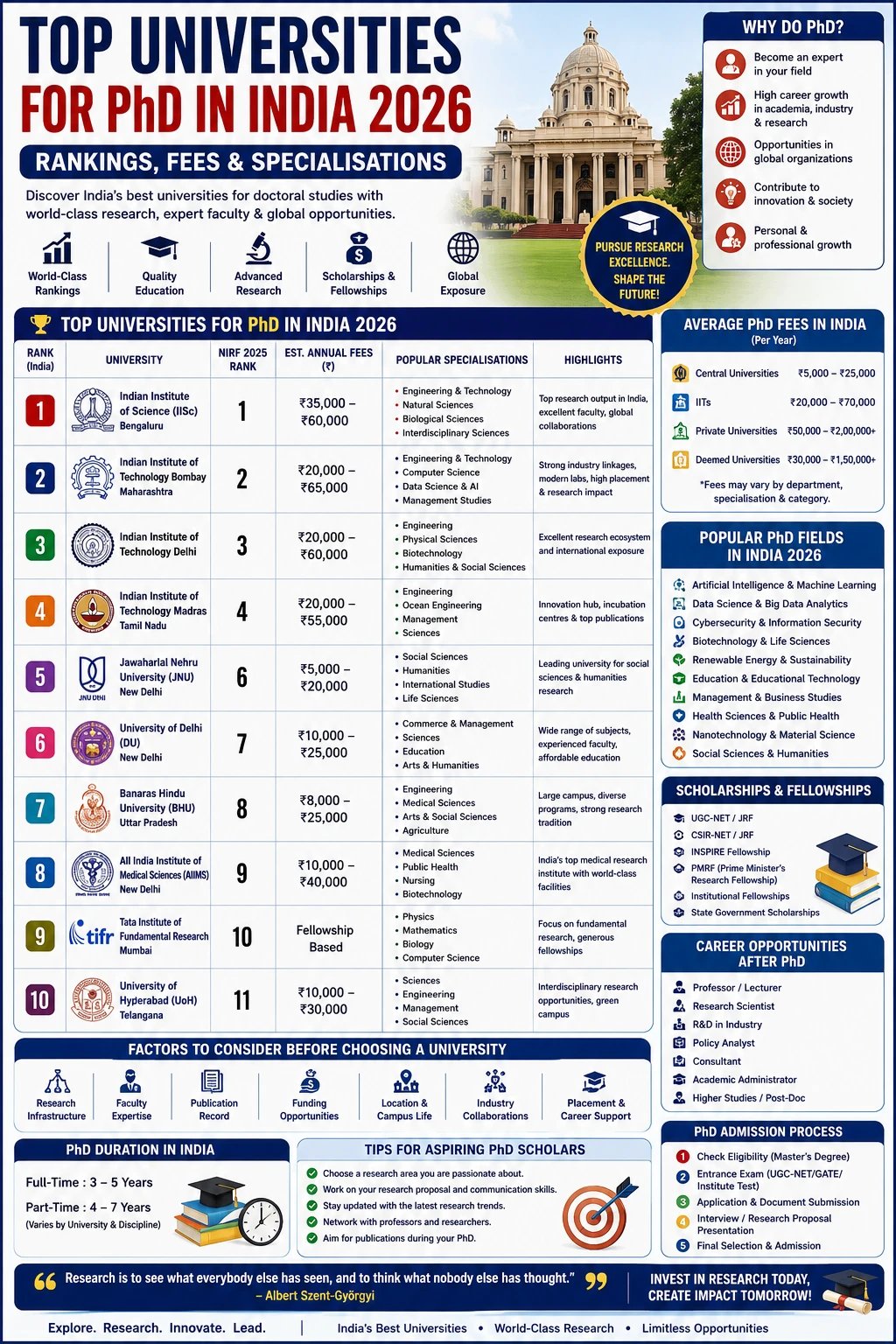
Top Universities for PhD in India 2026
1. Indian Institute of Science (IISc), Bangalore
The Indian Institute of Science remains one of India's premier research institutions.
Popular PhD Specializations
- Computer Science
- Mechanical Engineering
- Electrical Engineering
- Physics
- Chemistry
- Biological Sciences
- Artificial Intelligence
- Materials Science
Approximate Fees
- ₹35,000 to ₹60,000 per year
Highlights
- World-class research infrastructure
- Strong international collaborations
- High publication output
- Excellent fellowship opportunities
IISc consistently ranks among the best research institutions in India.
2. Indian Institutes of Technology (IITs)
The IIT system continues to attract top doctoral candidates from across the country.
Leading IITs include:
- IIT Bombay
- IIT Delhi
- IIT Madras
- IIT Kanpur
- IIT Kharagpur
- IIT Roorkee
Popular PhD Areas
- Engineering
- Artificial Intelligence
- Data Science
- Management
- Energy Studies
- Robotics
- Environmental Sciences
Approximate Fees
- ₹20,000 to ₹70,000 annually
Highlights
- Excellent research facilities
- Industry partnerships
- Strong global reputation
- Attractive fellowships
IIT graduates often secure positions in academia, research laboratories, and multinational corporations.
3. Jawaharlal Nehru University (JNU), New Delhi
JNU is particularly renowned for social sciences, humanities, and interdisciplinary research.
Popular PhD Programs
- Political Science
- Sociology
- International Relations
- Economics
- Education
- Life Sciences
- Language Studies
Approximate Fees
- ₹5,000 to ₹20,000 annually
Highlights
- Affordable education
- Strong research culture
- Excellent library facilities
- Diverse academic environment
JNU remains a preferred destination for social science researchers.
4. University of Delhi (DU)
The University of Delhi is one of India's most prestigious universities.
Specializations
- Commerce
- Economics
- Education
- Psychology
- Management
- Environmental Science
- Mathematics
Approximate Fees
- ₹10,000 to ₹30,000 annually
Highlights
- Extensive research network
- Experienced faculty
- Strong academic reputation
- Access to research funding
The university attracts thousands of PhD applicants every year.
5. Banaras Hindu University (BHU)
BHU offers a wide range of doctoral programs across disciplines.
Popular Research Areas
- Medical Sciences
- Agriculture
- Arts
- Commerce
- Education
- Engineering
- Social Sciences
Approximate Fees
- ₹8,000 to ₹25,000 annually
Highlights
- Large multidisciplinary campus
- Strong research tradition
- Affordable fee structure
- Excellent academic resources
BHU continues to be one of India's leading research universities.
6. Tata Institute of Fundamental Research (TIFR)
TIFR is known for advanced scientific research.
Specializations
- Physics
- Mathematics
- Computer Science
- Biology
- Astronomy
Approximate Fees
Most research scholars receive generous fellowships.
Highlights
- Cutting-edge research
- International collaborations
- Advanced laboratories
- Strong publication culture
TIFR is ideal for students interested in fundamental sciences.
7. All India Institute of Medical Sciences (AIIMS)
AIIMS remains India's top destination for medical and health sciences research.
PhD Areas
- Medical Sciences
- Public Health
- Nursing
- Biotechnology
- Clinical Research
Approximate Fees
- ₹10,000 to ₹40,000 annually
Highlights
- Advanced medical research facilities
- Access to clinical data
- Excellent healthcare infrastructure
- High-impact research opportunities
AIIMS scholars contribute significantly to healthcare innovation.
8. Jamia Millia Islamia (JMI)
JMI has emerged as a strong research-focused university.
Popular Areas
- Education
- Management
- Engineering
- Media Studies
- Social Sciences
Approximate Fees
- ₹8,000 to ₹30,000 annually
Highlights
- Modern research facilities
- Growing publication record
- Strong interdisciplinary focus
9. University of Hyderabad (UoH)
The University of Hyderabad is known for quality research and academic excellence.
Research Areas
- Sciences
- Humanities
- Social Sciences
- Computer Science
- Management
Approximate Fees
- ₹10,000 to ₹35,000 annually
Highlights
- Strong faculty base
- Interdisciplinary research opportunities
- Excellent campus infrastructure
10. Vellore Institute of Technology (VIT)
Among private institutions, VIT has developed a strong research reputation.
Specializations
- Engineering
- Computer Science
- Biotechnology
- Management
- Applied Sciences
Approximate Fees
- ₹50,000 to ₹1,50,000 annually
Highlights
- Industry-focused research
- Modern laboratories
- International partnerships
Top PhD Specializations in India for 2026
Certain fields are expected to experience significant research growth over the coming years.
Artificial Intelligence and Machine Learning
Applications include:
- Healthcare
- Finance
- Education
- Robotics
- Smart Cities
Demand for AI researchers continues to rise globally.
Data Science and Analytics
Research opportunities include:
- Big Data
- Predictive Analytics
- Business Intelligence
- Data Mining
Organizations increasingly rely on data-driven decision-making.
Environmental Science
Popular research areas include:
- Climate Change
- Renewable Energy
- Sustainable Development
- Pollution Control
Environmental research remains a national priority.
Management and Commerce
Research topics include:
- Digital Marketing
- Human Resource Management
- Finance
- Entrepreneurship
- Consumer Behavior
Business-related doctoral programs continue to attract significant interest.
Psychology
Growing awareness of mental health has increased demand for psychological research.
Popular areas include:
- Clinical Psychology
- Educational Psychology
- Organizational Psychology
- Mental Health Studies
Education
Research opportunities include:
- Educational Technology
- NEP 2020 Implementation
- Inclusive Education
- Online Learning
Education remains a major research area in India.
PhD Admission Process in India 2026
Although procedures vary across institutions, most universities follow a similar admission process.
Step 1: Check Eligibility
Most universities require:
- Master's degree with minimum qualifying marks
- UGC-NET, CSIR-NET, GATE, JRF, or equivalent qualification (where applicable)
Step 2: Submit Application
Applicants must submit:
- Academic transcripts
- Research proposal
- Statement of purpose
- Recommendation letters
Step 3: Entrance Examination
Many universities conduct their own entrance tests.
Step 4: Interview
Shortlisted candidates appear for a research interview or viva voce.
Step 5: Final Selection
Selection is based on academic performance, entrance scores, research proposal quality, and interview performance.
Scholarships and Fellowships for PhD Students
Several funding opportunities are available for doctoral scholars.
UGC-NET JRF
Provides monthly fellowships for eligible researchers.
CSIR-JRF
Available for science and technology disciplines.
INSPIRE Fellowship
Supports outstanding science researchers.
Prime Minister's Research Fellowship (PMRF)
Offers attractive financial support for scholars in premier institutions.
University Fellowships
Many universities offer institution-specific scholarships.
Funding significantly reduces financial stress during doctoral studies.
Career Opportunities After a PhD
A PhD opens doors to diverse career paths.
Popular options include:
- University Professor
- Research Scientist
- Data Scientist
- Policy Analyst
- Consultant
- Corporate Researcher
- Government Research Officer
- Academic Administrator
Industry demand for highly qualified researchers continues to grow across sectors.
Future of PhD Research in India
India is investing heavily in research, innovation, and higher education. Areas such as Artificial Intelligence, Sustainability, Healthcare, Advanced Manufacturing, Biotechnology, Education Technology, and Digital Transformation are expected to receive substantial attention.
Future-focused scholars who align their research with national and global priorities are likely to benefit from greater funding opportunities, stronger industry collaboration, and improved career prospects.
Conclusion
Selecting the right university is one of the most important decisions in a PhD journey. Institutions such as IISc, IITs, JNU, Delhi University, BHU, TIFR, AIIMS, Jamia Millia Islamia, University of Hyderabad, and VIT continue to provide excellent opportunities for doctoral research in India.
When choosing a university, scholars should evaluate rankings, faculty expertise, research facilities, funding options, publication support, and specialization areas rather than relying solely on reputation. A strong research environment, experienced supervision, and access to resources can significantly influence doctoral success.
With India's growing emphasis on innovation and research, pursuing a PhD from a leading university in 2026 can provide a solid foundation for a successful career in academia, industry, government, or entrepreneurship.