
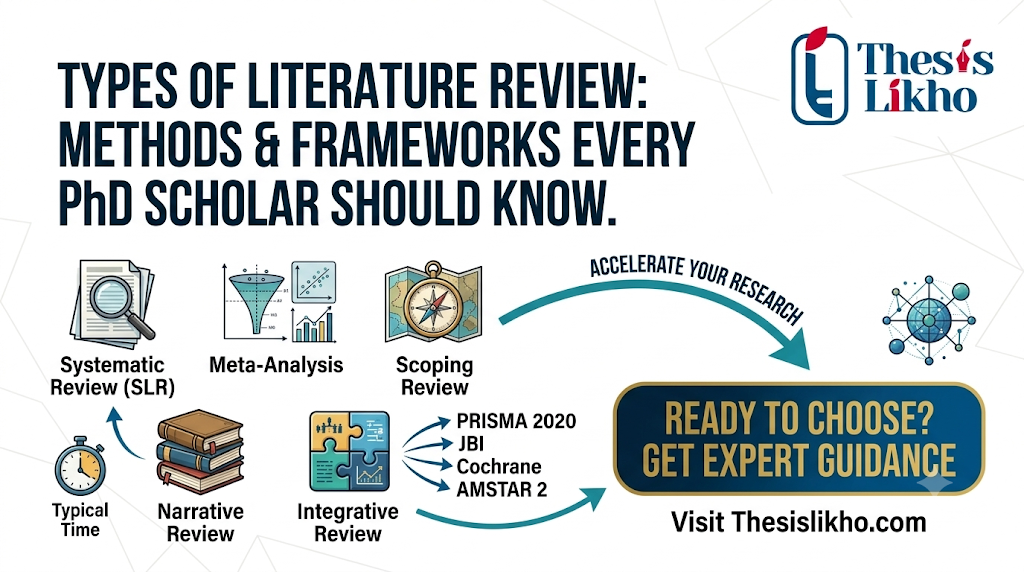
The literature review is the foundation of every thesis, dissertation and research paper. It shows what is already known, identifies the research gap and justifies your study. Yet many PhD scholars and postgraduate students are unsure which type of literature review they should write, and which method, framework or reporting guideline a supervisor or journal expects.
A narrative review written for a thesis chapter is very different from a systematic literature review (SLR) submitted to a Scopus indexed journal, which must follow PRISMA 2020. In this guide we explain the major types of literature review, the methodology each one needs, and the official frameworks — with links to the original sources for full information. If you need personal guidance, the Literature Review & Analysis service at Thesislikho can help you plan and structure your review.
What Is a Literature Review?
A literature review is a critical, organised summary and synthesis of published research on a specific topic. A good review does not simply list papers; it compares findings, evaluates methods, identifies contradictions and highlights gaps that future research — including yours — can address. Depending on the purpose, a literature review can be a chapter of a thesis or a standalone publication.
Quick Comparison: Types of Literature Review
| Type of Review | Main Purpose | Key Framework / Guideline | Typical Time |
|---|---|---|---|
| Narrative (traditional) review | Broad overview of a topic | SANRA checklist | 2–6 weeks |
| Systematic literature review | Answer a focused question transparently | PRISMA 2020, PICO, PROSPERO | 3–12 months |
| Meta-analysis | Statistically combine study results | PRISMA 2020, Cochrane Handbook | 4–12 months |
| Scoping review | Map the extent of evidence on a topic | PRISMA-ScR, Arksey & O'Malley, JBI | 2–6 months |
| Integrative review | Combine experimental and non-experimental studies | Whittemore & Knafl method | 2–6 months |
| Qualitative evidence synthesis | Synthesise qualitative studies | ENTREQ, SPIDER, CASP | 3–8 months |
| Rapid review | Timely evidence for decisions | Cochrane Rapid Reviews guidance | 1–3 months |
| Umbrella review | Review of systematic reviews | JBI umbrella method, AMSTAR 2 | 3–6 months |
| Bibliometric analysis | Analyse publication trends and networks | VOSviewer, Bibliometrix, Scopus/WoS data | 1–3 months |
| Realist review | Explain what works, for whom and why | RAMESES standards | 4–12 months |
1. Narrative (Traditional) Literature Review
The narrative review is the most common type in theses. It provides a broad, descriptive overview of a topic, theories and key debates. The author selects the literature, so the method is flexible but more open to selection bias.
Method: define the scope, search major databases (Scopus, Web of Science, Google Scholar, PubMed, IEEE Xplore), organise studies thematically, chronologically or methodologically, and critically discuss them.
Framework: The SANRA (Scale for the Assessment of Narrative Review Articles) checklist helps improve quality. Full information: SANRA – Research Integrity and Peer Review.
2. Systematic Literature Review (SLR)
A systematic literature review uses an explicit, reproducible method to identify, screen, appraise and synthesise all relevant studies on a focused research question. It is highly valued by Scopus indexed journals and is increasingly used in engineering, computer science, management and health sciences.
Methodology steps
- Formulate the research question using PICO (Population, Intervention, Comparison, Outcome) or a variant such as PICOS or PEO.
- Write and register a review protocol (for example on PROSPERO or OSF).
- Build a search string with keywords and Boolean operators (AND, OR, NOT).
- Search multiple databases and document the search strategy (see PRISMA-S for search reporting).
- Screen titles, abstracts and full texts against inclusion and exclusion criteria — ideally by two reviewers, using tools such as Rayyan or Covidence.
- Assess quality and risk of bias (e.g., Cochrane RoB 2, CASP, JBI checklists).
- Extract data and synthesise findings narratively or statistically.
- Report with the PRISMA 2020 checklist and flow diagram.
PRISMA 2020 framework
PRISMA 2020 (Preferred Reporting Items for Systematic Reviews and Meta-Analyses) is the international standard for reporting systematic reviews. It includes a 27-item checklist, an abstract checklist and the PRISMA flow diagram showing how many records were identified, screened, excluded and included. Full information and downloadable templates: prisma-statement.org and the original paper Page et al., BMJ 2021.
In software engineering and computer science, many researchers also follow the Kitchenham guidelines for systematic reviews.
3. Meta-Analysis
A meta-analysis is a statistical extension of a systematic review. It pools quantitative results (effect sizes) from comparable studies to produce an overall estimate with greater statistical power.
Method: follow all SLR steps, then calculate effect sizes, choose a fixed- or random-effects model, test heterogeneity (I², Q-test), check publication bias (funnel plot, Egger's test) and conduct sensitivity analysis. Common software includes RevMan, R (metafor, meta), Stata and CMA.
Frameworks: PRISMA 2020 for reporting, and the Cochrane Handbook for Systematic Reviews of Interventions for methods. For observational studies, see MOOSE guidelines. Certainty of evidence can be graded using GRADE. If statistics feel challenging, our PhD Data Analysis mentors can guide you.
4. Scoping Review
A scoping review maps the breadth of existing literature, identifies key concepts and evidence types, and reveals gaps — especially in emerging or complex fields. Unlike an SLR, it usually does not appraise study quality.
Method: the five-stage Arksey and O'Malley framework (2005): identify the research question, identify relevant studies, select studies, chart the data, and collate, summarise and report results. It was later refined by Levac et al. and by the JBI Manual for Evidence Synthesis, which uses the PCC (Population, Concept, Context) format.
Reporting: PRISMA-ScR (Extension for Scoping Reviews).
5. Integrative Review
An integrative review combines experimental, non-experimental, theoretical and empirical literature to give a comprehensive understanding of a phenomenon. It is popular in nursing, education and social sciences.
Framework: the five-stage method of Whittemore and Knafl (2005) — problem identification, literature search, data evaluation, data analysis and presentation.
6. Qualitative Evidence Synthesis (Meta-Synthesis)
This review type integrates findings from qualitative studies — interviews, focus groups, ethnographies — to generate new interpretations. Approaches include thematic synthesis, meta-ethnography and framework synthesis.
Frameworks: the SPIDER tool (Sample, Phenomenon of Interest, Design, Evaluation, Research type) for framing questions; ENTREQ for reporting; eMERGe for meta-ethnography; and CASP checklists for quality appraisal.
7. Rapid Review
A rapid review simplifies some systematic review steps — fewer databases, a single screener, date or language limits — to deliver evidence quickly for policy or practice decisions. Limitations must be stated clearly.
Framework: Cochrane Rapid Reviews Methods Group guidance.
8. Umbrella Review (Review of Reviews)
An umbrella review collects and evaluates existing systematic reviews and meta-analyses on a broad topic, offering a high-level summary of evidence.
Frameworks: the JBI umbrella review methodology (in the JBI Manual), quality appraisal with AMSTAR 2, and reporting with PRIOR.
9. Bibliometric Analysis and Systematic Mapping
Bibliometric reviews use quantitative analysis of publication data — citations, co-authorship, keyword co-occurrence, journals and countries — to reveal research trends and intellectual structure. They are widely published in Scopus journals in management, engineering and computer science.
Method and tools: export data from Scopus or Web of Science, clean it, and analyse with VOSviewer, Bibliometrix (R) or CiteSpace. Many authors combine bibliometric analysis with a PRISMA flow diagram for transparent data selection.
10. Realist Review
A realist review explains how and why complex interventions work in particular contexts, using Context–Mechanism–Outcome (CMO) configurations.
Framework: RAMESES publication standards.
How to Choose the Right Type of Literature Review
- Thesis background chapter? A well-structured narrative or integrative review is usually enough.
- Focused question with clear outcomes? Choose a systematic review, with meta-analysis if data are comparable.
- New or broad field? A scoping review or bibliometric analysis maps the landscape.
- Many reviews already exist? Consider an umbrella review.
- Limited time for policy input? A rapid review is suitable.
Common Mistakes in Writing a Literature Review
- Summarising papers one by one instead of synthesising themes.
- Calling a review "systematic" without a protocol, search strategy or PRISMA flow diagram.
- Relying on a single database or outdated sources.
- Not clearly stating inclusion and exclusion criteria.
- Missing a clear research gap at the end of the review.
- High similarity index due to close paraphrasing — always run a plagiarism check before submission.
How Thesislikho Supports Your Literature Review
Thesislikho mentors guide PhD scholars and postgraduate researchers at every stage of the review process, while the research and its intellectual contribution remain the scholar's own:
- Review planning and protocol design — choosing the right review type, framing PICO/PCC/SPIDER questions and building search strings, through Literature Review & Analysis and Methodology Assist.
- Data analysis support — guidance on meta-analysis and bibliometric tools via PhD Data Analysis.
- Editing and formatting — language editing, reference styling and PRISMA diagrams through Proofreading & Formatting.
- Publication preparation — turning your review into a journal-ready manuscript with Research Article support.
- Thesis guidance — integrating your review chapter into your full thesis with Thesis support.
Explore all our research services, check pricing, read testimonials from scholars, or browse more guides on the Thesislikho blog. Preparing for doctoral studies? Visit our PhD Admission and PhD Entrance Exam pages. Have questions? See our FAQs.
Conclusion
Choosing the right type of literature review — narrative, systematic, meta-analysis, scoping, integrative, qualitative synthesis, rapid, umbrella, bibliometric or realist — depends on your research question, timeline and target journal. Following recognised frameworks such as PRISMA 2020, PRISMA-ScR, JBI, Cochrane and AMSTAR 2 makes your review transparent, reproducible and far more likely to be accepted by Scopus indexed journals and appreciated by your research committee.
Need expert guidance on your literature review?
Get mentor support for review planning, PRISMA reporting, meta-analysis and journal-ready formatting.
Literature Review Support Contact Us