
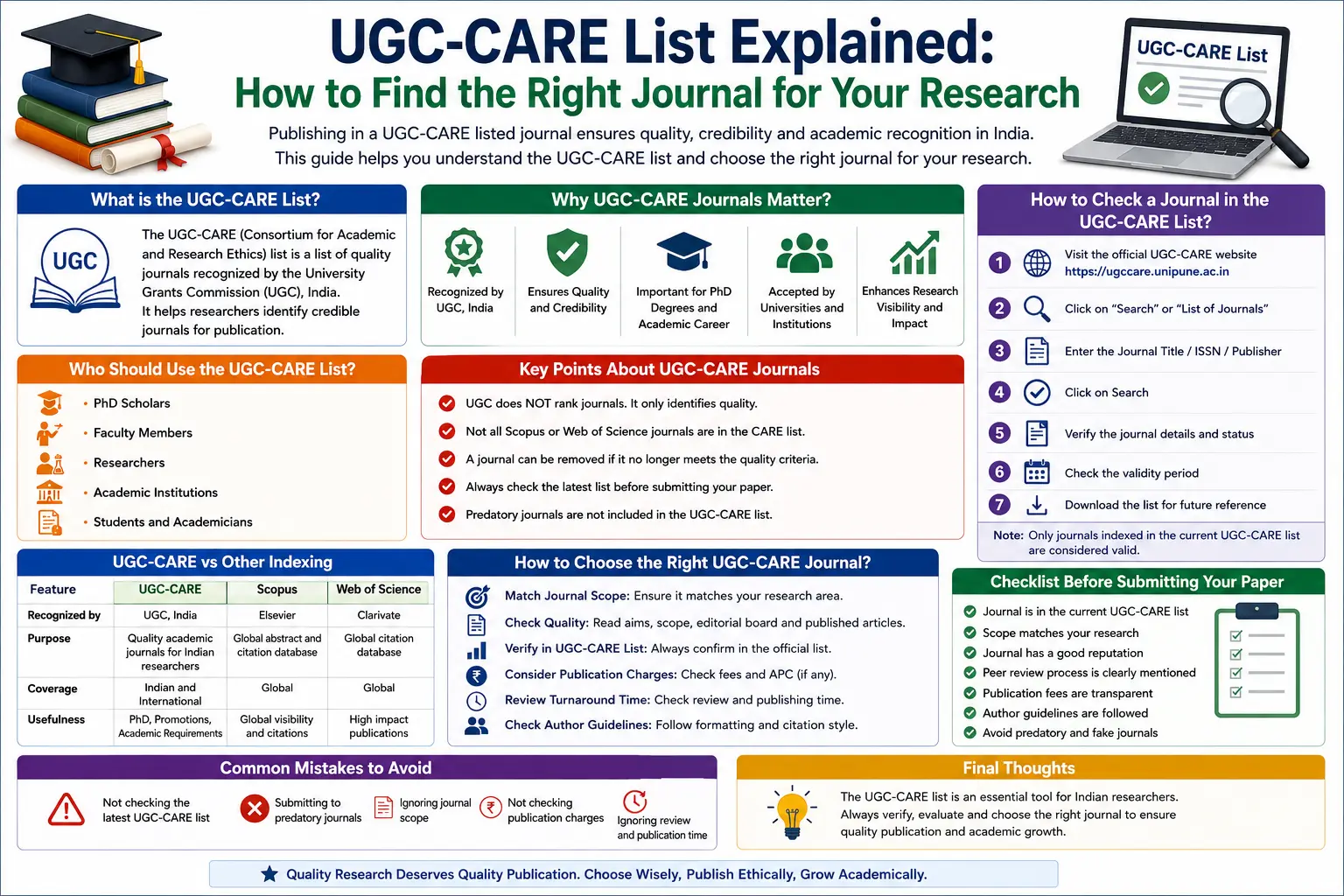
Selecting the right journal is one of the most important decisions a researcher makes during the publication process. A well-written research paper can face rejection or receive limited visibility if published in an inappropriate or low-quality journal. In India, one of the most commonly discussed concepts among researchers, PhD scholars, and faculty members is the UGC-CARE List.
Many scholars are aware that publishing in UGC-CARE-approved journals is important for academic promotions, PhD requirements, and research credibility. However, many still have questions such as:
- What is the UGC-CARE List?
- Why was it introduced?
- Is it still relevant in 2026?
- How can researchers find suitable journals?
- What is the difference between UGC-CARE and Scopus journals?
- How can one avoid predatory journals?
This comprehensive guide explains everything researchers need to know about the UGC-CARE List and provides practical strategies for selecting the right journal for research publication.
What Is the UGC-CARE List?
The UGC-CARE List refers to a collection of high-quality academic journals identified and monitored by the University Grants Commission through its Consortium for Academic and Research Ethics (CARE) initiative.
The initiative was introduced to:
- Improve publication quality
- Promote ethical research practices
- Discourage publication in predatory journals
- Ensure academic credibility
- Support genuine scholarly communication
The UGC-CARE framework was developed after concerns emerged regarding the rapid growth of questionable journals that charged publication fees without proper peer review.
Why Was the UGC-CARE List Introduced?
Before the introduction of CARE, many researchers unknowingly published papers in low-quality journals.
Several problems existed:
Rise of Predatory Journals
Many journals promised:
- Quick publication
- Guaranteed acceptance
- Minimal review process
These journals often lacked academic standards.
Pressure to Publish
Faculty members and research scholars often faced pressure to publish for:
- Promotions
- Recruitment
- PhD completion
- Academic evaluations
This created opportunities for unethical publishers.
Poor Research Quality
The absence of quality filters led to:
- Weak peer review
- Low-quality publications
- Reduced credibility of academic research
To address these concerns, UGC launched the CARE initiative.
What Is UGC-CARE?
CARE stands for:
Consortium for Academic and Research Ethics
Its objectives include:
- Promoting responsible publishing
- Enhancing publication standards
- Identifying quality journals
- Protecting researchers from predatory publishers
CARE serves as a quality assurance mechanism for scholarly publishing in India.
Importance of UGC-CARE Journals
Publishing in UGC-CARE-listed journals offers several benefits.
Academic Recognition
Publications in recognized journals carry greater academic value.
Universities often consider these publications during:
- Faculty recruitment
- Promotions
- Performance evaluations
PhD Requirements
Many Indian universities require PhD scholars to publish research papers in recognized journals before thesis submission.
UGC-CARE journals often satisfy these requirements.
Research Credibility
Publishing in reputable journals increases trust in your research.
Readers assume that the work has undergone proper peer review and editorial evaluation.
Better Visibility
Quality journals typically attract:
- Researchers
- Academicians
- Policymakers
- Industry professionals
This increases the likelihood of citations.
Ethical Publishing
UGC-CARE encourages ethical publication practices and discourages questionable publishing outlets.
How the UGC-CARE Journal System Works
The UGC-CARE framework evaluates journals using various quality parameters.
These include:
Peer Review Process
The journal should have a transparent and credible peer review system.
Editorial Board Quality
Editorial members should possess academic expertise and recognized credentials.
Publication Ethics
The journal must follow accepted publication ethics and editorial standards.
Indexing Status
Many journals are evaluated based on indexing and visibility.
Consistency
Regular publication schedules and content quality are important factors.
Categories of Journals Under UGC-CARE
Researchers often encounter different categories while searching for journals.
Group I Journals
These journals undergo direct evaluation through the CARE framework.
Characteristics include:
- Editorial scrutiny
- Quality assessment
- Compliance with publication standards
Group II Journals
These journals are generally indexed in internationally recognized databases.
Examples may include journals indexed in:
- Scopus
- Web of Science
These databases already maintain quality control mechanisms.
.
How to Find the Right Journal for Your Research
Selecting the right journal is often more important than writing the manuscript itself.
A journal mismatch is one of the leading reasons for rejection.
Step 1: Understand Your Research Topic
Before searching for journals, identify:
- Subject area
- Research objectives
- Methodology
- Target audience
For example:
A paper on Artificial Intelligence in Healthcare should not be submitted to a journal focused on pure economics.
Step 2: Define Your Research Discipline
Determine whether your research belongs to:
- Engineering
- Management
- Education
- Social Sciences
- Medicine
- Computer Science
- Humanities
Choosing the correct discipline narrows the journal search significantly.
Step 3: Examine Journal Scope
Every journal publishes an "Aims and Scope" section.
Check whether your paper aligns with:
- Topics covered
- Research methods accepted
- Audience served
Ignoring journal scope frequently results in desk rejection.
Step 4: Review Previously Published Articles
Read recent publications in the journal.
Ask:
- Does my study fit this style?
- Are similar topics being published?
- Is my contribution relevant?
This step greatly improves journal selection accuracy.
Step 5: Evaluate Journal Quality Indicators
Consider:
Peer Review
A credible journal should have a clear review process.
Editorial Board
Check whether editors and board members are qualified researchers.
Publication Frequency
Reliable journals publish consistently.
Transparency
The journal should clearly explain:
- Submission process
- Publication policies
- Ethical standards
How to Identify Predatory Journals
One of the biggest challenges for researchers is avoiding predatory publishers.
Warning signs include:
Guaranteed Acceptance
No reputable journal guarantees publication.
Extremely Fast Review
Claims such as:
"Publication within 3 days"
are major red flags.
Poor Website Quality
Look for:
- Broken links
- Spelling mistakes
- Missing information
Fake Editorial Boards
Verify whether editorial board members actually exist.
Aggressive Email Invitations
Be cautious of unsolicited emails promising easy publication.
Questions to Ask Before Selecting a Journal
Before submitting your manuscript, ask:
Does the journal match my research topic?
Is the journal peer-reviewed?
Is the journal recognized by my institution?
Does it follow ethical publishing practices?
Does it have a reasonable publication timeline?
Is it suitable for my academic goals?
Answering these questions can save months of frustration.
Common Mistakes Researchers Make
Many scholars select journals based solely on convenience.
Avoid these mistakes.
Choosing Only Based on Publication Speed
Fast publication does not always indicate quality.
Ignoring Journal Scope
Even strong papers get rejected when submitted to unsuitable journals.
Submitting Without Reading Author Guidelines
Formatting issues create unnecessary delays.
Focusing Only on Publication Fees
Low fees should not be the primary selection criterion.
Not Checking Journal Reputation
Always investigate the journal before submission.
Journal Selection Strategy for PhD Scholars
PhD students should adopt a strategic approach.
Early-Stage Researchers
Focus on:
- Reputable peer-reviewed journals
- Realistic acceptance chances
- Strong editorial support
Mid-Stage PhD Scholars
Consider:
- Specialized journals
- Better indexing
- Higher visibility
Final-Year PhD Scholars
Balance:
- Publication requirements
- Review timelines
- Academic quality
Planning ahead reduces stress near thesis submission deadlines.
Benefits of Publishing in Quality Journals
Publishing in reputable journals provides long-term advantages.
Increased Citations
Quality journals attract more readers.
Academic Networking
Publications help connect researchers with scholars worldwide.
Career Advancement
Publications support:
- Promotions
- Faculty appointments
- Research grants
Global Visibility
Research becomes accessible to a wider audience.
Future of Research Publishing in India
The academic publishing landscape is evolving rapidly.
Emerging trends include:
Open Access Publishing
Increasing accessibility of research.
AI-Assisted Editorial Systems
Improved manuscript screening and review management.
Stronger Publication Ethics
Greater emphasis on transparency and integrity.
International Collaboration
Growing partnerships between Indian and global researchers.
Researchers who understand these developments can make better publication decisions.
Checklist for Choosing the Right Journal
Before submission, ensure:
Journal scope matches your topic
Peer-review process is clearly defined
Editorial board is credible
Publication ethics are transparent
Journal is recognized by your institution
Publication timeline suits your needs
Previous articles resemble your research area
Predatory publishing indicators are absent
Author guidelines are reviewed
Manuscript formatting complies with journal requirements
Conclusion
The UGC-CARE initiative has played a significant role in promoting research quality and ethical publishing practices in India. For PhD scholars, faculty members, and researchers, understanding how the UGC-CARE system works is essential for making informed publication decisions. However, selecting the right journal involves more than simply checking whether it is recognized or indexed. Researchers must carefully evaluate journal scope, peer-review standards, editorial quality, publication ethics, and alignment with their academic goals.
A thoughtful journal selection strategy not only improves publication success rates but also enhances the visibility, credibility, and long-term impact of research. By understanding the UGC-CARE framework and applying best practices in journal selection, researchers can confidently choose publication venues that support both their academic growth and the advancement of knowledge.
Contact ThesisLikho Today
Call / WhatsApp: +91 96438 02216
Visit: ThesisLikho.com