
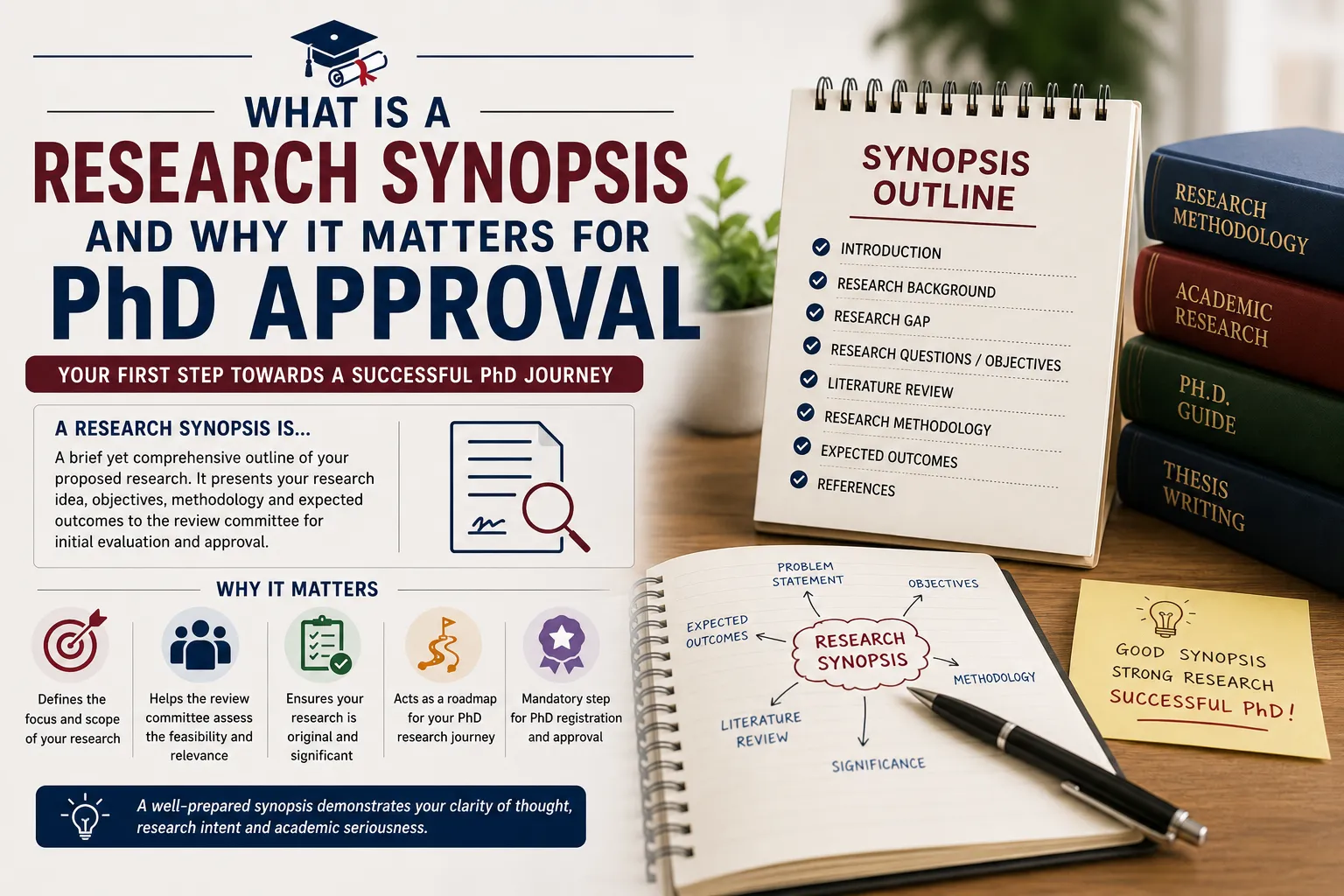
Before you can properly begin your PhD research, there's a gatekeeping document most first-time scholars underestimate: the synopsis. It's shorter than a thesis, more formal than a proposal draft, and it decides whether your Doctoral Research Committee formally approves your research plan — or sends you back to rework your topic, methodology, or scope before you've even started data collection.
This guide answers exactly what a research synopsis is and why it matters for PhD approval — what it needs to contain, how long it should be, how it differs from a thesis or a proposal, and what actually gets a synopsis approved without rounds of revision. We've written it the way an experienced PhD mentor would talk a first-time scholar through this stage, because that's genuinely the kind of guidance ThesisLikho's PhD-qualified team provides to the thousands of scholars we've supported through synopsis writing and beyond.
What Is a PhD Research Synopsis?
A PhD synopsis is a structured, formal summary of your proposed research — typically covering background, objectives, hypotheses, proposed methodology, and expected significance — submitted to your university's Doctoral Research Committee (DRC) or Research Advisory Committee (RAC) for approval. In most Indian universities, this approval is a mandatory gate: without it, your PhD registration cannot formally proceed, and any research work you do before approval technically sits outside your registered scope.
It's easy to underestimate how much rigor this document demands, precisely because it's shorter than a full thesis. But a synopsis isn't just a summary of your plan — it's effectively an academic argument for why your specific research deserves to be carried out, evaluated by faculty members who will scrutinize whether your problem is genuinely original and your proposed method is sound.
Why the Synopsis Matters for PhD Approval
The synopsis stage exists to catch problems early — before a scholar spends a year or more on a topic that's too vague, already well-covered, or paired with a methodology that can't actually answer the stated research question. UGC's doctoral framework requires every PhD scholar to be assigned a Research Advisory Committee (comprising the supervisor and at least two other faculty members) that monitors research progress from this very early stage onward.
This is really the heart of why understanding a research synopsis and why it matters for PhD approval isn't just procedural box-ticking: an approved synopsis formally registers your specific research problem with your university, which matters later too — a significant deviation between your approved synopsis and your final thesis can create real complications at the viva stage, since your examiners are ultimately evaluating whether you delivered on what was approved.
Synopsis vs. Proposal vs. Thesis: What's the Difference?
Although these terms are often used interchangeably, they represent different stages of the research process.
Research Proposal: An initial document that presents your research idea, objectives, and proposed methodology for topic approval or admission. It is usually prepared at the beginning of the research journey.
Research Synopsis: A detailed and structured research plan submitted for PhD registration. It expands on the proposal by including a stronger literature review, refined methodology, and a clear research roadmap.
Thesis: The final and complete research document that presents your findings, analysis, and conclusions after the study has been completed.
In short: A Proposal introduces the idea, a Synopsis formalizes and justifies the research plan, and a Thesis presents the completed research.
Standard Synopsis Structure
While exact section names vary slightly by university, most PhD synopses in India follow a consistent core structure:
- Title (working title, refined later if needed)
- Introduction / Background — context and why the problem matters
- Review of Related Literature — brief, not comprehensive
- Research Gap / Problem Statement
- Objectives and Hypotheses
- Proposed Methodology
- Expected Outcomes / Significance
- Proposed Chapter Scheme
- References (some universities exclude citations from the synopsis itself — check your specific format)
Some institutional guidelines are notably specific about formatting details: one university's published guidelines specify that the synopsis should be double-spaced, should not include internal headings, diagrams, or illustrations, should not exceed 20 pages, and — notably — should exclude citations altogether, focusing purely on background, objectives, hypothesis, methods, and findings/implications. This is a good reminder that format expectations genuinely differ by institution, so always confirm the exact structure your specific DRC expects rather than assuming a single universal template applies.
For a deeper, university-format-specific breakdown, see our companion guide: Standard Synopsis Format Explained for PhD and MPhil Scholars.
Typical Word Count and Format Standards
Word count guidance varies meaningfully by institution and even by field:
- General dissertation synopses (MPhil, master's-level research) commonly fall in the 1,500–3,000 word range.
- PhD synopses often extend up to 5,000 words, though some universities instead specify a page limit (commonly around 15–20 double-spaced pages) rather than a strict word count.
- Certain fields — medical research, for instance — sometimes use noticeably shorter synopsis formats, occasionally as brief as 1,000 words, reflecting a more standardized reporting structure in that discipline.
Because these figures vary this much, the single most important practical step is confirming your specific university's PhD ordinance or DRC guidelines before drafting — submitting a synopsis that's significantly over or under your institution's specified length is a common, entirely avoidable reason for delay.
The Chapter Scheme: Why Committees Expect One
Most Indian DRCs expect the synopsis to include a proposed chapter scheme — essentially a sketch of what the eventual completed thesis's chapters will look like, even though the actual content obviously doesn't exist yet.
This isn't a formality your committee skims past. A clear chapter scheme demonstrates that you already have a coherent mental model of how your research will unfold from introduction to conclusion — which reassures a committee that you're not simply proposing an interesting question without having thought through how you'll actually get from that question to a completed, defensible thesis.
A typical PhD chapter scheme might look like:
- Chapter 1: Introduction and Research Background
- Chapter 2: Review of Literature
- Chapter 3: Research Methodology
- Chapter 4: Data Analysis and Results (or a case-study/empirical chapter, depending on discipline)
- Chapter 5: Discussion
- Chapter 6: Conclusion, Contribution, and Recommendations
Your actual thesis chapter count and titles will likely evolve as your research progresses — that's expected and normal — but a synopsis with no chapter scheme at all, or one that's vague and generic, tends to invite more committee questions than one with a clear (even if provisional) structure.
Writing the Background and Rationale
Your background section needs to do more than describe your topic — it needs to position your specific research within the existing body of work and make clear what it adds. Elsevier's guidance on writing a research proposal frames this section as the place to synthesize prior research and place your proposed work into the larger picture of what's already been studied, specifically to convince your reader that the work is original and genuinely adds to current knowledge.
This is a useful mental test for your own background section: after reading it, would a committee member understand not just what you're studying, but why it hasn't already been adequately answered? If your background reads only like a general summary of the field with no clear gap identified, it likely needs another pass before it does its actual job.
Objectives and Hypotheses
Your objectives should be specific and measurable — vague objectives ("to study the impact of X on Y") tend to produce vague methodology sections later, since there's nothing concrete to design a method around. Where your research is quantitative or causal in nature, state your hypotheses explicitly (null and alternative), since this gives your committee a precise sense of what your data collection and analysis will actually test.
Proposed Methodology
This is frequently where synopses lose committee confidence, not because the underlying idea is weak, but because the plan for executing it isn't concrete. Elsevier's guidance is direct on this point: your methodology section should be written with enough clarity and logical organization that your reader comes away confident you have the skills and plan needed to actually complete the project — not just an interesting idea about what you'd like to find out.
Your methodology section should specify your research design (qualitative, quantitative, or mixed), your target population and sampling approach, your data collection method, and your intended analysis technique — specific enough that a knowledgeable reader could picture exactly how you'd carry it out, not just what topic you'd study.
What the DRC/RAC Actually Evaluates
Doctoral committees generally assess a synopsis against a consistent set of criteria: whether the research problem is clearly defined and sufficiently original, whether the proposed methodology genuinely matches the stated objectives, whether the scope is realistic given the scholar's timeline, and whether the candidate demonstrates sufficient grounding in the existing literature to justify pursuing this specific question.
Knowing this in advance is useful — it means your synopsis doesn't need to impress on breadth or ambition alone. A tightly scoped, clearly justified, methodologically sound proposal on a modest but genuine gap will typically be approved faster than an ambitious, sprawling topic with a thin methodology section.
Organizing Your Literature Review for Synopsis Stage
Since the synopsis requires only a brief literature justification rather than a full critical review, the challenge most scholars face isn't finding sources — it's organizing them efficiently enough to write a tight, well-grounded background section without spending months on preliminary reading.
A practical approach here comes from Mendeley's guidance on managing academic literature: rather than reading everything first and sorting it out at the end, group your annotated sources by recurring theme as you go. For a PhD synopsis, this might mean tagging papers into categories like "established frameworks in this area," "recent applications," and "acknowledged gaps or limitations" as you read each one. By the time you sit down to write your background section, you already have a thematic skeleton rather than a pile of disconnected notes — which makes it far easier to write a background section that clearly points toward your specific gap, rather than one that reads as a loosely connected summary of everything you've read.
This same organizational habit pays off again later, when you move from synopsis to full thesis and need to expand this brief literature justification into a proper, comprehensive literature review chapter.
How Synopsis Requirements Vary Across Disciplines
Synopsis requirements differ across academic fields, even though the overall purpose remains the same.
Management & Social Sciences
Focuses on a clear conceptual framework, research objectives, and a well-justified sampling or survey design.
Engineering & Computer Science
Emphasizes technical feasibility, tools, datasets, implementation methods, and the expected technical contribution.
Medical & Life Sciences
Highlights ethical approval, sample or patient selection, and statistical analysis plans, often in a more structured format.
Humanities
Prioritizes theoretical frameworks, critical analysis, and the use of textual or archival sources over experimental methods.
Note: Always follow your university or department's official synopsis guidelines, as formatting, structure, and word limits can vary by discipline.
Common Formatting Mistakes That Delay Approval
Beyond the substantive issues covered earlier (vague scope, mismatched methodology), a surprising number of synopsis delays come down to avoidable formatting errors:
- Including diagrams or illustrations when the institution's guidelines specifically exclude them from the synopsis format
- Citing sources inconsistently — mixing citation styles, or citing at all when the specific format calls for a citation-free synopsis
- Exceeding the page or word limit and submitting anyway, assuming the committee will overlook it
- Missing the required cover page elements — registration number, department, supervisor details, and other administrative fields that specific institutional templates require
- Submitting a chapter scheme copied nearly verbatim from a published thesis in the field, rather than one genuinely reflecting the scholar's own proposed structure — this is both a credibility issue and, in some cases, a plagiarism-flagging risk
None of these are difficult to avoid, but they're common precisely because scholars focus most of their attention on content and treat formatting as an afterthought, right before a deadline.
Common Reasons Synopses Get Sent Back
- Research problem too broad or too vague to evaluate for originality
- Methodology doesn't match the stated objectives — for example, proposing a purely qualitative approach for a hypothesis clearly requiring statistical testing
- Insufficient literature grounding — the background section doesn't demonstrate the candidate has read enough to know the field's current state
- Missing or generic chapter scheme, giving the committee no sense of how the completed thesis will actually unfold
- Format non-compliance — exceeding the specified word/page limit, or including elements (like citations or diagrams) the specific institution's guidelines say to exclude
- Overlap with existing, already-registered research at the same institution, without acknowledging or addressing the overlap
Two Realistic Scenarios
Scenario 1 — Kavita, a first-time PhD scholar in a management department Kavita's first synopsis draft proposed studying "the impact of digital transformation on Indian businesses" — a topic broad enough that her DRC couldn't evaluate whether it was original or feasible within a PhD timeline. Her supervisor asked her to narrow it, and her revised synopsis focused specifically on how mid-sized manufacturing SMEs in one state had adopted ERP systems, with a clearly defined mixed-methods design. The narrower scope wasn't a smaller idea — it was the same broad interest, made concrete enough for a committee to actually evaluate and approve.
Scenario 2 — Arvind, a PhD scholar in an engineering department Arvind's synopsis proposed an ambitious methodology involving a large-scale primary data collection effort across multiple states, but his timeline and available resources didn't realistically support that scope. His DRC didn't reject the topic — they asked him to revise the methodology to a more feasible single-region case study with a clearly justified sampling rationale. The lesson, in both cases, is the same: DRCs aren't looking for the most ambitious possible research question — they're looking for one that's genuinely completable and defensible within the scholar's actual circumstances.
Tips for Getting Your Synopsis Approved Faster
- Confirm your university's exact synopsis format before drafting — word/page limits, whether citations are expected, and whether a chapter scheme is required all vary by institution.
- Narrow your research problem before writing anything else. A specific, well-scoped problem makes every other section easier to write convincingly.
- Make your methodology concrete, not aspirational. Name your sample size, tool, and analysis method rather than describing your approach in general terms.
- Build your chapter scheme early, even in draft form — it forces you to think through the full arc of your research before you've written a single results chapter.
- Get informal feedback from your supervisor before formal submission. Most supervisors would rather catch a scope or methodology issue in an early draft than at the formal DRC meeting.
For a structured way to review your own draft before submission, see our companion piece: How to Self-Review Your Synopsis Before Submission.
A Note on Publication Requirements
Scholars sometimes ask whether a synopsis needs to reference a plan for pre-submission journal publication, since earlier UGC regulations (2016) required PhD candidates to publish at least one paper before final thesis submission. This specific mandatory publication requirement has since been relaxed under more recent UGC regulatory updates, and individual universities now set their own publication expectations rather than following one uniform national rule. Because this has genuinely shifted in recent years and continues to vary by institution, confirm your specific university's current publication requirement directly with your RAC rather than assuming either the older mandatory-publication rule or its complete removal applies to your program.
What Happens After Approval
Once your synopsis is approved, your topic is formally registered, and your research advisory committee will continue reviewing your progress at periodic intervals as your research unfolds. Minor adjustments to scope, title, or methodology are usually permitted with your supervisor's approval as your understanding of the topic deepens — this is normal and expected. Major changes (a fundamentally different research question, a paradigm shift in approach, or a change of supervisor) typically require a formal resubmission and re-approval process, which can meaningfully affect your registration timeline, so it's worth getting your core scope right at synopsis stage rather than relying on major revisions later.
Much further down the line, before your final thesis submission, most universities also require a separate pre-submission seminar — presenting your completed research to your committee and incorporating their feedback. This is a distinct, later milestone from synopsis approval, not the same step under a different name.
Pre-Submission Checklist
- Confirmed your university's specific word/page count and format requirements
- Research problem is specific enough for your committee to judge its originality
- Background section clearly identifies a gap, not just a summary of the field
- Objectives are specific and measurable; hypotheses are explicitly stated where relevant
- Methodology names a specific sample, data collection method, and analysis approach
- Chapter scheme is included and reflects a coherent, realistic thesis structure
- Formatting matches your institution's specific rules (citations, diagrams, spacing)
- Supervisor has reviewed and given informal sign-off before formal DRC submission
Getting Expert Support
Even experienced researchers benefit from a second, informed read on a synopsis before it goes to committee — a vague methodology section or an overly ambitious scope is far easier to fix on paper than after months of research built on an unclear foundation.
ThesisLikho's mentoring team — PhD-qualified experts who've guided over 10,000 scholars through this exact stage — offers structured synopsis review and drafting support as part of our Synopsis Writing Service, helping you tighten your research problem, chapter scheme, and methodology before it reaches your DRC.
Frequently Asked Questions
What is a research synopsis and why does it matter for PhD approval?
It's a structured, formal summary of your proposed PhD research — covering background, objectives, methodology, and a chapter scheme — that your Doctoral Research Committee must approve before your PhD registration can formally proceed.
How long does it take to complete a synopsis using this approach?
Drafting a solid synopsis typically takes 2–6 weeks of focused work, while the DRC/RAC review and approval process can add several more weeks depending on your university's meeting schedule and how much revision is requested.
Is professional help available for research synopsis writing?
Yes — structured mentoring on synopsis structuring, chapter-scheme drafting, and literature framing is a standard, legitimate form of academic support. ThesisLikho's PhD-qualified mentors offer this kind of guided review for research scholars.
Why does a research synopsis matter for PhD approval?
It's the formal gate that registers your specific research problem with your university and confirms your committee believes your topic is original and your methodology is sound — without this approval, your research technically can't proceed.
How does a research synopsis affect a PhD candidate's overall thesis journey?
A well-scoped, clearly approved synopsis sets the boundaries your eventual thesis is expected to stay within — significant deviation later can create complications at the viva stage, so getting the scope right early genuinely shapes the rest of your PhD journey.
Get Synopsis Help Now
If you'd like a mentor to review your synopsis draft before it goes to your DRC, ThesisLikho's team is ready to help.