
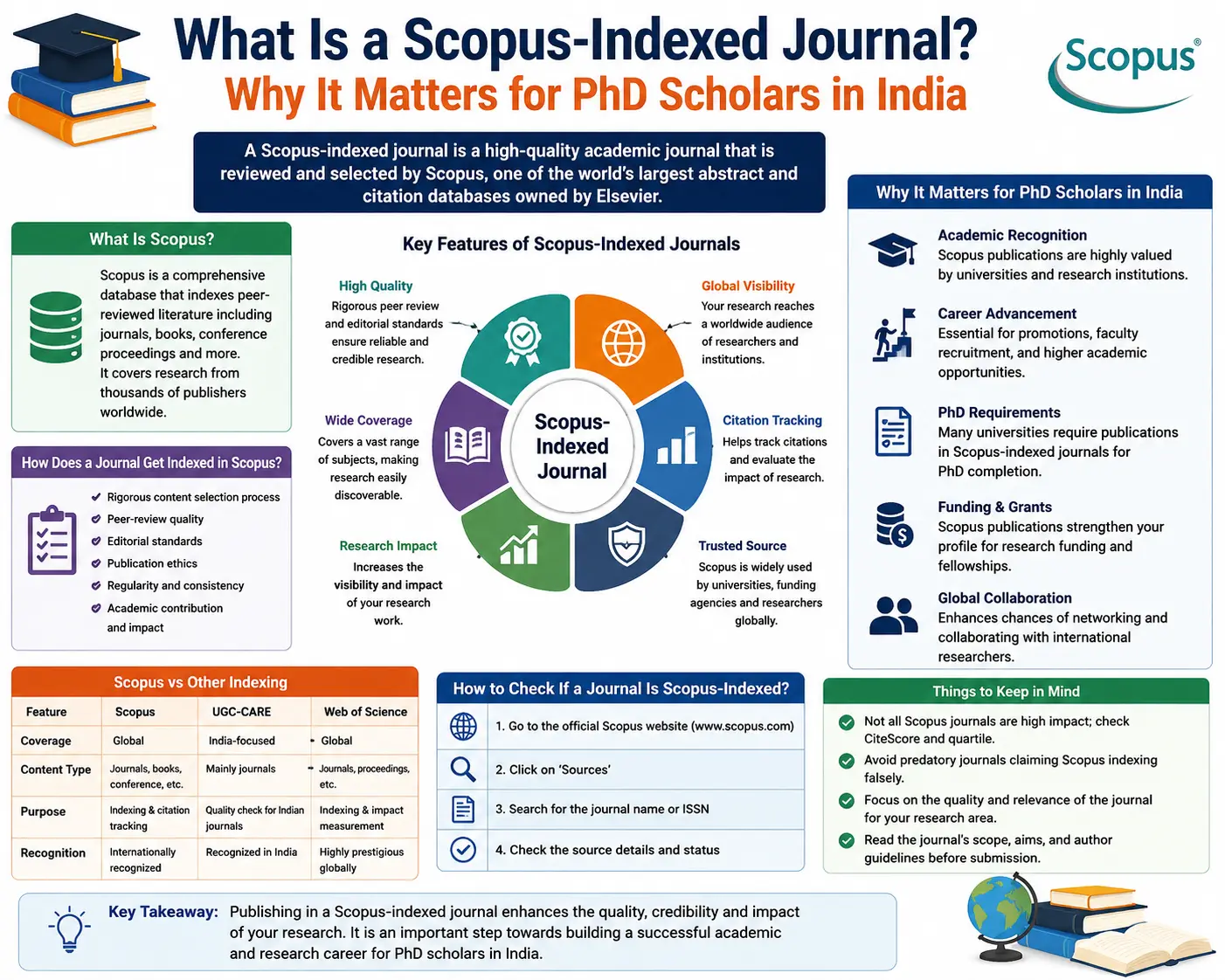
For PhD scholars, faculty members, and researchers in India, publishing research papers is an essential part of academic growth. Whether you are pursuing a doctoral degree, applying for academic positions, seeking promotions, or building a research profile, one term you will frequently encounter is Scopus-indexed journals.
Many universities, research institutions, and employers emphasize publications in Scopus-indexed journals because they are considered indicators of quality, credibility, and international visibility. However, many researchers—especially early-career scholars—often have questions such as:
- What exactly is a Scopus-indexed journal?
- Why is Scopus important?
- How does a journal get indexed in Scopus?
- Is Scopus better than UGC-CARE?
- How can I verify whether a journal is truly indexed?
- How do I avoid fake Scopus journals?
This comprehensive guide explains everything you need to know about Scopus-indexed journals and why they matter for PhD scholars in India.
What Is Scopus?
Scopus is one of the world's largest abstract and citation databases for peer-reviewed academic literature.
It is owned and managed by Elsevier and contains millions of records from journals, conference proceedings, books, and other scholarly publications.
Researchers use Scopus to:
- Discover academic literature
- Track citations
- Analyze research impact
- Identify influential journals
- Evaluate research performance
Because of its extensive coverage and quality standards, Scopus has become one of the most trusted indexing databases globally.
What Is a Scopus-Indexed Journal?
A Scopus-indexed journal is a scholarly journal that has been evaluated and accepted for inclusion in the Scopus database.
Before a journal is indexed, it undergoes a rigorous review process assessing factors such as:
- Peer-review quality
- Editorial standards
- Publication ethics
- Citation performance
- Academic contribution
- International relevance
Only journals meeting Scopus quality criteria are included in the database.
Therefore, publication in a Scopus-indexed journal generally indicates that the research has appeared in a recognized and credible academic outlet.
Why Are Scopus-Indexed Journals Important?
Scopus indexing serves as a quality benchmark in academic publishing.
Researchers, universities, and funding agencies often view Scopus publications as evidence of high-quality scholarly work.
Importance of Scopus Journals for PhD Scholars
For PhD scholars in India, publishing in Scopus-indexed journals offers several advantages.
Enhanced Academic Credibility
Scopus journals are generally considered more reliable because they follow established editorial and peer-review standards.
Publishing in these journals demonstrates research quality and scholarly competence.
Better Career Opportunities
Many academic institutions consider Scopus publications during:
- Faculty recruitment
- Promotions
- Research fellowships
- Postdoctoral applications
A strong publication record in Scopus journals can significantly strengthen a candidate's profile.
Greater Research Visibility
Research published in Scopus-indexed journals becomes accessible to a global academic audience.
This increases:
- Readership
- Citations
- Collaboration opportunities
International visibility is particularly valuable for early-career researchers.
Improved Citation Potential
Since Scopus is widely used by researchers worldwide, papers published in indexed journals often receive more exposure and citations.
Higher citations contribute to academic reputation and research impact.
Support for PhD Completion Requirements
Many universities in India encourage or require publications in recognized journals as part of doctoral program requirements.
Scopus-indexed journals are frequently preferred because of their international recognition.
How Does a Journal Get Indexed in Scopus?
Not every journal can become Scopus-indexed.
Journals must satisfy strict selection criteria established by the independent review body known as the Content Selection and Advisory Board (CSAB).
The evaluation process considers several factors.
Journal Policy
The journal must have:
- Clear aims and scope
- Ethical publishing policies
- Transparent review procedures
Peer Review System
Scopus requires evidence of a genuine peer-review process.
Journals without rigorous review standards are unlikely to be accepted.
Editorial Quality
The editorial board should consist of qualified scholars with expertise in the subject area.
Regular Publication
Journals must publish issues consistently and on schedule.
Irregular publication can affect indexing status.
Academic Contribution
The content should contribute meaningful knowledge to its field.
International Diversity
Scopus often favors journals that attract contributions from multiple countries and regions.
What Types of Content Are Indexed in Scopus?
Scopus includes a wide range of scholarly materials.
These include:
- Research articles
- Review papers
- Conference proceedings
- Books
- Book chapters
- Editorials
- Notes and letters
This broad coverage makes Scopus a valuable resource for literature reviews and research evaluation.
Scopus Quartiles Explained
When discussing Scopus journals, researchers often encounter terms such as Q1, Q2, Q3, and Q4.
These quartiles help assess journal performance within specific subject categories.
Q1 Journals
Top 25% of journals in a field.
Characteristics:
- High impact
- Strong citation performance
- Competitive acceptance rates
Publishing in Q1 journals is highly prestigious.
Q2 Journals
Journals ranked between the top 25% and 50%.
They maintain strong academic standards and good visibility.
Q3 Journals
Middle-tier journals with moderate citation performance.
They often provide realistic publication opportunities for emerging researchers.
Q4 Journals
Journals in the lower quartile of indexed publications.
While still indexed, they generally have lower citation metrics compared to Q1 and Q2 journals.
Understanding CiteScore
Scopus uses a metric known as CiteScore to evaluate journal influence.
CiteScore measures the average number of citations received by documents published in a journal over a defined period.
Higher CiteScore values generally indicate greater research impact.
However, CiteScore should not be the only factor considered when selecting a journal.
Benefits of Publishing in Scopus Journals
Global Recognition
Research becomes visible to scholars worldwide.
Increased Citations
Greater exposure often leads to higher citation counts.
Stronger Academic Profile
Scopus publications enhance:
- CVs
- Academic portfolios
- Faculty applications
Research Collaboration Opportunities
International researchers can discover and engage with your work.
Funding and Grant Advantages
Funding agencies often consider publication quality when evaluating applications.
Challenges of Publishing in Scopus Journals
Although rewarding, publishing in Scopus journals can be challenging.
Higher Standards
Scopus journals typically require:
- Strong methodology
- Original research
- Comprehensive analysis
Longer Review Process
Peer review may take:
- Several weeks
- Several months
Patience is essential.
Competitive Acceptance Rates
Many journals receive far more submissions than they can publish.
Quality and relevance are critical.
How to Verify Whether a Journal Is Scopus-Indexed
One of the most important steps before submission is verifying indexing claims.
Some journals falsely claim to be indexed.
Researchers should:
Check Official Journal Information
Review the journal website carefully.
Verify Indexing Directly
Always confirm indexing through official database sources rather than relying solely on publisher claims.
Review Current Status
Indexing status can change over time.
A journal previously indexed may later be discontinued.
How to Avoid Fake Scopus Journals
Predatory publishers sometimes misuse the Scopus name to attract submissions.
Watch for warning signs.
Guaranteed Publication
No legitimate journal guarantees acceptance.
Unrealistically Fast Publication
Promises such as:
- Publication in 48 hours
- Acceptance in one week
are major red flags.
Poor Website Quality
Look for:
- Broken pages
- Grammar mistakes
- Missing editorial information
Lack of Peer Review Details
Reputable journals clearly explain their review process.
Suspicious Email Invitations
Be cautious when receiving unsolicited publication offers.
Tips for Choosing the Right Scopus Journal
Selecting the correct journal improves publication success.
Match the Journal Scope
Ensure your research aligns with the journal's focus area.
Review Recent Articles
Analyze previously published papers.
Ask:
- Is my topic relevant?
- Does my methodology fit?
Consider Review Timelines
Some journals provide estimated review durations.
Evaluate Journal Metrics
Metrics may provide insight into visibility and influence.
Understand Publication Fees
Some journals charge article processing fees, while others do not.
Always review fee policies before submission.
Common Reasons Scopus Journal Submissions Get Rejected
Many manuscripts are rejected because of:
Weak Research Questions
Poorly defined objectives reduce impact.
Limited Originality
The study does not contribute new knowledge.
Methodological Problems
Weak design or analysis affects credibility.
Poor Writing Quality
Even good research can suffer from unclear presentation.
Journal Mismatch
Submitting to an inappropriate journal frequently leads to rejection.
Strategies for PhD Scholars to Publish Successfully
Start Publishing Early
Do not wait until the final year of your PhD.
Publishing gradually reduces pressure.
Focus on Research Quality
Strong methodology improves publication prospects.
Learn Academic Writing
Develop skills in:
- Scientific writing
- Data presentation
- Literature synthesis
Seek Supervisor Feedback
Experienced mentors can identify weaknesses before submission.
Respond Professionally to Reviewers
Constructive responses increase the likelihood of acceptance.
Future Trends in Academic Publishing
The research publishing landscape continues to evolve.
Key trends include:
Open Access Publishing
Growing accessibility of scholarly content.
AI-Assisted Editorial Systems
Improved screening and manuscript management.
Open Peer Review
Greater transparency in evaluation processes.
Research Data Sharing
Increasing emphasis on reproducibility and transparency.
Researchers who understand these developments can better navigate future publication environments.
Checklist Before Submitting to a Scopus Journal
Before submission, ensure:
Research question is clear
Literature review is comprehensive
Methodology is rigorous
Results are properly analyzed
Journal scope matches the topic
Manuscript follows author guidelines
References are accurate
Plagiarism is minimized
Ethical approvals are included where required
Indexing claims are verified
Conclusion
Scopus-indexed journals play a vital role in the academic and research ecosystem, particularly for PhD scholars in India seeking recognition, visibility, and career advancement. Because Scopus maintains rigorous standards for journal selection, publishing in indexed journals signals research quality, credibility, and scholarly impact. These publications often lead to greater international exposure, higher citation potential, stronger academic profiles, and improved opportunities for funding, employment, and collaboration.
However, success in Scopus publishing requires more than simply submitting a manuscript. Researchers must focus on originality, methodological rigor, ethical practices, journal selection, and professional academic writing. By understanding how Scopus indexing works and learning how to identify legitimate journals, PhD scholars can make informed publication decisions and maximize the impact of their research. In today's competitive academic environment, a well-planned Scopus publication strategy can become a powerful foundation for long-term research success.
Contact ThesisLikho Today
Call / WhatsApp: +91 96438 02216
Visit: ThesisLikho.com