
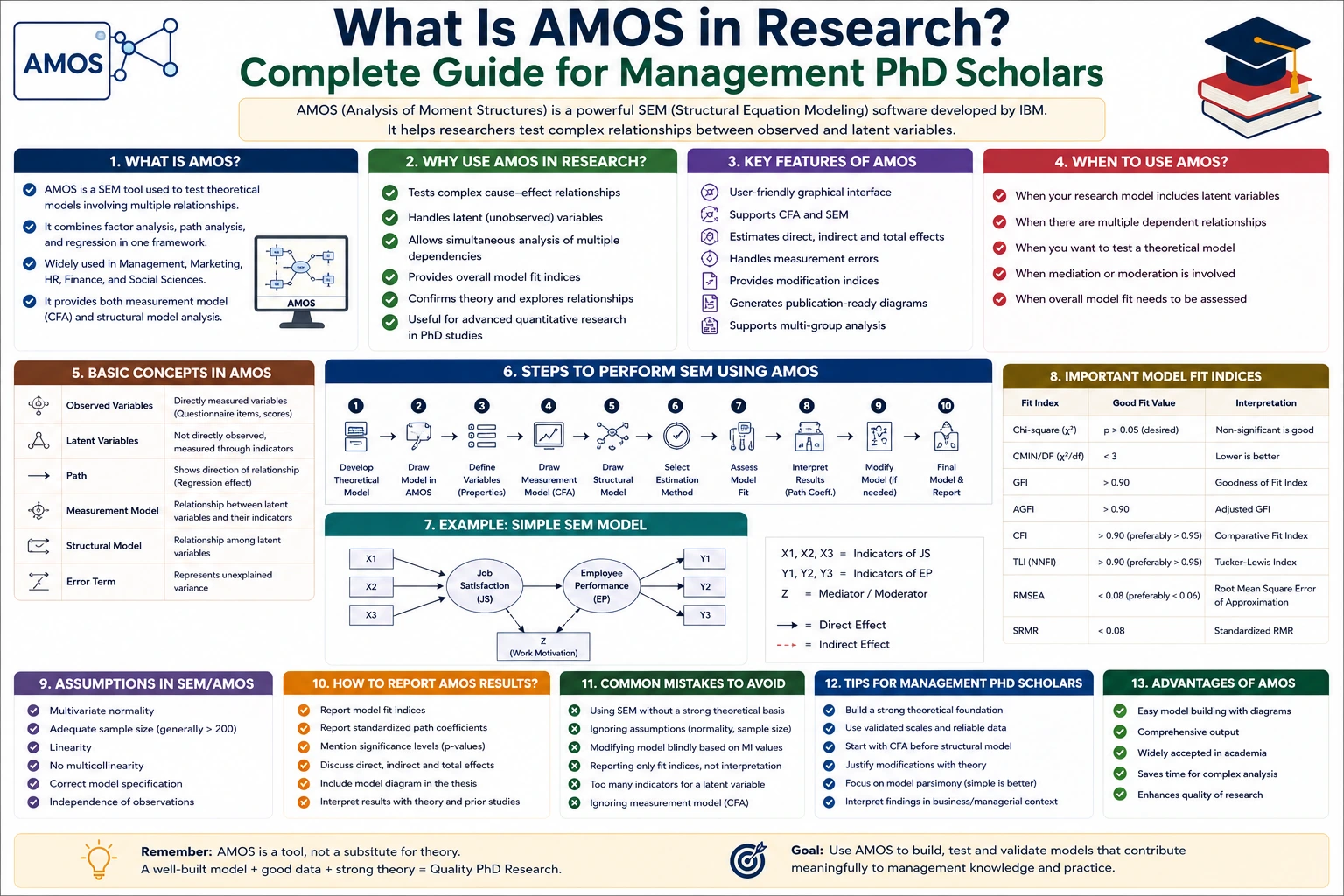
In today's research landscape, data analysis has become more sophisticated than ever before. Traditional statistical techniques such as correlation, regression, and ANOVA are useful for analyzing individual relationships between variables, but many doctoral research studies involve complex theoretical models with multiple constructs, mediating variables, and indirect relationships. This is where AMOS (Analysis of Moment Structures) becomes an essential tool for researchers.
AMOS is one of the most widely used software applications for Structural Equation Modeling (SEM) and Confirmatory Factor Analysis (CFA). It enables researchers to test theoretical models, validate measurement instruments, and analyze relationships among observed and latent variables using an intuitive graphical interface.
For Management PhD scholars in India, AMOS has become a preferred choice for research involving topics such as employee engagement, organizational behavior, customer satisfaction, leadership, consumer behavior, technology adoption, human resource management, marketing, finance, and business strategy. Many universities also recommend AMOS for thesis work because of its integration with SPSS and its ability to generate publication-quality SEM outputs.
If you're new to AMOS or planning to use it for your doctoral research, this guide will explain everything you need to know—from the basics of AMOS and its features to model building, assumptions, fit indices, advantages, limitations, and best practices.
What Is AMOS?
AMOS (Analysis of Moment Structures) is statistical software developed specifically for Structural Equation Modeling (SEM). It allows researchers to analyze complex relationships among variables, test theoretical models, and validate latent constructs using Confirmatory Factor Analysis (CFA).
Unlike many statistical packages that require extensive programming, AMOS uses a graphical interface where researchers create models by drawing variables and connecting them with arrows. This visual approach makes SEM easier to understand and apply, especially for beginners.
AMOS is commonly used alongside IBM SPSS Statistics, making it a familiar choice for researchers who already analyze descriptive statistics and regression using SPSS.
Why Is AMOS Important in PhD Research?
Modern management research often investigates concepts that cannot be measured directly, such as:
- Employee engagement
- Organizational commitment
- Customer satisfaction
- Brand loyalty
- Leadership effectiveness
- Innovation capability
- Service quality
- Employee motivation
These concepts are known as latent variables because they are measured indirectly through multiple questionnaire items.
AMOS helps researchers:
- Validate measurement scales.
- Test conceptual frameworks.
- Examine multiple relationships simultaneously.
- Analyze mediation and indirect effects.
- Improve research credibility.
- Produce results suitable for publication in peer-reviewed journals.
Who Uses AMOS?
AMOS is widely used by researchers across multiple disciplines, particularly those involving behavioral and social sciences.
Common fields include:
- Management
- Marketing
- Human Resource Management
- Finance
- Organizational Behavior
- Psychology
- Education
- Healthcare Management
- Public Administration
- Hospitality and Tourism
- Information Systems
- Consumer Behavior
Management PhD scholars frequently use AMOS because many business theories involve latent constructs and complex relationships.
Understanding Structural Equation Modeling (SEM)
Before learning AMOS, it's important to understand the concept of Structural Equation Modeling.
SEM combines:
- Factor Analysis, which validates measurement scales.
- Regression Analysis, which tests relationships among constructs.
Unlike multiple regression, SEM allows researchers to examine an entire theoretical framework simultaneously.
For example, a management researcher may hypothesize that:
- Leadership positively influences employee engagement.
- Employee engagement improves job performance.
- Organizational commitment mediates the relationship between leadership and performance.
AMOS enables all of these relationships to be tested within one integrated model.
Key Concepts in AMOS
Understanding a few foundational concepts makes working with AMOS much easier.
Observed Variables
Observed variables are directly measured.
Examples include:
- Age
- Salary
- Individual questionnaire items
- Years of experience
In AMOS diagrams, observed variables are represented by rectangles.
Latent Variables
Latent variables represent concepts that cannot be measured directly.
Examples include:
- Customer satisfaction
- Brand trust
- Employee engagement
- Organizational culture
They are measured through multiple observed indicators and represented by ovals.
Indicators
Indicators are survey questions or observed variables used to measure a latent construct.
Example:
Latent Construct:
Employee Engagement
Indicators:
- I enjoy my work.
- I feel motivated at work.
- I am enthusiastic about my job.
- I feel emotionally connected to my organization.
Each indicator contributes to measuring the overall construct.
Major Features of AMOS
AMOS includes several powerful capabilities for advanced statistical modeling.
1. Graphical Model Builder
Researchers create SEM models by dragging variables onto the workspace and connecting them with arrows.
This visual approach simplifies model development and interpretation.
2. Confirmatory Factor Analysis (CFA)
CFA assesses whether observed variables accurately measure the intended latent constructs.
Researchers evaluate:
- Factor loadings
- Composite reliability
- Convergent validity
- Discriminant validity
CFA is usually conducted before testing structural relationships.
3. Structural Equation Modeling
AMOS estimates relationships among latent constructs while accounting for measurement error.
Researchers can analyze:
- Direct effects
- Indirect effects
- Total effects
- Complex theoretical frameworks
4. Mediation Analysis
AMOS allows researchers to examine whether one variable explains the relationship between two others.
Example:
Leadership → Job Satisfaction → Employee Performance
Bootstrapping techniques can be used to estimate indirect effects and confidence intervals.
5. Multi-Group Analysis
Researchers can compare structural relationships across different groups.
Examples include:
- Male vs. female respondents
- Public vs. private organizations
- Urban vs. rural participants
This helps determine whether relationships differ across populations.
6. Model Fit Evaluation
AMOS provides several fit indices that help researchers assess how well the proposed model represents the observed data.
These indices are essential for evaluating model quality.
Steps to Use AMOS for PhD Research
Following a systematic process improves the quality of SEM analysis.
Step 1: Develop a Conceptual Framework
Begin by reviewing the literature and identifying theoretical relationships.
Example:
- Leadership → Employee Engagement
- Employee Engagement → Job Performance
- Organizational Commitment → Employee Retention
Every proposed relationship should be supported by prior research.
Step 2: Design the Questionnaire
Develop measurement items for each latent construct.
Best practices include:
- Adapting validated scales from published studies.
- Using consistent Likert-scale response formats.
- Conducting a pilot study.
- Refining ambiguous questions.
Reliable measurement is essential for successful SEM.
Step 3: Collect Data
Gather responses from an appropriate sample.
Sample size depends on:
- Model complexity.
- Number of constructs.
- Number of indicators.
- Desired statistical power.
Researchers should justify their sample size using methodological guidance or power analysis.
Step 4: Prepare the Data
Before importing data into AMOS:
- Remove duplicate responses.
- Address missing values.
- Screen for outliers.
- Check data entry accuracy.
- Assess assumptions such as multivariate normality where applicable.
High-quality input data improve model estimation.
Step 5: Import Data into AMOS
Since AMOS integrates with SPSS, researchers typically:
- Clean the data in SPSS.
- Save the dataset.
- Open AMOS.
- Link the SPSS data file.
- Build the SEM model graphically.
This workflow is common in management research.
Step 6: Build the Measurement Model
Draw latent variables and connect them to their indicators.
Then estimate the model and examine:
- Standardized factor loadings.
- Reliability.
- Validity.
Only after establishing a satisfactory measurement model should you proceed to the structural model.
Step 7: Test the Structural Model
Specify relationships among latent constructs based on your hypotheses.
Evaluate:
- Path coefficients.
- Statistical significance.
- Indirect effects.
- Explained variance (R²).
Interpret findings in relation to your research objectives.
Understanding Model Fit Indices in AMOS
Model fit indices indicate how well the proposed model represents the observed data.
Researchers generally consider multiple indices rather than relying on a single statistic.
Commonly reported indices include:
Chi-Square (χ²)
Measures the discrepancy between observed and model-implied covariance matrices.
Because it is sensitive to sample size, it should be interpreted alongside other fit measures.
Comparative Fit Index (CFI)
Compares the proposed model with a baseline model.
Higher values generally indicate better fit.
Tucker–Lewis Index (TLI)
Assesses model fit while accounting for model complexity.
Root Mean Square Error of Approximation (RMSEA)
Evaluates approximate model fit.
Lower values generally indicate better fit.
Standardized Root Mean Square Residual (SRMR)
Measures the average standardized difference between observed and predicted correlations.
Researchers should report and interpret these indices collectively.
Reliability and Validity in AMOS
Measurement quality is a critical aspect of SEM.
Reliability
Researchers commonly evaluate:
- Composite Reliability (CR)
- Cronbach's Alpha (often assessed before SEM)
Reliable constructs produce consistent measurements.
Convergent Validity
Convergent validity assesses whether indicators of the same construct are strongly related.
Researchers typically examine:
- Standardized factor loadings.
- Average Variance Extracted (AVE).
Discriminant Validity
Discriminant validity ensures that different constructs represent distinct concepts.
Common approaches include:
- Fornell–Larcker criterion.
- Comparison of construct correlations.
Establishing validity strengthens the credibility of the measurement model.
Applications of AMOS in Management Research
AMOS is widely used across business disciplines.
Common applications include:
Human Resource Management
- Employee engagement
- Job satisfaction
- Organizational commitment
- Leadership effectiveness
Marketing
- Customer satisfaction
- Brand loyalty
- Purchase intention
- Consumer trust
Finance
- Financial behavior
- Investment decisions
- Risk perception
Organizational Behavior
- Workplace motivation
- Organizational culture
- Team performance
Information Systems
- Technology acceptance
- User satisfaction
- Digital transformation
Its flexibility makes AMOS suitable for a wide range of management research topics.
Advantages of AMOS
AMOS offers numerous benefits.
User-Friendly Interface
The graphical interface simplifies model construction.
SPSS Integration
Researchers can move easily from descriptive analysis in SPSS to SEM in AMOS.
Comprehensive SEM Capabilities
AMOS supports:
- CFA
- SEM
- Mediation analysis
- Multi-group analysis
- Model comparison
Publication-Quality Output
AMOS produces standardized estimates, diagrams, and fit statistics commonly reported in academic journals.
Limitations of AMOS
Despite its strengths, AMOS has some limitations.
Researchers should be aware that:
- It is commercial software requiring a license.
- It primarily supports covariance-based SEM.
- It generally assumes approximate multivariate normality.
- Complex models may require substantial sample sizes.
- It is less suitable for highly prediction-oriented research than some alternative SEM approaches.
Understanding these limitations helps researchers choose the most appropriate analytical tool.
Common Mistakes When Using AMOS
Many beginners encounter avoidable problems.
Examples include:
- Skipping Confirmatory Factor Analysis.
- Ignoring poor measurement quality.
- Reporting only significant paths.
- Focusing on a single fit index.
- Modifying models without theoretical justification.
- Using inadequate sample sizes.
- Ignoring data screening before analysis.
Careful planning and transparent reporting improve research quality.
Best Practices for Using AMOS
To conduct rigorous SEM analysis:
- Develop a strong theoretical framework.
- Use validated measurement scales.
- Pilot test your questionnaire.
- Screen data thoroughly before modeling.
- Evaluate the measurement model before the structural model.
- Report reliability and validity assessments.
- Interpret model fit comprehensively.
- Discuss findings in relation to theory and prior literature.
Following these practices enhances the credibility of your thesis and publications.
Frequently Asked Questions (FAQs)
What is AMOS used for in research?
AMOS is primarily used for Structural Equation Modeling (SEM) and Confirmatory Factor Analysis (CFA). It helps researchers validate measurement models and examine relationships among latent variables.
Is AMOS better than SPSS?
AMOS and SPSS serve different purposes. SPSS is commonly used for descriptive statistics, regression, ANOVA, and other traditional analyses, while AMOS specializes in SEM and CFA. They are often used together in management research.
Can beginners learn AMOS?
Yes. AMOS is considered beginner-friendly because of its graphical interface. However, researchers should first understand the fundamentals of SEM, measurement theory, and research methodology.
What sample size is required for AMOS?
The required sample size depends on factors such as model complexity, the number of indicators, estimation method, and desired statistical power. Researchers should justify their sample size using methodological guidance or power analysis rather than relying solely on rules of thumb.
Is AMOS suitable for all research studies?
No. AMOS is most appropriate for studies involving latent constructs, Confirmatory Factor Analysis, Structural Equation Modeling, mediation, or complex theoretical frameworks. Simpler research questions may be addressed effectively using regression, correlation, or other statistical techniques.
Conclusion
AMOS has become one of the most trusted software tools for Management PhD research because it enables scholars to test sophisticated theoretical models, validate measurement instruments, and analyze complex relationships among latent constructs. Its intuitive graphical interface, seamless integration with SPSS, and comprehensive SEM capabilities make it particularly valuable for researchers working in management, marketing, human resources, organizational behavior, finance, education, and related fields.
However, using AMOS effectively requires more than learning the software itself. High-quality SEM research depends on a well-developed theoretical framework, reliable measurement scales, careful data preparation, appropriate model specification, and thoughtful interpretation of results. By combining methodological rigor with AMOS's analytical capabilities, Management PhD scholars in India can produce robust, publication-ready research that meets international academic standards and contributes meaningful insights to their field.
Website: www.thesislikho.com
Call / WhatsApp: +91-96438 02216