
Introduction
Selecting the right research design is one of the most critical decisions for any PhD scholar. In management research, scholars often investigate complex organizational phenomena, leadership challenges, business strategies, innovation processes, and human behavior in real-world contexts. Traditional quantitative methods may not always capture the depth and complexity of these issues. This is where case study research design becomes a powerful research approach.
Case study research design allows researchers to explore a phenomenon in its natural setting and gain a comprehensive understanding of the underlying factors, processes, and relationships. It is particularly valuable in management studies because businesses and organizations operate in dynamic environments influenced by multiple variables that are difficult to isolate.
For Management PhD scholars, case study research provides an opportunity to investigate real organizational problems, generate practical insights, and contribute to theory development. Whether you are studying leadership effectiveness, organizational change, digital transformation, employee engagement, or strategic decision-making, a case study design can offer rich and meaningful findings.
This comprehensive guide explains what case study research design is, its characteristics, types, methodology, advantages, limitations, and practical tips for conducting successful case study research in management.
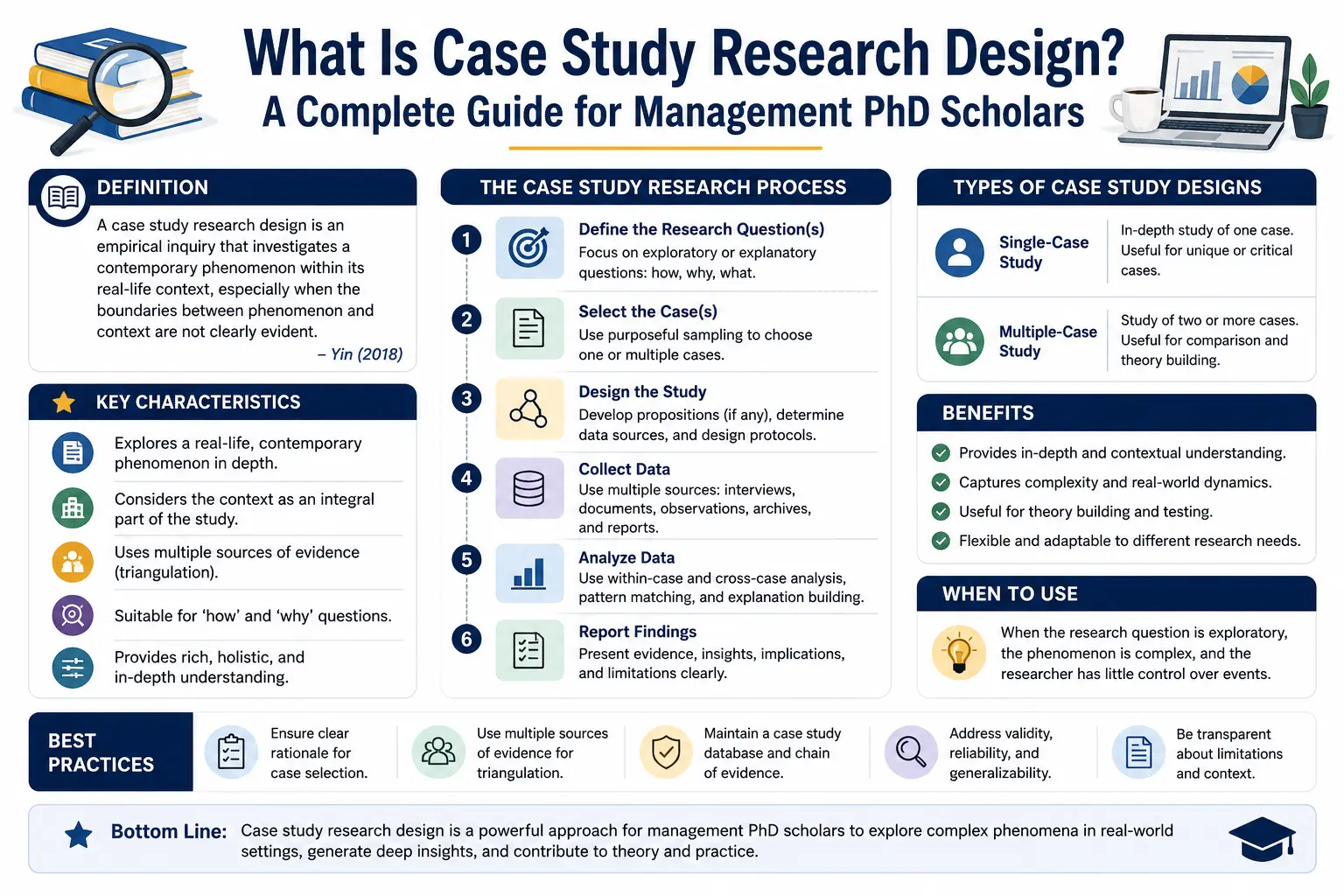
What Is Case Study Research Design?
Case study research design is a qualitative or mixed-method research approach that involves an in-depth investigation of a particular individual, organization, group, event, process, or phenomenon within its real-life context.
Unlike surveys or experiments that focus on large samples and statistical generalizations, case studies emphasize detailed exploration and contextual understanding.
According to renowned researcher Robert K. Yin, a case study is:
"An empirical inquiry that investigates a contemporary phenomenon within its real-world context, especially when the boundaries between phenomenon and context are not clearly evident."
In management research, a case study may focus on:
- A company implementing digital transformation
- A startup's growth strategy
- Leadership practices in an organization
- Employee retention initiatives
- Corporate social responsibility programs
- Organizational culture and performance
- Crisis management during business disruptions
The goal is to understand how and why certain events occur rather than merely identifying statistical relationships.
Why Case Study Research Is Important in Management Studies
Organizations are complex systems influenced by people, culture, technology, leadership, market conditions, and external environments. Many management issues cannot be fully understood through numerical data alone.
Case study research helps scholars:
- Explore real-world business problems
- Understand organizational behavior
- Examine decision-making processes
- Develop and test management theories
- Generate practical recommendations
- Study emerging business phenomena
For example, if a researcher wants to understand why certain organizations successfully adopt artificial intelligence while others struggle, a case study can reveal the organizational, cultural, and strategic factors influencing implementation.
Key Characteristics of Case Study Research Design
1. Real-Life Context
Case studies investigate phenomena within their natural environment rather than in controlled laboratory settings.
Example:
Studying employee engagement within an actual organization rather than through simulated scenarios.
2. In-Depth Investigation
Researchers collect detailed information from multiple sources to gain a holistic understanding.
3. Multiple Data Sources
Case study research often combines:
- Interviews
- Observations
- Documents
- Reports
- Archival records
- Surveys
- Organizational data
This process strengthens research credibility through triangulation.
4. Focus on "How" and "Why" Questions
Case studies are particularly useful when researchers seek answers to questions such as:
- How did the organization achieve success?
- Why did the change initiative fail?
- How do employees respond to leadership practices?
5. Contextual Understanding
Researchers examine relationships between the phenomenon and its surrounding environment.
Types of Case Study Research Design
Understanding the different types of case studies helps scholars select the most appropriate design for their research objectives.
1. Exploratory Case Study
Exploratory case studies are conducted when little information exists about a phenomenon.
Purpose:
- Identify research questions
- Generate hypotheses
- Explore emerging issues
Example:
Investigating the impact of generative AI tools on management consulting firms.
2. Descriptive Case Study
Descriptive case studies provide detailed descriptions of a phenomenon within its context.
Purpose:
- Document organizational practices
- Describe processes and behaviors
Example:
Analyzing the implementation process of an employee wellness program.
3. Explanatory Case Study
Explanatory case studies seek to explain cause-and-effect relationships.
Purpose:
- Understand why events occur
- Identify influencing factors
Example:
Explaining why a digital transformation initiative succeeded in one organization but failed in another.
4. Intrinsic Case Study
Researchers focus on a unique case because it is inherently interesting.
Example:
Studying a highly innovative startup that disrupted an entire industry.
5. Instrumental Case Study
A specific case is used to understand a broader issue.
Example:
Examining one company to understand employee resistance to organizational change.
6. Collective or Multiple Case Study
Researchers investigate several cases simultaneously.
Purpose:
- Compare different cases
- Identify patterns and variations
Example:
Comparing digital transformation strategies across five multinational corporations.
Single Case vs Multiple Case Study Design
One of the most important decisions in case study research is choosing between a single-case and multiple-case design.
Single Case Study
Focuses on one organization, event, or phenomenon.
Advantages
- Rich and detailed analysis
- Greater depth
- Easier data management
Example
Studying leadership practices within a specific family-owned business.
Multiple Case Study
Involves examining several cases.
Advantages
- Better comparison
- Increased validity
- Stronger theoretical development
Example
Comparing employee engagement practices across multiple organizations.
Management PhD scholars often prefer multiple-case designs because they provide broader insights and stronger academic contributions.
When Should Management PhD Scholars Use Case Study Research?
Case study research is appropriate when:
The Research Questions Focus on How and Why
Example:
How do organizational leaders influence innovation culture?
The Context Matters
Example:
Understanding workplace behavior within a specific industry.
The Phenomenon Is Complex
Example:
Investigating digital transformation in multinational companies.
Existing Theory Is Limited
Example:
Studying emerging technologies and their organizational impact.
Real-Life Understanding Is Essential
Example:
Examining crisis management during economic downturns.
Steps to Conduct Case Study Research
Step 1: Define the Research Problem
Clearly identify the issue you want to investigate.
Example:
Understanding factors affecting employee retention in technology startups.
Step 2: Develop Research Questions
Good case study questions often begin with:
- How
- Why
- What
Examples:
- How do startups retain high-performing employees?
- Why do employees leave despite attractive compensation packages?
Step 3: Review Relevant Literature
Conduct a comprehensive literature review to:
- Understand existing theories
- Identify research gaps
- Build conceptual frameworks
Step 4: Select the Case
Choose cases that align with your research objectives.
Selection criteria may include:
- Accessibility
- Relevance
- Uniqueness
- Industry representation
Step 5: Design Data Collection Methods
Use multiple sources of evidence.
Interviews
Gather insights from managers, employees, and stakeholders.
Observations
Observe organizational processes and behaviors.
Documents
Analyze reports, policies, and internal records.
Surveys
Collect supplementary quantitative data.
Step 6: Collect Data
Systematically gather information while maintaining ethical standards.
Important considerations include:
- Informed consent
- Confidentiality
- Data security
Step 7: Analyze Data
Common analysis techniques include:
Thematic Analysis
Identifying recurring themes and patterns.
Content Analysis
Examining textual information systematically.
Pattern Matching
Comparing findings with theoretical expectations.
Cross-Case Analysis
Used in multiple-case studies to identify similarities and differences.
Step 8: Interpret Findings
Connect findings with:
- Research questions
- Existing literature
- Theoretical frameworks
Explain what the findings mean and why they matter.
Step 9: Report Results
Present findings in a structured format:
- Introduction
- Literature Review
- Methodology
- Findings
- Discussion
- Conclusion
Data Collection Methods in Case Study Research
Management scholars typically use multiple methods to strengthen validity.
Interviews
The most common data collection technique.
Benefits:
- Detailed insights
- Flexible questioning
- Rich qualitative data
Observation
Researchers observe activities, meetings, and interactions.
Benefits:
- Captures actual behavior
- Provides contextual understanding
Documents and Records
Examples include:
- Annual reports
- Organizational policies
- Strategic plans
- Performance reports
Benefits:
- Historical perspective
- Objective evidence
Surveys
Useful for collecting supporting quantitative information.
Benefits:
- Larger participant coverage
- Statistical support
Advantages of Case Study Research Design
Provides Rich Insights
Case studies offer detailed understanding of organizational phenomena.
Captures Context
Researchers can examine environmental influences and organizational dynamics.
Supports Theory Development
Case studies often contribute to building new management theories.
Encourages Practical Relevance
Findings can directly inform managerial decision-making.
Allows Methodological Flexibility
Researchers can combine qualitative and quantitative approaches.
Limitations of Case Study Research
Limited Generalizability
Findings may not apply to all organizations.
Time-Consuming
Data collection and analysis require significant effort.
Potential Researcher Bias
Subjective interpretations can influence findings.
Access Challenges
Organizations may restrict access to sensitive information.
Large Volumes of Data
Managing extensive qualitative data can be challenging.
Despite these limitations, rigorous research procedures can enhance reliability and validity.
Ensuring Quality in Case Study Research
Management PhD scholars should focus on research rigor.
Construct Validity
Use multiple data sources and evidence.
Internal Validity
Establish logical relationships between variables.
External Validity
Clearly explain how findings relate to broader contexts.
Reliability
Document research procedures carefully.
Maintaining transparency improves the credibility of the study.
Case Study Research Example in Management
Research Topic
Digital Transformation in Retail Organizations
Research Problem
Many retail businesses invest heavily in digital technologies, yet implementation outcomes vary significantly.
Research Question
How do leadership practices influence digital transformation success in retail organizations?
Cases Selected
- Retail Company A
- Retail Company B
- Retail Company C
Data Sources
- Executive interviews
- Employee surveys
- Company reports
- Strategic documents
Findings
The study reveals that leadership commitment, employee training, and organizational culture are critical factors influencing successful digital transformation.
This example demonstrates how case study research can generate practical and theoretical contributions.
Common Mistakes to Avoid
Management PhD scholars should avoid:
- Choosing cases without clear justification
- Collecting data from a single source
- Ignoring theoretical frameworks
- Using vague research questions
- Failing to document research procedures
- Drawing conclusions without evidence
Careful planning helps avoid these pitfalls.
Tips for Management PhD Scholars
Start with a Clear Research Problem
A focused problem leads to stronger findings.
Select Cases Strategically
Choose cases that best address your research objectives.
Use Multiple Data Sources
Triangulation strengthens credibility.
Maintain Detailed Records
Document all research activities.
Connect Findings to Theory
Demonstrate academic contribution.
Be Ethical
Protect participant confidentiality and organizational data.
Conclusion
Case study research design is one of the most valuable methodologies for Management PhD scholars seeking to understand complex organizational phenomena. By investigating real-world situations in depth, researchers can uncover insights that are often missed by purely quantitative approaches.
Whether studying leadership, innovation, digital transformation, organizational culture, employee engagement, or strategic management, case study research provides a powerful framework for exploring how and why business events occur. Its ability to combine multiple sources of evidence, capture contextual realities, and generate meaningful theoretical contributions makes it particularly relevant for doctoral-level management research.
While case studies require careful planning, rigorous data collection, and thoughtful analysis, the rewards are substantial. A well-executed case study can contribute valuable knowledge to the academic community while offering practical solutions to real organizational challenges. For Management PhD scholars, mastering case study research design can significantly enhance the quality, impact, and relevance of their doctoral work.
Contact ThesisLikho Today
Call / WhatsApp: +91 96438 02216
Visit: ThesisLikho.com