
Introduction
For PhD scholars, research students, faculty members, and academic researchers in India, publishing in a reputed journal is often a key requirement for degree completion, promotions, funding applications, and academic recognition. Before submitting a manuscript, researchers frequently encounter the term Impact Factor (IF).
Questions such as "What is a good impact factor?", "How is impact factor calculated?", and "How can I check a journal's impact factor?" are common among Indian scholars.
The Impact Factor is one of the most widely used metrics for evaluating the influence and reputation of academic journals. Although it is not the only measure of journal quality, it remains an important indicator used by universities, research institutions, and funding agencies worldwide.
This comprehensive guide explains the meaning of impact factor, its importance, calculation methods, advantages, limitations, and the step-by-step process to check a journal's impact factor in India.
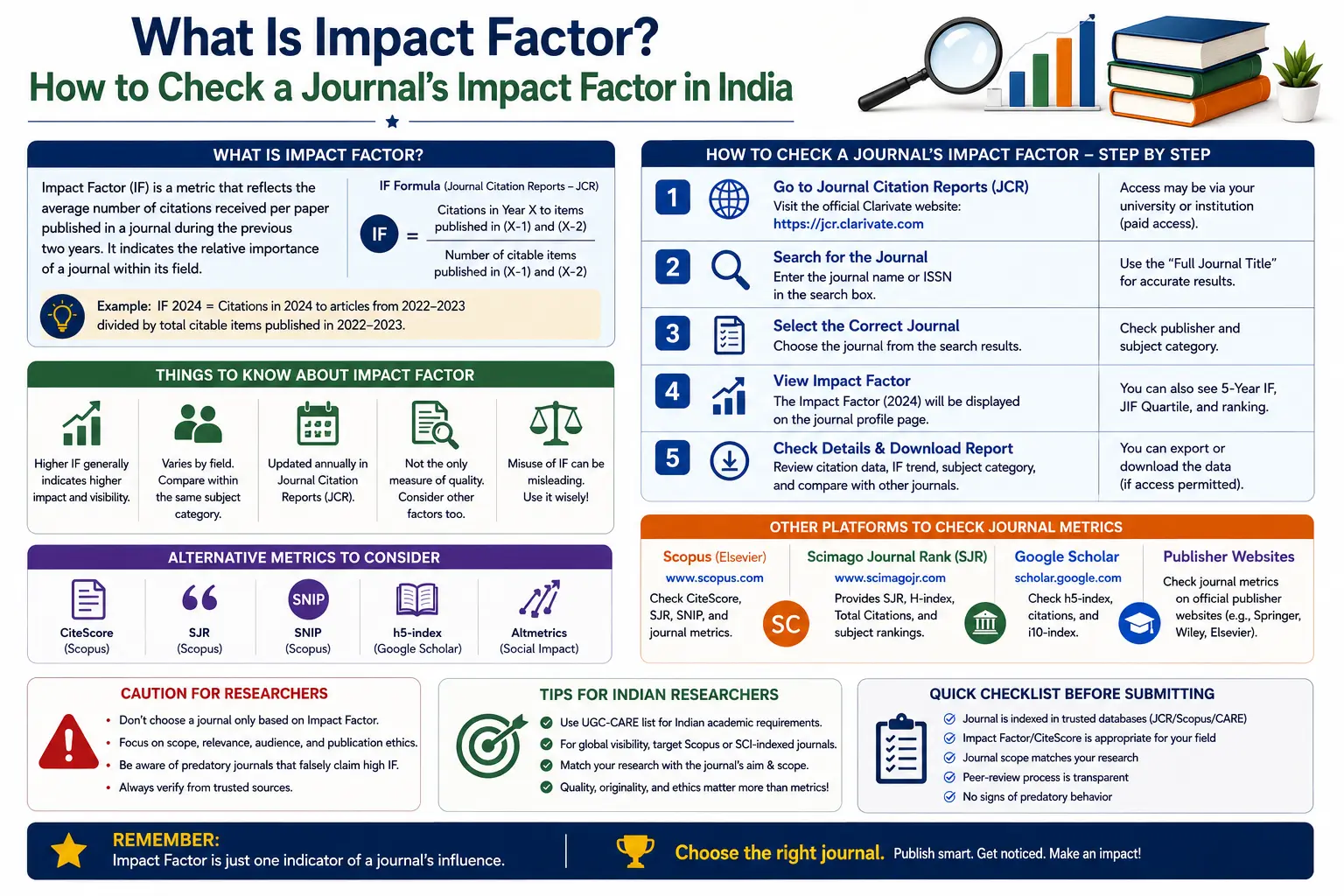
What Is Impact Factor?
Impact Factor (IF) is a metric used to measure the average number of citations received by articles published in a journal during a specific period.
Simply put, it indicates how frequently articles from a journal are cited by other researchers.
A higher impact factor generally suggests that the journal publishes influential and widely referenced research.
Simple Definition
Impact Factor measures the average number of times articles published in a journal are cited by other academic publications.
For example:
If Journal A has an Impact Factor of 8.0, it means that articles published in that journal were cited, on average, eight times during the evaluation period.
Who Calculates Impact Factor?
The official Journal Impact Factor is calculated annually by:
Clarivate
Clarivate publishes impact factors through its:
Journal Citation Reports (JCR)
Only journals indexed in the Web of Science Core Collection receive an official Impact Factor.
Why Is Impact Factor Important?
Impact factor plays a significant role in academic publishing and research evaluation.
1. Measures Journal Influence
A high-impact journal generally attracts quality research and receives more citations.
2. Helps Researchers Choose Journals
Researchers often use impact factors when deciding where to submit their manuscripts.
3. Supports Academic Career Growth
Many universities consider publications in high-impact journals for:
- Faculty promotions
- Research assessments
- Funding applications
- Academic recruitment
4. Enhances Research Visibility
Papers published in high-impact journals often receive greater readership and citations.
5. Assists Funding Agencies
Funding organizations may consider publication records in high-impact journals when evaluating research proposals.
How Is Impact Factor Calculated?
The calculation is relatively straightforward.
Formula for Impact Factor
Impact Factor (Year X) = Citations in Year X to Articles Published in Years X-1 and X-2 ÷ Number of Citable Articles Published in Years X-1 and X-2
Example
Suppose a journal published:
- 100 articles in 2024
- 100 articles in 2025
Total articles = 200
In 2026, those articles received:
- 1,000 citations
Impact Factor =
1,000 ÷ 200 = 5.0
Therefore, the journal's Impact Factor is 5.0.
Impact Factor Across Different Disciplines
Citation rates vary significantly among subjects.
Engineering
A journal with an IF of 3–5 may be considered highly respected.
Computer Science
Many reputable journals have impact factors between 2 and 8.
Medicine
Top medical journals often exceed 20 or even 50.
Social Sciences
An IF of 2–5 is often considered strong.
Education
Many respected journals have impact factors between 1 and 5.
Therefore, comparisons should always be made within the same discipline.
Difference Between Impact Factor and Journal Quality
Many researchers mistakenly assume that a higher impact factor automatically means a better journal.
This is not always true.
Journal quality also depends on:
- Peer-review standards
- Editorial board reputation
- Research ethics
- Indexing status
- Acceptance criteria
- Relevance to your research field
A journal with a lower impact factor may still be highly respected in a specialized area.
Impact Factor vs CiteScore
Indian researchers often encounter both metrics.
Impact Factor
Provided by:
- Clarivate
- Journal Citation Reports (JCR)
Based on:
- Two-year citation window
CiteScore
Provided by:
- Elsevier
Based on:
- Four-year citation window
Impact Factor vs Scopus Indexing
Many Indian scholars confuse these terms.
Scopus Indexing
Means a journal is included in the Scopus database.
Impact Factor
Measures citation performance.
Important:
- A journal can be Scopus-indexed without having an Impact Factor.
- A journal with an Impact Factor is usually indexed in Web of Science.
How to Check a Journal's Impact Factor in India
Researchers should verify impact factors before submitting manuscripts.
Method 1: Check Journal Citation Reports (JCR)
The most reliable source is:
Journal Citation Reports (JCR)
Steps
- Access JCR through your institution.
- Search for the journal title.
- View:
- Impact Factor
- Ranking
- Category
- Quartile
This is the official source.
Method 2: Visit the Journal Website
Most reputable journals display their current impact factor.
Check
- Journal homepage
- About Journal section
- Metrics page
Always verify that the metric comes from Clarivate.
Method 3: Check Publisher Websites
Major publishers provide journal metrics.
Examples include:
- Elsevier
- Springer Nature
- Taylor & Francis
- Wiley
- Sage
Journal pages usually list:
- Impact Factor
- CiteScore
- Quartile Ranking
Method 4: Use University Library Access
Many Indian universities subscribe to:
- Web of Science
- JCR
- Scopus
Students and faculty can access official journal metrics through institutional subscriptions.
How to Verify If an Impact Factor Is Genuine
Predatory journals often advertise fake impact factors.
Be cautious if you see terms such as:
- Global Impact Factor
- Universal Impact Factor
- Scientific Impact Factor
- Cosmos Impact Factor
These are generally not recognized academic metrics.
Always Verify Through
- Journal Citation Reports (JCR)
- Clarivate
- Official publisher websites
What Is a Journal Quartile?
Besides impact factor, journals are categorized into quartiles.
Q1
Top 25% journals
Q2
25–50% range
Q3
50–75% range
Q4
Bottom 25%
Quartile Importance
Many Indian universities and funding agencies value:
- Q1 journals
- Q2 journals
More than impact factor alone.
Should Indian Researchers Choose Journals Only Based on Impact Factor?
No.
Impact factor should be one consideration among many.
Before submission, evaluate:
Journal Scope
Does the journal publish research similar to yours?
Indexing
Check:
- Scopus
- Web of Science
Acceptance Rate
Highly competitive journals may have low acceptance rates.
Review Timeline
Important for thesis deadlines.
Publication Charges
Check APCs before submission.
Advantages of Impact Factor
1. Easy Comparison
Allows comparison between journals.
2. Reflects Citation Influence
Measures scholarly attention.
3. Recognized Worldwide
Accepted by universities and research institutions globally.
4. Supports Journal Selection
Helps researchers identify influential journals.
Limitations of Impact Factor
Despite its popularity, impact factor has limitations.
1. Field Differences
Citation patterns vary across disciplines.
2. Does Not Measure Individual Article Quality
A highly cited paper can appear in a lower-impact journal.
3. Can Be Misused
Some journals may focus excessively on citation counts.
4. Short Citation Window
The two-year calculation period may not reflect long-term impact.
Common Mistakes Made by Indian Scholars
Choosing Only High Impact Factor Journals
Many researchers submit to unrealistic targets and face repeated rejection.
Ignoring Journal Scope
Scope mismatch is a major reason for manuscript rejection.
Believing Fake Metrics
Always verify through official sources.
Confusing Indexing With Impact Factor
A journal can be indexed without having an official impact factor.
Impact Factor and PhD Research in India
For PhD scholars, impact factor often becomes important during:
- Thesis publication requirements
- Faculty recruitment
- Academic promotions
- Research grants
However, many universities now place equal emphasis on:
- Scopus indexing
- Quartile ranking
- Research quality
- Citation impact
The focus is gradually shifting toward overall research excellence rather than a single metric.
Future of Research Metrics
Academic publishing is evolving rapidly.
Researchers increasingly evaluate journals using:
- Impact Factor
- CiteScore
- h-index
- SNIP
- SJR
- Altmetrics
Future research assessment systems are expected to use multiple indicators rather than relying solely on impact factor.
Conclusion
Impact Factor remains one of the most important journal evaluation metrics in academic publishing. It helps researchers assess a journal's influence, visibility, and citation performance. For Indian scholars, understanding impact factor can improve journal selection, publication strategy, and academic career planning.
However, impact factor should never be the only criterion when choosing a journal. Researchers should also evaluate indexing status, quartile ranking, scope, review quality, and publication ethics.
By combining these factors, scholars can make informed publishing decisions and maximize the impact of their research contributions.
Frequently Asked Questions (FAQs)
1. What is a journal impact factor?
Impact Factor measures the average number of citations received by articles published in a journal over a specific period.
2. Who calculates impact factor?
The official Journal Impact Factor is calculated by Clarivate through Journal Citation Reports (JCR).
3. Is a higher impact factor always better?
Not necessarily. Journal relevance, indexing, and quality are equally important.
4. Can a Scopus journal have no impact factor?
Yes. Many Scopus-indexed journals do not have an official Impact Factor.
5. How can I check a journal's impact factor in India?
You can verify it through Journal Citation Reports (JCR), publisher websites, or university library subscriptions.
6. What is considered a good impact factor?
Generally, an impact factor above 3 is considered good, but standards vary by discipline.
7. Are quartile rankings important?
Yes. Q1 and Q2 journals are highly valued by universities and research institutions.
8. Are fake impact factors common?
Yes. Researchers should verify journal metrics through official sources such as Clarivate and Journal Citation Reports.
Contact ThesisLikho Today
Call / WhatsApp: +91 96438 02216
Visit: ThesisLikho.com