
Introduction
Plagiarism is one of the most serious ethical issues in academic and research writing. Whether you are a PhD scholar, master's student, researcher, professor, or academic writer, understanding plagiarism is essential for maintaining research integrity and credibility.
In today's digital age, where information is easily accessible, many researchers unknowingly commit plagiarism by copying text, ideas, data, images, or research findings without proper acknowledgment. Universities, journals, and research institutions worldwide have strict policies against plagiarism, and violations can result in thesis rejection, article retraction, academic penalties, or damage to a researcher's reputation.
This comprehensive guide explains what plagiarism in research is, its various types, real-world examples, consequences, and practical strategies to avoid it.
What Is Plagiarism in Research?
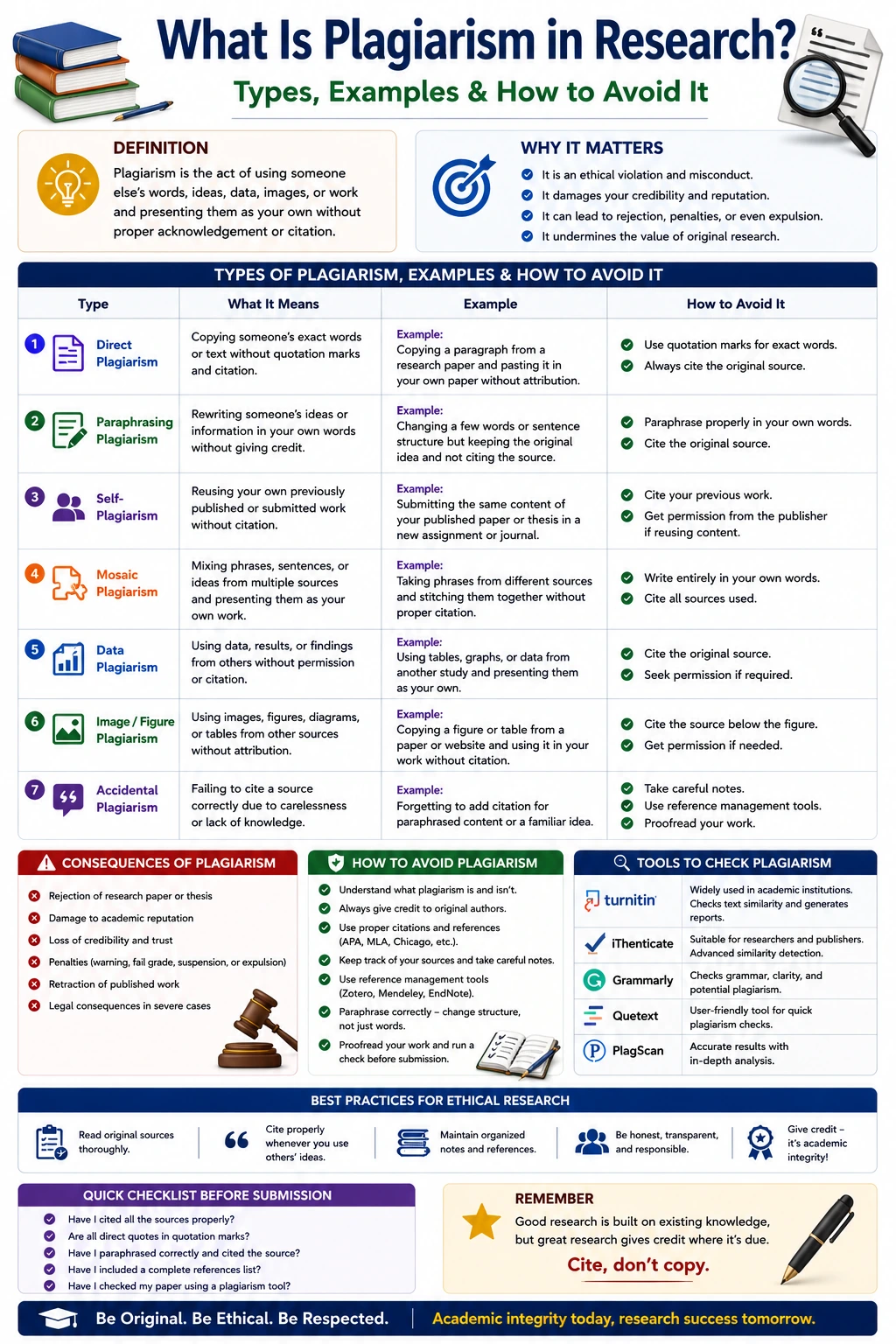
Plagiarism refers to presenting someone else's work, ideas, words, data, images, or intellectual property as your own without giving proper credit to the original source.
In academic research, plagiarism is considered a violation of research ethics because it misrepresents originality and undermines the trustworthiness of scholarly work.
According to most universities and academic institutions, plagiarism can occur intentionally or unintentionally. Even if a researcher accidentally fails to cite a source, it may still be classified as plagiarism.
Simple Definition
Plagiarism means using another person's work without acknowledging them properly.
For example:
Original Text:
"Artificial intelligence is transforming healthcare through improved diagnostic accuracy and patient care."
Plagiarized Version:
"Artificial intelligence is transforming healthcare through improved diagnostic accuracy and patient care."
If copied without quotation marks or citation, this is plagiarism.
Why Is Plagiarism a Serious Issue in Research?
Research is built upon honesty, transparency, and originality. Every academic contribution should clearly distinguish between:
- Original ideas
- Existing knowledge
- Referenced sources
When plagiarism occurs, it creates false impressions about the author's contribution.
Importance of Avoiding Plagiarism
- Maintains academic integrity
- Protects intellectual property rights
- Builds credibility as a researcher
- Improves research quality
- Ensures publication acceptance
- Prevents legal and academic consequences
Researchers are expected to contribute new knowledge rather than copy existing work.
Types of Plagiarism in Research
Understanding different types of plagiarism helps researchers identify and avoid unethical practices.
1. Direct Plagiarism
Direct plagiarism occurs when someone copies text word-for-word from another source without citation or quotation marks.
Example
Original source:
"Climate change poses significant challenges to global food security."
Copied text:
"Climate change poses significant challenges to global food security."
Without citation, this is direct plagiarism.
Why It Is Serious
Direct plagiarism is considered one of the most severe forms because it intentionally copies another author's work.
2. Self-Plagiarism
Self-plagiarism happens when researchers reuse their own previously published work without proper acknowledgment.
Many people assume they cannot plagiarize themselves, but academic institutions often consider duplicate publication unethical.
Example
A researcher publishes an article in a journal and later copies large sections into another paper without citation.
This constitutes self-plagiarism.
Common Forms
- Reusing thesis content in multiple publications
- Duplicate journal submissions
- Recycling previously published literature reviews
3. Mosaic Plagiarism
Mosaic plagiarism occurs when someone copies phrases, sentence structures, or ideas from a source and slightly modifies the wording.
Example
Original:
"Machine learning algorithms can identify patterns within large datasets."
Modified:
"Machine learning techniques can detect patterns in massive datasets."
Even though words have changed, the structure and idea remain nearly identical.
4. Paraphrasing Plagiarism
Paraphrasing plagiarism occurs when text is rewritten in different words but the source is not cited.
Many students believe changing a few words eliminates plagiarism, but this is incorrect.
Example
Original:
"Social media influences consumer purchasing decisions."
Paraphrased:
"Consumers often make buying choices influenced by social networking platforms."
Without citation, this remains plagiarism.
5. Accidental Plagiarism
Accidental plagiarism occurs due to negligence, poor note-taking, or lack of citation knowledge.
Examples
- Forgetting citations
- Incorrect referencing format
- Missing quotation marks
- Losing source information
Although unintentional, institutions may still impose penalties.
6. Source-Based Plagiarism
This type occurs when sources are intentionally or unintentionally misrepresented.
Examples
- Citing sources not actually used
- Providing incorrect references
- Using fabricated sources
- Misquoting original authors
Source-based plagiarism damages research reliability.
7. Idea Plagiarism
Plagiarism is not limited to copying words. Stealing another person's unique idea without acknowledgment is also unethical.
Example
A researcher reads an unpublished conference paper and uses its innovative methodology without crediting the original author.
This is idea plagiarism.
8. Data Plagiarism
Using another researcher's data, statistics, tables, or results without permission or citation constitutes data plagiarism.
Examples
- Copying survey results
- Using experimental findings
- Reproducing datasets
- Borrowing statistical analyses
Data plagiarism can have severe academic consequences.
9. Image and Figure Plagiarism
Researchers often forget that images, charts, diagrams, and graphs are also protected intellectual property.
Example
Using a diagram from a journal article without permission or citation.
Always cite the source and obtain permission when required.
Real-Life Examples of Plagiarism in Research
Many famous researchers, politicians, and academics have faced plagiarism allegations.
Example 1: Thesis Plagiarism
A PhD student copies literature review sections from online sources without citation. During plagiarism screening, similarity exceeds university limits, leading to thesis revision.
Example 2: Journal Article Retraction
A published paper is found to contain copied paragraphs from another article. The journal retracts the publication.
Example 3: Duplicate Publication
An author submits nearly identical research findings to multiple journals, resulting in publication ethics violations.
These examples demonstrate why originality is critical in scholarly work.
Consequences of Plagiarism in Research
Plagiarism can have serious short-term and long-term consequences.
Academic Consequences
Universities may:
- Reject assignments
- Fail students
- Suspend enrollment
- Cancel degrees
- Reject theses and dissertations
Research Consequences
Researchers may face:
- Journal rejection
- Article retraction
- Funding withdrawal
- Loss of professional credibility
Professional Consequences
Plagiarism can affect:
- Academic careers
- Promotion opportunities
- Research collaborations
- Institutional reputation
Legal Consequences
Copyright infringement can lead to:
- Legal notices
- Financial penalties
- Intellectual property disputes
How Universities Detect Plagiarism
Most institutions use plagiarism detection software to identify copied content.
Common plagiarism checking tools include:
- Turnitin
- iThenticate
- Grammarly Plagiarism Checker
- Copyscape
- PlagScan
- Quetext
These tools compare submitted content against:
- Academic databases
- Journal publications
- Books
- Websites
- Student submissions
The software generates a similarity report highlighting matched content.
What Is a Plagiarism Similarity Score?
A similarity score represents the percentage of text matching existing sources.
Important Note
Similarity does not always mean plagiarism.
Legitimate matches may include:
- References
- Common phrases
- Technical terminology
- Quotations
Universities evaluate the quality of matches rather than only the percentage.
Typical Similarity Limits
Many institutions prefer:
- Below 10% – Excellent
- 10–15% – Generally acceptable
- 15–20% – Requires review
- Above 20% – May require revision
Requirements vary across universities and journals.
How to Avoid Plagiarism in Research
Preventing plagiarism requires careful writing and referencing practices.
1. Cite Every Source Properly
Whenever you use:
- Ideas
- Data
- Statistics
- Images
- Theories
- Direct quotations
Provide proper citations.
Popular Citation Styles
- APA
- MLA
- Harvard
- Chicago
- IEEE
- Vancouver
Follow your institution's preferred style consistently.
2. Learn Effective Paraphrasing
Good paraphrasing means:
- Understanding the source
- Writing in your own words
- Changing sentence structure
- Preserving original meaning
- Including citations
Poor Paraphrasing
Changing only a few words.
Good Paraphrasing
Completely rewriting concepts while citing the source.
3. Use Quotation Marks
For direct quotes, place the text inside quotation marks and include citations.
Example
According to Smith (2024), "Digital transformation is reshaping global business models."
This clearly distinguishes quoted material from original writing.
4. Maintain Research Notes
Good note-taking helps avoid accidental plagiarism.
Tips
- Record source details immediately
- Separate your ideas from sourced content
- Maintain a reference database
- Save publication information
5. Use Reference Management Software
Reference management tools simplify citation organization.
Popular options include:
- Zotero
- Mendeley
- EndNote
- RefWorks
These tools automatically generate citations and bibliographies.
6. Check Your Work Before Submission
Always run a plagiarism check before submitting:
- Thesis
- Dissertation
- Research paper
- Journal article
- Conference paper
Early detection allows time for corrections.
7. Write from Understanding, Not Copying
Read source material thoroughly and then explain concepts in your own language.
This approach naturally reduces similarity while improving comprehension.
8. Avoid Copy-Paste Habits
Many plagiarism issues originate from copying content into drafts and forgetting to revise later.
Instead:
- Read
- Understand
- Summarize
- Cite
This method promotes originality.
Best Practices for PhD Scholars and Researchers
Researchers can maintain academic integrity by following these practices:
Before Writing
- Conduct systematic literature reviews
- Organize references properly
- Track sources carefully
During Writing
- Use citations consistently
- Paraphrase responsibly
- Distinguish original ideas
After Writing
- Review references
- Run plagiarism checks
- Verify quotations
- Ensure citation consistency
Common Myths About Plagiarism
Myth 1: Changing a Few Words Removes Plagiarism
False.
Proper citation is still required.
Myth 2: Information from the Internet Is Free to Use
False.
Online content is protected by copyright and must be cited.
Myth 3: Self-Plagiarism Is Acceptable
False.
Many journals and universities prohibit duplicate publication.
Myth 4: Only Text Can Be Plagiarized
False.
Images, tables, figures, data, and ideas can also be plagiarized.
Myth 5: Software Detects Everything
False.
Human review remains essential because software cannot always identify idea plagiarism or contextual misuse.
The Role of Research Ethics in Preventing Plagiarism
Research ethics promote:
- Honesty
- Transparency
- Accountability
- Respect for intellectual property
Ethical researchers acknowledge contributions made by previous scholars while clearly presenting their own findings.
Academic institutions increasingly emphasize ethics training to reduce plagiarism and improve research quality.
Future of Plagiarism Detection in the AI Era
With the rise of artificial intelligence tools, plagiarism detection is becoming more sophisticated.
Modern systems can identify:
- AI-assisted rewriting
- Paraphrased plagiarism
- Source manipulation
- Duplicate publications
Researchers must use AI responsibly and ensure that generated content is properly reviewed, verified, and cited when necessary.
The focus is shifting from merely detecting copied text to evaluating originality, authorship, and intellectual contribution.
Conclusion
Plagiarism in research is more than copying words—it involves the unethical use of another person's ideas, data, images, or intellectual contributions without proper acknowledgment. Whether intentional or accidental, plagiarism can lead to serious academic, professional, and legal consequences.
Understanding the different types of plagiarism, practicing proper citation, developing strong paraphrasing skills, and using plagiarism detection tools can help researchers maintain academic integrity. For PhD scholars, master's students, and academic writers, producing original and ethically sound research is essential for long-term success.
By following ethical research practices and respecting intellectual property, researchers can contribute meaningful knowledge to their fields while building trust and credibility within the academic community.
Frequently Asked Questions (FAQs)
1. What is plagiarism in research?
Plagiarism in research is the use of another person's words, ideas, data, or work without proper acknowledgment or citation.
2. Is paraphrasing considered plagiarism?
Paraphrasing without citing the original source is considered plagiarism. Proper citations are required even when content is rewritten.
3. What percentage of plagiarism is acceptable in a thesis?
Most universities prefer similarity scores below 10–15%, but acceptable limits vary by institution.
4. Can self-plagiarism affect journal publication?
Yes. Reusing previously published content without disclosure can result in rejection or retraction.
5. Which tools are commonly used to detect plagiarism?
Popular tools include Turnitin, iThenticate, Grammarly Plagiarism Checker, Quetext, and PlagScan.
6. How can PhD scholars avoid plagiarism?
By citing sources correctly, paraphrasing effectively, maintaining research notes, using reference management software, and checking similarity reports before submission.
7. Is copying images or tables considered plagiarism?
Yes. Images, charts, graphs, and tables are intellectual property and must be cited appropriately.
8. Why is plagiarism considered unethical?
Because it falsely represents another person's work as original and violates academic integrity and intellectual property rights.
Contact ThesisLikho Today
Call / WhatsApp: +91 96438 02216
Visit: ThesisLikho.com