
Introduction
One of the most critical — and most misunderstood — decisions a PhD student makes is choosing a research design. Ask ten doctoral candidates what "research design" means and you'll likely get ten different answers. Some confuse it with research methods. Others conflate it with the research topic itself. Many simply pick whatever their supervisor used in their own dissertation, without understanding why.
That confusion is costly. Your research design is the architectural blueprint of your entire study. Get it wrong, and your data, methods, and conclusions may never align. Get it right, and your PhD becomes a coherent, defensible, publishable contribution to knowledge.
This guide breaks down what research design actually is, walks you through the major types, and gives you a practical framework for choosing the one that fits your PhD research question.
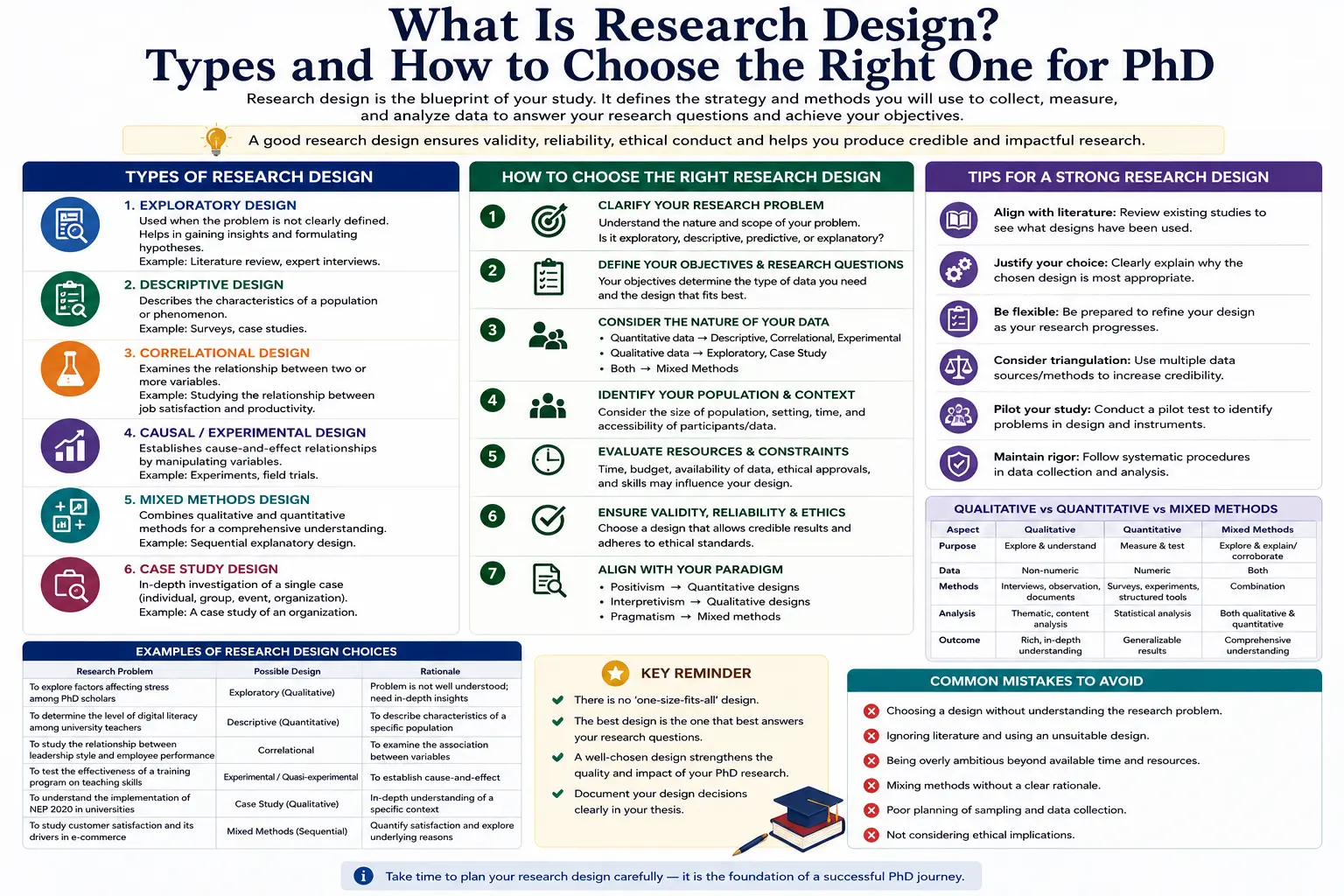
What Is Research Design?
Research design is the overall strategy that integrates all components of a research study in a coherent and logical way. It is not merely the methods you use to collect data — it is the overarching plan that determines how you will answer your research question with validity and rigor.
Think of it this way: your research question is the destination; your research design is the map and the vehicle. It answers fundamental questions such as:
- What type of evidence will best answer my research question?
- How will I collect that evidence?
- How will I analyze what I collect?
- How will I ensure the findings are credible and trustworthy?
Research design sits at the intersection of your philosophical worldview (your ontological and epistemological assumptions), your methodology (the overall approach), and your methods (the specific tools for data collection and analysis).
Getting clear on this distinction is foundational for a PhD. Your design must be philosophically coherent — a positivist researcher does not typically conduct unstructured interviews without justification, and an interpretivist does not usually run large-scale surveys and call it a day.
Why Research Design Matters for a PhD
At the undergraduate or master's level, research design choices are sometimes made casually. At the PhD level, you are expected to explicitly justify every design decision in your methodology chapter.
Your examiners will ask:
- Why did you choose this design over alternatives?
- Is this design appropriate for your research question?
- Does your design align with your philosophical stance?
- Does it allow you to achieve your stated research aims and objectives?
A poorly reasoned research design is one of the most common reasons PhD students face major revisions or, in serious cases, fail their viva voce. Understanding the types of research design — and knowing how to argue for your choice — is not optional. It is a core PhD competency.
The Major Types of Research Design
Research designs are commonly classified along several dimensions. The most important ones for PhD students are:
1. Quantitative Research Design
Quantitative research design is used when the goal is to measure, quantify, and analyze numerical data to identify patterns, relationships, or causal effects. It is rooted in positivism — the belief that objective reality can be measured.
Common quantitative designs include:
Experimental Design — Considered the gold standard for establishing causality. Participants are randomly assigned to treatment or control conditions, and outcomes are compared. Widely used in psychology, medicine, education, and natural sciences. The key strength is internal validity; the limitation is that controlled environments may not reflect real-world complexity.
Quasi-Experimental Design — Similar to experimental, but without random assignment. Used when random assignment is impractical or unethical. For example, comparing outcomes in two schools where one adopted a new curriculum and one did not.
Survey/Correlational Design — Used to measure variables and examine relationships between them across a large sample. Ideal for descriptive or explanatory research. Does not establish causation but can uncover associations. Commonly used in social sciences, business, and public health.
Longitudinal Design — Data is collected from the same subjects at multiple time points. Useful for studying change over time, development, or the long-term effects of interventions. Requires significant time investment — a practical consideration for PhD timelines.
Cross-Sectional Design — Data is collected at a single point in time from a sample representing a population. Faster and more feasible than longitudinal designs but cannot track change.
2. Qualitative Research Design
Qualitative research design is used when the goal is to explore, understand, and interpret phenomena from the perspectives of those involved. It is grounded in interpretivism or constructivism — the belief that reality is socially constructed and context-dependent.
Common qualitative designs include:
Phenomenology — Explores the lived experience of individuals around a particular phenomenon. The researcher attempts to understand the essence of an experience as it is perceived by participants. Deeply personal and subjective. Used in nursing, psychology, education, and sociology.
Grounded Theory — A systematic methodology for generating theory from data. The researcher does not begin with a hypothesis; instead, theory emerges from the data through iterative coding and comparison. Particularly useful when little existing theory applies to your area of interest.
Ethnography — The researcher immerses themselves in a social group or setting over an extended period to understand culture, behaviors, and social dynamics. Rooted in anthropology but now widely used in education, organizational research, and health sciences.
Case Study — An in-depth investigation of a single case (individual, group, event, organization) or a small number of cases in their real-life context. Useful for exploring complex phenomena where contextual factors matter. Can be qualitative, quantitative, or mixed.
Narrative Research — Focuses on stories told by individuals to understand how they make sense of their experiences. Used in education, healthcare, and social work to give voice to lived experiences.
Discourse Analysis / Content Analysis — Examines language, text, or communication to understand meaning, power structures, or social phenomena. Used in linguistics, media studies, political science, and sociology.
3. Mixed Methods Research Design
Mixed methods research combines both quantitative and qualitative approaches within a single study. The rationale is that using both provides a more complete picture than either approach alone.
Common mixed methods designs include:
Explanatory Sequential Design — Quantitative data is collected and analyzed first; qualitative data is then used to explain or elaborate the quantitative findings. Useful when statistical results need contextual depth.
Exploratory Sequential Design — Qualitative data is collected first to explore a phenomenon; those insights then inform the development of a quantitative instrument (e.g., a survey). Useful when little is known about a topic.
Convergent Parallel Design — Quantitative and qualitative data are collected simultaneously and then compared or triangulated. Useful for validating and cross-checking findings.
Mixed methods PhDs are increasingly popular but also more demanding. They require proficiency in both quantitative and qualitative analysis, a larger time investment, and careful justification of why integration adds value beyond using one approach alone.
4. Other Recognized PhD Research Designs
Action Research — Involves working collaboratively with practitioners to address a real-world problem, implementing interventions, and evaluating change. Common in education, nursing, and organizational development. Blurs the boundary between researcher and participant.
Systematic Review and Meta-Analysis — Rather than collecting primary data, the researcher systematically identifies, evaluates, and synthesizes existing studies. Highly valued in medicine, public health, and evidence-based policy. A PhD based on a systematic review requires rigorous search strategy design and quality appraisal skills.
Historical Research — Uses primary and secondary historical sources to answer research questions about the past. Used in history, education, sociology, and policy studies.
How to Choose the Right Research Design for Your PhD
With so many options, how do you decide? Follow this structured decision-making framework:
Step 1: Clarify Your Research Question
Your research question is the single most important driver of design selection. Ask yourself: Is the question asking what, how much, or how many? That points toward quantitative. Is it asking why, how, or what does it mean? That points toward qualitative. Is it asking both? Consider mixed methods.
Step 2: Identify Your Research Aims and Objectives
Are you trying to explore an under-researched area (exploratory)? Describe a phenomenon in detail (descriptive)? Test a hypothesis or examine relationships (explanatory or causal)? Each purpose aligns with different design types.
Step 3: Examine Your Philosophical Position
What do you believe about the nature of reality (ontology) and how we can know it (epistemology)? A positivist stance aligns with quantitative methods. A constructivist or interpretivist stance aligns with qualitative methods. A pragmatist stance supports mixed methods. You do not need to choose a philosophy and then find a method — often, your intuitive approach to the research will reveal your assumptions.
Step 4: Consider Practical Constraints
PhD research is constrained by time, funding, access, and ethics. A longitudinal design may be theoretically ideal but impractical within a three-year timeline. Ethnography in a sensitive setting may face ethical barriers. Experimental designs require controlled conditions. Be realistic about what is achievable within your context.
Step 5: Review What Exists in Your Field
Read published PhD theses and journal articles in your discipline. What designs do established researchers in your field use? What has been used to study similar questions? While originality matters, fitting within your discipline's methodological conventions — or consciously departing from them with justification — is important.
Step 6: Consult Your Supervisor Early
Your supervisor's expertise and your institution's resources matter. If your supervisor specializes in quantitative methods and your department lacks qualitative software support, that context shapes feasibility. Have the design conversation early and revisit it often.
Common Mistakes PhD Students Make with Research Design
- Confusing method with design. A survey is a data collection method. Survey research or correlational design is the broader strategy. These are not the same thing.
- Choosing a design because it seems easier. Qualitative research is not easier than quantitative research — it is different. Every design has its own demands and rigors.
- Failing to align design with the research question. This is the most fundamental error and the one most likely to surface in your viva.
- Ignoring philosophical underpinnings. Examiners will probe your ontological and epistemological positioning. Know why your design fits your worldview.
- Underestimating mixed methods complexity. If you choose mixed methods, be prepared to demonstrate proficiency in both strands.
Final Thoughts
Research design is not a bureaucratic box to tick in your methodology chapter. It is the intellectual spine of your entire PhD. It signals to your examiners that you understand not just what you did, but why you did it — and why it was the right choice for the question you set out to answer.
Take the time to understand the landscape of designs available to you. Ground your choice in your research question, your philosophical stance, and your practical context. Be prepared to defend it with clarity and confidence.
When you can articulate not just what your design is, but why it is the most appropriate design for your study, you have crossed a threshold that separates a competent PhD student from a genuine researcher.
Contact ThesisLikho Today
Call / WhatsApp: +91 96438 02216
Visit: ThesisLikho.com