
Research is all about discovering reliable knowledge and generating trustworthy findings. However, one of the biggest challenges faced by researchers is ensuring that their results are accurate, valid, and credible. This is where the concept of triangulation in research becomes important.
Triangulation is widely used in academic research, especially in PhD studies, social sciences, management research, education, healthcare, psychology, and interdisciplinary fields. It helps researchers validate findings by using multiple perspectives, methods, data sources, or researchers to study the same phenomenon.
In India, PhD scholars are increasingly adopting triangulation to strengthen their dissertations, improve publication quality, and satisfy the rigorous requirements of universities, peer reviewers, and research journals.
This comprehensive guide explains what triangulation is, its types, advantages, challenges, practical examples, and why it has become an essential tool for PhD researchers in India.
What Is Triangulation in Research?
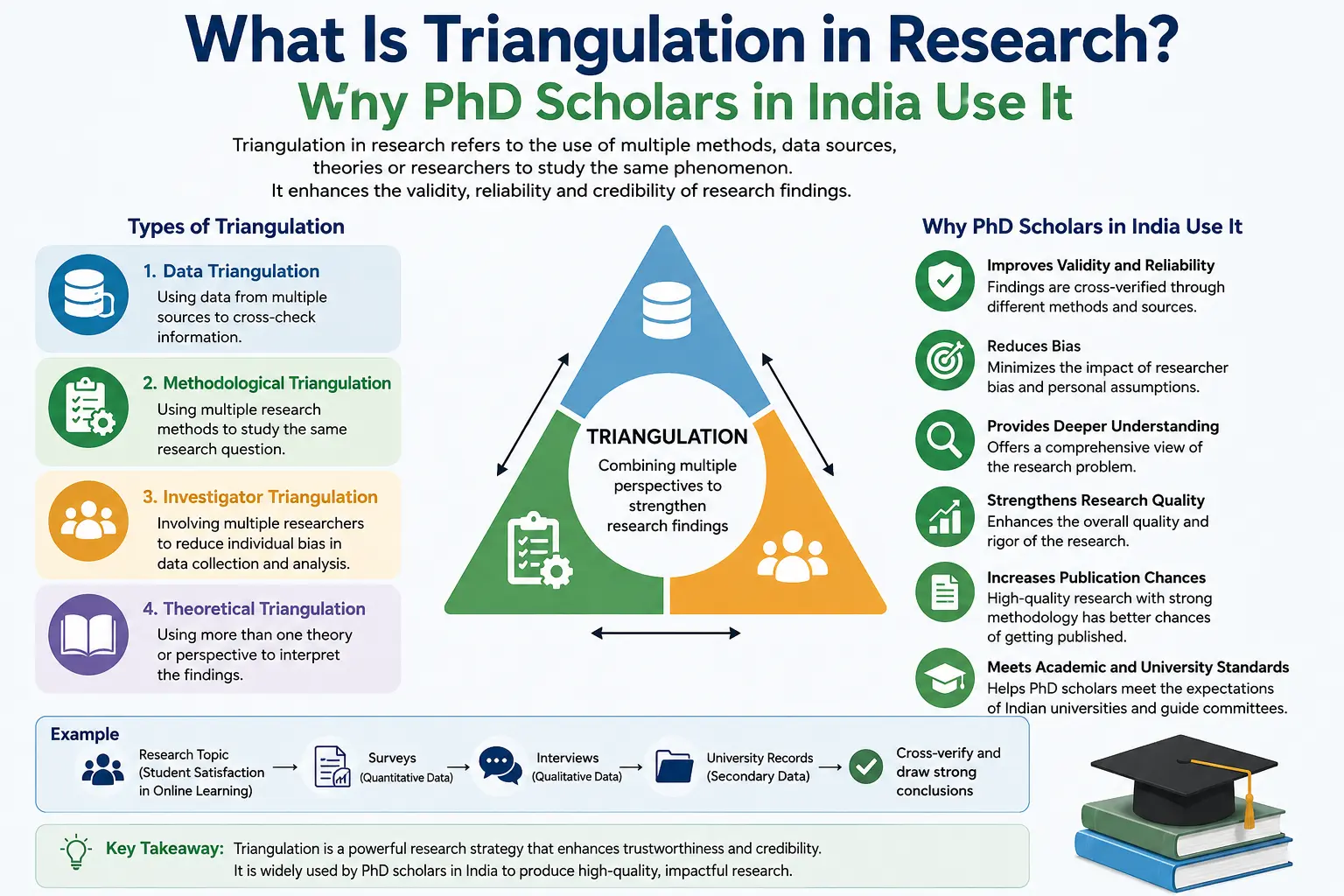
Triangulation in research refers to the use of multiple methods, data sources, theories, or investigators to study a single research problem.
The objective is to verify findings from different perspectives and reduce the limitations associated with relying on a single method.
In simple terms, triangulation helps researchers answer the question:
"Do different approaches lead to the same conclusion?"
If multiple methods produce similar findings, confidence in the results increases significantly.
Origin of the Concept of Triangulation
The term "triangulation" originated from navigation and surveying.
In navigation, a person's location can be determined more accurately by measuring distances from multiple reference points.
Researchers adopted the same principle.
Instead of relying on one source of evidence, researchers gather information from multiple sources to improve accuracy and credibility.
Why Is Triangulation Important in Research?
Research findings can be affected by:
- Researcher bias
- Sampling errors
- Measurement limitations
- Subjective interpretations
- Data collection challenges
Triangulation helps minimize these problems.
Improves Validity
Validity refers to whether the research truly measures what it intends to measure.
Using multiple approaches helps confirm findings.
Enhances Reliability
Reliable results are consistent and reproducible.
Triangulation increases confidence in consistency.
Reduces Bias
Different methods can compensate for weaknesses in each other.
Provides Comprehensive Understanding
Complex research problems often require multiple perspectives.
Triangulation helps capture a richer understanding of reality.
Why PhD Scholars in India Use Triangulation
Indian universities increasingly emphasize research quality and methodological rigor.
PhD scholars use triangulation because it helps:
- Improve dissertation quality
- Strengthen research credibility
- Address reviewer concerns
- Increase publication acceptance rates
- Support mixed-method research
- Generate robust findings
Many journals indexed in Scopus and Web of Science prefer studies that demonstrate strong methodological foundations.
Types of Triangulation in Research
Researchers typically use four major types of triangulation.
1. Data Triangulation
Data triangulation involves collecting information from multiple sources.
The goal is to compare findings across different datasets.
Example
A PhD scholar studying employee satisfaction may collect data from:
- Employees
- Managers
- Human resource professionals
If findings are consistent across groups, confidence increases.
Benefits
- Broader perspective
- Stronger evidence
- Better generalizability
2. Methodological Triangulation
Methodological triangulation involves using more than one research method.
This is one of the most common forms used by PhD scholars.
Example
A researcher studying online education may use:
Quantitative Method
Survey of students.
Qualitative Method
In-depth interviews with teachers.
Combining both methods provides deeper insights.
Why It Is Popular
Many Indian universities encourage mixed-method research because it combines numerical evidence with detailed explanations.
3. Investigator Triangulation
Investigator triangulation involves multiple researchers participating in the study.
Different researchers independently analyze the same data.
Example
Three researchers examine interview transcripts separately.
If they reach similar conclusions, confidence in findings increases.
Benefits
- Reduces individual bias
- Improves objectivity
- Strengthens interpretation accuracy
4. Theoretical Triangulation
Theoretical triangulation involves examining data through multiple theoretical perspectives.
Example
A researcher studying consumer behavior may use:
- Behavioral Theory
- Technology Acceptance Model
- Innovation Diffusion Theory
Different theories may provide unique insights.
Benefits
- Deeper analysis
- Broader interpretation
- Enhanced academic contribution
Methodological Triangulation: The Most Common Approach
Among all forms of triangulation, methodological triangulation is particularly popular among PhD scholars.
This approach combines:
- Quantitative research
- Qualitative research
into a single study.
Example in MBA Research
Research Topic:
"Impact of Artificial Intelligence on Employee Productivity"
Quantitative Component:
Survey of 500 employees.
Qualitative Component:
Interviews with 20 managers.
Combining both approaches generates stronger evidence than using either method alone.
Triangulation in Quantitative Research
Although commonly associated with qualitative studies, triangulation is also useful in quantitative research.
Researchers may:
- Use multiple datasets
- Compare statistical models
- Collect data from different populations
This helps verify consistency of findings.
Triangulation in Qualitative Research
Qualitative researchers frequently use triangulation because of concerns about subjectivity.
Methods may include:
- Interviews
- Observations
- Focus groups
- Document analysis
Comparing findings across methods improves trustworthiness.
Triangulation in Mixed-Methods Research
Mixed-methods research naturally incorporates triangulation.
Researchers combine:
- Numerical evidence
- Narrative explanations
This approach is increasingly popular among Indian PhD scholars.
Examples of Triangulation in Different Disciplines
Education Research
Research Question:
How effective is online learning?
Methods:
- Student surveys
- Teacher interviews
- Classroom observations
Healthcare Research
Research Question:
Why do patients miss appointments?
Methods:
- Hospital records
- Patient interviews
- Doctor surveys
Business and Management Research
Research Question:
How does leadership influence employee performance?
Methods:
- Employee questionnaires
- Manager interviews
- Performance records
Social Science Research
Research Question:
What factors influence voter behavior?
Methods:
- Surveys
- Focus groups
- Election data analysis
Benefits of Triangulation for PhD Scholars
Stronger Research Findings
Results become more convincing.
Better Dissertation Quality
Universities value methodological rigor.
Higher Publication Potential
Strong studies are more attractive to peer-reviewed journals.
Increased Reviewer Confidence
Reviewers appreciate evidence from multiple sources.
Enhanced Academic Credibility
Research becomes more trustworthy.
Challenges of Using Triangulation
Despite its advantages, triangulation presents several challenges.
Time-Consuming
Collecting multiple forms of data requires significant effort.
Resource Intensive
Additional tools, software, and participants may be required.
Complex Analysis
Integrating multiple datasets can be challenging.
Higher Costs
Research budgets may increase.
How to Use Triangulation Effectively
To maximize benefits:
Clearly Define Objectives
Know why triangulation is needed.
Select Appropriate Methods
Choose methods that complement each other.
Maintain Consistency
Ensure all methods address the same research question.
Plan Data Integration
Determine how findings will be combined.
Document the Process
Clearly explain triangulation procedures in the methodology section.
How to Write About Triangulation in a PhD Thesis
Researchers should explain:
Why Triangulation Was Used
Describe the rationale.
Types of Triangulation Applied
Specify whether data, methodological, investigator, or theoretical triangulation was used.
Data Collection Methods
Explain how information was gathered.
Data Integration Process
Describe how findings were combined.
Benefits Achieved
Discuss how triangulation improved validity and reliability.
Example Thesis Statement
"The study employed methodological triangulation by combining quantitative survey data with qualitative interviews. This approach enhanced the validity and credibility of findings through cross-verification from multiple sources."
Such explanations demonstrate methodological rigor.
Common Mistakes Researchers Make
Avoid the following mistakes:
Using Multiple Methods Without Integration
Methods should complement one another.
Poor Planning
Triangulation requires careful design.
Inconsistent Research Questions
All methods should address the same objectives.
Inadequate Explanation
Researchers must clearly describe triangulation procedures.
Role of Triangulation in Research Publications
Many high-impact journals favor studies that use triangulation because they:
- Produce stronger evidence
- Reduce methodological limitations
- Enhance credibility
Triangulation can significantly improve publication prospects in Scopus-indexed and Web of Science journals.
Future of Triangulation in Research
As research becomes increasingly interdisciplinary, triangulation is expected to become even more important.
Emerging trends include:
- AI-assisted qualitative analysis
- Big data integration
- Digital ethnography
- Multi-source analytics
- Mixed-method innovations
Future researchers will likely use triangulation more extensively than ever before.
Checklist for Using Triangulation
Before implementing triangulation, ensure:
Research objectives are clearly defined
Appropriate triangulation type is selected
Multiple data sources are available
Data collection methods are complementary
Analysis procedures are planned
Findings can be integrated effectively
Methodology section explains the process clearly
Conclusion
Triangulation is one of the most powerful techniques available to researchers for improving the validity, reliability, and credibility of their studies. By combining multiple methods, data sources, theories, or investigators, researchers can verify findings from different perspectives and overcome the limitations associated with a single approach. For PhD scholars in India, triangulation has become increasingly important as universities, academic journals, and research supervisors place greater emphasis on methodological rigor and evidence-based conclusions.
Whether conducting research in management, education, healthcare, social sciences, engineering, or interdisciplinary fields, triangulation helps produce stronger and more trustworthy findings. Although it may require additional time, effort, and resources, the benefits often outweigh the challenges. As research methodologies continue to evolve, triangulation will remain a cornerstone of high-quality academic research and a valuable tool for scholars seeking meaningful and impactful contributions to knowledge.
Contact ThesisLikho Today
Call / WhatsApp: +91 96438 02216
Visit: ThesisLikho.com