
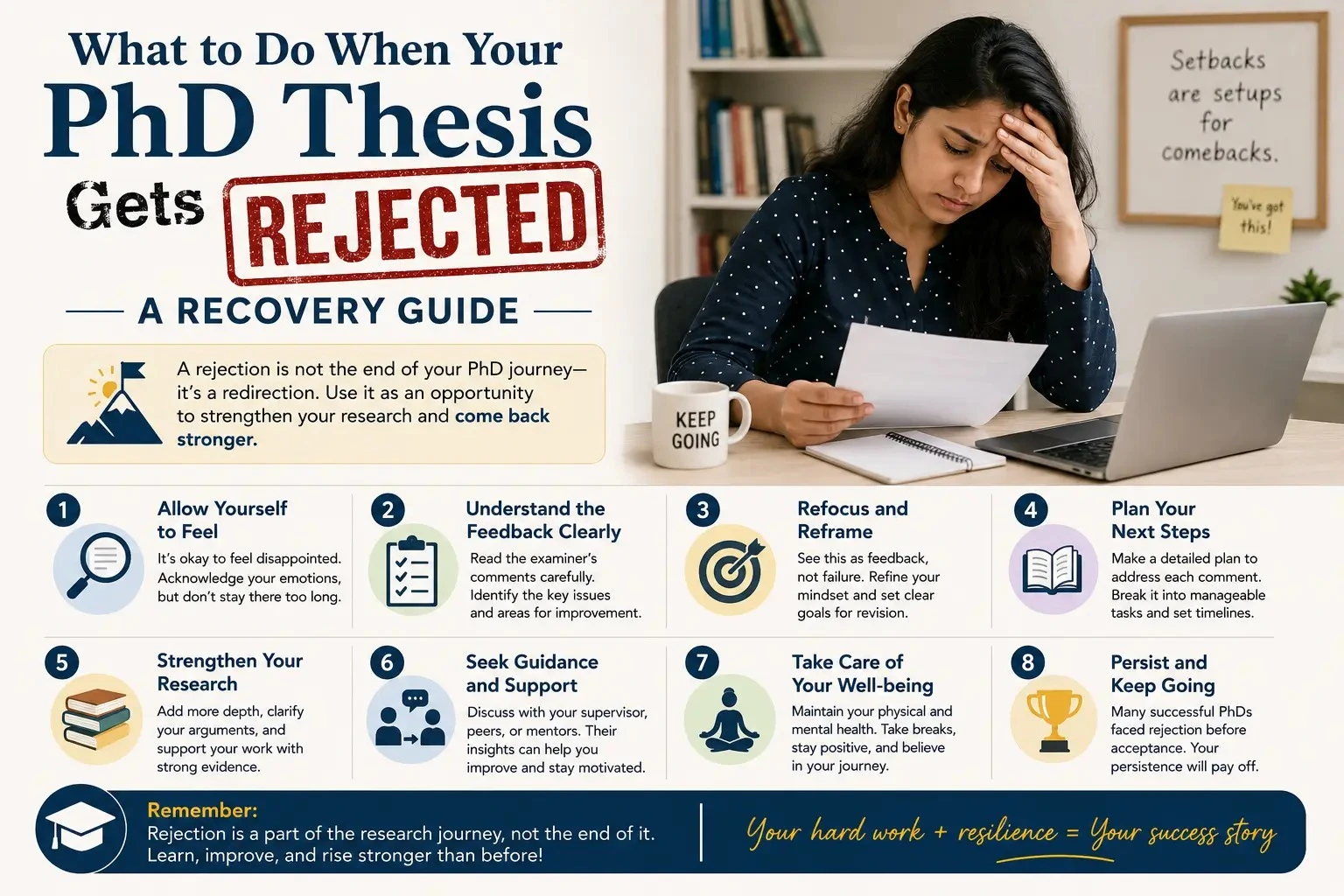
Submitting a PhD thesis marks a big milestone for an academic. You go through years of hard work, from gathering data to revisions to sleepless nights, and submitting the thesis is one of the final steps of getting the degree. Unfortunately, not all theses are approved post submission. Sometimes major revisions are requested by the examiners of the thesis, and in some cases, examiners will reject the thesis outright.
The rejection of a PhD thesis can be devastating, both personally and professionally. The researcher can feel a variety of emotions from disappointment to embarrassment, to more demoralizing feelings of self-doubt. The backlog of years of hard work being rejected is, understandably, an overwhelming experience.
The silver lining to a thesis rejection is that the academic career is not over. Throughout the doctorate programs of many influential researchers, professors, and industry people, there were setbacks. Your response to the thesis rejection will be what defines the next steps of your career. This guide will focus on the causes of the thesis rejections, the emotional aspects of rejections, and the steps that can be taken post rejection.
—---
The first thing that must be done when processing a thesis rejection is to understand the reason for the rejection.
Many universities, including those in India, have similar ways of classifying thesis evaluations. The evaluations may be classified as:
- Thesis accepted without corrections
- Thesis accepted with minor revisions
- Thesis accepted with major revisions
- Thesis resubmission required
- Thesis rejected
Receiving a thesis rejection does not necessarily imply that your research is of no value. A thesis may be rejected due to:
- Methodology
- Data analysis
- Literature review
- Originality of the research
- Quality of the writing
- Presentation, structure, and layout
- Research ethics
In fact, sometimes the research is perfectly fine, and the reviewers will have no issues with the research that has been conducted. The reviewers may have issues with the way that the findings were presented in the thesis.
The first step in the recovery process is to understand the reasons for the rejection.
Step 1: Take Time Before Trying to Respond to Rejection
Receiving a thesis rejection may evoke a wide variety of emotions that may include:
- Shock
- Anger
- Upset
- Anxiety
- Confusion
- Low self-esteem
All of these reactions are completely justified. It is important that you do not try to respond to the rejection before the initial emotional reactions have subsided. This may take several days. During this time, be sure to talk to your close friends, family members, and research colleagues or anyone else that you consider to be supportive.
It is imperative that the rejection be considered as a single event. You must ensure that you do not consider it to be a reflection of your self-worth and that you do not consider this to be a personal failure as it will happen to many other PhD candidates as well.
Step 2: Read the Examiners' Comments Very Carefully
Now that you have emotionally stabilized, you will need to read the comments given by the examiners in detail. This may be several readings.
Major Concerns
Some factors related to research that cannot be overlooked or minimized because they affect the validity of the research include:
- Poorly constructed theories
- Lack of evidence
- Flaws in methods
- Conclusions that cannot be substantiated
Minor Concerns
These issues tend to be more straightforward.
Examples include:
- Issues in formatting
- Grammar/Language problems
- Issues with citing sources
- Inconsistency in structure
Write a list of examiner comments. Grouping feedback helps identify patterns and helps create an approach to address feedback.
Step 3: Meeting Your Supervisor
Your PhD supervisor is likely your best resource available to you during what is likely to be a stressful time.
You should plan to meet and discuss:
- Reasons your work was rejected
- What the examiners are likely expecting
- Strategies for revision
- Policies of the university
- Opportunities for working on your thesis again
A good supervisor will often be able to provide more context and more clarity on the feedback provided from examiners.
If your supervisor was surprised that your work was rejected, take the opportunity to get their assessment.
The objective should not be to place blame. The objective should be to make progress.
Step 4: Knowing the Policies of Your University
Thesis rejection policies can be different depending on the university.
Examples include:
- Substantial revisions allowed with resubmission
- New examiners later
- Significant revisions and an oral review
- Examiner decisions can be challenged
You should familiarize yourself with the handbook for the university where you work as well as the policies and regulations for working on your doctorate.
You should ask yourself at least:
- Can I work on my thesis again?
- How long do I have to work on it?
- How many times can I work on my thesis?
- Can I challenge the decision?
- Do I have to pay to work on my thesis again?
Step 5: Stop Comparing Yourself to Others
After a thesis rejection, everyone makes the same mistake: looking at peers for comparison. You probably notice:
- Friends graduate before you
- Colleagues get teaching jobs
- Young scholars get their PhDs
That's only a fraction of your peers.
Comparing yourself with others increases your stress and worsens your mental health.
Remember, everyone's PhD journey is unique.
- Projects can be complex
- Projects can lack resources
- Projects can lack quality supervision
- Projects can lack funding
- Projects can lack supporting research
Focus on your own journey.
Step 6: Create a Revision Plan
After understanding the feedback, the next step is to create a revision plan.
Break the revision up by comments and/or by sections.
Here is an example of a possible 10 week revision plan.
- Weeks 1 and 2: Understanding the comments and doing your research
- Weeks 3 and 4: Research methodology
- Weeks 5 and 6: Research and clarify your data analysis
- Weeks 7 and 8: Rewrite your discussion and conclusion
- Weeks 9 and 10: Revise and format your document
Step 7: Ask for More Professional Feedback
It is a good idea to gather feedback on your thesis from as many people as you can, including:
- Experts in your field
- Senior academics
- Postdocs
- Academic editors
- Statisticians
Step 8: Better Your Academic Writing
Above all else, thesis writing is an important academic writing endeavor.
Common writing problems:
- poor clarity
- poor development of arguments
- needless duplication
- poor structure
- incomplete citations
To improve readability:
- shorten sentences
- create logical flow
- substantiate claims
- remove jargon
Using a professional academic editing service can help with the quality of the manuscript.
Great research deserves great presentation.
Step 9: Improving Research Gaps and Originality
Exam boards tend to like research that they know makes a substantial contribution to the body of knowledge.
Ask yourself the following questions about the research you have done:
- What does my research address?
- What kind of knowledge does my research provide?
- Are there other studies that have researched this?
If the contribution is still unclear, amend the thesis to include:
- Novelty of the research
- Contributions of the research
- Practical contributions of the research
- Theoretical contributions of the research
Having a strong originality statement tends to have a positive influence on how a thesis is perceived.
Step 10: Address Methodological Weakness
Methodology tends to be a go to for thesis rejection.
Does your study cover:
- Research Design
- Sampling Method
- Data Collection
- Analysis Methods
- Validity and Reliability
If your methodology is questioned, provide more justification and strengthen your evidence.
In some cases, provide more data.
This type of work, while tedious, may improve the quality of the thesis considerably.
Step 11: Mental Health
The emotional toll that comes with a thesis rejection should not be ignored.
Many doctoral candidates struggle with:
- Burnout
- Depression
- Anxiety
- Imposter Syndrome
Preserving your mental well-being may depend upon:
- Taking time for yourself
- Exercising
- Spending time with friends and family
- Receiving therapy
- Performing mindfulness activities
Remember that your mental health has the same value that your research has.
A healthy mind has a positive effect on your ability to think and creates a sense of balance.
Step 12: Consider an Appeal if Necessary
In rare cases, the decision made by the examiners may have:
- Errors
- Irregularities
- Lack of Objectivity
- Misunderstanding of the Research
You must approach your supervisor and the University’s management regarding the appeal, should you truly believe the decision lacked validity.
Appeals based on emotion rather than proof are not encouraged.
You must first view the situation correctly and determine that, in fact, the greater good would be served by not appealing.
Step 13: Gain Knowledge from the Situation
While usually a devastating experience, rejection has
Many maintain that the negative feedback they received to their thesis was of great value and helped them improve their thesis the most.
The critical feedback was a lesson in:
- Resilience
- Rigor
- Critical Thinking
- Professional Growth
These are the most valuable skills to achieve success in Academia, Industry, and Research long after the rejection is forgotten.
Instead of posing the question:
"Why did this happen to me?”
You should be asking yourself:
"What is the value of this experience?"
This mindset will bring value in the long-term.
# What to Do if your Thesis is Rejected for a Second Time
Rarely a Thesis gets rejected for any reason beyond once and if so, your career has not reached a dead-end.
You can still chase opportunities in:
## Industry Research
Companies recruit researchers, regardless of your PhD completion.
## Government Organizations
Most research and policy positions recruit based on knowledge and skills, not PhDs.
## Data Analysis
Skills from research are easily adaptable to most fields.
## Scientific Writing
A lot of researchers find a successful career in writing and publishing.
## Consulting
Research skills are useful in business and policy consulting.
Most skills learned from research are useful in multiple professions.
Examples of Trials and Triumphs of Scholars
In academia, you can find a lot of examples of successful researchers that faced a lot of rejections in their early career.
Successful researchers often have a long history of:
- Rejections
- Unsuccessful grants
- Revamped Theses
- Criticism
The most important of these was their ability to keep going. No one rejection defines a career, and your thesis rejection does not define your success.
When facing setbacks, the most important factor is the response to the setback more so than the setback.
Conclusion
Even though a researcher can face a lot of emotional strain from a PhD thesis rejection, journey is far from over. There is a lot of reasoning and feedback to process that will require a lot of time and detail to formulate a plan, but the most important thing to keep in mind is that rejections from this process absolutely do not represent your skills.
There are lots of successful academics who have experienced similar challenges and still built their dream careers. If you're willing to be patient and learn from your mistakes, you won't just bounce back from being rejected from your ideal thesis, you will be a much stronger researcher.
Even though your PhD has hit a roadblock, it is still possible to navigate around.
ThesisLikho supports scholars throughout the dissertation process helping them turn research ideas into quality academic contributions that meet university and publication standards.
Contact ThesisLikho
Website: www.ThesisLikho.com
Call/WhatsApp: +91 96438 02216