
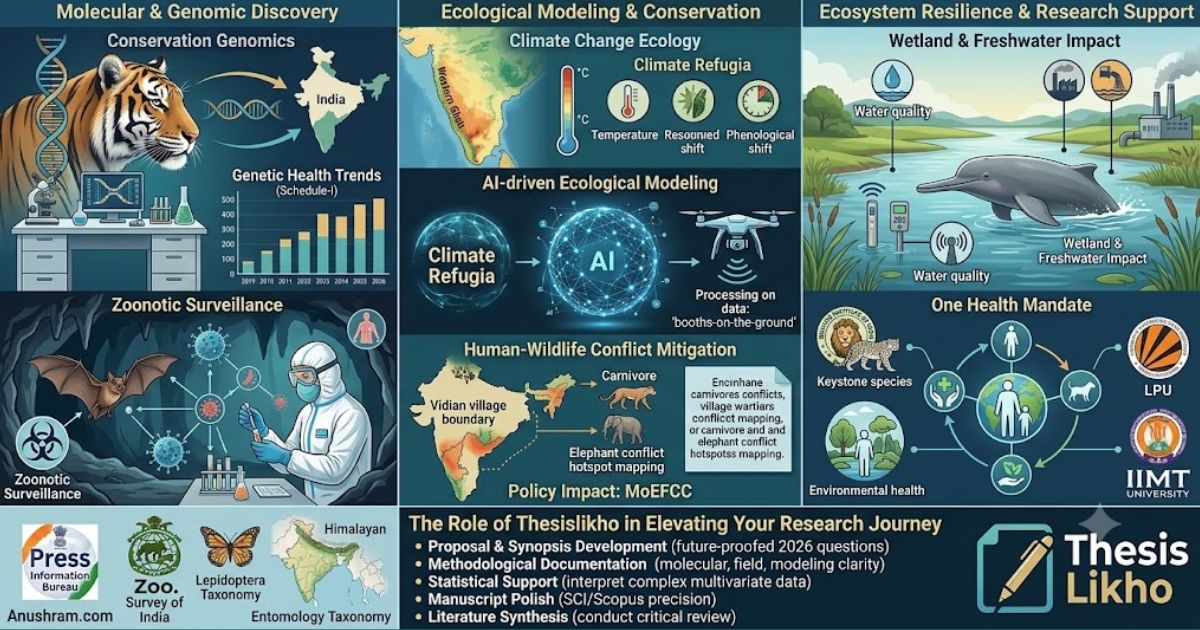
Today, as we navigate the complex ecological realities of mid-2026, Indian zoology has transformed into a highly interdisciplinary, data-intensive science. It stands at the absolute vanguard of global efforts to mitigate the climate crisis, prevent zoonotic pandemics, and preserve the genetic integrity of the world’s most significant biodiversity hotspots.
With India recognized as a megadiverse nation—hosting four major biodiversity hotspots (the Himalayas, the Western Ghats, the Indo-Burma region, and Sundaland)—the research scope for zoologists is practically limitless. The current academic landscape requires scholars to blend "boots-on-the-ground" field biology with "lab-at-the-bench" molecular inquiry and computational modeling. This fusion is producing high-impact research consistently published in top-tier, SCI-indexed journals like Nature Ecology & Evolution, Biological Conservation, and Journal of Animal Ecology.
This comprehensive guide explores seven critical areas of zoological research currently dominating the Indian academic landscape, providing evidence-based insights into where the field is headed and how emerging scholars can carve out highly impactful PhD and research careers.
1. Integrative Taxonomy and Cryptic Biodiversity Exploration
Despite centuries of biological cataloging, India's biodiversity remains vastly underexplored. In a landmark announcement in June 2026, the Zoological Survey of India (ZSI) reported the addition of an astounding 709 new animal species to the national faunal database in a single year, bringing India’s total documented faunal biodiversity to nearly 106,000 species.
The Shift to Integrative Methods
Classical taxonomy relied entirely on morphological characteristics (how an animal looks). However, modern zoological research has shifted to Integrative Taxonomy. This approach combines traditional morphological measurements with molecular phylogenetics (such as DNA barcoding of the COI gene), ecological data, and bioacoustics. This is particularly crucial for identifying "cryptic species"—animals that look identical to the naked eye but are genetically distinct and reproductively isolated.
Recent Breakthroughs and Evidence
The 2026 ZSI report highlighted that states like Kerala and Arunachal Pradesh are absolute goldmines for new discoveries. A significant portion of these discoveries were insects (over 59%), reflecting the massive, uncharted territory of invertebrate zoology. For instance, Indian researchers recently published the discovery of novel lichen moth species (Caulocerahollowayi and Asura buxa) in the Himalayas.
Research Significance for Scholars
Studying these organisms is not merely an exercise in stamp-collecting. The lichen moths discovered by the ZSI serve as critical bioindicators for air pollution and ecosystem health. Furthermore, the discovery of a new Himalayan bat species (Myotis himalaicus) adds crucial data to our understanding of high-altitude mammalian adaptation. For a PhD scholar, publishing a new species description using integrative taxonomy in SCI journals like Zootaxa or Systematic Entomology guarantees high citation rates and establishes a foundational academic reputation.
2. AI-Driven Ecological Monitoring and Spatial Dynamics
The days of tracking animal populations solely through manual pugmark counting or direct visual encounters are largely over. The most heavily funded and widely published zoological research in India today involves the integration of Artificial Intelligence (AI), Machine Learning (ML), and spatial ecology to monitor wildlife and mitigate Human-Wildlife Conflict (HWC).
Methodological Innovations
Research institutions such as the Wildlife Institute of India (WII) are pioneering the use of deep learning neural networks to process vast amounts of ecological data. The deployment of the AI-Based Tiger Identification System (AI-TIS) for the All India Tiger Estimation program is a prime example. This system uses advanced computer vision algorithms to instantly identify individual tigers from millions of camera-trap images by analyzing their unique stripe patterns, eliminating human error and drastically reducing processing time.
Furthermore, zoologists are utilizing Unmanned Aerial Vehicles (UAVs/Drones) equipped with thermal imaging cameras to study the spatial dynamics of large, far-ranging herbivores like the Asian Elephant. By overlaying this movement data onto GIS (Geographic Information Systems) maps featuring human settlements and agricultural lands, researchers can create predictive models.
Research Significance for Scholars
As human populations expand into forest fringes, conflict is inevitable. Research in this domain focuses on developing Early Warning Systems (EWS). A zoology scholar working in this field essentially becomes a data scientist, using R or Python to model resource selection functions and predict where a leopard or elephant is most likely to cross into human territory. Publishing predictive models that successfully reduce retaliatory killings of endangered species is highly prized in journals like Journal of Applied Ecology and Conservation Biology.
3. Conservation Genomics and Population Rescue
As habitats become increasingly fragmented due to infrastructure development (highways, dams, and urbanization), many of India's apex predators and endemic herbivores find themselves trapped in isolated "island" populations. This isolation prevents natural gene flow, leading to inbreeding depression, reduced fertility, and high susceptibility to disease.
The Genomic Toolkit
Conservation genomics is arguably the most prestigious sub-field of modern zoology. Researchers are utilizing Next-Generation Sequencing (NGS) and Whole-Genome Sequencing (WGS) to map the genetic health of these isolated populations. Instead of darting and drawing blood—which causes physiological stress to the animal—modern zoologists rely on non-invasive sampling, extracting high-quality DNA from scat, hair snares, or shed feathers.
Evidence-Based Application
Recent studies by the WII and the National Centre for Biological Sciences (NCBS) have focused heavily on the genetic bottlenecking of the Asiatic Lion in the Gir forest and the isolated tiger populations in Ranthambore. By assessing the "genetic load" (the accumulation of deleterious mutations), researchers can scientifically advise the National Tiger Conservation Authority (NTCA) on which specific individuals should be translocated to introduce fresh genetic material into a stagnant gene pool. Furthermore, zoologists are studying the physiological stress of reintroduced populations (like tigers in Panna and Sariska) by analyzing fecal glucocorticoid (cortisol) levels.
Research Significance for Scholars
For doctoral candidates, conservation genomics offers a pathway into high-impact science. Research focusing on the major histocompatibility complex (MHC)—the genes responsible for immune system health in wild populations—is critical for ensuring species survive emerging diseases. Dissertations in this area frequently result in publications in Molecular Ecology and directly influence national conservation legislation.
4. Climate Change Ecology and Phenological Shifts
India’s geography is incredibly diverse, ranging from the freezing trans-Himalayan deserts of Ladakh to the tropical rainforests of the Andaman Islands. This makes the subcontinent a massive, living laboratory for observing the real-time impacts of global climate change on animal life.
The Study of Shifting Baselines
Current zoological research focuses heavily on phenology—the study of cyclic and seasonal natural phenomena, especially in relation to climate and plant and animal life. Rising temperatures and erratic monsoon patterns are altering the breeding cycles of amphibians, the migration routes of birds across the Central Asian Flyway, and the emergence times of crucial insect pollinators.
The "Mountaintop Trap"
One of the most alarming areas of research involves endemic species in the Western Ghats and the Himalayas. As lower altitudes become too hot, species are forced to migrate higher up the mountains to stay within their thermal tolerance limits. However, researchers are documenting the "mountaintop trap" phenomenon: eventually, these species run out of mountain.
Research Significance for Scholars
Zoologists are currently racing to identify and map Climate Refugia—areas that are predicted to remain relatively stable and cool despite global warming. Identifying these zones is critical for future-proofing India's Protected Area (PA) network. A thesis that models the future distribution of an endangered species under various IPCC climate change scenarios provides actionable intelligence for the Ministry of Environment, Forest and Climate Change, and is highly sought after by journals like Global Change Biology.
5. Zoonotic Disease Surveillance and the "One Health" Paradigm
The global trauma of the COVID-19 pandemic irrevocably changed the scope of zoological research. It highlighted a stark reality: approximately 75% of all emerging infectious diseases are zoonotic, meaning they originate in animals before spilling over into human populations.
The One Health Approach
Indian zoologists are now integral members of "One Health" task forces, working alongside virologists, epidemiologists, and public health officials. The research focuses on the wildlife-human-livestock interface—areas where deforestation or the wildlife trade brings humans into unnaturally close contact with wild reservoir hosts.
Viral Reservoirs and Surveillance
Current research involves the extensive trapping, swabbing, and releasing of specific wildlife populations to monitor their viral loads. Indian researchers are conducting intensive genomic surveillance of bat populations (specifically Pteropus species) in Kerala and the Northeast to understand the circulation dynamics of the Nipah virus and coronaviruses. Similar studies are tracking Kyasanur Forest Disease (KFD) in primate and tick populations in the Western Ghats, and Avian Influenza (H5N1) in migratory waterfowl.
Research Significance for Scholars
This is arguably the most well-funded area of zoological research globally. Scholars who can combine field trapping skills with advanced molecular virology and epidemiological modeling are in unprecedented demand. Research that identifies the ecological drivers of viral spillover (such as how habitat destruction stresses bats, causing them to shed more virus) is consistently published in elite journals like The Lancet Planetary Health or Emerging Infectious Diseases.
6. Wildlife Forensics and Anti-Poaching Technologies
Despite strict legal frameworks under the Wildlife Protection Act (1972), the illicit wildlife trade remains a multi-billion dollar criminal enterprise. To combat sophisticated poaching syndicates, zoology has merged with criminal justice to create the highly specialized field of Wildlife Forensics.
Molecular Crime Scene Investigation
When authorities seize a shipment of ground-up rhino horn, carved ivory, or dried pangolin scales, visual identification is impossible. Zoologists at the WII’s Wildlife Forensics and Conservation Genetics laboratory use DNA Barcoding to definitively prove the species of origin, which is required for legal prosecution.
Furthermore, advanced zoological research is now utilizing Stable Isotope Analysis. By analyzing the isotopes of carbon, nitrogen, and oxygen in a seized elephant tusk or tiger bone, researchers can determine the exact geographic region—and sometimes the specific forest—where the animal was poached. This is because the chemical signature of the local water and vegetation is permanently recorded in the animal's tissues.
Research Significance for Scholars
For students interested in applied science, wildlife forensics offers a direct line to enforcement and policy. Developing faster, cheaper, and more accurate molecular assays for field-based species identification (such as portable CRISPR-based diagnostic kits) is a massive area of opportunity. Research in this sector frequently appears in Forensic Science International and Conservation Genetics.
7. Marine Zoology and Coastal Ecosystem Resilience
India possesses a coastline of over 7,500 kilometers, supporting immense marine biodiversity and the livelihoods of millions of fisherfolk. However, marine zoology in India is currently in a race against time, combating the twin threats of Ocean Acidification and Thermal Anomalies (marine heatwaves).
Understanding Trophic Cascades
Marine biologists and zoologists are conducting extensive underwater surveys in the Lakshadweep archipelago, the Gulf of Mannar, and the Andaman and Nicobar Islands. The primary research focus is the resilience of coral reef ecosystems. When ocean temperatures rise, corals expel their symbiotic algae, resulting in mass bleaching events. Current research is dedicated to identifying "super corals"—specific genotypes that exhibit higher thermal tolerance—for use in reef restoration projects.
Additionally, researchers are studying the impact of commercial overfishing on marine trophic cascades. By analyzing the stomach contents and stable isotopes of apex predators like sharks and tuna, zoologists can understand how the removal of top predators destabilizes the entire oceanic food web, leading to population explosions of jellyfish or other lower-trophic species.
Research Significance for Scholars
Marine zoology is critical to India's "Blue Economy" initiatives. Scholars who can SCUBA dive to collect ecological data and utilize advanced hydrodynamic modeling to predict larval dispersal patterns are highly valued. The results of these studies inform the creation of Marine Protected Areas (MPAs) and sustainable fishing quotas. Top publications in this field include Marine Biology and Coral Reefs.
Elevating Your Academic Trajectory with Thesislikho.com
The scope of zoology in India is breathtaking, offering scholars the chance to solve some of the most pressing ecological and biological crises of the 21st century. However, the transition from a passionate student to a published, doctoral-level scientist is fraught with administrative and technical hurdles.
Embarking on a PhD or a master’s research project requires more than just field expertise; it requires statistical mastery, impeccable data handling, and the ability to articulate complex findings according to the rigid stylistic guidelines of international peer review. This is where many brilliant field biologists stumble.
Thesislikho.com acts as your specialized academic partner, providing the structural, technical, and editorial scaffolding required to ensure your research achieves its maximum potential.
1. PhD Admission and Proposal Development
Securing a position at a premier institute (like WII, ZSI, NCBS, or top central universities) is highly competitive. The selection committees look for research proposals that are novel, feasible, and aligned with current global trends.
- How We Help: Our consultants help you refine your raw ideas into a compelling, scientifically rigorous synopsis. Whether you want to study the gut microbiome of the Indian Leopard or the phenology of Himalayan butterflies, we ensure your literature review identifies a genuine research gap, positioning you as a highly desirable candidate for admission.
2. Methodological Documentation and Research Design
The bedrock of reproducibility in science is a flawlessly designed methodology. In modern zoology, a poorly designed sampling strategy or an incorrect PCR protocol can invalidate months of fieldwork.
- How We Help: We provide expert guidance on structuring your research design. From detailing non-invasive DNA extraction protocols to designing camera-trap grids for spatial capture-recapture (SCR) models, we ensure your methodology chapter is bulletproof and capable of withstanding the scrutiny of a doctoral defense committee.
3. Statistical Analysis and Bioinformatics Support
Modern zoology is awash in data. Whether you are analyzing thousands of genomic sequences, calculating species diversity indices, or running predictive climate models, a deep understanding of biostatistics (using R, Python, or specialized GIS software) is mandatory.
- How We Help: If coding and statistics are not your primary strengths, our team of data scientists and bioinformaticians steps in. We help you clean your data, run the appropriate multivariate analyses (PCA, GLMMs, ANOVA), and generate the high-quality, publication-ready graphs and spatial maps that SCI journals demand.
4. Manuscript Polish for Q1/SCI-Indexed Journals
The final, and often most frustrating, hurdle is getting published. Top-tier zoology journals have rejection rates upwards of 80%. Often, excellent science is rejected simply because the manuscript suffers from poor narrative flow, incorrect formatting, or improper academic English.
- How We Help: The editing team at Thesislikho.com specializes in academic manuscript preparation. We provide comprehensive structural editing, ensuring your arguments are logically sound and your citations are perfectly formatted. We help you translate your localized Indian research into a manuscript that speaks to a global scientific audience, drastically increasing your chances of acceptance in high-impact Scopus and SCI-indexed journals.
Conclusion
The future of Indian biodiversity is currently being written in the laboratories, forests, and coastal waters across the subcontinent. From the microscopic analysis of a bat's viral load to the satellite tracking of a migrating elephant, the zoologist of 2026 is a vital guardian of the natural world.
Your research has the potential to change national policy, save a species from extinction, or prevent the next pandemic. Do not let the complexities of academic formatting or statistical modeling slow down your contribution to science. Partner with Thesislikho.com, and ensure that your zoological research leaves a lasting, published legacy in the scientific community.
Website: www.thesislikho.com
Call / WhatsApp: +91 96438 02216