
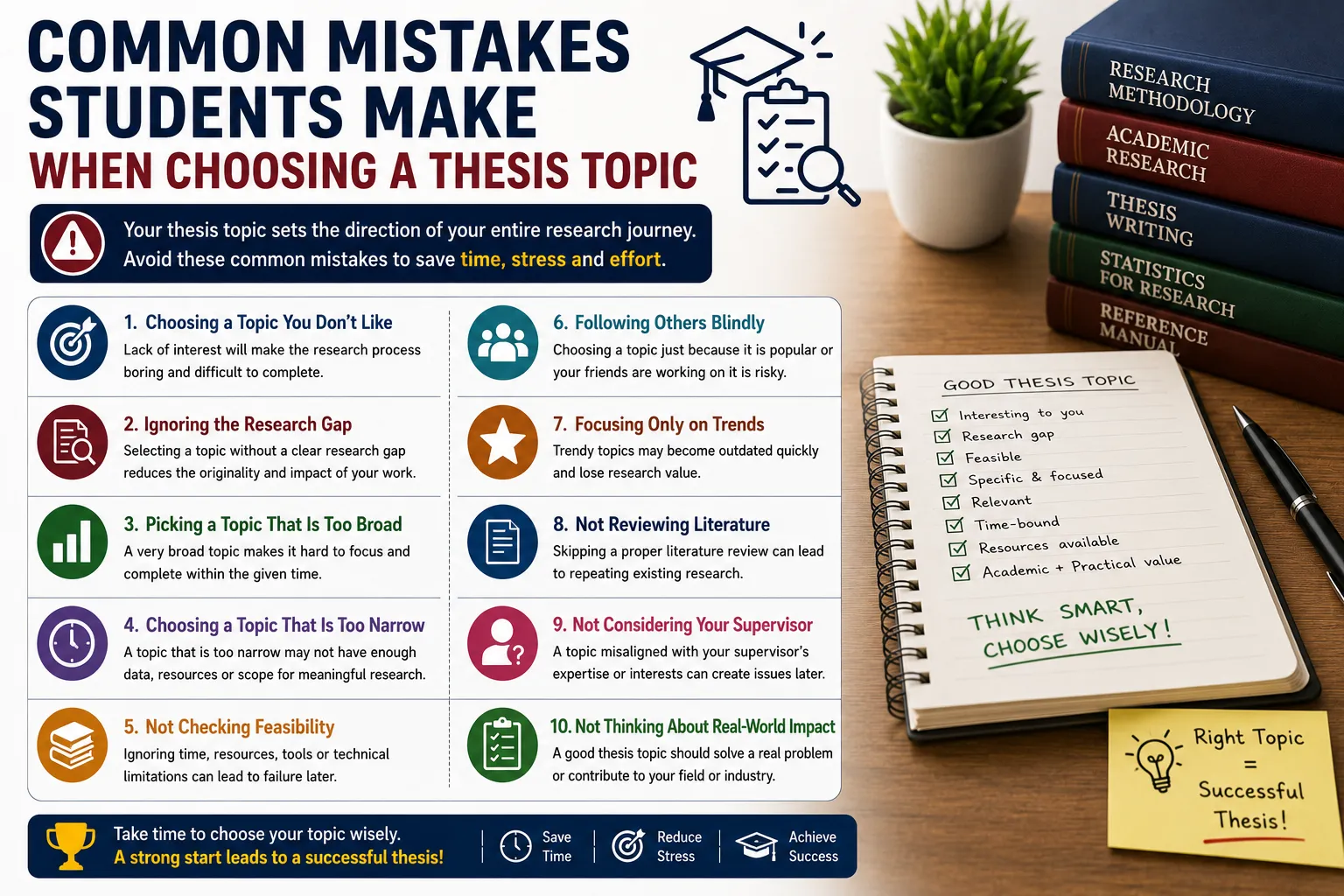
If your first draft of a thesis topic has already been through four versions and you still don't feel sure about it, take a breath — this is one of the most common places for research scholars to get stuck, and it's rarely because you lack ability. It's usually because of a handful of specific, predictable mistakes students make when choosing a thesis topic, mistakes that are easy to spot once you know what to look for, and expensive to fix once you've already started writing. This guide walks through exactly what those mistakes look like, why they happen, and how to catch them before they cost you months.
Think of this as the conversation an experienced thesis mentor would have with you at the topic-selection stage — not a generic list of "be careful," but specific traps, real examples, and what to do instead. Every mistake below is one our mentors have seen repeat across disciplines — from MBA dissertations to STEM theses to social-science research — which is exactly what makes them predictable, and predictable mistakes are the easiest kind to prevent.
Why Topic Selection Mistakes Are So Costly
Every mistake covered in this guide has one thing in common: it's cheap to fix at the topic-selection stage and expensive to fix later. A scope problem caught before you write a single chapter costs you a conversation with your supervisor. The same scope problem caught during data collection can cost you a semester. That asymmetry is exactly why this stage deserves far more attention than most first-time scholars give it.
It's also worth saying clearly: making one of these mistakes doesn't mean you're not cut out for research. These are structural, predictable errors — the kind that show up across disciplines, across universities, and across experience levels, precisely because topic selection sits at the intersection of academic judgment, practical logistics, and institutional process, and very few students are ever formally taught how to navigate all three at once.
If you haven't yet gone through a structured process for testing your topic, our companion guide How to Validate a Thesis Topic Before You Start Writing walks through that process step by step. This article focuses specifically on the mistakes that process is designed to catch.
Mistake 1: Choosing a Topic That's Too Broad
This is, by a wide margin, the most common mistake among first-time thesis writers. A broad topic feels safe — "a study on digital transformation in Indian banking" sounds impressive and gives you room to write. In practice, it does the opposite: it gives you so much room that you can't build a focused argument, and every chapter ends up trying to cover too much ground shallowly instead of one thing well.
The tell-tale sign of a too-broad topic is that you can't summarize your research question in a single, specific sentence without using the word "and" three times. If your topic statement reads like a table of contents rather than a question, it's still too broad.
Fix: Narrow along one dimension at a time — population, geography, timeframe, or a specific variable — until the topic compresses into one clear sentence. "Digital transformation in Indian banking" becomes "how tier-2 private bank branches in India are adapting core operations to UPI-first customer behavior since 2023" — still substantial, but now answerable.
Mistake 2: Choosing a Topic That's Too Narrow
The opposite mistake is just as common, especially among students who've read the "keep it narrow" advice a little too literally. A topic can be scoped so tightly that there simply isn't enough existing literature to build a defensible argument around it, or so specific that you can't find enough data to reach the word count or sample size your program requires.
This mistake often shows up only after a student has already started writing — the literature review chapter refuses to reach a reasonable length no matter how much they search, because there genuinely isn't much scholarly conversation happening around that exact intersection of variables.
Fix: If your topic returns fewer than a handful of closely related papers even after a thorough search across databases, treat that as a signal to widen slightly — add a related variable, extend the population, or connect your specific interest to a broader theoretical conversation it can sit inside.
Mistake 3: Mistaking "Under-Published" for "Under-Researched"
This is a subtler version of Mistake 2, and it deserves its own entry because it's so easy to fall into. A quick search returning very few results on a topic feels exciting — "nobody's studied this!" — but a real research gap and an area nobody has bothered to study are not the same thing. Sometimes a combination of variables is under-published because researchers have deliberately avoided it: a confounding factor makes clean analysis nearly impossible, the relationship has already been shown to be trivial, or the data simply can't be collected reliably.
Fix: Before treating a lack of literature as a gap, dig one level deeper — read a couple of adjacent papers closely enough to see whether anyone mentions why this specific angle hasn't been pursued. If a paper's "limitations" or "future research" section explicitly avoids your exact combination, that's worth investigating rather than ignoring.
Mistake 4: Picking a Trending Topic With a Short Shelf Life
Choosing a topic because it's currently popular — a hot technology theme, a viral social trend, a policy that just made headlines — feels like a smart, relevant choice in the moment. The mistake is failing to ask what that topic will look like six to twelve months from now, which is roughly how long a typical master's thesis takes from topic approval to submission. A trending AI tool, a specific app, or a policy still under debate can shift meaningfully in that window, sometimes making your framing outdated before you've even finished data collection.
This is a genuine, well-documented risk rather than a hypothetical one: research-methods guidance across multiple academic-support sources specifically flags "pursuing popular topics with limited shelf life" as a recurring, avoidable mistake. Fix: distinguish between a topic that's currently relevant (which is good) and one that's currently trending (which carries risk). Anchor trend-adjacent topics to a stable underlying question — the adoption pattern, the user behavior, the policy mechanism — rather than to the specific tool, app, or news cycle that made it visible.
Mistake 5: Ignoring Feasibility Until It's Too Late
A topic can be intellectually excellent and still be a bad thesis topic if you can't realistically execute it — no accessible sample, no institutional permission, a required tool or dataset you don't have access to, or a timeline that assumes six months of fieldwork when you only have three. This mistake is dangerous specifically because it's invisible on paper; a proposal can read beautifully and still be unworkable.
Fix: Before committing, confirm — in writing, not just in your head — that you can access the data, respondents, tools, or lab time your topic requires, within your actual timeline and budget. If you can't confirm this within a week or two of trying, that's your answer.
This is worth treating as a hard gate rather than a soft consideration, because feasibility problems rarely announce themselves early. A topic can sail through supervisor approval and look completely reasonable on paper, and still quietly assume something — a company willing to share internal data, a hospital granting ethics clearance quickly, a specific software license you don't yet have — that turns out to be far harder to secure than expected. The fix isn't to avoid ambitious topics; it's to test the specific assumption your topic depends on before you build months of work on top of it.
Mistake 6: Starting the Literature Review Before Locking the Question
It's tempting to start reading broadly the moment you have a rough interest area, especially because "doing the literature review" feels productive. But reading without a locked research question tends to produce an unfocused, sprawling literature review that's hard to use later, because you don't yet know what to keep and what to set aside. Dissertation-methodology guidance consistently flags this sequencing error — researching and reporting on tangential material because the core question wasn't nailed down first — as a recurring, avoidable cause of wasted writing time.
Fix: Do enough preliminary reading to identify a rough gap, then stop and lock a working research question before you go back to full-scale literature review. The literature review should test and support your question, not generate it from scratch.
.Mistake 7: Choosing a Topic Too Close to Existing Published Work
Every Indian thesis, once approved, is added to ShodhGanga — INFLIBNET's national repository of Indian theses — within a month of approval, and that repository becomes part of the very database used to check future submissions for similarity (Source: UGC framework governing Indian thesis submission and repository requirements). This means choosing a topic that closely mirrors an existing, published Indian thesis isn't just an originality concern in principle — it's a concrete, checkable risk once your own work is compared against that growing database.
This mistake often happens innocently: a student finds a well-structured thesis from a few years earlier, likes its framing, and builds something extremely similar "in a different context," without realizing how much structural and conceptual overlap will show up in a similarity report even with different wording.
Fix: Use existing theses for structural inspiration only — how a chapter is organized, how objectives are framed — never as a template to substitute your own literature search and gap-finding process. If your topic is close to something already published, your contribution needs to be genuinely distinct, not just relocated to a new city or company.
Mistake 8: Letting the Title Overstate the Topic
A smaller but surprisingly common mistake: titling the topic in a way the actual research doesn't support — claiming to present a "novel framework" or "new model" when the contribution is really an application of existing theory to a new context. IEEE's own authoring guidance explicitly advises against using words like "novel" or "new" in a title, on the basis that the content should demonstrate novelty rather than the title asserting it — an unearned title claim tends to invite exactly the kind of scrutiny a first-time scholar wants to avoid at committee review (Source: IEEE Author Center, article-structuring guidance).
Fix: Let your title describe what you studied and where, precisely, rather than what you're claiming about its importance. A precise, modest title survives committee scrutiny far better than an ambitious one that oversells the work.
Mistake 9: Skipping Supervisor Input Until the Topic Feels "Final"
Some students wait to approach their supervisor until they feel their topic is fully polished, worried that showing an early draft will look unprepared. This backfires — supervisors are far more useful when they can weigh in while a topic is still flexible, catching a scope or feasibility problem before you've built three weeks of reading around it. Waiting until the topic "feels done" often means the changes a supervisor suggests require undoing more work than if you'd checked in earlier.
Fix: Bring a rough, working version of your topic to your supervisor early and explicitly ask what could go wrong with it — not just whether they like it. This is a stage where imperfect and early beats polished and late.
Mistake 10: Treating Topic Selection as a One-Time Decision
The SAGE Encyclopedia of Communication Research Methods frames topic selection accurately: it's described as an ongoing process of exploring, defining, and refining an idea, not a single choice made once and then fixed (Source: SAGE Research Methods, "Research Topic, Definition of"). Students who treat their first topic idea as permanent tend to force-fit a weakening idea rather than adjusting it, simply because "changing the topic" feels like starting over.
Fix: Give yourself explicit permission to refine — narrowing, widening, or pivoting a topic in its first few weeks is normal and expected, not a sign of failure. The mistake isn't changing your topic; it's refusing to change it when the evidence says you should.
Two Real Scenarios: Watching These Mistakes Play Out
Scenario 1 — The trending-topic trap. A first-year master's student in a business program chose to study consumer trust in a specific generative-AI shopping assistant that had just launched and was getting heavy media coverage. It felt current and exciting. By the time she reached data collection five months later, the exact product had been rebranded and its core feature set had changed, and her survey instrument no longer matched what respondents were actually using. She had to reframe the entire study around the broader behavior pattern — trust formation in AI-mediated shopping generally — rather than the specific product, which cost her several weeks of rework that a slightly more stable framing would have avoided from the start. This is exactly the kind of scope decision covered in our related post, [Link: Top MBA Thesis Topics in Marketing for 2026.
Scenario 2 — The over-borrowed structure. A first-generation research scholar, unsure how to start, found a well-organized thesis on ShodhGanga in an adjacent area and used its chapter structure, objectives, and even some of its phrasing as a starting template for her own — changing the company name and location but keeping most of the framing intact. Her similarity report came back well above her university's comfort threshold, not because she'd copied text directly, but because the structural and conceptual overlap was substantial enough to register. She had to rebuild her literature review and objectives from her own reading, which took longer than if she'd used the existing thesis only for inspiration on formatting from the outset. Turning a research question into a genuinely original problem statement — rather than borrowing someone else's framing — is covered in more depth in How to Turn a Research Question Into a Thesis Problem Statement.