
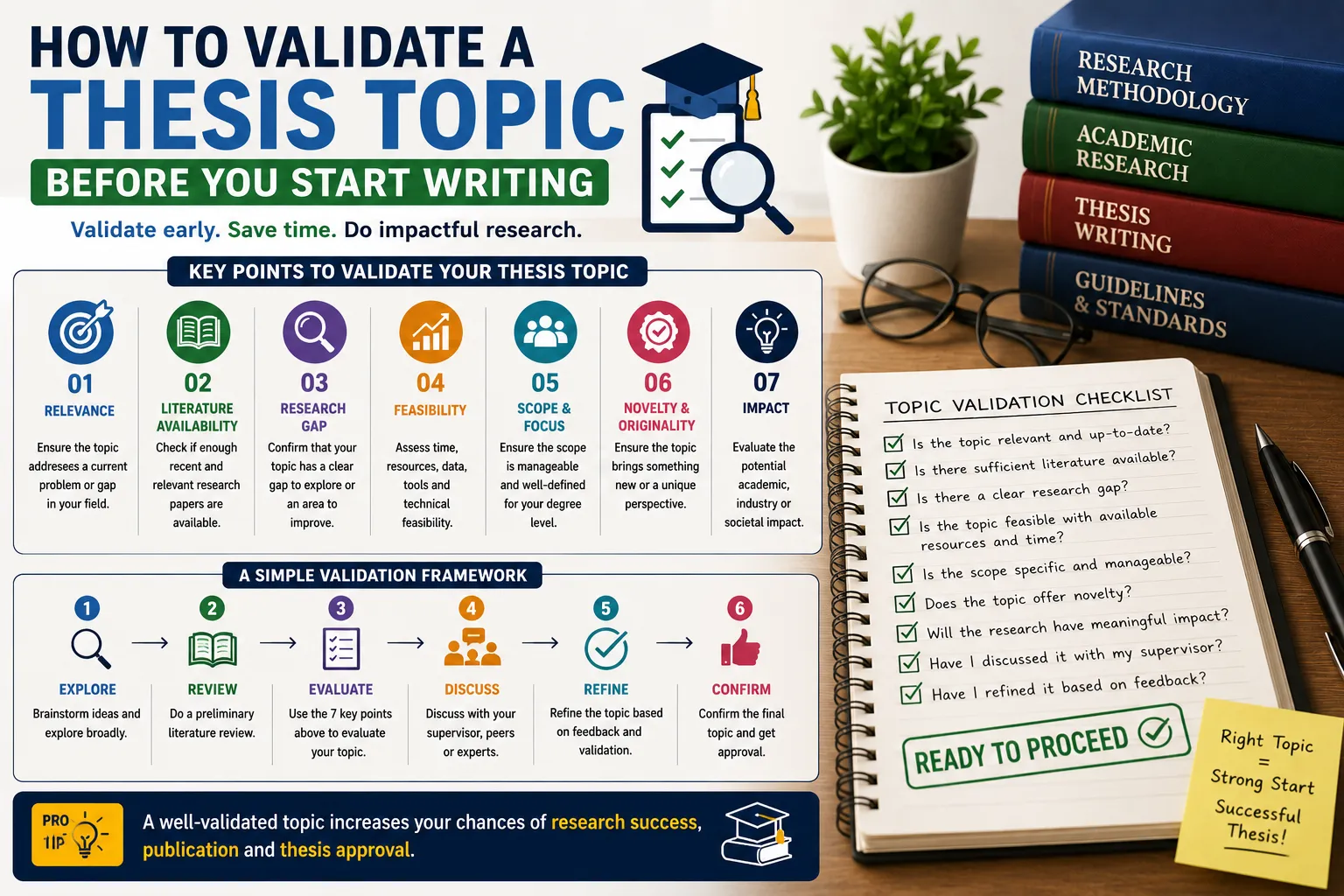
If you've ever sat down to write your first chapter and felt a small, nagging doubt — "but is this even a good topic?" — you're not alone, and you're not wrong to pause. Learning how to validate a thesis topic before you start writing is arguably the single highest-leverage step in the entire thesis process, because every hour you spend writing on an unvalidated topic is an hour you might have to redo. This guide walks you through exactly how to do it — step by step, with real examples from Indian research scholars — so you can move into Chapter 1 with confidence instead of guesswork.
This isn't a theoretical checklist. It's the process PhD-qualified mentors actually use when a scholar walks in with a rough idea and needs to leave with something a committee will approve.
Why Topic Validation Matters More Than Students Realize
Most students treat topic selection as a formality — something to get past quickly so the "real work" of writing can begin. In practice, the topic is the real work. A thesis is only as strong as the question it's trying to answer, and a weak or unvalidated question tends to surface its problems at the worst possible time: three chapters in, during data collection, or worse, at the pre-submission seminar when a committee member asks "what exactly is new here?"
Validating a thesis topic before you start writing means testing your idea against reality — the literature, your resources, your timeline, and your institution's expectations — before you invest months into it. Done properly, it also has a quiet side benefit that doesn't get talked about enough: it reduces the pressure that leads to careless, copy-heavy literature reviews later. When students haven't nailed down a genuine gap early, they often end up skimming and lightly paraphrasing sources under deadline pressure during the literature review — which is precisely where plagiarism similarity tends to concentrate. Under the UGC Plagiarism Regulations 2018, which remain the governing framework for Indian thesis submissions in 2026, similarity above 10% requires revision, above 40% means a year's debarment from resubmission, and above 60% can mean cancellation of registration. Getting the topic and its boundaries right early is one of the most underrated ways to avoid ending up in that situation months later.
If you want a deeper look at how committees specifically evaluate topics at the approval stage, see our related guide: Thesis Topic Approval Process: What University Committees Look For.
What "Validating a Thesis Topic" Actually Means
Validation isn't the same as "picking a topic you find interesting." It's a structured check across four dimensions:
- Research gap — does the literature actually show an unaddressed or under-addressed question, or are you about to repeat work that's already been done?
- Feasibility — can you realistically access the data, sample, tools, and time this topic demands?
- Scope — is the topic narrow enough to complete within your word count and timeline, but broad enough to be defensible?
- Institutional fit — will your department, supervisor, and research committee actually approve it?
A useful way to structure this thinking is the FINER framework, originally developed for clinical research questions but now widely used across disciplines: a strong research question should be Feasible, Interesting, Novel, Ethical, and Relevant (Source: Hulley et al., FINER framework, referenced across research methodology literature). Most weak thesis topics fail on Feasibility or Novelty specifically — either the data doesn't exist in an accessible form, or the "gap" turns out not to be a gap at all once you dig deeper.
Step 1: Start From a Genuine Research Gap, Not a General Interest
The single most common validation mistake is starting with a broad area of interest ("I want to study social media marketing" or "I'm interested in employee retention") and mistaking that interest for a research topic. A research gap is much narrower — it's a specific, unresolved question that existing literature has not adequately answered.
The reliable way to find one:
1. Narrow your broad interest first. Don't start reading widely across "everything related to X" — you'll drown in options and gaps that feel exciting but aren't specific enough to build a study around.
2. Read recent literature reviews and meta-analyses before primary studies. These synthesis papers map out what's already settled in a field, which saves you from spending weeks reading individual papers that all say the same thing.
3. Pay close attention to "limitations" and "future research" sections. Authors routinely flag exactly what their study couldn't address — this is often a ready-made launch point for your own research gap .
4. Check whether the gap is genuine or just under-published. A topic with very little existing research isn't automatically a gap — sometimes it means the area isn't considered valuable yet, or the data simply doesn't exist. A real gap shows up as a pattern across multiple credible sources, not a single paper's silence on the subject.
A quick way to sanity-check your gap: can you finish the sentence "Existing research has looked at X and Y, but hasn't examined Z in the context of ___" with something specific? If you're using vague words like "more research is needed," you haven't found a gap yet — you've found a general area.
Which Tools Actually Help You Find a Gap
Beyond a manual literature review, a few tools consistently show up in how experienced researchers approach gap-finding, and they're worth building into your process from day one rather than discovering them halfway through:
- Google Scholar and Scopus for a first-pass sweep of what's been published and how recently — a topic where the most-cited work is fifteen years old may itself be a signal that either the area has been abandoned, or it's simply been settled and isn't worth revisiting.
- Connected Papers or similar citation-mapping tools to visualize how a cluster of papers relates to each other, which makes it much faster to spot an isolated, under-cited corner of a field that hasn't been fully explored.
- A simple gap-tracking sheet — nothing fancy, just a running log of every candidate gap you come across, the paper it came from, and a one-line note on why it might or might not be worth pursuing. Trying to hold five or six possible gaps in your head at once is how students end up committing to the first idea they had rather than the strongest one.
None of this replaces close reading — it just makes your reading faster to organize and easier to defend later when a committee member asks "what did you actually find in the literature that led you here?"
Step 2: Run Your Topic Through a Feasibility Check
This is the step students skip most often, and it's the one that causes the most damage later. Ask yourself, honestly:
- Data access: Can you actually get the sample, dataset, or organizational access this topic requires — in India, within your timeline, without needing permissions you don't have?
- Time: Does your topic require six months of primary data collection when you only have three months before your submission deadline?
- Expertise and tools: Does the required methodology (say, structural equation modelling, or a specific lab technique) match tools and skills you actually have, or will have time to learn?
- Cost: Will data collection, travel, software licenses, or lab work require money you don't have budgeted?
This maps directly onto the "Feasible" pillar of the FINER framework and it's worth treating as a hard gate, not a soft consideration. A fascinating topic with no realistic path to data is not a viable thesis topic — it's a good conversation starter.
Step 3: Write a Rough Problem Statement and Research Objectives
Before you take anything to your supervisor, force yourself to write a rough, one-paragraph problem statement and two to three research objectives. This single exercise exposes weak topics faster than almost anything else, because vague topics simply refuse to compress into a clear problem statement.
A workable problem statement usually answers three questions in plain language:
- What is the specific issue or gap?
- Why does it matter (to theory, practice, or policy)?
- What will your study specifically examine to address it?
If you find yourself writing three paragraphs and still not landing on a clear "what," that's a signal your topic is still too broad — go back to Step 1 and narrow further.
It helps to see the difference side by side. A weak version might read: "This study examines digital marketing practices among small businesses in India." It's not wrong, exactly — it's just too broad to be researched by one person in one thesis. A validated version of the same interest area might read: "This study examines why WhatsApp Business adoption among small retail businesses in Tier-2 Indian cities has plateaued despite low implementation cost, focusing on the trust and digital-literacy barriers reported by owners over 40." The second version tells you exactly what data you'll need, exactly which population you're studying, and exactly what gap you're filling — which is what a committee is actually looking for at approval stage.
Your research objectives should follow directly from this problem statement — typically two to four objectives, each one a specific, achievable action ("to examine," "to compare," "to assess") rather than a restatement of the whole topic. If your third objective is basically your first objective reworded, you likely have one solid study hiding inside what looks like three.
Step 4: Get Informal Feedback Before the Formal Presentation
Before you present your topic formally to your Research Advisory Committee (RAC) or your guide, run it past someone informally first — a senior scholar, a peer a year ahead of you, or a subject expert. This isn't about seeking approval; it's about stress-testing your problem statement in a low-stakes setting so you catch obvious gaps (a missing variable, an already-answered question, an access problem) before it costs you a formal revision cycle.
If you'd like expert guidance in validating and developing your thesis topic before you take it to your committee, you can check out our Thesis Writing Service — our PhD-qualified mentors have helped thousands of Indian scholars stress-test topics at exactly this stage, before a single chapter is written.
Step 5: Present to Your Supervisor and Committee — and Expect to Iterate
In the Indian university system, topic approval isn't just an informal nod from your guide — it usually runs through a structured Doctoral Research Committee (DRC) and Research Advisory Committee (RAC) process. For research-degree scholars, this typically involves submitting a synopsis (commonly 2,000–5,000 words) and presenting it in an open seminar, after which the RAC recommends the topic for formal registration, sometimes with required revisions (Source: university PhD Ordinance/SOP frameworks, aligned with UGC Minimum Standards for PhD Degree Regulations, 2022). MBA and master's-level dissertations usually follow a lighter version of the same principle — a guide or coordinator sign-off on a proposal before you're cleared to proceed.
The important mindset shift here: committee feedback at this stage is a feature, not a failure. A topic that gets sent back for revision once is completely normal and far cheaper than discovering the same problem after your literature review is written. For a closer look at exactly what committees are checking for at this stage, see our companion guide: Thesis Topic Approval Process: What University Committees Look For.
Step 6: Run a Tiny Pilot Check on Your Scope
Before committing fully, do a small-scale reality check — this could be a mini literature scan of 15–20 recent papers to confirm your gap still holds, a quick chat with two or three potential respondents to confirm access, or a short trial run of your intended analysis method on a small sample of data. This isn't a full pilot study; it's a scope check, and it typically takes a few days, not weeks. Its entire purpose is to catch a fatal feasibility problem while it's still cheap to fix.
Build a One-Page Topic Validation Memo
Once you've worked through the gap check, feasibility check, and problem statement, it's worth consolidating everything into a single one-page memo before you approach your supervisor formally. This isn't an official university document — it's a working tool for you — but it forces clarity in a way that scattered notes across notebooks and browser tabs never do. A useful memo covers:
- The specific research gap, in one or two sentences, with the two or three sources that support it existing
- Your rough problem statement and research objectives
- A short feasibility note: confirmed data access, estimated timeline, tools or software required
- Any known risks or open questions you still need your supervisor's input on
Scholars who walk into their first supervisor meeting with this kind of memo — rather than a vague topic idea and a request for direction — tend to get through the approval stage faster, simply because the conversation starts from "here's what I've already checked" instead of "here's what I'm thinking about." It also becomes the backbone of your formal synopsis later, so the time you spend on it isn't wasted even if your supervisor asks you to adjust the angle.
Two Real Scenarios: What Goes Wrong (and How It's Caught Early)
Scenario 1 — The MBA marketing student with no accessible data. An MBA scholar wanted to study the impact of influencer marketing on Gen Z purchase decisions specifically within Tier-2 Indian cities. The topic was genuinely interesting and reasonably novel — most existing studies focused on metro audiences. But when she tried to design her sample, she discovered she had no institutional access to a large enough Tier-2 respondent pool within her three-month window, and running a paid survey panel wasn't within her budget. The fix wasn't to abandon the idea — it was to narrow the scope to a single accessible city with an existing alumni network she could survey through, which kept the novelty intact while making the data collection realistic. This is exactly the kind of feasibility-versus-ambition trade-off covered in our related read, Top MBA Thesis Topics in Marketing for 2026.
Scenario 2 — The first-time scholar who confused "under-published" with "under-researched." A first-generation research scholar chose a topic because a preliminary Google Scholar search returned very few papers on it — she assumed this meant she'd found a strong gap. A closer literature review revealed why: the topic combined two variables that researchers had deliberately avoided studying together because a confounding factor made the relationship nearly impossible to isolate cleanly. The absence of research wasn't a gap; it was a known methodological dead end. Catching this during validation — rather than three months into data analysis — saved her an entire semester. This is one of the most common traps covered in our companion post, Common Mistakes Students Make When Choosing a Thesis Topic.
Common Mistakes That Undo Good Validation Work
- Validating the topic once and never revisiting it. Literature moves; a gap that existed six months ago may have since been published by someone else. Do a final gap-check right before you formally register.
- Skipping the feasibility check because the topic "feels" doable. Feelings aren't data access. Confirm it in writing — an email, a data-sharing agreement, a confirmed respondent list.
- Writing a problem statement that describes a topic instead of a problem. "A study on employee engagement in IT firms" is a topic. "Why does employee engagement decline after year two in mid-sized Indian IT firms despite standard retention policies" is a problem statement.
- Treating committee revisions as a personal failure. They're a normal, expected part of the process — even strong scholars get sent back for scope adjustments.
- Choosing a topic that's too close to something already thoroughly published without checking whether your specific angle, population, or context is genuinely different enough to matter.
How Long Should Topic Validation Actually Take?
There's no single fixed number, but as a working benchmark: focused topic validation — narrowing your interest, checking the literature for a gap, running a feasibility check, and drafting a rough problem statement — typically takes two to four weeks of concentrated effort, done in parallel with your early background reading rather than as a separate multi-month phase. Skipping it doesn't save time; it just moves the delay downstream. Indian master's theses commonly take six to twelve months end-to-end, and weak topic scoping is one of the most frequent reasons that stretches to eighteen months or more, usually because of a late-discovered data-access or scope problem that a proper validation step would have caught early.
Where Professional Guidance Fits In
You don't have to run this process alone, and there's no extra credit for struggling through topic validation in isolation. Many Indian scholars — especially those without a strong research background or working with a supervisor who has limited bandwidth — benefit from an experienced second opinion at exactly this stage: someone who can stress-test a research gap, flag a feasibility risk before it becomes a crisis, and help translate a rough idea into a problem statement a committee will actually approve.
That's precisely the kind of support our Thesis Writing Service provides — PhD-qualified mentors who've guided thousands of scholars through this exact validation stage, well before the writing begins.
FAQs
How do you validate a thesis topic before you start writing?
Confirm a genuine research gap through recent literature reviews, check feasibility (data access, time, tools, cost), draft a rough problem statement and objectives, get informal feedback, and present the topic to your supervisor or committee for formal sign-off before you begin full-scale writing.
Why should I validate a thesis topic before you start writing?
Because unvalidated topics tend to fail later — during data collection, at committee review, or during the literature review when time pressure leads to rushed, poorly paraphrased writing. Validating early is far cheaper than revising three chapters in.
When should you validate a thesis topic before you start writing for a thesis?
As early as possible — ideally before you finalize your synopsis or proposal, and definitely before you begin drafting your literature review. A quick re-check just before formal registration is also good practice, since the literature can shift.
How long does it take to complete a thesis using this approach?
Master's theses commonly take six to twelve months end-to-end when the topic is properly validated upfront; weak validation is one of the most common reasons that timeline stretches to eighteen months or more. Topic validation itself usually takes two to four weeks, run alongside your early reading.
Is professional help available to validate a thesis topic before you start writing?
Yes. Many scholars work with experienced academic mentors at this stage specifically to stress-test their research gap and feasibility before committing months to a single direction — this is a core part of what services like ThesisLikho's Thesis Writing Service support.
How do you know if your topic is too broad or too narrow?
Too broad usually shows up as an inability to write a single, specific problem statement without hedging into multiple directions. Too narrow usually shows up during your feasibility check — you can't find enough literature to build a defensible argument, or there's no real debate or gap to engage with.
Choosing a validated, well-scoped topic doesn't just make your proposal stronger — it changes the entire experience of writing the thesis that follows. If you'd like an experienced second opinion on your topic before you commit to it, Talk to a Thesis Expert →