
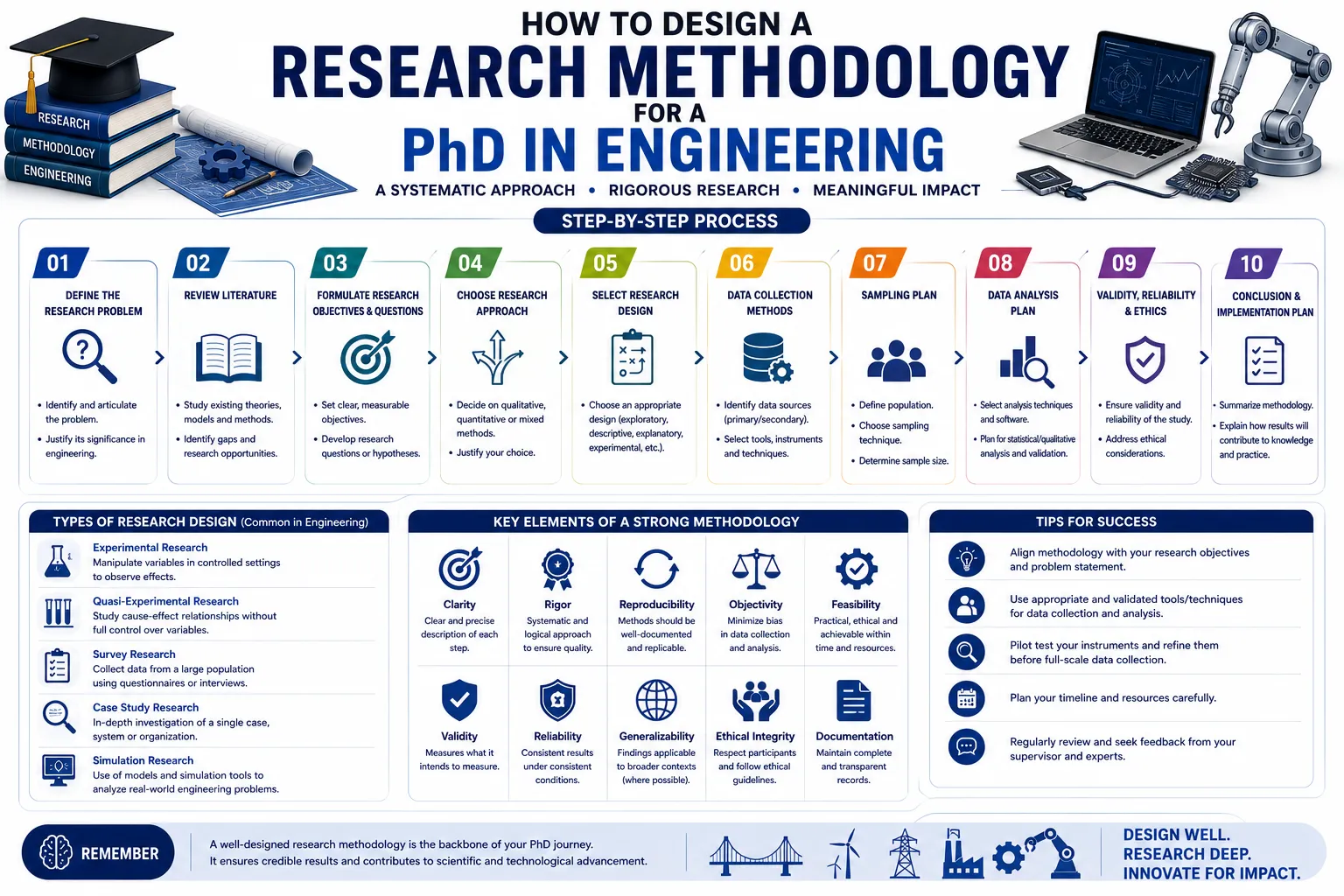
If your Research Advisory Committee has sent your synopsis back with "methodology not clearly defined," you're facing one of the most common and most fixable stumbling blocks in an engineering PhD. Learning how to design a research methodology for a PhD in engineering means choosing deliberately between experimental, computational, analytical, and design-based approaches — and, for whichever you choose, being specific enough about your data collection, testing structure, and validation plan that another researcher could follow and replicate what you did. This guide walks through exactly how to make that choice and build a methodology chapter that holds up to committee scrutiny, including the formal standards — Design of Experiments and ASME's verification and validation framework — that current engineering research is increasingly expected to follow.
Why Engineering Methodology Is More Varied Than It Looks
It's tempting to assume engineering research methodology always means "build something and test it," but the reality is considerably more varied. A published systematic review of leading engineering-design journals actually found that qualitative approaches were the most common methodology in that specific sub-field, with quantitative and mixed-methods studies also well represented — a useful reminder that even a discipline as hands-on as engineering doesn't have a single default methodology. What matters is choosing deliberately, based on what your specific research question requires, rather than defaulting automatically to whichever approach your background or your department's dominant culture favors.
If you haven't yet locked a specific, defensible topic, our companion guide, PhD Thesis Topics in Engineering: Research Ideas for 2026, is worth working through first, since your methodology needs to be designed alongside your topic rather than after it — the two constrain each other directly.
The Four Core Engineering Research Methodologies
Engineering PhD research methodology is generally organized around four core approaches, and almost every design decision starts by identifying which of these — or which combination — your research question actually calls for.
Experimental/quantitative methods involve physical testing under controlled conditions, with results analyzed using statistical techniques ranging from basic descriptive statistics to formal hypothesis testing and Design of Experiments. This remains the dominant approach across most applied engineering subfields, particularly where a new material, device, or process needs to be rigorously compared against existing alternatives.
Computational/simulation methods model a system's behavior using specialized software — ANSYS for structural and thermal analysis, MATLAB and Simulink for control systems, CFD tools for fluid dynamics — and are particularly valuable where physical testing would be too costly, too dangerous, or simply impractical at the scale or under the conditions your research question requires.
Analytical/theoretical methods derive results through mathematical modeling and formal analysis, without necessarily requiring physical testing or computational simulation — establishing bounds, optimal conditions, or theoretical relationships that hold under stated assumptions. This remains foundational in areas involving control theory, structural mechanics, or thermodynamic analysis.
Design-based and qualitative methods, more common in engineering-design research specifically, study the design process itself — how engineers make decisions, how design methods perform in practice, or how a design's usability and effectiveness are perceived by its intended users. This methodology type is genuinely under-recognized relative to how often it's actually used in published engineering-design research.
Many strong engineering PhD theses combine two or more of these deliberately — an analytical chapter establishing theoretical expectations, followed by an experimental or computational chapter testing whether those expectations hold under realistic conditions.
Choosing Between Them Based on Your Research Question
The decision isn't about which method matches your existing lab skills most comfortably — it's about what your specific research question requires to be answered credibly. A useful diagnostic: read your research question back to yourself and ask what kind of evidence would actually satisfy it.
- If your question is fundamentally about how a specific material, device, or process performs under real-world conditions — you need experimental methods, likely structured through formal Design of Experiments.
- If your question requires testing at a scale, cost, or risk level that physical testing can't accommodate — computational simulation is the appropriate tool, provided you build in a genuine verification and validation plan.
- If your question is about establishing theoretical bounds, optimal conditions, or a formal relationship between variables — analytical/theoretical methods are the right foundation, potentially followed by empirical testing to confirm the theory holds in practice.
- If your question is about how engineers design, decide, or how a design is experienced by its users — qualitative or design-based methods, borrowing tools from the social sciences, are the appropriate fit, even though this can feel unfamiliar if your background is purely technical.
Step 1: Start From Your Research Question, Not a Preferred Method
The most common methodology mismatch in engineering PhDs is defaulting to whichever approach the scholar already knows well — often simulation for those from a strong computational background, or pure lab testing for those from a strong hands-on background — even when the actual research question calls for something else, or for a combination. If your question includes phrases like "how does X perform compared to Y under real operating conditions," that's a signal you likely need physical experimental validation, not just a simulation, regardless of how much more comfortable simulation feels.
Before finalizing your methodology, write your research question and objectives on paper and check honestly whether each objective can actually be answered through your preferred method alone, or whether it implicitly requires a different or additional approach.
Step 2: Use Design of Experiments for Rigorous Experimental Work
If your methodology involves physical testing, it's worth moving beyond a one-factor-at-a-time, trial-and-error approach and adopting formal Design of Experiments (DOE) techniques instead. Rather than testing one variable at a time while holding everything else constant — which requires far more total tests and can miss important interactions between factors — DOE uses structured designs (factorial designs, response surface methodology, Taguchi-style robust designs) to efficiently assess the effect of multiple factors on a performance outcome simultaneously, dramatically reducing the number of tests required while still producing statistically defensible, generalizable results.
This matters beyond just efficiency: poor experimental design has been repeatedly identified in reproducibility surveys as one of the most commonly cited causes of irreproducible research results, alongside flawed statistical analysis. Investing time in a properly structured experimental design from the outset — rather than an ad hoc testing plan you build as you go — directly protects your results' credibility at both publication and viva stage.
In practical terms, adopting DOE means deciding upfront which factors you'll vary, how many levels of each factor you'll test, and which specific combinations your chosen design requires — a full factorial design tests every combination of every factor level, which becomes impractical quickly as factors and levels increase, while fractional factorial or response-surface designs let you test a carefully chosen subset that still reveals the key relationships and interactions with far fewer total runs. Statistical software (Minitab, JMP, or R packages built for DOE) can generate an appropriate design once you specify your factors and their ranges, and the same software then supports the analysis once your test results are in, keeping your experimental plan and your eventual statistical analysis consistent with each other from the start.
Step 3: Plan for Verification and Validation if You're Simulating
If your methodology relies on computational simulation, it's worth structuring your approach around the same verification and validation (V&V) discipline that ASME's formal VVUQ standards define for computational engineering research — distinct standards exist for computational solid mechanics (V&V 10), computational fluid dynamics and heat transfer (V&V 20), and medical device modeling (V&V 40), all built around the same core distinction: verification asks whether your computational model is solved correctly (are the equations implemented and computed accurately), while validation asks whether the model accurately represents real-world behavior (does it match physical reality, not just internal mathematical consistency).
Practically, this means your methodology chapter should address both questions explicitly: how you verified your simulation's numerical accuracy (mesh convergence studies, comparison against known analytical solutions for simplified cases), and how you validated it against real experimental or field data, even if only at a smaller scale or for a simplified case. A simulation-only thesis that skips this validation step risks producing confident-looking results that don't actually reflect real-world behavior — precisely the concern ASME's VVUQ standards were developed to address.
You don't necessarily need to follow a specific ASME standard's full formal procedure if it isn't standard practice in your particular subfield, but borrowing its core logic strengthens any simulation-heavy methodology: run a mesh or grid convergence study to show your numerical solution has stabilized rather than being an artifact of an under-resolved model, compare your simulation against at least one known analytical or experimental benchmark case before applying it to your novel research question, and explicitly state the specific conditions under which your validated model's results can and can't be trusted to generalize.
Step 4: Define Your Data Collection and Statistical Analysis Plan
Whether your work is primarily experimental, computational, or a combination, specify in advance exactly how much data you'll collect, how many repetitions or simulation runs you'll perform, and what statistical methods you'll use to analyze the results. A single favorable test result reported without repetition or variance reporting is a common and easily challenged weakness — any result involving inherent variability needs to be reported across multiple repetitions with clear statistical treatment, not a single point estimate presented as definitive.
Step 5: Address Uncertainty and Limitations Honestly
Every engineering methodology has specific, well-known sources of uncertainty, and a strong methodology chapter names them explicitly. For experimental work, this typically means addressing measurement uncertainty, environmental variability between test runs, and the limits of your specific test conditions' generalizability to real-world deployment. For computational work, uncertainty quantification — a formal part of ASME's VVUQ framework — means explicitly characterizing how much confidence your results deserve given known sources of numerical and modeling error. Naming these limitations directly, rather than presenting results as if they carry more certainty than they do, is a sign of methodological maturity that strengthens rather than weakens a committee's confidence in your work.
Structuring the Methodology Chapter Itself
Once your design decisions are made, the chapter itself typically follows this order: a statement of your overall methodological approach (experimental, computational, analytical, design-based, or a stated combination, with your rationale for that choice); your specific experimental or computational design, including equipment, software, or simulation setup; your data collection methods, sample sizes, and repetition structure; your statistical analysis or validation approach, specified precisely enough to be replicable; and finally, an honest discussion of uncertainty, limitations, and threats to the validity of your conclusions.
Why Combining Methods Often Strengthens an Engineering Thesis
If you do end up combining approaches — an analytical chapter establishing theoretical expectations followed by an experimental or computational chapter testing them, for instance — it's worth explicitly designing your chapters to speak to each other rather than treating them as loosely connected halves of the same thesis. If your theoretical model predicts a specific relationship between variables, your experimental or simulation chapter should be designed specifically to test whether that relationship holds under realistic conditions, rather than exploring a related but different question. This kind of deliberate connection matters for two reasons: examiners specifically look for coherence between a thesis's chapters, and a claim supported by both theoretical derivation and independent empirical or computational evidence is simply more persuasive than either form of evidence alone. It's worth adding a short paragraph to your methodology chapter explicitly stating how your different methodological components connect to and reinforce one another — this single addition often does more to strengthen a combined methodology than any other single revision.
A Real Example: Trial-and-Error vs a Structured Experimental Design
A scholar researching how three different process parameters affected the mechanical strength of a 3D-printed composite material initially planned to test each parameter separately, holding the other two constant — a natural, intuitive approach, but one that would have required a large number of individual print-and-test cycles and couldn't reveal whether the parameters interacted with each other in ways a one-at-a-time approach would miss. Working with his supervisor, he redesigned his methodology around a factorial Design of Experiments, testing combinations of all three parameters in a structured, statistically efficient pattern that required substantially fewer total print runs while also revealing a genuine interaction effect between two of the parameters that his original one-at-a-time plan would never have detected. The revised methodology not only saved months of material and printer time but produced a stronger, more defensible result — precisely the kind of interaction effect that formal DOE techniques are specifically designed to surface.
Common Methodology Mistakes in Engineering PhDs
- Defaulting to a familiar method rather than the one the question requires. Choosing pure simulation or pure lab testing because it's more comfortable, rather than because the research question specifically calls for it, is the single most common mismatch.
- Using trial-and-error testing instead of a structured experimental design. A one-factor-at-a-time approach wastes testing resources and can miss genuine interaction effects between variables that a properly designed experiment would reveal.
- Treating simulation validation as optional. A computational result presented without any comparison against real experimental or field data, even at a smaller validating scale, is a common and easily challenged weakness.
- Reporting a single favorable result as definitive. Any result with inherent variability needs multiple repetitions and clear statistical or uncertainty reporting, not a single number presented as conclusive.
- Skipping an honest discussion of uncertainty and limitations. Every methodology has boundaries; naming them directly reads as rigor, not weakness, to an experienced committee.
- Choosing analytical methods alone when the question needs empirical confirmation. A theoretical model that predicts a relationship still needs to be tested against reality unless your specific research question is purely about the mathematics itself — a common gap between what's provable and what's actually true under real-world conditions.
- Underestimating equipment or software lead time. Specialized testing equipment often requires booking well in advance, and some simulation software requires licenses or training that take time to arrange — build this into your methodology timeline rather than assuming access will be immediate once you're ready to start.
How Methodology Design Fits Into the Broader PhD Timeline
Methodology design isn't a one-time chapter you write and set aside — it's typically approved by your Research Advisory Committee before formal registration proceeds, and it directly shapes what equipment, software, or industry partnerships you need to secure early. Getting it right matters because UGC regulations require your entire thesis-evaluation process, including the viva-voce, to be completed within six months of final submission, leaving little room to discover a fundamental methodology mismatch late in your registration. A methodology genuinely matched to your research question, with a structured experimental design or a proper validation plan built in from the outset, is one of the most reliable ways to keep your three-to-six-year registration window on track.
Where Professional Guidance Fits In
Choosing between experimental, computational, analytical, and design-based methods — and knowing how to structure a rigorous experimental design or a proper validation plan — are skills many engineering scholars pick up unevenly through trial and error rather than being explicitly taught. An experienced second opinion at this stage can save months of redesign later.
If you'd like expert guidance designing or refining your research methodology, our PhD thesis assistance service works specifically with engineering scholars at exactly this stage, from initial design through to methodology-chapter drafting. And once your methodology is in place, our companion guide, PhD in Engineering: Publication and Viva Preparation Tips, covers the stage that follows.
FAQs
How do you design a research methodology for a PhD in engineering?
Start from your specific research question, choose between experimental, computational, analytical, or design-based methods (or a combination) based on what that question genuinely requires, then define your experimental design or simulation setup, data collection plan, and validation approach in enough detail that another researcher could replicate your process.
Why should you design a research methodology so carefully for a PhD in engineering?
Because a methodology mismatched to your research question is one of the most common reasons a synopsis gets sent back for revision, and because poor experimental design and inadequate validation are well-documented, commonly cited causes of irreproducible research results.
When should you design a research methodology for a PhD thesis?
Early — ideally alongside your topic selection and before your Research Advisory Committee formally approves your proposal, since your methodology choice directly determines what equipment, software licenses, or industry partnerships you'll need to secure.
How long does it take to complete a PhD thesis using this approach?
Under UGC norms, a PhD runs a minimum of three years and a maximum of six, including coursework; a methodology genuinely matched to the research question from the outset, with a structured experimental design or validation plan built in early, tends to keep scholars closer to the shorter end of that range.
Is professional help available to design a research methodology for a PhD in engineering?
Yes. Experienced research mentors routinely help scholars evaluate whether their research question calls for experimental, computational, analytical, or design-based methods, and can support structuring a rigorous experimental design or validation plan — this is a core part of what services like ThesisLikho's PhD thesis assistance provide.
A methodology genuinely built to answer your research question — with rigor built in from the start — is what carries the rest of your thesis. If you'd like expert input on designing or refining yours, Book a PhD Research Consultation →