
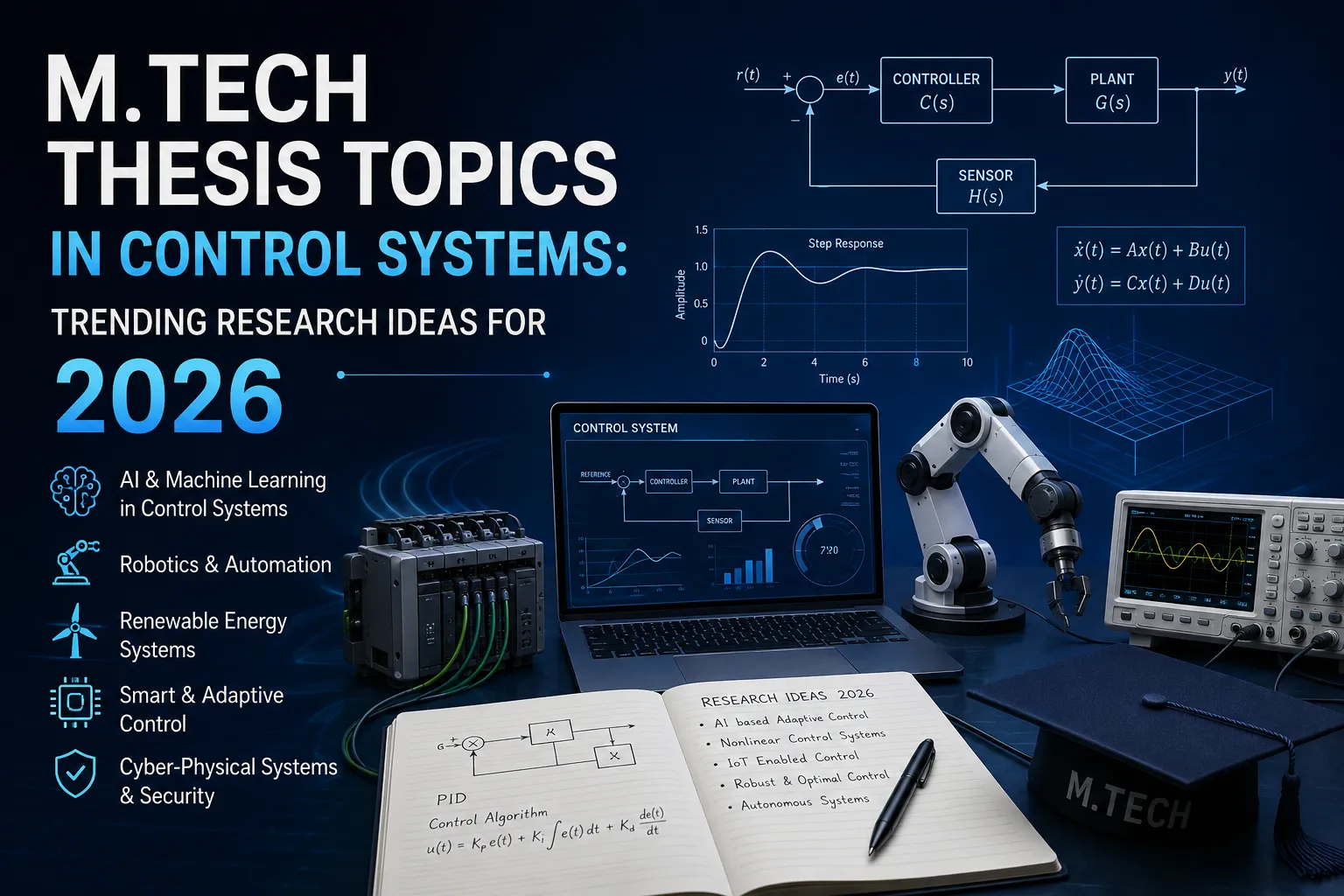
Control systems is one of those M.Tech specializations where the classical foundation — PID, state-space, root locus — hasn't gone anywhere, but the frontier has moved considerably. If you're searching for M.Tech thesis topics in control systems trending research ideas for 2026, you've likely noticed that a huge share of recent literature now blends classical control theory with reinforcement learning and digital twins, which is exciting but also genuinely confusing when you're trying to scope a feasible, one-semester thesis rather than a research programme.
This guide is built the way an experienced control systems research supervisor would walk you through it — a working framework, not a recycled list. We'll cover categorized topic ideas across classical and modern control, AI-integrated control, robotics and autonomous systems, and industrial applications, the trends genuinely shaping 2026 research, a feasibility checklist tuned to simulation-and-hardware realities, methodology guidance, and the mistakes that quietly derail a first-time thesis writer.
At ThesisLikho, our PhD-qualified mentors have guided more than 10,000 scholars through topic selection, simulation planning, and thesis writing across M.Tech, MBA, and PhD programmes, including control systems and allied electrical/mechanical engineering research. What follows draws on that mentoring experience, grounded in current research on reinforcement learning-based control, digital twin technology, and AI-integrated control systems from 2025–2026.
1. Why Control Systems Topics Need Careful Scoping in 2026
Control systems research right now sits at an interesting crossroads: the field's classical toolkit (PID tuning, state-space design, robust and adaptive control) remains genuinely relevant and widely used in industry, while the research frontier has increasingly shifted toward reinforcement learning-based control, digital twin-synchronized systems, and AI-classical control hybrids. This creates a real scoping trap — "I want to apply reinforcement learning to control systems" describes an entire, still-maturing research area, not a thesis topic.
The second scoping trap is specific to this field's relationship with hardware. A topic purely in simulation (testing a control algorithm on a mathematical plant model in MATLAB/Simulink) is highly tractable within a standard M.Tech timeline. A topic requiring physical hardware — a robotic arm, a drone, an actual industrial process — adds real complexity: sensor integration, real-time implementation constraints, safety considerations, and genuine engineering time that a purely simulated study doesn't require. Deciding honestly which category your topic falls into, before you commit, is what separates a thesis that gets built from one that stalls waiting on hardware integration.
2. What an M.Tech Control Systems Thesis Actually Requires
M.Tech programmes in India, operating under AICTE's technical education framework, typically require a two-semester (sometimes one-year) dissertation involving a literature survey, a proposed control strategy or algorithm, simulation-based implementation (and hardware validation where feasible), performance comparison against existing approaches using standard metrics (settling time, overshoot, steady-state error, tracking accuracy, robustness under disturbance), and a conclusion with future scope. A control systems thesis specifically is expected to demonstrate a genuine technical contribution — a novel control strategy, an improved tuning method, or a rigorous comparative performance study — validated through simulation and, ideally, at least a scaled-down hardware implementation.
Citation discipline in this field typically follows IEEE reference style, since the overwhelming majority of target publication venues — IEEE Transactions on Control Systems Technology, IEEE Transactions on Automatic Control, American Control Conference (ACC) and IEEE Conference on Decision and Control (CDC) proceedings — use IEEE's citation format. Building this consistency in from your first literature review draft saves considerable reformatting time later.
3. M.Tech Thesis Topics in Control Systems for 2026
Treat the list below as starting directions, not final titles — narrow each to a specific plant, algorithm, or performance metric before taking it to your guide.
A. Reinforcement Learning-Based Control
- Deep reinforcement learning-based control strategy design for a specific nonlinear plant model
- Soft Actor-Critic-based control design for robotic manipulator trajectory tracking
- Reinforcement learning-based adaptive PID tuning for a specific industrial process
- Model-free reinforcement learning control design for underactuated mechanical systems
- Combining reinforcement learning with model predictive control for improved sample efficiency
- Reinforcement learning-based fault-tolerant control for actuator failure scenarios
- Safe reinforcement learning control design with constraint satisfaction guarantees
- Transfer learning approaches for reinforcement learning-based control across similar plants
- Reward function design analysis for reinforcement learning-based control stability
- Reinforcement learning-based control for a specific autonomous underwater or surface vehicle
- Comparative analysis of reinforcement learning versus classical control for a specific benchmark system
- Reinforcement learning-based energy-efficient control for HVAC or building automation systems
B. Digital Twin-Enabled Control Systems
- Digital twin-synchronized control design for real-time robotic arm trajectory tracking
- Digital twin-based predictive maintenance and control co-design for industrial equipment
- Digital twin framework design for validating control algorithms before physical deployment
- Real-time digital twin synchronization strategy for autonomous vehicle control systems
- Digital twin-enabled adaptive control for uncertain nonlinear systems
- Digital twin-based control co-design combining physical system and controller optimization
- Uncertainty quantification methods for digital twin-based model predictive control
- Digital twin-driven fault detection and control reconfiguration for manufacturing systems
- Digital twin framework design for active suspension system control optimization
- Sim-to-real transfer strategy design for digital twin-validated control policies
C. Model Predictive Control (MPC)
- Nonlinear model predictive control design for trajectory tracking in autonomous vehicles
- Robust model predictive control design under bounded parameter uncertainty
- Economic model predictive control design for energy-efficient industrial process control
- Distributed model predictive control design for multi-agent robotic systems
- Learning-based model predictive control design integrating data-driven plant models
- Explicit model predictive control implementation for real-time embedded control applications
- Event-triggered model predictive control design for reduced computational load
- Model predictive control design for battery energy storage system charge management
- Tube-based model predictive control design for robust constraint satisfaction
- Hybrid MPC-reinforcement learning control design for adaptive parameter tuning
D. Robust, Adaptive & Nonlinear Control
- Sliding mode control design for robust performance under matched and unmatched disturbances
- Adaptive backstepping control design for a specific underactuated nonlinear system
- H-infinity robust control design for uncertain linear parameter-varying systems
- Fuzzy adaptive control design for a system with poorly characterized dynamics
- Neural network-based adaptive control design for nonlinear system identification and control
- Fractional-order PID controller design and tuning for improved disturbance rejection
- Backstepping control design for quadrotor UAV trajectory tracking
- Adaptive dynamic programming-based optimal control design for nonlinear systems
- Disturbance observer-based control design for improved robustness in servo systems
- Gain-scheduled control design for systems with wide operating range variation
E. Fault Detection, Diagnosis & Fault-Tolerant Control
- AI-based fault diagnosis system design for rotating machinery condition monitoring
- Active fault-tolerant control design for actuator fault compensation in robotic manipulators
- Reinforcement learning-integrated fault diagnosis for industrial process control systems
- Sliding mode-based fault detection and isolation for sensor fault scenarios
- Passive fault-tolerant control design for multi-agent formation control under agent failure
- Digital twin-based fault prediction and remaining useful life estimation for control systems
- Deep learning-based anomaly detection for early fault warning in control loops
- Fault-tolerant control design for redundant actuator configurations in aerospace applications
- Data-driven fault diagnosis method design for systems with limited fault data availability
F. Robotics & Autonomous Systems Control
- Trajectory tracking control design for a mobile robot under dynamic obstacle constraints
- Formation control strategy design for multi-robot systems under communication constraints
- Impedance control design for safe human-robot collaborative manipulation
- Path planning and control integration for autonomous mobile robot navigation
- Vision-based control design for robotic manipulator object grasping tasks
- Control co-design for legged robot locomotion stability
- Swarm robotics control strategy design for coordinated task execution
- Autonomous underwater vehicle control design under ocean current disturbances
- UAV swarm formation control design for coordinated surveillance applications
- Whole-body control design for humanoid robot balance and locomotion
G. Power Systems & Renewable Energy Control (9 ideas)
- Load frequency control design for multi-area power systems with renewable integration
- Microgrid control strategy design for seamless grid-connected to islanded mode transition
- Wind turbine pitch control optimization for variable wind speed conditions
- Reinforcement learning-based energy management control for hybrid renewable energy systems
- Voltage stability control design for distribution networks with high solar penetration
- Battery management system control design for optimal charge-discharge cycling
- Frequency regulation control design for grid-connected inverter-based resources
- Adaptive control design for maximum power point tracking under partial shading
- Coordinated control strategy design for electric vehicle charging station grid impact management
H. Industrial Process & Manufacturing Control
- Digital twin-integrated process control design for smart manufacturing quality optimization
- Adaptive control design for temperature regulation in industrial furnace processes
- Model predictive control design for chemical process control with time delays
- Reinforcement learning-based control for adaptive manufacturing robot task execution
- Control strategy design for precision motion control in CNC machining systems
- Process control optimization for batch reactor temperature and pressure regulation
- Real-time control system design for additive manufacturing process parameter regulation
- Predictive control design for HVAC system energy efficiency in smart buildings
- Control system design for automated guided vehicle (AGV) fleet coordination in warehouses
I. Networked & Cyber-Physical Control Systems (9 ideas)
- Networked control system design under communication delay and packet loss
- Cybersecurity-aware control design for resilience against sensor spoofing attacks
- Event-triggered control strategy design for bandwidth-constrained networked systems
- Distributed control design for consensus in multi-agent cyber-physical systems
- Secure state estimation design for control systems under cyber-attack scenarios
- Edge computing-integrated control architecture design for latency-sensitive applications
- Resilient control design for critical infrastructure under adversarial disturbances
- Wireless networked control system design for industrial IoT applications
- Blockchain-integrated control architecture design for distributed multi-agent trust
J. Emerging & Cross-Disciplinary Control Applications
- Control system design for exoskeleton-assisted rehabilitation devices
- Adaptive control design for autonomous surface vessel navigation under maritime disturbances
- Control co-design combining physical system redesign and controller optimization across product generations
- Explainable AI framework design for interpretable reinforcement learning-based control decisions
- Control strategy design for soft robotic actuator precise positioning
- AI-integrated control design for smart grid demand response optimization
- Control system design for autonomous agricultural robot precision farming tasks
- Reinforcement learning-based traffic signal control for urban intersection optimization
- Control design for electric aircraft propulsion system stability
- Physics-informed neural network-based control design for systems with partial model knowledge
- Control strategy design for space robotics manipulator operation under microgravity
- Bio-inspired control algorithm design for adaptive locomotion in legged robots
- Control system design for autonomous mobile robot operation in GPS-denied environments
- Federated learning-based distributed control design for privacy-preserving multi-site systems
4. Latest Control Systems Research Trends Shaping 2026
A few cross-cutting shifts are worth understanding before committing to a domain:
- Reinforcement learning is being integrated into control systems across an increasingly wide range of applications, spanning optimal control, robust control, event-triggered control, distributed control, and safe control, with real-world applications now extending to unmanned vehicles, power systems, intelligent transportation, robot manipulators, and motors.
- Digital twin technology combined with reinforcement learning is a particularly active 2026 research thread, used for real-time control synchronization between physical and virtual systems — recent work spans robotic arm additive manufacturing, autonomous surface vessels, active suspension systems, and robotic embodied control, generally using a digital twin to safely train and validate control policies in simulation before deployment on physical hardware.
- A recent large-scale systematic mapping (188 peer-reviewed articles, 2000–2025) of AI-integrated control systems found three dominant research directions: control model strategies, parameter optimization methods, and adaptability mechanisms — with fuzzy logic structures, hybrid neuro-fuzzy controllers, artificial neural networks, and evolutionary/swarm-based methods among the most frequently adopted approaches, spanning renewable energy systems, industrial automation, robotics, power grids, and autonomous systems.
- Combining reinforcement learning with model predictive control (MPC) is an increasingly common hybrid approach, using RL to tune MPC parameters or identify model parameters in real time, aiming to combine MPC's constraint-handling guarantees with RL's adaptability to uncertain, changing conditions.
- A maturity model for reinforcement learning-based control deployment — ranging from pure simulation evaluation through limited lab validation to full real-world commercial deployment — is a useful framing for scoping your own thesis honestly: most M.Tech-level RL-control theses realistically sit at the simulation or limited-lab-validation stages, not full real-world deployment, and being explicit about this in your proposal is a strength, not a weakness.
- Fault diagnosis and fault-tolerant control research is increasingly AI-integrated, with reinforcement learning and deep learning-based approaches applied to fault detection in robotic manipulators, rotating machinery, and industrial systems — a genuinely practical, industry-relevant direction relative to more purely theoretical control topics.
5. A Topic Selection Framework You Can Actually Use
Step 1 — Interest-to-Tool Match. List two or three control systems themes you're genuinely curious about, then check which ones you can actually implement with the tools available to you (MATLAB/Simulink, Python with control and RL libraries, or a specific robotics simulation platform) and, if hardware validation is part of your plan, whether your department has the required actuators, sensors, and safety infrastructure.
Step 2 — Gap Verification. Search IEEE Xplore, Google Scholar, and recent conference proceedings (ACC, CDC, IROS) for the last 2–3 years in your shortlisted area. Given how fast RL-based and digital twin-integrated control research is moving, a "gap" from even two years ago may already be closed — narrow by specific plant, algorithm combination, or performance metric if your search returns dozens of similar studies.
Step 3 — Simulation-vs-Hardware Reality Check. Decide explicitly whether your thesis will be simulation-only or will include physical hardware implementation. This single decision drives your entire feasibility and timeline planning — confirm hardware access, sensor availability, and safety considerations before committing to a hardware-inclusive design.
Step 4 — Publication Pathway. Check whether your intended contribution (a novel control strategy, an improved tuning method, a specific robustness or efficiency improvement) is publishable as an IEEE conference paper — this is a useful sanity check on whether your scope is specific enough to produce a genuine, defensible contribution.
6. How to Identify a Genuine Research Gap
A defensible research gap in control systems satisfies three conditions:
- It's explicitly flagged in recent literature — a stated limitation, an untested plant or disturbance scenario, or a trade-off (sample efficiency vs. robustness, computational cost vs. performance) not yet adequately addressed together.
- It has measurable performance relevance — something you can quantify through simulation or hardware testing (settling time, tracking error, robustness margin, computational latency) rather than a purely conceptual claim.
- It's answerable with tools, hardware, and computational resources available to you within your programme's timeline.
A practical technique: pull 12–15 recent IEEE papers in your shortlisted area, note their stated future work and limitations in a spreadsheet, and look for the two or three that recur — an untested disturbance condition, an unaddressed sample-efficiency problem, or a missing comparative baseline against a classical control approach. That recurring gap is usually your strongest, most defensible starting point. For a deeper walkthrough, see [Link: What Is a Research Gap and How to Identify One for Your Thesis].
7. Topic Feasibility Checklist
Before presenting any topic to your guide, verify each of these:
- Simulation tool (MATLAB/Simulink, Python control/RL libraries, or a robotics simulator) confirmed available and suited to the topic
- Decision made explicitly: simulation-only, or simulation-plus-hardware implementation
- If hardware is planned, actuator, sensor, and safety equipment access confirmed
- Topic narrowed to a specific plant, algorithm, and performance metric — not a broad survey
- At least 10–15 recent (2023–2026) IEEE-indexed papers identified in the exact area
- A clear comparison baseline identified (an existing control strategy or classical approach to benchmark against)
- Guide has relevant expertise or interest in the chosen control systems domain
- Computational resources sufficient for training (if using reinforcement learning) confirmed
8. Choosing the Right Simulation Tools and Methodology
- MATLAB/Simulink with Control System Toolbox and Reinforcement Learning Toolbox — the most widely used platform in Indian academic control systems research, strong for both classical control design and increasingly for RL-based control experimentation, particularly useful for scholars wanting an integrated environment for both approaches.
- Python with OpenAI Gym/Gymnasium and Stable-Baselines3 — increasingly common for reinforcement learning-based control research, given strong library support and active community development; a good choice if your topic leans heavily toward RL algorithms specifically.
- ROS/ROS2 with Gazebo or Unity for robotics-focused topics — the standard combination for robotic control research requiring realistic physics simulation and, where relevant, sim-to-real transfer to physical robotic platforms; Unity in particular has emerged as a valuable simulation platform across robotics, autonomous navigation, and underwater vehicle testing when paired with ROS/ROS2 for real-time synchronization.
- Digital twin frameworks — where your thesis involves digital twin-based control validation, this typically means building a high-fidelity simulation model that stays synchronized with either a physical system or a more detailed simulation, used to safely train and validate control policies before any real-world deployment.
- Hardware-in-the-loop or scaled physical prototypes — where hardware validation is included, a scaled-down or simplified physical setup (a small robotic arm, an inverted pendulum, a DC motor testbed) is usually more feasible within an M.Tech timeline than a full-scale industrial system.
Whichever tools and approach you choose, confirm you or your department have working licenses and hardware access, and that your topic doesn't quietly depend on computational resources (particularly for RL training, which can be resource-intensive) or physical equipment you don't actually have. This is one of the most common causes of stalled M.Tech control systems theses.
If your topic needs help translating from a research idea into a structured, simulation-backed thesis document, our M.Tech Thesis Assistance service supports scholars through exactly this stage.
9. Supervisor Approval Tips
- Bring two to three narrowed options, each with a specific plant, algorithm, and performance metric, rather than a broad theme like "reinforcement learning for control."
- State upfront whether your design will be simulation-only or hardware-inclusive — guides approve topics faster when this scope decision is already made, not left open-ended.
- Reference recent (2024–2026) IEEE literature in your pitch — it signals you're working at the current edge of the field, particularly around RL-MPC hybrids and digital twin-based validation, rather than recycling an older topic list.
- Prepare a one-page concept note: background, gap, proposed control strategy, simulation tool, target performance metrics, and timeline — before your guide meeting.
- Anticipate the "what's novel here" question. Be ready to state, in one sentence, what specifically distinguishes your approach from the closest prior paper you found.
10. Common Mistakes First-Time M.Tech Thesis Writers Make
- Choosing a topic based on trend-chasing ("I want to do something with reinforcement learning and control") rather than a scoped design with a specific plant and metric.
- Underestimating the computational cost of reinforcement learning training, discovering months in that training a control policy from scratch requires far more compute or time than initially planned.
- Copying topic titles verbatim from online lists without checking whether the exact algorithm-and-plant combination has already been extensively studied.
- Skipping the comparison baseline — a thesis proposing a "novel" RL-based controller without a clear classical control benchmark (PID, LQR, or another established method) is hard to evaluate and hard to publish from.
- Overreaching into hardware without confirming access — planning a physical robotic implementation without confirming actuator, sensor, and safety equipment availability early.
- Treating the literature review as a summary rather than a synthesis — a strong review surfaces trade-offs and gaps, not just a list of paper summaries.
- Ignoring the "why 2026" justification — a strong control systems thesis explains why the specific gap matters now, tied to real RL-control integration or digital twin developments, not just that the general topic area exists.
11. Publication Opportunities
M.Tech theses in control systems are commonly adapted into IEEE conference papers, with student-friendly venues within India — regional IEEE Control Systems Society events, university-hosted symposiums, and national conferences — as realistic first targets, with major international venues like ACC, CDC, or IROS, or journals like IEEE Transactions on Control Systems Technology, as a stretch goal for particularly strong, novel contributions. Structuring your simulation and, where applicable, hardware results chapter with publication-ready figures (tracking performance plots, disturbance rejection comparisons, training convergence curves for RL-based approaches) and a clearly stated contribution from the outset makes this conversion considerably easier later.
12. Two Realistic Case Studies
Case Study 1 — From "RL for Control" to a Defensible Thesis
An M.Tech scholar at a state technical university began with the idea "reinforcement learning for control systems" — a topic so broad it drew immediate pushback from the department committee. After a structured gap-verification exercise against recent IEEE literature, the scholar narrowed the scope to Soft Actor-Critic-based trajectory tracking control for a robotic manipulator under actuator constraints, matched to a Python-based simulation environment with Stable-Baselines3, and a clear comparison baseline against a classical PID-based tracking controller from recent literature. The narrowed scope — one algorithm, one plant, one clear baseline — is what got the proposal approved on the second attempt.
Case Study 2 — Building a Thesis Around Simulation-Only Feasibility
A first-time M.Tech thesis writer without access to physical robotic hardware or specialized actuators initially planned a hardware-inclusive control implementation project. Recognizing that hardware access and safety infrastructure weren't realistic within the department's resources and remaining timeline, the scholar redesigned the project as a simulation-only study on digital twin-based validation of a model predictive control strategy for an autonomous underwater vehicle under current disturbances, using MATLAB/Simulink simulation with results benchmarked against published performance data from comparable designs in recent literature. This choice avoided months of potential delay chasing hardware access and produced a complete, well-validated thesis within the standard timeline.
If your topic idea resembles either of these scenarios, our M.Tech Thesis Assistance service can help you pressure-test scope, confirm tool and hardware feasibility, and prepare your synopsis presentation.
FAQs
What is "M.Tech thesis topics in control systems trending research ideas for 2026"?
It refers to identifying current, feasible, and technically defensible research topics within control systems for the 2026 M.Tech research cycle — spanning reinforcement learning-based control, digital twin-enabled control, model predictive control, robust and adaptive control, fault-tolerant control, and robotics applications.
Why does M.Tech thesis topics in control systems trending research ideas for 2026 matter?
Because topic selection determines whether your thesis is genuinely feasible given your simulation tools and, where relevant, hardware access, whether your gap is current given how fast RL-integrated and digital twin-based control research is moving, and how defensible your contribution will be at evaluation and, ideally, publication.
How does this approach affect an M.Tech thesis in practice?
Scholars who explicitly decide between simulation-only and hardware-inclusive scope early, and verify their gap against recent (2024–2026) literature, typically experience fewer committee rejections, smoother implementation timelines, and a clearer path to a publishable contribution.
How long does it take to complete an M.Tech thesis using this approach?
Most Indian M.Tech dissertations run one to two semesters depending on the university's structure, following topic approval, literature review, implementation, and thesis writing. A well-scoped, tool-matched topic — particularly one with an explicit simulation-vs-hardware decision made upfront — meaningfully reduces the time typically lost to hardware integration delays.
Is professional help available for M.Tech thesis topics in control systems trending research ideas for 2026?
Yes — mentorship support covering topic selection, simulation planning, and thesis structuring is available through services such as M.Tech Thesis Assistance.
What are some examples of strong M.Tech control systems thesis topics for 2026?
Examples include Soft Actor-Critic-based robotic manipulator control, digital twin-synchronized model predictive control for autonomous vehicles, reinforcement learning-based adaptive PID tuning for industrial processes, and fault-tolerant control design for actuator failure scenarios — provided each is scoped to a specific plant, algorithm, and comparison baseline.
Ready to move from a list of ideas to an approved, feasibility-checked thesis proposal? Get M.Tech Thesis Guidance from ThesisLikho's PhD-qualified mentors.