
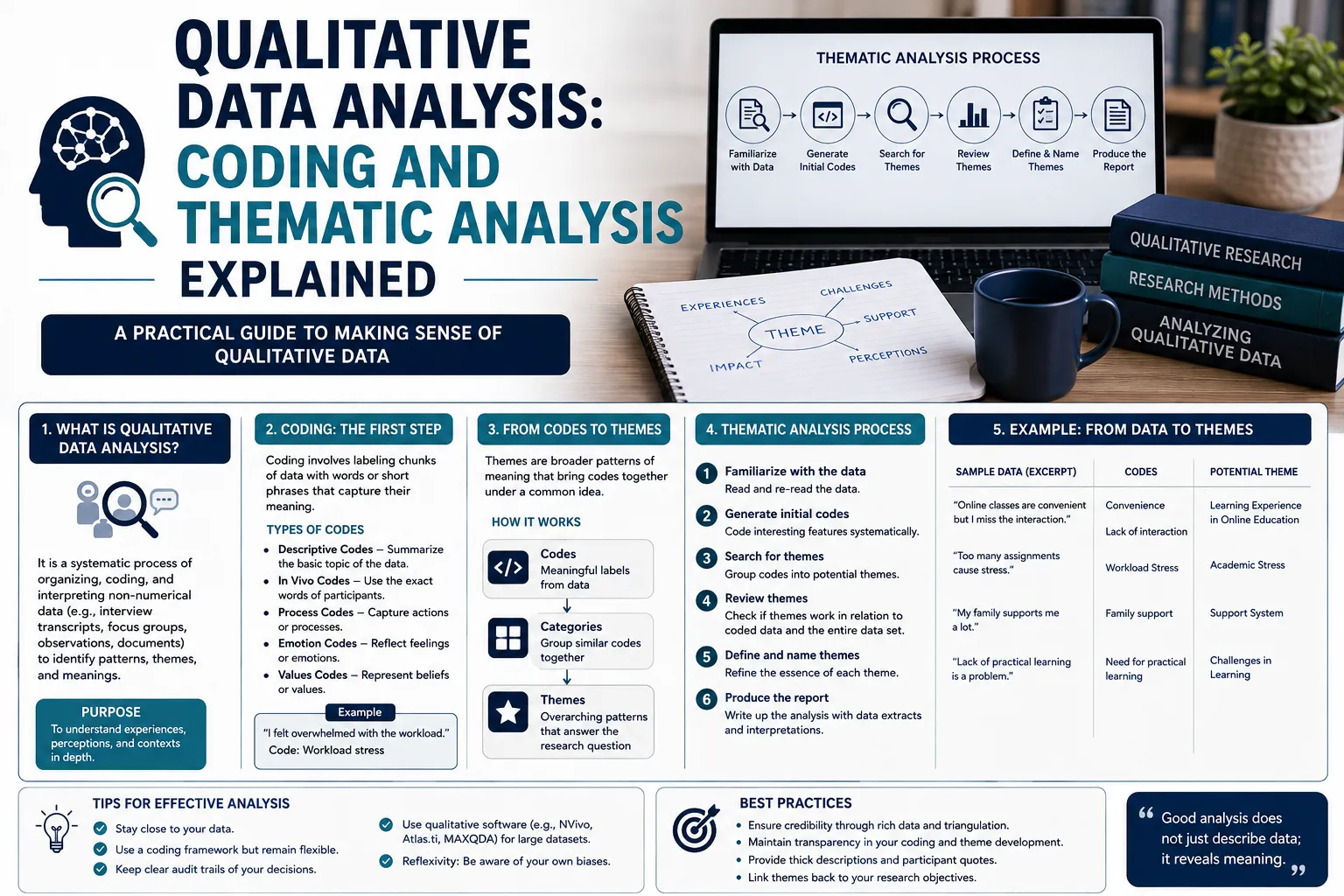
You've finished your interviews. The transcripts are sitting in a folder, and now comes the part many thesis writers find genuinely intimidating: turning pages of conversation into a set of clear, defensible themes. Unlike quantitative analysis, there's no single formula to run — qualitative data analysis is a structured but interpretive process, and doing it well means understanding both the mechanics of coding and the judgment calls that shape good thematic analysis.
This guide explains qualitative data analysis through coding and thematic analysis — what each step actually involves, how Braun and Clarke's widely used six-phase framework works in practice, and how to avoid the mistakes that most commonly undermine an otherwise strong qualitative thesis chapter. We've written it the way an experienced thesis mentor would talk you through your own dataset, because that's genuinely the kind of guidance ThesisLikho's PhD-qualified team provides to the thousands of scholars we've supported through exactly this process.
If you haven't finalized your overall methodology yet, our companion guide — How to Present Data Analysis Results in a Thesis Chapter — is worth reading once your analysis is underway.
What Qualitative Data Analysis Actually Involves
Qualitative data analysis is the process of systematically organizing, interpreting, and making sense of non-numerical data — interview transcripts, focus group recordings, open-ended survey responses, or observational notes — to answer a research question. Unlike quantitative analysis, which reduces data to numbers and applies statistical tests, qualitative analysis works directly with meaning, language, and context, aiming to surface patterns that explain not just what happened, but why and how participants experienced or understood something.
Elsevier Researcher Academy's guidance on methodology choice frames this well: qualitative approaches suit topics that aren't yet well understood, relying on interpretation and thematic analysis rather than statistical testing to draw conclusions. This is exactly why thematic analysis — the most widely used qualitative analysis method across social science, education, and health research — has become the default approach for so many thesis-level qualitative studies.
Coding vs. Thematic Analysis: Understanding the Relationship
These two terms are closely related but not identical, and understanding the distinction matters for how you structure your analysis chapter. Coding is the specific, granular process of labeling segments of your data with short descriptive tags that capture an idea, concept, or feature relevant to your research question. Thematic analysis is the broader analytical process that coding feeds into — grouping related codes together, identifying recurring patterns across your entire dataset, and developing those patterns into fully formed, named themes that answer your research question.
Put simply: coding is how you break your data down into manageable, labeled pieces. Thematic analysis is how you build those pieces back up into a coherent, meaningful argument. You can't do thematic analysis without coding first, but coding alone — without the subsequent work of grouping, reviewing, and refining codes into themes — doesn't yet constitute a complete analysis.
Braun and Clarke's Six-Phase Framework
The most widely used and cited approach to conducting thematic analysis comes from Virginia Braun and Victoria Clarke's 2006 framework, later refined into what they termed "reflexive thematic analysis" in 2019. Their six phases are familiarization with the data, generating initial codes, searching for initial themes, reviewing and developing themes, defining and naming themes, and writing up the final analysis. This framework has become the standard reference point across psychology, education, health sciences, and increasingly management and business research, precisely because it offers a structured but genuinely adaptable process rather than a rigid, one-size-fits-all formula.
Understanding each phase in detail — and just as importantly, understanding that they don't proceed in a strict straight line — is what separates a thesis chapter that reads as rigorous from one that reads as a loosely organized collection of quotes.
Phase 1: Familiarization With the Data
Before any formal coding begins, this phase involves immersing yourself in your data — transcribing interviews if this hasn't already been done, then reading and re-reading transcripts to develop a genuine, detailed understanding of their content. This isn't a step to rush through; researchers who skip or shortcut familiarization often end up coding on the basis of a surface-level impression rather than a genuine grasp of what participants actually said.
Practical familiarization work includes taking initial notes on interesting or recurring observations as you read, without yet trying to formalize them into codes — these early notes often become the seeds of your eventual coding scheme.
Phase 2: Generating Initial Codes
This phase involves systematically working through your entire dataset, labeling segments of text — a sentence, a few sentences, sometimes a whole paragraph — with a short descriptive code capturing an idea or feature relevant to your research question. Coding should be applied comprehensively across the full dataset, not just the sections that seem most obviously interesting, since patterns that matter can emerge from data you initially considered unremarkable.
A single passage can, and often should, receive multiple codes if it touches on more than one relevant idea. At this stage, codes are typically numerous and granular — dozens or even over a hundred initial codes across a full interview dataset isn't unusual, and that's expected; this phase isn't about narrowing down yet, it's about comprehensively capturing everything potentially relevant.
Phase 3: Searching for Themes
Once your dataset is fully coded, this phase involves stepping back and looking across all your codes to identify broader patterns — clustering related codes together into candidate themes that capture something more substantial than any single code on its own. According to Braun and Clarke's own definition, a theme captures something important about the data in relation to the research question, representing a patterned response or meaning across the dataset — not simply a topic that appeared once or twice in isolation.
This phase often benefits from visual organization — many researchers build a thematic map (similar to a mind map) at this stage, physically or digitally grouping codes under candidate theme headings to see how the overall structure is taking shape.
Phase 4: Reviewing Themes
Candidate themes from Phase 3 need to be checked against two things: do they genuinely fit the specific coded extracts grouped under them, and do they hold up when checked against the entire dataset, not just the portions that initially inspired them. This is where themes often get split (a single candidate theme turns out to actually contain two distinct ideas), merged (two candidate themes turn out to be facets of the same underlying pattern), or discarded (a candidate theme doesn't have enough supporting data across the dataset to genuinely hold up).
This review phase is one of the most commonly rushed steps in student thematic analysis, precisely because it can feel like backtracking after Phase 3 already produced a seemingly complete set of themes — but skipping genuine review is exactly what leaves weak, thin, or overlapping themes in a final thesis chapter.
Phase 5: Defining and Naming Themes
Once your themes have been reviewed and refined, this phase involves clearly defining what each theme specifically captures and finalizing a clear, descriptive name for it. A good theme name should be specific enough that a reader immediately understands what the theme is about, rather than a vague, overly broad label a reader would need extensive explanation to interpret. Alongside naming, this phase typically involves writing a short explanatory paragraph for each theme, describing its "story" — what aspect of the data it captures and why it matters in relation to your research question.
Phase 6: Writing Up the Analysis
The final phase involves weaving your defined and named themes into a coherent narrative that directly answers your research question, supported by carefully selected illustrative quotes or extracts from your data. Each theme in your final write-up should connect explicitly back to your research question, and ideally to existing literature or theory, showing not just what the theme is, but why it matters to the broader conversation your thesis is contributing to.
Selecting quotes for this phase deserves real care — choose extracts that clearly and specifically illustrate the theme, rather than the longest or most dramatic-sounding quote available, and ensure your selected quotes represent the genuine range of how participants expressed that theme, not just the single most articulate example.
Why the Process Isn't Actually Linear
A detail that catches many first-time qualitative researchers off guard: despite being presented as six sequential phases, thematic analysis is explicitly recursive in practice, not a strict one-directional pipeline. Braun and Clarke themselves describe good thematic analysis as requiring researchers to move back and forth between phases — reviewing themes in Phase 4 might reveal a gap that sends you back to generate additional codes in Phase 2, and writing up your analysis in Phase 6 often surfaces refinements that loop back into how a theme was defined in Phase 5.
Write-up itself typically begins well before the formal "final" phase, evolving alongside the analysis as codes and themes shift and develop — rather than only starting once every prior phase is fully complete. Understanding this upfront helps prevent a common source of frustration: discovering midway through Phase 4 or 5 that you need to revisit earlier coding isn't a sign you did something wrong — it's a normal, expected part of how genuinely rigorous thematic analysis actually works.
Using NVivo for Coding and Theme Development
NVivo remains the standard software for managing thematic analysis at thesis level, and for good reason — manually tracking dozens or hundreds of codes across a full interview dataset using paper or a basic word processor becomes genuinely unmanageable past a certain point. NVivo lets you import transcripts directly, tag segments with codes as you work through Phase 2, and then reorganize, merge, and hierarchically group those codes into candidate themes during Phases 3 and 4 — all while retaining a clear link back to the original data extract each code came from, which is essential for Phase 6's quote-selection work.
Beyond pure organization, NVivo also supports basic pattern-checking features — such as showing how frequently a code appears across different participants or transcript sections — which can help identify whether a candidate theme genuinely represents a pattern across your dataset, or is concentrated in just one or two outlier interviews.
Handling Contradictory or Outlier Data
A specific, commonly cited mistake in student thematic analysis is focusing exclusively on the dominant, easily visible patterns while quietly setting aside data that doesn't fit neatly into an emerging theme. This is an understandable instinct — contradictory data is genuinely harder to work with — but good thematic analysis practice requires actively acknowledging and reflecting on divergent voices in your data, rather than smoothing them out of the final narrative.
Contradictory or outlier data isn't a problem to hide; it's often a source of real analytical value. A participant whose experience clearly diverges from your dominant theme might reveal an important boundary condition, suggest a meaningful subtheme, or indicate that your initial theme needs reconsidering. Explicitly addressing this kind of divergence in your write-up — rather than pretending your dataset was more uniform than it actually was — tends to strengthen a thesis chapter's credibility rather than weaken it.
Common Mistakes in Thematic Analysis
A frequent early-stage mistake is coding too narrowly — only tagging the sections of data that seem obviously relevant on a first read, rather than comprehensively coding the entire dataset, which risks missing patterns that only become visible once every transcript has been coded consistently. A related mistake is generating themes prematurely, jumping from a handful of interesting codes straight to named themes without genuinely reviewing whether those candidate themes hold up across the full dataset.
Presenting a "theme" that's really just a topic — something participants mentioned, without any deeper patterned meaning or interpretation attached — is another common gap; a theme needs to say something analytically, not just describe a subject that came up. Cherry-picking quotes that support a predetermined narrative, rather than selecting quotes that genuinely represent the range of how a theme showed up across participants, undermines a chapter's credibility even when the underlying coding was done carefully. And treating the six phases as a strict, one-time linear sequence — refusing to revisit earlier coding once later phases reveal a gap — often produces thinner, less well-supported themes than a genuinely recursive process would.
A Realistic Example Walkthrough
Scenario — Nikhil, a first-time qualitative thesis writer researching remote work adoption
Nikhil's first attempt at thematic analysis moved quickly from his fifteen interview transcripts straight to five named themes, without much visible work in between. When his supervisor asked him to walk through his coding process, it became clear he'd essentially skimmed for quotes that stood out and grouped them loosely by topic, rather than systematically coding the entire dataset first. His revision started over from Phase 2, coding every transcript comprehensively in NVivo — a process that took considerably longer than his first attempt, but surfaced a genuinely important pattern he'd missed entirely: a recurring tension between employees who valued remote flexibility and those who reported feeling professionally isolated by it, a divergence his original quick-pass analysis had smoothed over in favor of a single, tidier "employees value flexibility" theme.
This is a pattern we see constantly in mentoring work: rigorous thematic analysis takes real time specifically because the recursive, comprehensive coding process is what surfaces the nuances a quick read-through misses.
Scenario — Priyal, a PhD scholar working with a research assistant on coding
Priyal's study involved a larger qualitative dataset — twenty-eight interviews — coded jointly with a research assistant to manage the volume of work. Midway through Phase 2, she noticed she and her assistant were applying noticeably different codes to similar passages, with no clear process for reconciling the differences. Rather than pressing forward and hoping the discrepancies would sort themselves out during theme development, she paused coding, developed a shared codebook with clear definitions and example extracts for each code, and had both coders independently re-code a sample of five transcripts to check agreement before continuing. This single step, while it cost a few days upfront, meant her eventual themes were built on a genuinely consistent coding foundation — something her committee specifically asked about during her synopsis-stage review, and something she could answer with confidence because she'd addressed it directly rather than hoping it wouldn't come up.
If you'd like a second opinion on your own coding and theme development before you finalize your analysis chapter, our Thesis Writing Service offers exactly this kind of structural review from PhD-qualified mentors. For guidance on presenting your finished analysis clearly, our companion guide — How to Present Data Analysis Results in a Thesis Chapter — covers that next step in detail.
Coding Consistency and Reflexivity
Whether you're coding alone or with a research assistant, consistency across your dataset matters for credibility. If you're working with a co-coder, developing a shared codebook — a document defining each code with a clear description and an example extract — before dividing up transcripts prevents exactly the kind of drift Priyal encountered above. Checking inter-coder agreement on a sample of transcripts, even informally, is worth doing before committing to code the full dataset independently.
If you're coding solo, a related concept matters just as much: reflexivity. Because thematic analysis is inherently interpretive, your own position, assumptions, and prior expectations inevitably shape how you code and what patterns you notice. Reflexive thematic analysis — Braun and Clarke's own 2019 refinement of their original framework — explicitly asks researchers to acknowledge this rather than pretending coding is a purely objective, mechanical process. Keeping a short research journal or memo log throughout your coding process, noting decisions you made and why, serves two purposes: it documents your reasoning for your eventual methodology write-up, and it helps you notice when your own assumptions might be steering your coding in a particular direction.
How Thematic Analysis Compares to Other Qualitative Approaches
Thematic analysis is the most widely used qualitative analysis method for thesis-level research, but it's worth briefly knowing where it sits relative to a few related approaches, since your specific research question might actually call for one of these instead. Content analysis shares thematic analysis's coding foundation but tends to place more emphasis on quantifying how often certain codes or categories appear, sometimes producing frequency counts alongside interpretive findings — useful when you want to combine qualitative depth with some numerical pattern-tracking. Grounded theory goes further than thematic analysis in aiming to build an entirely new theoretical framework directly from the data, typically requiring a more extensive, iterative data collection and analysis cycle than most single-author thesis timelines can support. Narrative analysis focuses specifically on the structure and content of participants' stories as coherent wholes, rather than breaking data into codes and themes, and suits research questions specifically about how people construct meaning through storytelling.
For most thesis-level qualitative research answering a fairly direct "how" or "why" question, thematic analysis remains the most practical, well-supported choice — but knowing these alternatives exist is useful if your specific research question and data don't quite fit the thematic-analysis mold.
Pre-Submission Checklist
Before finalizing your thematic analysis chapter, confirm that your entire dataset was coded comprehensively, not just the most obviously relevant sections. Confirm your themes were genuinely reviewed against the full dataset, not just the extracts that initially inspired them. Confirm each theme represents a patterned, analytically meaningful idea, not simply a topic participants happened to mention. Confirm you've acknowledged and reflected on any contradictory or outlier data rather than smoothing it out of your narrative. Confirm your selected quotes represent the genuine range of how each theme appeared across participants, not just the most articulate single example. And confirm your write-up explicitly connects each theme back to your research question and relevant literature.
Getting Expert Support
Even experienced qualitative researchers benefit from a second, structured read on their coding and theme development before finalizing an analysis chapter — thin themes or premature pattern-spotting are far easier to catch and correct with a fresh set of eyes than after the write-up is already complete.
ThesisLikho's mentoring team — PhD-qualified experts who've guided over 10,000 scholars through this exact process — offers structured qualitative analysis review as part of our Thesis Writing Service, helping you strengthen your coding rigor and theme development before submission.
Frequently Asked Questions
What is qualitative data analysis using coding and thematic analysis?
It's a systematic process for organizing and interpreting non-numerical data — most commonly interview transcripts — by first labeling segments of text with descriptive codes, then grouping related codes into broader, meaningful themes that answer the research question, typically following Braun and Clarke's widely used six-phase framework.
How long does it take to complete a thesis using this approach?
Thematic analysis of a typical thesis-level dataset of ten to fifteen interviews commonly takes several weeks to a few months, given the framework's explicitly recursive nature — genuinely rigorous analysis usually requires revisiting earlier coding as later phases reveal gaps, rather than moving through the six phases in a single straight pass.
Is professional help available for qualitative data analysis coding and thematic analysis?
Yes — structured mentoring on coding practice, theme development, and NVivo setup is a standard, legitimate form of academic support. ThesisLikho's PhD-qualified mentors offer this kind of guided review for thesis scholars conducting qualitative analysis.
Why does qualitative data analysis coding and thematic analysis matter?
Rigorous coding and thematic analysis is what transforms raw interview transcripts into a defensible, analytically meaningful contribution — without a systematic process, a qualitative chapter risks reading as a loosely organized collection of quotes rather than genuine research.
How does qualitative data analysis affect a thesis overall?
The quality of your coding and thematic analysis directly determines how credible and persuasive your qualitative findings chapter is to examiners — thin, prematurely generated themes or cherry-picked quotes are among the most commonly flagged weaknesses in qualitative thesis defenses.
Talk to a Thesis Expert
If you'd like a mentor to review your coding process or thematic analysis before you finalize your findings chapter, ThesisLikho's team is ready to help.